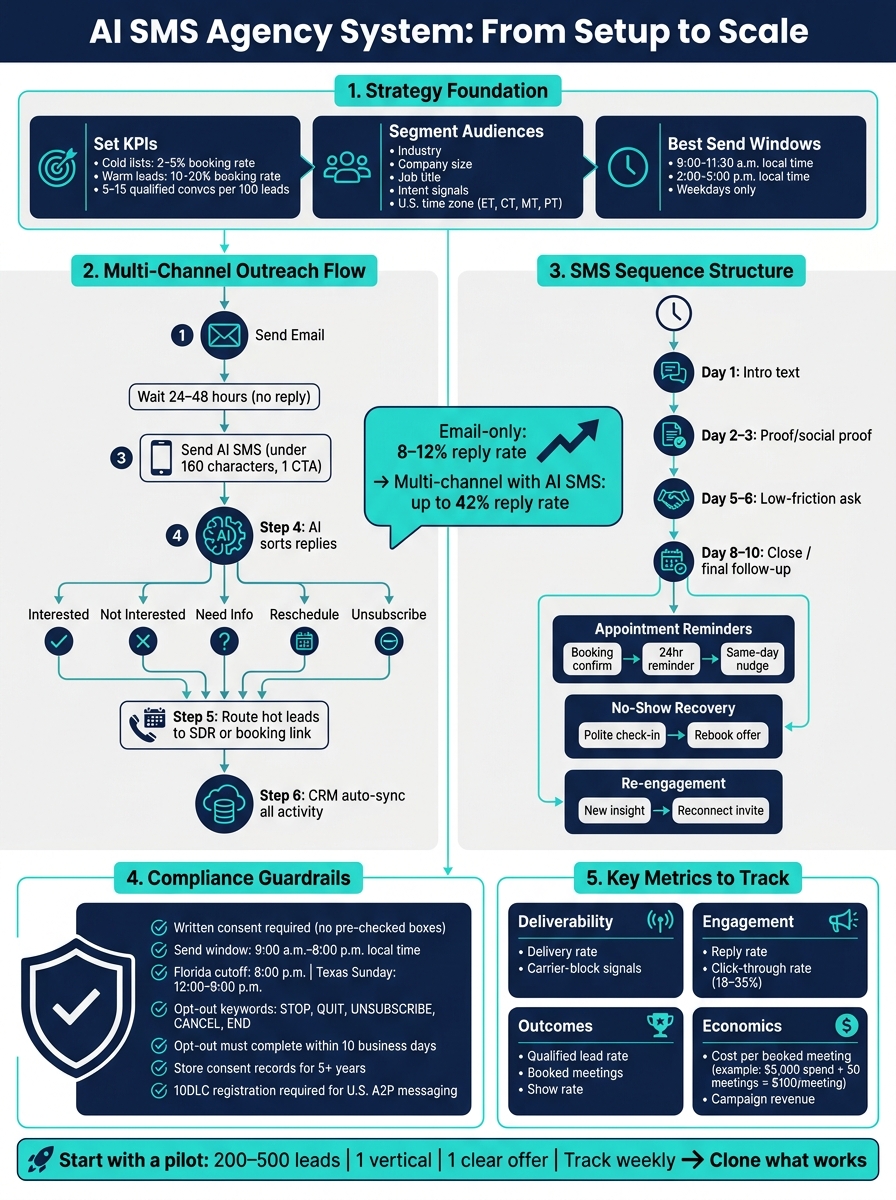
If I want to scale AI SMS for an agency, I need one thing above all: a repeatable system. That system should cover audience segments, short SMS sequences, AI reply handling, CRM sync, consent records, and weekly reporting.
Here’s the article in plain English:
SMS helps agencies book more meetings without adding SDR headcount
AI handles first-touch texts, replies, qualification, and routing
Cold SMS goals often start around 2%–5% booked meetings on targeted lists
Warm lead booking rates can reach 10%–20%
Best send windows are often 9:00–11:30 a.m. or 2:00–5:00 p.m. in the lead’s local time
A simple sequence is usually 4–6 touches over 7–10 business days
Compliance in the U.S. matters: get written consent, honor opt-outs, and stay inside local time rules
A pilot of 200–500 leads in one niche is the safest place to start
What stood out to me is this: SMS works best when it is not alone. It does more when paired with email, calls, reminders, and CRM follow-up. And if I can’t track delivery, replies, booked meetings, show rates, and cost per meeting, I’m guessing.
The article also makes a simple business case for agencies. Instead of billing for manual work, I can package outreach + qualification + booking into a monthly service tied to results.
If I had to boil the whole piece down into one checklist, it would be this:
Pick one vertical
Define KPIs
Segment by industry, title, company size, intent, and U.S. time zone
Review reply rate, booking rate, show rate, and cost per booked meeting every week
That’s the core idea of the article: don’t treat AI SMS like mass texting. Treat it like a controlled sales system that can be sold, cloned, and run across client accounts.
AI SMS Agency System: From Setup to Scale
How I Scaled My AI Automation Agency to $20k/month (2025)
sbb-itb-a781ab9
Building a Strategy Before You Scale
Once you’ve set SMS up as a conversion channel, the next step is simple: get clear on the goals, the audience, and the job SMS is supposed to do. That sounds obvious, but a lot of teams skip it. Then every send feels disconnected, and results bounce around for no clear reason.
Before you scale AI SMS, lock in the goals, audiences, and channel role that will shape each message.
Set Clear KPIs for Agency Growth
After SMS has a defined place in your outreach mix, spell out what success means. Don’t settle for vague wins like “more engagement.” Tie performance to the numbers agencies and clients care about: qualified conversations, booked meetings, pipeline value, retention, and revenue per account.
For cold outbound, a solid starting benchmark is 5–15 qualified conversations per 100 leads contacted, depending on the niche and the quality of the list. For booked meetings, aim for a 2–5% booking rate on targeted cold lists and 10–20% on warm leads. It also helps to set pipeline goals in dollar terms so clients can stack SMS up against email and phone outreach without guessing.
Segment Audiences for Better Reply Rates
Blasting the same text to every contact is one of the fastest ways to get ignored. Segmentation is what makes a message feel timely instead of out of the blue.
The most useful segments for AI SMS are:
Industry
Company size
U.S. region and time zone
Job title
Intent signals
Each one changes both the message and the timing. A dental clinic owner cares about filling appointment slots. A SaaS marketing director cares about demo volume. Same service, different pain point. If the message doesn’t reflect that, it’ll fall flat.
Time zone is a big one, and many agencies miss it. Send texts in the recipient’s local time, often 9:00–11:30 a.m. or 2:00–5:00 p.m. on weekdays. It’s smart to segment by ET, CT, MT, and PT from day one. Intent matters too. If someone visited your pricing page in the last 7 days, they should get a direct follow-up, not the same cold opener you’d send to someone with zero prior contact.
Use these segments to shape the angle, timing, and follow-up path for each lead.
Place SMS Inside a Multi-Channel Outreach System
SMS usually works best as part of a broader outreach system, not as a replacement for email, calls, or CRM follow-up. Think of it as the nudge that keeps the whole sequence moving.
Email-only campaigns often level off at 8–12% reply rates, even when the copy is strong. Add AI-personalized SMS to a multi-channel sequence, and top-performing agencies can hit 42% reply rates.[1]
A simple flow often looks like this:
Send the email first
Follow with SMS after 24–48 hours if there’s no reply
Route positive responses to an SDR
Send booking confirmations by text
Every SMS send, reply, and stage change should sync into the CRM on its own. That gives the team a clear view of what’s working and keeps follow-up from slipping through the cracks.
White-label systems like SalesLabel let agencies package email, SMS, follow-up, and booking into one branded workflow.
The Infrastructure Agencies Need to Run AI SMS at Scale
Once your goals and audience segments are set, the next piece is the system behind the scenes. You need a stack that can send texts, manage replies, and log results without your team doing everything by hand.
Core Technology Stack for AI SMS
Each part of an AI SMS setup has its own job. If those parts don’t connect well, things fall apart fast.
At the base is message delivery. For U.S. campaigns, that usually means registering 10DLC numbers for application-to-person (A2P) messaging. Toll-free numbers and short codes can work too, but they usually make more sense only when send volume is high enough to justify the slower setup and added cost.
Then comes the AI orchestration layer. This is the part that handles personalization and rule-based follow-up paths. It should be able to:
tailor messages to each contact
branch sequences based on what someone says
read intent
pull out key details from replies
score replies
pass qualified leads to a human at the right time
Next up is CRM sync, and there’s no wiggle room here. Every text sent, every reply received, and every stage change should log on its own as timeline activity inside your CRM, whether that’s HubSpot, Salesforce, or another system.
You also need a few other parts to make the stack usable day to day: opt-out management with automatic STOP handling, suppression lists by client and by sending number, audit logs for consent and message history, shared inbox routing, and real-time analytics for delivery, replies, bookings, conversion, and revenue.
Once that stack is set, agencies need a setup that keeps each client separate while the team still runs everything from one place.
Using White-Label Systems to Scale Under Your Brand
If you’re managing SMS for more than one client, you need a multi-tenant white-label system. That means isolated workspaces, separate numbers, separate lists, and separate reporting. The agency gets a central admin view, while each client only sees their own data under your brand.
This kind of setup also makes it much easier to standardize how campaigns go out across accounts. You can build one sequence, tweak the copy for each client, and roll it out across many accounts without starting from scratch every time.
One detail that’s worth fixing early is role-based access. Agency staff should be able to manage all accounts from the center, while client logins should stay limited to their own workspace. It keeps governance clean and helps stop accidental changes across accounts.
That’s the kind of operating model a white-label platform is built for.
SalesLabel brings together lead sourcing, enrichment, outreach, follow-up, AI replies, inbox management, and booking inside one white-label workspace [2][3].
For reply handling, SalesLabel has two modes. Autopilot lets the AI run conversations from start to finish - qualifying leads, answering questions, and sending booking links without human help. Copilot lets the AI draft replies for a person to review before sending. That’s useful when you’re tuning the AI to match a new client’s voice or working on a high-stakes account [7].
As replies come in, lead scores update in real time, so agencies can quickly see which leads are hot and send them to the right rep or client team [7]. Everything runs under the agency’s brand, from the domain to the dashboard [3].
How to Launch and Automate AI SMS Campaigns
Once your stack is set up, the next step is turning it into a live system that books meetings. That comes down to three things: writing texts that get replies, building sequences that move leads along, and using AI to handle reply volume your team can't keep up with by hand.
Write Compliant, High-Converting SMS Sequences
In the U.S., strong SMS messages are short, direct, and conversational. Keep the main message under 160 characters, lead with something specific to the person you're texting, and include one clear call to action.
For example: Hi Sarah, this is Mike from GrowthBridge. We help B2B agencies add 10–15 booked calls/month with AI SMS. Open to a quick reply this week?
A few rules matter here:
Include a clear opt-out in the first text
Send only during the recipient's local business hours
Keep the message under 160 characters
That may sound simple, but it's easy to miss. SMS gives you very little room, so every word has to pull its weight.
Build Drip Sequences for Lead Nurture and Appointment Booking
A solid starting point is 4–6 touches over 7–10 business days. Think of the flow like this: intro, proof, low-friction ask, and close.
Cold outreach is only one piece of the system. Agencies should also set up separate tracks for appointment reminders, no-show recovery, and re-engagement so everything works together instead of living in silos.
A reminder flow might send:
A confirmation when the meeting is booked
A reminder 24 hours before
A same-day nudge with a reschedule option
For no-shows, a two-touch sequence works well: a polite check-in, then a rebook offer. That can recover a meaningful share of missed appointments. Re-engagement campaigns for past leads can share a new insight or an updated offer, then invite them to reconnect.
None of this works well if replies sit too long. Once people start texting back, speed matters.
Use AI to Handle Replies at Scale
As replies come in, AI can take over the sorting and qualifying work. It can group incoming messages into buckets like Interested, Not interested, Need more info, Reschedule, Unsubscribe, or Needs clarification, then flag top-priority leads for human follow-up. Real-time lead scoring can factor in response speed, sentiment, and fit data so your team knows which conversations deserve attention first.
SalesLabel can classify replies, draft responses, and route qualified leads to a human rep. When a lead reaches a qualification threshold, the system can send them through a CRM task, alert, or calendar booking link inside the agency's branded workflow. That helps keep response times tight and stops warm leads from cooling off.
That routing also keeps the CRM clean and sets up the reporting in the next section.
Compliance, Reporting, and Ongoing Optimization
Once AI starts handling replies, compliance and reporting become the guardrails. They help you scale without losing control, and they show whether the program is making money.
Stay Aligned with U.S. SMS Compliance Rules
The TCPA makes U.S. marketing texts a high-risk channel. One message sent at the wrong time can lead to expensive penalties. A safe default is 9:00 a.m.–8:00 p.m. local time. You also need to log prior express written consent and handle opt-outs within 10 business days[12][13][14][10][15]. Some states are stricter. Florida uses an 8:00 p.m. cutoff, and Texas limits Sunday sends to noon–9:00 p.m.[10][15].
Do not send marketing texts before 8:00 a.m. or after 9:00 p.m. local time[12][13][14]. Every campaign needs prior express written consent. That means a clear opt-in showing that the contact agrees to receive marketing texts sent with automated or AI tools, that message and data rates may apply, and that consent is not required to make a purchase[14][13]. Pre-checked boxes do not count.
For audit defense, store the consent timestamp, source, disclosure language, phone number, and IP or device data for at least five years[9][17].
Opt-out rules have tightened too. People can revoke consent by any reasonable means, not only by texting "STOP"[4][17]. Your system should catch common phrases such as:
STOP
QUIT
UNSUBSCRIBE
CANCEL
END
It should then send one non-promotional confirmation within a few minutes and complete the opt-out within 10 business days[13][4][17][9]. Those numbers should flow into a centralized suppression list across all client accounts. SalesLabel can support this by checking consent before a sequence starts and syncing opt-outs at once to a global suppression list.
With compliance handled, the next job is simple: find out if the campaign is producing profitable meetings.
Track the Metrics That Drive Growth
Track performance across four layers: deliverability, engagement, outcomes, and economics.
Delivery: delivery rate and carrier-block signals
Engagement: reply rate and click-through rate
Outcomes: qualified lead rate, booked meetings, and show rate
Economics: cost per booked meeting and campaign revenue
Open rates, click-through rates, and conversion rates also help as reference points. Click-through rates often fall between 18% and 35%[6][5][16]. In well-run programs, conversion rates can reach 21%–30%[5][11][8].
For cost per booked meeting, divide total monthly campaign costs by meetings booked. Include platform fees, data, and labor. If a campaign costs $5,000 and produces 50 meetings, the cost per booked meeting is $100.
The point isn't to stare at dashboards all day. It's to spot what works, cut what doesn't, and turn good results into a system you can run again.
Turn Winning Campaigns Into Repeatable Agency Playbooks
The agencies that grow fastest treat top campaigns like reusable assets, not lucky one-time wins. At the end of each month, look at which campaigns drove the best reply rates, qualified lead rates, and lowest cost per meeting. Then look for the pattern. Maybe it was the audience segment. Maybe it was the hook, the number of touches, or the send time.
Once you see the pattern, write it down. A strong playbook should spell out the target profile, data sources, consent process, message templates, sending windows, qualification criteria, and handoff rules. From there, you can clone that setup inside SalesLabel and adjust it for new client accounts with minor changes. That cuts onboarding time and keeps launches steady.
Run a weekly dashboard for volume, delivery, replies, opt-outs, and bookings. Then use a monthly review to compare segments and retire weak sequences.
Conclusion: What Agencies Need to Scale AI SMS Successfully
Once strategy, compliance, and automation are set, scale comes from running one repeatable system. AI SMS growth isn't about blasting more texts. It's about having one connected setup instead of a pile of disconnected tactics.
AI SMS is a growing channel, but agencies only win when the base is solid: clear ICPs, tested offers, documented consent, and a stack that can handle higher volume.
The best agencies turn campaigns that work into assets they can use again. SalesLabel helps with that by letting agencies clone proven sequences, adjust them for each vertical, and launch them under their own brand.
Start with a tight pilot: 200 to 500 leads, one vertical, one clear offer. Then track what works and build from there. That makes compliance easier to control, results easier to read, and clients more confident. When it's set up well, AI SMS becomes a repeatable growth channel.
FAQs
How do I know if AI SMS is a good fit for my agency clients?
AI SMS works well when you need to grow lead generation and outbound outreach without hiring more people. It’s a smart option for agencies that still depend on manual prospecting, spreadsheets, or virtual assistants. That setup often leads to uneven pipelines and more client churn.
With tools like SalesLabel, you can automate lead sourcing, personalized messaging, and meeting bookings under your own brand.
What should I set up before launching an AI SMS pilot?
Before launching an AI SMS pilot, set a clear foundation.
Use SalesLabel to automate lead sourcing, enrichment, and personalized outreach
This helps you focus on the right audience, prioritize the most promising prospects, and scale campaigns under your own brand without wasting time.
When should AI handle replies versus a human rep?
AI should handle simple conversations on its own. That’s how you get the most out of it: more efficiency, round-the-clock engagement, and less time spent on routine back-and-forth.
With SalesLabel, you can automate prospecting, follow-ups, and meeting bookings without manual work.
When things get more nuanced, a human rep should step in. You can also use a copilot setup, where AI drafts replies and your team approves them before anything goes out. It’s a smart middle ground. You stay in control, and your reps get to spend more time on high-value closing work.