White Label Software vs In-House Solutions: What Works
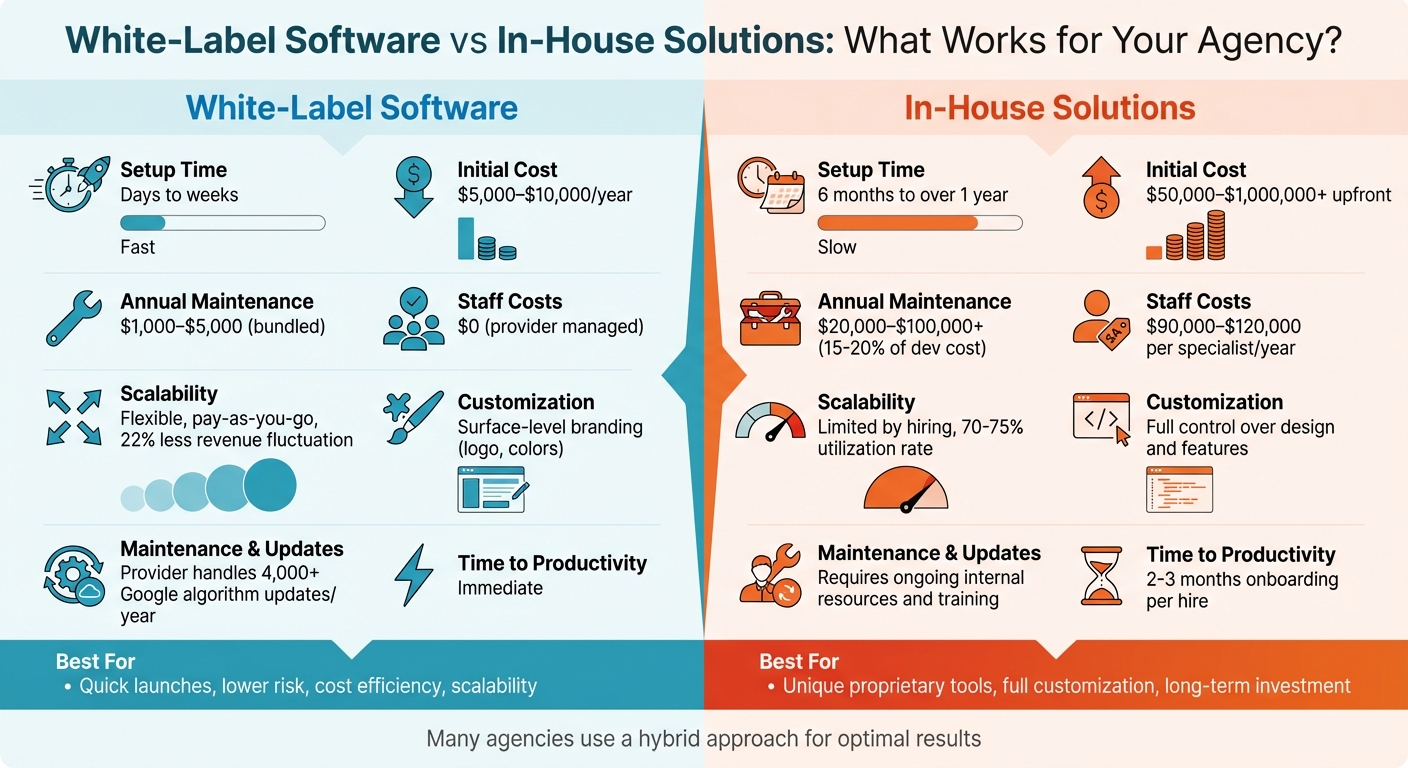
White-label enables fast, low-cost launches; in-house provides deep customization at higher cost and longer timelines. Many agencies adopt a hybrid model.
SalesLabel Team
Growth Expert • 1/26/2026
Share:
Looking for a done-for-you solution?
SalesLabel automates outbound end-to-end — AI finds prospects, sends personalized messages, and books meetings under your brand.
White Label Software vs In-House Solutions: What Works
Choosing between white-label software and in-house solutions depends on your agency's priorities: speed, cost flexibility, or customization. Here's a quick breakdown:
White-label software is pre-built, rebrandable, and deployable in days or weeks. It reduces upfront costs and converts fixed expenses into variable ones, making it easier to scale. Pricing averages $5,000–$10,000 annually, with minimal maintenance effort. It's ideal for agencies wanting quick launches and lower financial risk.
In-house solutions offer complete control over customization and ownership but come with high costs and longer development times (6 months to over a year). Initial costs can exceed $50,000–$1,000,000, plus $90,000–$120,000 annually per specialist. It's best for agencies seeking unique, proprietary tools and willing to invest heavily.
Quick Comparison
Criteria
White-Label Software
In-House Solutions
Setup Time
Days to weeks
6 months to over a year
Cost
$5,000–$10,000/year + optional fees
$50,000–$1,000,000+ upfront, plus salaries
Scalability
Flexible, pay-as-you-go
Limited by hiring and resources
Customization
Surface-level branding
Full control over design and features
Maintenance
Managed by provider
Requires ongoing internal resources
Expertise Required
Minimal
High, with ongoing training
White-label solutions are great for speed and cost efficiency, while in-house systems allow for deeper customization but demand significant time and resources. Many agencies find a hybrid approach works best, combining white-label tools with in-house innovation to balance flexibility and control.
White Label Software vs In-House Solutions: Cost, Time, and Scalability Comparison
Cost Comparison and Budget Impact
White-Label Software Pricing
White-label platforms operate on a subscription model, which shifts fixed costs into variable ones. Licensing fees typically range from $5,000 to $10,000 per year or a few hundred dollars per month [9]. Maintenance is often bundled into these fees, though it may add an extra $1,000 to $5,000 annually[9]. One key advantage is scalability - during slower periods, costs can drop to zero. This flexibility helps minimize financial volatility, as noted in industry reports [3].
Another major benefit? There’s no need to budget for recruitment, hardware, or ongoing training. The provider handles all updates and adjustments, including keeping pace with Google's 4,000+ algorithm updates every year[3]. These savings make white-label solutions an attractive option for agencies aiming to reduce overhead without sacrificing service quality.
In-House Solution Expenses
Building an in-house solution, on the other hand, comes with a completely different set of financial demands. Custom software development alone can cost anywhere from $50,000 to over $1,000,000, depending on the complexity of the platform [9]. Annual maintenance fees typically run 15% to 20% of the initial development cost, which translates to $20,000 to $100,000+ per year[9].
Salaries are the biggest ongoing expense. A mid-level digital marketing specialist earns between $65,000 and $85,000 annually, but when you factor in benefits (adding 25–30%), taxes, equipment, and office space, the total cost can climb to $90,000 to $120,000[3]. Similarly, a web designer’s annual cost, including salary, benefits, subscriptions, and other expenses, can exceed $100,000[3]. To justify these costs, a designer would need to complete at least 14.4 standard website projects per year to break even compared to white-label alternatives [3].
As Timothy Campos, former CIO at Facebook, wisely observed:
"I take the build vs. buy decision very seriously. Anything we build will have a maintenance cost in the future that has to be considered" [10].
Hidden costs also pile up quickly. Recruitment fees alone can range from $3,000 to $7,000 per hire, while specialized tools may cost $200 to $500 per month per user. Onboarding new hires takes time too - most need 2 to 3 months to become fully productive [3]. One agency owner shared this insight:
"By white-labeling SEO services instead of hiring a three-person team, we reduced our fixed monthly costs by approximately $22,000 while maintaining similar profit margins" [3].
Setup Time and Launch Speed
White-Label Setup Process
White-label platforms are known for their quick deployment times, with many solutions ready to go live in just days or weeks - some even as fast as 3 minutes[2][8]. The setup process is usually simple: you add your logo, adjust brand colors, redirect your domain, and connect payment gateways. Best of all, there’s no coding involved[8].
This efficiency stems from the fact that the provider has already done the heavy lifting - building, testing, and refining the software workflows. You’re essentially plugging into a ready-made solution, skipping the steep learning curve and avoiding the need to hire additional staff. This allows you to hit the ground running and start scaling operations almost immediately[4]. On the other hand, creating a custom in-house solution is far more time-consuming and resource-heavy.
In-House Team Building
Building an in-house solution is a much slower process. Developing custom software from scratch can take anywhere from 6 months to over a year[2]. Even before writing a single line of code, you’ll need to recruit specialized talent, which adds both time and expense. Hiring costs alone range from $3,000 to $7,000 per new employee, and onboarding typically takes 2–3 months before they reach full productivity[3].
Meanwhile, you’re paying full salaries and benefits - around $90,000 to $120,000 annually for mid-level specialists[3] - while your team gets up to speed. And with the average tenure for digital marketing specialists sitting at just 2.3 years[3], you may find yourself repeating this costly and time-intensive cycle more often than you’d like.
Growth Capacity and Adaptability
Scaling with White-Label Platforms
White-label platforms provide agencies with the flexibility to adjust their operations based on demand. Whether managing multiple large-scale projects or handling a temporary surge in workload, agencies can rely on their partner's team of trained specialists. This approach avoids the time and expense of recruiting and onboarding new employees[3].
Another advantage lies in the financial setup. White-label solutions turn fixed costs into variable ones, meaning agencies only pay for services when they’re needed. This model helps reduce revenue fluctuations by about 22% during periods of client variability[3][8]. Plus, these platforms solve the issue of "fractional specialists" by allowing agencies to purchase exactly the amount of support they require - no more, no less[3].
On the flip side, scaling internally presents its own set of challenges.
Scaling with In-House Teams
Growing an in-house team takes more time and requires a significant upfront commitment. Agencies must cover full salaries well before new hires start contributing to revenue[3]. Even then, in-house teams often operate at only 70–75% capacity, leaving resources underutilized[3].
As teams grow, the administrative workload also increases. For teams larger than five, leaders can spend up to half their time managing tasks like performance reviews, resolving conflicts, and training. This shift in focus can detract from strategic priorities[3]. Adding to the challenge, digital marketing specialists have an average tenure of just 2.3 years, forcing agencies into frequent and costly recruitment cycles[3].
Branding Options and Customization
White-Label Branding Features
White-label platforms let agencies put their own logo, company name, and color scheme on pre-built software, making it look like the agency created it. The original developer stays behind the scenes, so clients only see the agency's branding[11].
Many platforms also support custom domain mapping (CNAME) and branded client portals, helping agencies present a polished, professional image under their own name. This setup can enhance trust with clients, who expect a seamless, agency-branded experience.
That said, the customization options are usually limited to surface-level changes like logos, colors, and small interface adjustments. Agencies often can't alter core workflows, add specialized features, or overhaul the user experience beyond what the vendor allows. Some platforms may still include "powered by" links in footers or support materials, which can weaken the illusion of full branding. Be sure to confirm whether the client-facing portal is entirely rebrandable before committing.
In-House Customization Control
Building software in-house gives agencies full control over every detail, from the design of the user interface to the underlying code. This level of control allows for the development of unique workflows, tailored features, and a distinctive look and feel that can set the agency apart.
Another advantage of in-house development is ownership. Agencies retain the intellectual property and source code, which means no dependence on a vendor for updates or changes. This independence allows for faster adjustments as client needs change.
However, this level of control comes with a hefty price tag. Hiring professionals can cost between $90,000 and $120,000 annually per person, and initial development costs can range from $50,000 to over $500,000[3][12]. Many agency owners say the ability to maintain strict quality control is their main reason for investing in in-house development[3]. While expensive, this approach appeals to agencies that prioritize brand originality and are willing to invest significant resources to achieve it.
These varying levels of customization open the door to exploring how each option integrates with your existing tools.
Connecting with Existing Tools
White-Label Platform Integration
White-label platforms are designed to work effortlessly with tools you already use - think CRMs, email services, analytics platforms, and payment systems. They often adopt an "API-first" approach, meaning they’re built specifically to share data with other systems right from the start[13].
"One of the great advantages of white-label CRM software is that it's designed to integrate smoothly with other tools and platforms you're already using."
– Humritha K, SEO Content Specialist, Vendasta[6]
These platforms typically offer real-time data synchronization, ensuring that updates like lead details, campaign performance, and client activities are reflected across all connected systems without delays[13]. Integration timelines can vary: simpler setups might be ready in 2–4 weeks, while more complex configurations could stretch beyond 12 weeks[13].
Before diving in, it’s a good idea to evaluate the quality of the platform’s API documentation. Professional services for custom integrations can range from $2,000 to $15,000 per integration[13].
If you're considering a system built in-house, the integration process looks quite different.
In-House System Integration
Building your software in-house means your team must handle all third-party tool connections from scratch. This involves documenting current system integrations, planning API connection strategies, and setting up development and testing environments before any coding begins[13].
While this approach gives you full control over how data flows and allows for custom business logic, it comes with a hefty technical workload. Each time a third-party tool updates its API, your team will need to adjust the integration code to ensure everything keeps running smoothly.
"Integration complexity is the #1 cause of project delays."
– White Label Wonder[13]
In fact, 31% of software implementation failures are directly tied to underestimating how challenging integration can be[13]. Custom integrations also require ongoing maintenance, especially when third-party APIs change. For enterprise-level solutions, these updates can lead to delays and costs running into hundreds of thousands of dollars[14]. Unlike white-label platforms, which handle updates and maintenance as part of their service, in-house teams must allocate continuous resources to keep integrations functional.
sbb-itb-a781ab9
Access to Skills and Specialized Tools
White-Label Platform Expertise
White-label platforms provide agencies with immediate access to expertise in areas like SEO, PPC, web design, and lead generation. This eliminates the need to navigate the lengthy and often challenging process of skill development [3].
These platforms come equipped with systems refined over years, including proven workflows, quality assurance protocols, proprietary templates, and detailed reporting dashboards. They also leverage historical performance data from hundreds of accounts, offering insights that would be difficult for a single in-house specialist to match [3]. On the technical side, tasks like software development, bug fixes, server uptime, and regular updates are fully managed by the white-label provider. This is especially critical given Google's staggering 4,000+ algorithm updates each year [3]. By distributing the costs of staying current across multiple clients, white-label teams relieve agencies of the financial burden tied to continuous training and updates.
Another advantage is the inclusion of professional tools. Instead of paying separately for SEO tools (which can range from $200–$500 per month) or creative software (around $600 per year per user), these costs are bundled into the white-label service fee.
However, taking the in-house route comes with its own set of challenges.
Building In-House Expertise
While white-label platforms offer ready-made expertise, building in-house capabilities requires a substantial financial and time commitment. Recruiting in-house talent involves not only high fixed costs like salaries and benefits but also additional expenses for hiring and onboarding [3].
The investment doesn’t stop there. Digital marketing skills can quickly become outdated as platforms evolve and best practices shift. For example, one agency spent $15,000 on training and consulting to help their Facebook ads expert regain proficiency after major platform changes [3].
Agencies also need to account for software subscriptions, ongoing certifications, and the time required to keep their team up to date. Research shows that in-house designers only spend about 70–75% of their time on billable work, meaning 25–30% of their salary covers tasks that don’t directly generate revenue [3].
This can lead to what’s known as the "fractional specialist" problem. If an agency’s workload requires the equivalent of 1.5 SEO specialists, they’re left with two options: hire two full-time employees and risk overstaffing or rely on one employee and risk burnout. White-label solutions solve this issue by offering scalable services - you only pay for what you need, exactly when you need it [3].
Lead Quality and Results Tracking
White-Label Lead Results
White-label platforms excel at delivering high-quality leads thanks to their specialized systems, honed through managing hundreds of client accounts. These platforms rely on automated tools like Snapshot Reports to evaluate a prospect's digital presence - looking at SEO gaps, review scores, and social media performance - before your sales team even begins the conversation. This ensures your outreach is built on solid, actionable data [5][15].
Automated emails stand out for their effectiveness, generating a 2,270% increase in conversion rates, 84% higher open rates, and 341% higher click rates[1]. Automated insight reports further amplify success, driving an 18× boost in pipeline revenue[15]. To make things even easier, white-label platforms often include real-time dashboards with AI-powered alerts. For example, if your return on ad spend dips below a specific threshold, the system notifies you instantly - no manual monitoring required [16].
Consistency is another strong suit of white-label providers. They follow structured quality assurance protocols and rely on project management oversight, areas where in-house teams can sometimes fall short [4]. Plus, by analyzing historical performance data across many accounts, these platforms deliver optimization insights that go beyond what a single specialist could typically provide [3].
On the other hand, in-house solutions often struggle to match this level of efficiency and consistency, which can lead to delays and missed opportunities.
In-House Performance Results
Unlike white-label platforms, in-house systems often face hurdles that limit their ability to ensure consistent lead quality. Manual processes and the limited capacity of individual specialists can create bottlenecks, delaying workflows and impacting both the quality and timeliness of leads [4].
Frequent platform updates add to the challenge. Google, for instance, rolls out more than 4,000 algorithm updates each year, requiring internal teams to invest heavily in ongoing training just to stay up-to-date [3]. Additionally, manual report aggregation can consume 10–15 hours per week, compared to the 2–3 hours typically required when using automated white-label tools [16]. These time-consuming processes not only slow things down but also increase the risk of errors, potentially affecting client trust and the speed of decision-making.
Team Focus and Resource Management
White-Label Resource Benefits
When it comes to operational efficiency, focusing your team’s energy on what they do best can make all the difference. Outsourcing technical tasks allows agencies to concentrate on closing deals and driving strategic growth. For example, agency owners with teams of five or more often spend about half of their time managing people - handling performance reviews, resolving conflicts, and guiding career development [3]. By outsourcing these time-consuming tasks, your internal team can zero in on their strengths. Designers can dedicate themselves to crafting exceptional UX and creative concepts, while project managers can prioritize hitting client milestones instead of constantly putting out fires [3].
Another major perk of white-label partnerships? They take the hassle out of hiring. With digital marketing specialists averaging a tenure of just 2.3 years, agencies can sidestep the endless cycle of recruitment and training [3]. This approach not only saves time but also ensures your team stays focused on growth rather than administrative distractions.
In-House Resource Requirements
Running an in-house team, on the other hand, often pulls valuable resources away from revenue-generating activities. Beyond the obvious costs, agencies have to pour time into recruitment, onboarding, training, and daily management. For instance, in-house designers typically achieve a 70–75% utilization rate, meaning up to 30% of their paid time is spent in internal meetings or handling administrative tasks instead of delivering client work [3].
This balancing act becomes even tougher as teams grow. Expanding agencies frequently encounter the "fractional specialist" dilemma - where a role might require 1.5 full-time employees, but hiring half a person isn’t an option. This can result in overstaffing or, worse, burning out your existing team [3]. When workloads spike, agencies often scramble to hire in a panic or risk overwhelming their staff. One agency, for example, spent $15,000 on training just to get their team back on track after major platform updates [3]. Between ongoing professional development and the daily grind of team management, agency owners can easily lose sight of the bigger picture: growing their business.
Software Development: In-House vs Outsourcing vs White Label | Crypto Expo Dubai 2022
Conclusion
Deciding between white-label software and in-house solutions comes down to your agency’s current needs and future goals. White-label platforms stand out for their speed, predictable costs, and immediate access to specialized expertise, making them ideal for agencies aiming to launch quickly, scale efficiently, or experiment with new services without taking on significant risk. With white-label, you can roll out solutions in days rather than months [2][7].
On the other hand, in-house development offers unmatched customization, which is invaluable when creating something truly one-of-a-kind - whether it’s a proprietary workflow, patented technology, or a solution tailored to a highly regulated industry. But this path comes with serious investments: specialists command salaries of $90,000–$120,000 annually, and managing a team of five or more can take up a considerable chunk of your time [2][3].
In short, if your agency thrives on strategic client engagement rather than technical innovation, white-label solutions allow you to focus on your strengths while leaving execution to experts. Agencies that partner with white-label providers often enjoy better financial stability, even during periods of fluctuating client demand [3]. For many, the sweet spot lies in a hybrid model - leveraging white-label for scalable, standardized services while maintaining control over core strategy and client relationships. This approach balances efficiency with the personal touch that strengthens client trust [2].
FAQs
What are the key cost differences between white-label software and building an in-house solution?
The cost differences between white-label software and in-house solutions primarily boil down to upfront investment, ongoing costs, and scalability. Developing an in-house solution demands a hefty initial investment. This includes hiring skilled staff, providing training, and purchasing necessary tools. These costs are fixed, meaning they remain constant whether business is booming or slowing down, which can put a strain on budgets during quieter periods.
On the flip side, white-label software usually follows a subscription or pay-as-you-go model. This setup eliminates the need for large upfront spending and offers more flexibility in managing cash flow. Businesses only pay for what they use, making it easier to align costs with actual demand. Plus, white-label solutions scale more naturally - expenses increase as client demand grows. In contrast, maintaining an in-house team requires steady funding, even when workloads fluctuate.
For agencies aiming to keep initial costs low, stay flexible, and scale effortlessly with client needs, white-label software often proves to be the smarter financial choice.
What are the scalability differences between white-label software and in-house solutions?
Scalability is a key factor when comparing white-label software to in-house solutions, and the two approaches differ significantly in this area.
White-label software tends to be more scalable because it enables businesses to expand their services quickly without needing to hire or train additional staff. These solutions are designed to integrate seamlessly into existing workflows, allowing companies to meet growing client demands with minimal internal adjustments.
In contrast, in-house solutions come with a heavier lift when it comes to scalability. Expanding such systems requires building a dedicated team, hiring and training new staff, and investing in infrastructure - all of which take time and drive up costs. That said, in-house setups do provide greater control over customization and quality, making them a strong option for businesses focused on long-term, tailored growth.
For companies aiming for rapid and adaptable expansion, white-label software often proves to be the more practical choice. Meanwhile, in-house solutions are better suited for those who value control and bespoke processes as they scale.
What are the benefits and challenges of combining white-label software with in-house solutions?
Using a mix of white-label software and in-house solutions can strike a powerful balance for businesses, offering a blend of speed, cost-effectiveness, and customization. The biggest draw? Flexibility. White-label tools allow for quick deployment and lower expenses, while in-house expertise steps in for tasks that demand tailored solutions or strategic oversight. This combination can accelerate growth by letting external providers handle routine operations, giving internal teams the bandwidth to focus on innovation and core business goals.
However, this approach isn’t without its hurdles. Managing both systems requires precise coordination to maintain consistency and quality. Internal teams often need to juggle integration efforts and ensure smooth communication with external providers. Plus, differences in standards or priorities between the two can lead to inefficiencies. That said, when executed thoughtfully, a hybrid model can be a game-changer - helping businesses stretch resources, cut costs, and strike the right balance between agility and control.