Lead scoring helps your sales team focus on leads that are most likely to convert. By assigning numerical values to potential customers based on their characteristics (like job title or company size) and actions (like visiting a pricing page), you can prioritize high-quality leads and reduce wasted time. Businesses using lead scoring report up to 70% better lead generation ROI and as much as a 50% revenue boost.
Here’s what you need to know:
What is Lead Scoring? Assign scores to leads based on explicit data (e.g., job title) and implicit data (e.g., website activity).
Why It Matters: Without it, sales teams waste time on unqualified leads. Lead scoring ensures focus on the best opportunities.
How It Works: Combine demographic and behavioral data to determine whether a lead is ready for sales or requires nurturing.
Advanced Techniques: Use time-based score decay to keep scores relevant and AI for predictive scoring to identify patterns in lead behavior.
The key is aligning sales and marketing teams, refining your scoring model regularly, and focusing on quality over quantity. A simple, effective system can help you convert more leads into customers while maximizing efficiency.
Lead Scoring Fundamentals
What is Lead Scoring?
Lead scoring is a way to assign values to potential customers based on who they are and how they interact with your business [5][7]. It’s a system designed to separate high-interest buyers from those who may not be ready to engage.
This system uses two types of data: explicit data and implicit data. Explicit data includes concrete details like job title, company size, industry, and location. Implicit data, on the other hand, focuses on actions - things like visiting your website, clicking on emails, downloading content, or requesting a demo [7][2][6]. When a lead’s score hits a certain threshold, they move from being a Marketing Qualified Lead (MQL) to a Sales Qualified Lead (SQL), signaling they’re ready for more direct outreach from your sales team [2][3].
This structured approach is the foundation for understanding why lead scoring is so important.
Why Lead Scoring Matters
Without lead scoring, sales teams often waste valuable time chasing leads that aren’t ready to convert.
Businesses that use lead scoring report a 70% improvement in lead generation ROI and can see annual revenue grow by as much as 50%[10][2]. It’s a game-changer for sales teams because it helps them focus on the right opportunities. This is especially critical given that 53% of salespeople say selling has become harder over the past year[5].
"The biggest lift in lead scoring is not defining how many points something is worth, it's making sure everyone internally is aligned." - Ryan Durling, Inbound Consultant, HubSpot [5]
This alignment and precision make lead scoring an essential tool for driving sales success.
Demographic vs. Behavioral Scoring
Demographic scoring looks at whether a lead aligns with your ideal customer profile. Points are assigned based on attributes like holding a C-level position (+25 points), working at a company with 500+ employees (+20 points), or being part of a target industry [9][6][2].
Behavioral scoring, on the other hand, focuses on how interested a lead seems based on their actions. For example, visiting your pricing page might earn them +10 points, while requesting a demo could add +15 points [9][6][2]. A high behavioral score suggests the lead is actively moving through the buyer’s journey, even if they haven’t explicitly said so.
The real magic happens when these two scoring methods are combined. For instance, a lead might have a perfect demographic profile but show no interest - they’re not ready for a sales call and need further nurturing. On the flip side, a highly engaged lead who doesn’t fit your demographic criteria (like using a personal Gmail address in a B2B scenario) might need to be excluded. To refine the process even further, modern systems use negative scoring to disqualify leads. For example, visiting a careers page could subtract 10 points, or unsubscribing from emails might lower their score. This ensures sales teams focus only on genuine opportunities [9][5][2].
sbb-itb-a781ab9
Advanced Lead Scoring Techniques for B2B Tech Companies
How to Build a Lead Scoring Framework
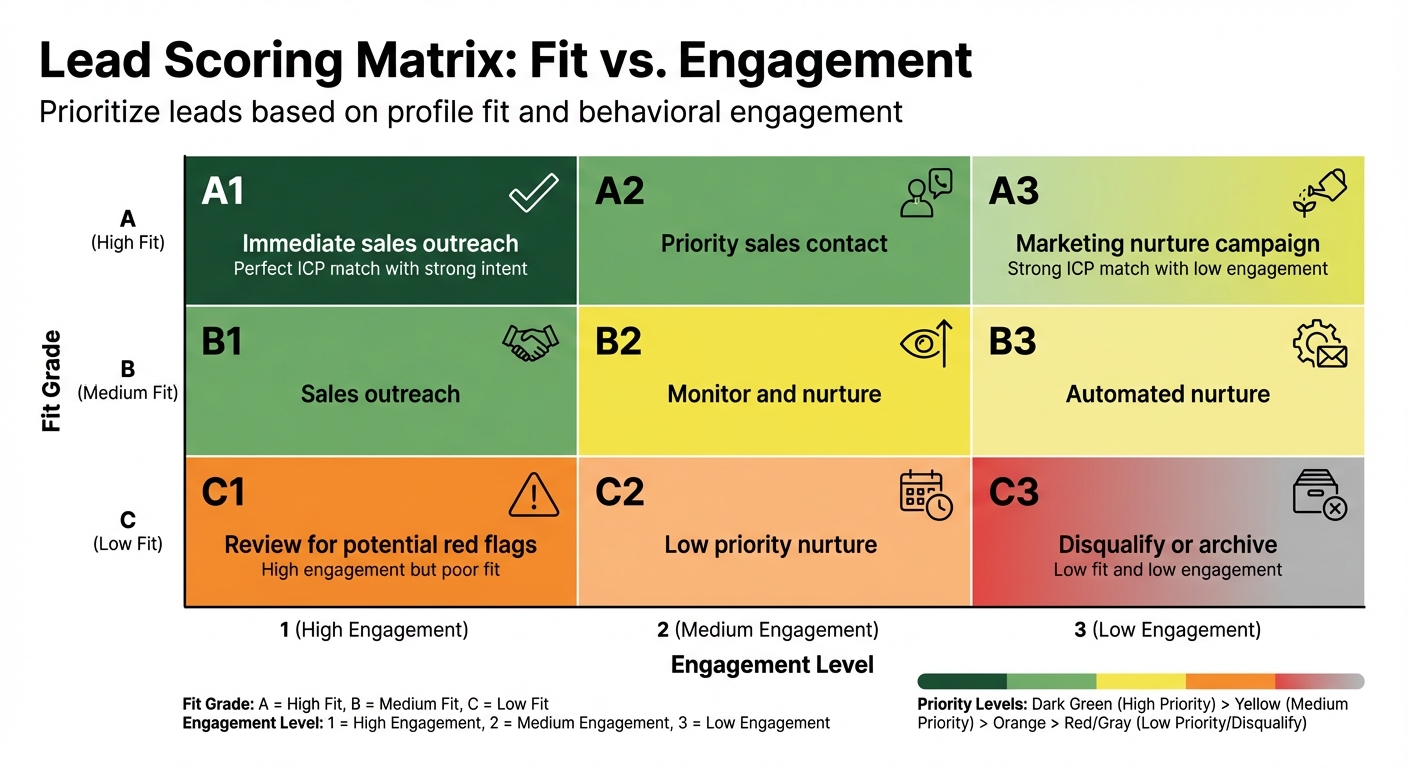
Two-Dimensional Lead Scoring Matrix: Fit vs Engagement
Define Your Ideal Customer Profile (ICP)
Start by analyzing data from last year's converted leads. Look for patterns in areas like industry, company size, job titles, and revenue [8][12]. This historical analysis helps you understand who your actual best customers are, rather than relying on assumptions.
It's crucial to align your sales and marketing teams on what defines a qualified lead. Without this internal alignment, your scoring model won't deliver the results you're aiming for [3][4][5].
Talk to your current customers across different sales cycles to identify the key factors that drove their purchase decisions [5][12]. Equally important is reviewing deals that didn’t close - these can reveal negative traits that signal a poor fit [8][12].
To get started, focus on 5–10 attributes your sales team finds most impactful [4]. These often include job title, department, geographic location, company revenue, employee count, and technology stack [3][4][12]. Use your baseline lead-to-customer conversion rate as a benchmark to identify which ICP attributes consistently perform above average [5][8].
Assign Point Values for Fit and Engagement
Use a 0–100 scale to assign weighted points to different criteria. Give higher scores to actions that show strong intent, like requesting a demo, while assigning fewer points to lighter engagements, such as opening an email [4][9].
For demographic fit, reward leads that align closely with your ICP, such as decision-makers or companies meeting firmographic benchmarks. For engagement, prioritize behaviors that demonstrate serious interest, like visiting your pricing page, attending a webinar, or requesting more details.
Don’t forget to incorporate negative scoring. For example, deduct points for behaviors like visiting the careers page or using a personal email, as these can signal a lack of buying intent [9][5][2].
Create a Two-Dimensional Scoring Model
A two-dimensional scoring model evaluates leads based on two key factors: Fit (how well they match your ICP) and Engagement (the level of interest they’ve shown) [4][13]. This approach helps you avoid false positives - leads that are highly engaged but lack authority or budget - and highlights promising leads that may need more nurturing [4][2].
Use a matrix with letter grades for Fit (A, B, C) and numbers for Engagement (1, 2, 3) [13]. For example:
A1: A perfect ICP match with strong intent, ready for immediate sales outreach.
A3: A strong ICP match with low engagement, requiring more marketing efforts.
C1: High engagement but a poor fit, needing further review for potential red flags.
C3: Low fit and low engagement, likely to be disqualified.
Fit Grade
Engagement Level
Action
A (High Fit)
1 (High Engagement)
Immediate sales outreach
A (High Fit)
3 (Low Engagement)
Marketing nurture campaign
C (Low Fit)
1 (High Engagement)
Review for potential red flags
C (Low Fit)
3 (Low Engagement)
Disqualify or archive
Make sure these scores are integrated into your CRM so sales reps can easily prioritize their outreach. Define a clear threshold for "sales-ready" leads - for instance, leads graded as A1, A2, or B1 could be passed to sales immediately [3][13].
Once your basic framework is in place, you can start exploring more advanced techniques to refine and optimize your lead scoring process.
Advanced Lead Scoring Techniques
Implement Time-Based Score Decay
Sometimes, a lead might appear more valuable than they actually are, simply because their score hasn’t been adjusted over time. Without factoring in time-based decay, leads who were active months ago but have since gone quiet may still carry high scores, leading your sales team to pursue outdated opportunities [11]. To avoid this, you can implement a system that gradually reduces scores based on inactivity. For instance, subtract 10 points after 60 days, 25 points after 90 days, and 120 points after 120 days[1].
Additionally, you can apply recency modifiers to reward recent actions. For example, increase scores by 20% for activity within the past seven days or by 10% for actions within 14 days [11]. Here’s a quick breakdown of how these adjustments might look:
Time Since Last Action
Modifier
< 7 days
100% value (or +20% boost)
7–14 days
75% value (or +10% boost)
15–30 days
50% value
60 days
Deduct 10 points or reset behavior score
> 90 days
Deduct 25 points or move to "Cold" tier
It’s important to note that fit scores - like the lead’s job title or company size - should remain static. For example, a VP at a 500-person company will always meet your ideal customer profile, even if they stop engaging. Only behavioral scores should decay over time [11].
While time-based decay helps refine how you track engagement, AI takes things a step further by predicting which leads are truly worth pursuing.
Use AI for Predictive Lead Scoring
Traditional lead scoring often relies on rigid rules, such as assigning a set number of points for downloading an eBook. AI-powered predictive scoring, however, uses historical CRM data to uncover patterns and identify the traits and behaviors most likely to result in closed deals [1][9]. In fact, Salesforce reports that 98% of sales teams using AI feel it helps them prioritize leads more effectively [1].
AI systems excel at recognizing patterns by analyzing past deals and flagging leads with similar profiles [1][9]. This capability is especially valuable for agencies managing large pipelines [6]. To make the most of predictive scoring, ensure your advertising channels - like Facebook, LinkedIn, Google Ads, and TikTok - are synced with your CRM. This gives the AI a complete picture of lead behavior [1].
If your database is still growing, you can start with a global scoring model based on anonymous aggregate data. As your data pool expands, transition to a custom model tailored to your specific audience [1]. Define clear action thresholds as well, such as automatically assigning leads with AI scores above 65 to a Sales Development Representative or triggering a personalized email sequence [11].
"Lead scoring is not a data function. It's a routing function. Until your score drives real action... it is just another field in the CRM." - LeadOps [11]
Test and Optimize Your Lead Scoring Model
Creating a lead scoring model is just the first step. The real challenge lies in keeping it effective over time. Markets shift, buyer behaviors evolve, and what worked a few months ago might not hold up today. Regular testing and updates ensure your lead scoring adapts to these changes, keeping it relevant and effective.
Validate Your Scoring System
Start by calculating your baseline lead-to-customer conversion rate. For example, if leads scoring above 65 points convert at 15%, compared to a 3% baseline, your model is on the right track. But if high-scoring leads convert at the same rate as low-scoring ones, it’s time to rethink your approach [5][1].
Next, dig into attribute close rates for specific behaviors. For instance, compare leads who requested a demo to those who downloaded an eBook. If demo requests close at 20% while your baseline is 1%, that behavior deserves a much higher weight in your scoring system [5]. This step ensures your point assignments directly reflect behaviors that drive sales.
Don’t stop there - talk to your sales team to identify false positives. These are leads with high scores that didn’t translate into good opportunities. Ryan Durling, an Inbound Consultant at HubSpot, puts it this way:
"The biggest lift in lead scoring is not defining how many points something is worth, it's making sure everyone internally is aligned" [5].
You can also back-test your model by analyzing recent closed-won deals. If many of these customers had low scores during their prospect phase, it’s a sign your scoring criteria need fine-tuning [4]. Attribution reports can further help by identifying behaviors - such as visits to your pricing page - that consistently lead to conversions [5][14].
With this data in hand, adjust your scoring system to better prioritize leads and align with actual sales outcomes.
Adjust Scores Based on Performance Data
Fine-tuning your model is an ongoing process. Schedule quarterly reviews to make updates based on performance data, market trends, or changes in your product offerings [4][6].
Use your attribute analysis to recalibrate point values. For example, if webinar attendees are converting at twice the rate of whitepaper downloaders, increase the points for attending webinars. Collaborate with your sales team to define the "magic number" - the score that separates nurture-stage leads from sales-ready leads. This threshold might be 65 points for one company but 80 for another [9][3].
For those using predictive AI scoring tools, like Salesforce Einstein, ensure your models are retrained frequently. These systems often update automatically, with Salesforce Einstein retraining every 10 days using fresh customer data [1]. As Grant, a sales leader, explains:
"Lead scoring is no longer a set-it-and-forget-it deal. We're making real-time adjustments based on the latest data. This agility helps us stay ahead of the curve" [5].
Track Key Performance Metrics
Once you’ve adjusted your scoring system, monitor key metrics to ensure it’s working. Here are a few critical KPIs to track:
MQL-to-SQL Conversion Rate: This shows how effectively marketing is handing off leads to sales. A low rate might mean your scoring threshold is too low or the criteria aren’t aligned with what sales teams need [15].
Lead Velocity: This measures how quickly leads progress through your funnel. Faster movement often reflects better targeting and scoring accuracy [15].
Sales Cycle Duration: Evaluate whether high-scoring leads close deals faster than low-scoring ones.
Aligned sales and marketing teams often see 67% higher conversion rates and generate over 209% more revenue from their leads [14]. Automated lead management can also boost revenue by an average of 10% within six to nine months[9]. Make sure your scoring system reflects these benefits by tracking both operational and financial outcomes.
Metric
Purpose
How to Measure
Lead-to-Customer Rate
Baseline effectiveness
(Total Customers / Total Leads) × 100
MQL-to-SQL Conversion
Quality of marketing leads
% of Marketing Qualified Leads accepted by Sales
Attribute Close Rate
Validation of point values
Close rate of leads with specific traits/behaviors
Lead Velocity
Pipeline health
Rate at which leads move through funnel stages
Keep in mind, 98% of sales teams using AI-powered lead scoring report that it helps them prioritize leads more effectively [1]. Your metrics should reflect this same clarity, enabling your team to focus on the leads that matter most.
Common Lead Scoring Mistakes to Avoid
Even the most well-thought-out lead scoring models can fall short if certain pitfalls aren't sidestepped. These missteps don't just waste time - they can also damage the relationship between sales and marketing teams and divert resources toward leads that are unlikely to convert. Here's what you need to keep an eye on.
Ignoring Time Decay
Time decay is a crucial factor in lead scoring, but it's often overlooked or misapplied. Without adjusting scores for inactivity, outdated leads can maintain high rankings, pushing aside newer, more engaged prospects [16]. To avoid this, make sure your time decay parameters are applied consistently. For instance, you can use a percentage-based approach, like reducing scores by 25% each month if there's no new activity. High-intent actions, such as requesting a demo, should lose points faster as urgency fades, while static factors like job title or company size should remain steady [16].
Overcomplicating Your Scoring Model
A scoring model with too many criteria can backfire, making it overly complex and difficult for sales teams to trust or understand [4]. A simpler, streamlined model that focuses on 5–10 key attributes encourages better collaboration and transparency. For example, prioritize demographic factors like job title, industry, and company revenue, along with behavioral signals such as visits to pricing pages or demo requests [4]. You can always refine the model during quarterly reviews. For non-negotiable factors like geographic location, consider using automated filters rather than adding every disqualifier to the scoring system [1].
Prioritizing Quantity Over Quality
It's not just about avoiding complexity - lead quality matters just as much. Flooding sales teams with unqualified leads can undermine the entire scoring process, leading them to lose confidence in the system. The goal should always be to focus on leads that align with your Ideal Customer Profile (ICP) and show clear buying intent. Negative scoring can help weed out less relevant contacts by deducting points for actions like visiting the careers page, unsubscribing from emails, or using generic email domains in a B2B context. Companies that get this balance right often see a 70% boost in the ROI of their lead generation efforts [10].
Conclusion
Lead scoring plays a crucial role in directing attention to the leads most likely to convert. As the LeadOps Blueprint aptly states:
"Lead scoring is not a data function. It's a routing function. Until your score drives real action... it is just another field in the CRM" [11].
The difference between a scoring model that drives results and one that gathers dust lies in whether it actively influences how your teams work.
A well-rounded approach that combines demographic data (like job titles or company size) with behavioral signals (such as visits to the pricing page) can deliver impressive returns. But these outcomes only happen when sales and marketing teams agree on what makes a lead "qualified" and when specific scores lead to specific actions.
On top of this foundation, advanced tools like AI can refine lead prioritization even further. AI-driven predictive scoring analyzes vast data patterns, helping 98% of sales teams focus on the most promising leads [1]. That said, even the smartest models need regular upkeep. Conduct quarterly reviews to fine-tune scoring based on recent closed-won deals, introduce time-based decay to weed out stale leads, and set up feedback loops so sales teams can flag false positives.
The key is to prioritize quality over quantity. When lead scoring functions as it should, it ensures that sales teams focus on the right leads at the right time. Marketing gains confidence in the signals driving conversions, and both teams move past debates over lead quality. Use clear thresholds to trigger follow-ups, establish readiness tiers to guide outreach, and remember: only a small portion of leads will qualify for sales. Your scoring model exists to improve that ratio.
Start simple. Test your model with historical data and refine it based on what drives conversions. This iterative process aligns your teams and keeps your scoring system actionable. Companies achieving a 70% boost in lead generation ROI aren’t using the most complex models - they’re using systems that align teams, drive action, and evolve with time[10].
FAQs
How can I align my sales and marketing teams to improve lead scoring?
To get your sales and marketing teams on the same page for lead scoring, start by building a mutual understanding of what makes a lead worth pursuing. Work together to define scoring criteria that consider factors like demographics, company specifics, and behavioral patterns. The goal is to ensure both teams are aligned on how leads are evaluated.
Leverage shared tools, such as a CRM or marketing automation platform, to implement your lead scoring model. These tools not only provide real-time updates but also enhance transparency. Regular training sessions can help both teams understand how to read and act on lead scores effectively.
Another key step is creating a feedback loop. Sales teams should share their insights on lead quality and outcomes with marketing, enabling continuous improvements to the scoring process.
By encouraging open communication, using integrated tools, and focusing on teamwork, your sales and marketing teams can zero in on the most promising leads, boosting conversion rates and improving overall efficiency.
What are the advantages of using AI for predictive lead scoring?
AI-powered predictive lead scoring offers a game-changing advantage for sales teams. By analyzing and ranking prospects based on their likelihood to convert, it ensures that sales efforts are directed toward high-potential leads. This not only saves time but also ensures resources are allocated to the most promising opportunities.
What makes AI so effective? It processes massive amounts of data - like demographic details, behavioral patterns, and firmographic insights - in real time. This leads to more precise lead qualification and allows businesses to quickly respond to shifts in customer behavior. Companies leveraging AI in this way often experience faster deal closures, stronger collaboration between sales and marketing teams, and a boost in revenue.
In short, AI simplifies and optimizes the lead scoring process, enabling smarter, data-driven decisions while improving sales efficiency and maximizing ROI.
What is time-based score decay, and how can I use it in my lead scoring model?
Time-based score decay is a smart way to keep your lead scoring system sharp by gradually lowering a lead's score if they haven’t engaged in a while. This approach ensures your scoring model focuses on leads who are actively interacting and more likely to convert.
Here’s how it works: Assign higher scores to recent interactions while reducing the importance of older activities. Many businesses use an exponential decay formula for this. For instance, actions within the last 7 days might carry more weight, while older activities see their scores slowly decline over time.
Incorporating time-based score decay keeps your lead scoring dynamic. It mirrors real-time engagement, allowing your team to zero in on leads that are actively showing interest and are more conversion-ready.