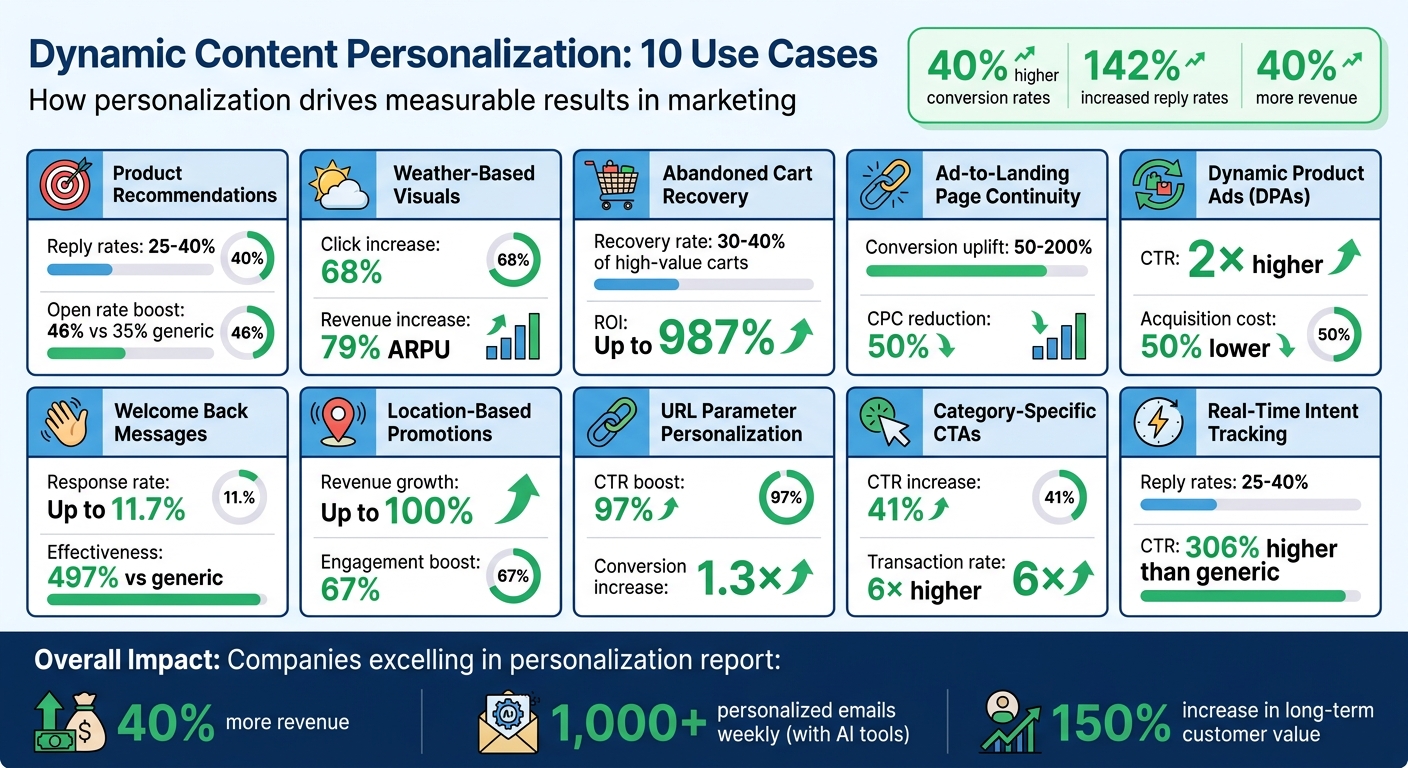
Dynamic content personalization tailors marketing messages in real-time based on user data, behavior, and context. This approach boosts results significantly, with personalized experiences delivering up to 40% higher conversion rates and 142% increased reply rates. Companies using personalization effectively generate 40% more revenue compared to their competitors.
Here are 10 practical use cases that show how personalization can improve outreach and engagement:
Product Recommendations: Align suggestions with user behavior or events (e.g., new hires, funding rounds) to achieve reply rates of up to 25%-40%.
Weather-Based Visuals: Use local weather data to adjust campaign imagery, increasing clicks by 68% and revenue by 79%.
Abandoned Cart Recovery: Target hesitant shoppers with tailored emails, reclaiming 30%-40% of high-value carts.
Ad-to-Landing Page Continuity: Match ad messaging with landing pages to improve conversion rates by 50%-200%.
Dynamic Product Ads (DPAs): Retarget users with personalized ads, doubling click-through rates and lowering acquisition costs by 50%.
Welcome Back Messages: Reference recent activity for higher engagement, achieving up to 11.7% response rates.
Location-Based Promotions: Customize offers based on user location, driving up to 100% revenue growth in some cases.
URL Parameter Personalization: Tailor landing pages dynamically using URL data, boosting click-through rates by 97%.
Category-Specific CTAs: Personalize calls-to-action based on user preferences, increasing click-through rates by 41%.
Real-Time Intent Tracking: Adjust follow-ups based on user actions, pushing reply rates to 25%-40%.
Personalization not only improves engagement but also scales efficiently with AI tools, enabling agencies to send 1,000+ personalized emails weekly. Tools like SalesLabel help automate these processes, saving time and driving better results. Companies that excel in personalization report 40% more revenue and higher long-term customer value.
Dynamic Content Personalization: 10 Use Cases with Performance Metrics
1. Product Recommendations in Outreach Emails
Relevance to Recipient's Context or Behavior
Tying product recommendations to real-world events - like funding rounds, new leadership appointments, or hiring trends - makes outreach far more relevant [4][6]. For instance, if a company recently brought on a new VP of Sales, suggesting a sales enablement tool aligns perfectly with their likely focus on evaluating and optimizing their tech stack within the first 90 days.
It’s also smart to align recommendations with specific buyer personas. A CFO is typically drawn to tools offering clear ROI, while a CTO is more likely to value scalability and seamless integration [4]. By layering multiple signals - such as a competitor loss combined with a key new hire - you can craft a narrative that clearly explains why your product is the right fit for their current needs [4][6]. This level of precision creates a strong foundation for better engagement.
Impact on Engagement
Data shows that personalized subject lines achieve a 46% open rate, compared to 35% for generic ones - a boost of 31% [4]. When you take it a step further by incorporating signal-based product recommendations, reply rates climb to 18%, which is 5.2 times higher than the average cold email [9][6]. Campaigns that combine multiple signals - like a funding announcement and a LinkedIn post about expansion - can drive reply rates to an impressive 25% to 40%[9][6].
"The first seller to reach a decision maker after a trigger event is 5x more likely to win the deal." - Autobound [4]
Ease of Implementation for Agencies
AI tools have dramatically cut down the time needed for research, reducing it from 15–30 minutes per prospect to just 30 seconds–2 minutes [6]. Platforms like SalesLabel can automatically pull insights from SEC filings, job postings, and news articles to generate tailored recommendations. This allows agencies to scale their efforts, sending out 100–200+ personalized emails daily while still achieving reply rates between 15% and 25% [6].
To maintain relevance even with incomplete data, agencies can use "if/else" logic in AI prompts - for example, referencing a job title if it’s available, or defaulting to the company name if it’s not [7]. Adding a 10% spot-check of AI-generated content before launching ensures quality without significantly slowing down the process [10].
sbb-itb-a781ab9
2. Weather-Based Image Changes in Campaign Messages
Relevance to Recipient's Context or Behavior
Weather-based visuals tap into contextual triggers, much like personalized product recommendations, to boost engagement. Weather has a strong influence on both mood and purchasing decisions. For instance, a home improvement brand might promote outdoor gardening supplies when it's sunny in a recipient's area, then shift to advertising indoor painting supplies when rain is forecasted. Similarly, HVAC providers can display heating system ads in colder regions and air conditioning offers during heatwaves [11].
Integrating a weather API with your email service provider (ESP) is straightforward. Agencies can connect their ESP to a weather API like AccuWeather using webhooks. The first webhook retrieves a "Location Key" based on the recipient's city and state, while the second webhook fetches the current weather forecast. AccuWeather uses unique location keys to ensure precise targeting [11].
Impact on Engagement
Emails that incorporate weather-based targeting see a 68% increase in clicks compared to generic campaigns [15]. If the weather data is detected at the moment the email is opened, that engagement boost rises slightly to 69%[15]. The revenue benefits are even more striking - weather-targeted banners can lead to a 79% increase in Average Revenue Per User (ARPU) compared to static images [14].
"Images in email campaigns serve as fast signals that are designed to trigger an emotional response. A recipient... will notice whether an image feels relevant to them." - Cloudinary [13]
Ease of Implementation for Agencies
Agencies can implement weather-based personalization quickly using no-code tools like NiftyImages or Hyperise[16]. The process involves designing a dynamic image template, generating a unique URL, and embedding it into any ESP, such as Klaviyo, Mailchimp, or Salesforce[16][12]. These images update in real-time to reflect the recipient's current local weather conditions at the moment the email is opened [16][17].
NiftyImages offers pricing starting at $20/month for up to 600,000 email opens annually, with advanced features available at $80/month [16]. To ensure quality even when weather data is unavailable, fallback images like a generic sunny scene can be used [17]. This streamlined setup shows how dynamic personalization can elevate email campaigns, setting the stage for the next use case.
3. Abandoned Cart Recovery Sequences
Relevance to Recipient's Context or Behavior
Abandoned cart emails are a direct response to a shopper's hesitation, targeting them at the moment they’re most likely to reconsider their purchase. With cart abandonment rates ranging from 70% to 78% across industries - and as high as 85.6% for mobile users - this is a crucial opportunity for businesses to act [21][20]. A common cause? Unexpected costs like shipping and taxes, which account for 48% of abandonments [20].
By using dynamic personalization, these emails go beyond simple reminders. They can suggest alternative products, highlight complementary items, or include targeted reviews to re-engage the shopper [18][19]. For high-value carts, some agencies even initiate human-assisted outreach within two hours, while smaller carts are handled through fully automated workflows [22].
Impact on Engagement
Abandoned cart emails deliver engagement metrics that blow standard promotional emails out of the water. Open rates hover between 40–50%, while click-through rates (CTR) land at 10–15% - three to five times higher than typical promo emails [20]. Personalization plays a big role here, with tailored sequences increasing open rates by 34% and conversion rates by 47% [22].
Timing is everything. Following up within 30–60 minutes - often called the "golden hour" - can boost conversions by 40–60%. Peak open rates are usually seen around 11 AM or 2 PM local time [18][22]. These well-timed, personalized efforts can lead to meaningful conversion gains and a strong return on investment.
Potential ROI or Conversion Uplift
The numbers speak for themselves: optimized abandoned cart recovery can reclaim 30–40% of high-value carts, compared to just 10–15% with older, less sophisticated methods [21]. And the cost? Recovering a $75 abandoned cart often requires just $0.50 in automation expenses, resulting in a 150× ROI [21].
Real-world examples highlight this potential. For instance, The Vault Pro Scooters implemented a three-email sequence (sent at 20 minutes, 24 hours, and 3 days) and recovered $38,605, achieving an incredible 987% ROI in just 30 days [23]. Similarly, a B2B equipment retailer focused on carts over $5,000 and achieved a 31.8% recovery rate, reclaiming $2.1 million in revenue from an $18,000 investment - a 117× ROI [22].
"The gap between a single 24-hour reminder email and a properly configured abandonment automation system represents 15–20× the recovery revenue."
Garrett Mullins, Workflow Specialist, US Tech Automations [22]
Ease of Implementation for Agencies
Setting up abandoned cart recovery systems is straightforward, especially when leveraging automation. The process starts by collecting customer emails early in their journey - either during checkout or through pop-ups - and ensuring the e-commerce platform integrates seamlessly with the email service provider [20]. A typical campaign includes a three-email flow:
Reminder email (1 hour): Highlights the cart contents.
Value-add email (24 hours): Incorporates social proof to build trust.
Urgency email (48–72 hours): Offers an incentive to complete the purchase [19][20].
To maximize performance, agencies should implement event tracking to capture key details like product IDs, images, and prices. This enables dynamic product blocks, which are essential for creating high-impact recovery campaigns [22].
4. Ad-to-Landing Page Message Continuity
Relevance to Recipient's Context or Behavior
Visitors take just 3 seconds to decide if your landing page delivers on your ad's promise [24]. That snap judgment hinges on message match - the alignment between your ad's promise and the landing page content. For instance, if your ad promotes "small business CRM" but your landing page highlights "Enterprise Solutions", you've created a disconnect that confuses users and tanks conversions. Keeping the messaging consistent is especially critical when using dynamic content personalization across multiple outreach channels.
Effective message continuity operates on four key levels: headlines that mirror your ad copy, visuals tailored to the visitor's industry (e.g., e-commerce dashboards for online retailers), social proof from relevant companies, and calls-to-action (CTAs) that match the offer in the ad [24]. Imagine a LinkedIn ad offering a "free audit", but the landing page instead asks for a "demo request" - this mismatch introduces unnecessary friction, discouraging potential leads before they even engage.
Impact on Engagement
Landing pages with headlines that match the ad copy see 2.4× higher conversion rates compared to generic pages [24]. Personalized CTAs outperform generic ones by 202%[25], and pages with a single, clear CTA achieve 371% better performance than those with multiple options [25].
Message continuity also impacts advertising costs. Google assigns higher Quality Scores to ads with relevant landing pages, which lowers cost-per-click (CPC). For example, a B2B SaaS company improved the Quality Score of their "small business CRM" ads from 4.2 to 8.1 by aligning their landing page headlines and benefits. This change slashed their CPC from $8.45 to $4.20 - a 50% reduction - and boosted conversion rates from 1.8% to 4.2% [26].
These improvements don’t just enhance engagement - they significantly improve ROI as well.
Potential ROI or Conversion Uplift
Optimizing for message match can drive conversion rates up by 50% to 200%[24], making it one of the most impactful adjustments you can make in paid advertising. The beauty of this strategy? It maximizes the value of your existing traffic without increasing ad spend.
A great example comes from Tekashi Young, Optimizely's Digital Marketing Manager, who created 26 tailored website versions for different audiences in 2019. This approach led to a 113% increase in conversions to their Solutions page and a 117% boost in account creation conversions [30]. Similarly, Juniqe used dynamic personalization in their SEM campaigns in 2025, achieving a 20% increase in campaign revenue and an 8% uplift in product page revenue[27].
"Message match is the highest-ROI optimization in paid media."
The good news? Achieving strong message continuity doesn’t require building hundreds of unique landing pages. Tools like Dynamic Text Replacement (DTR) allow agencies to automatically update headlines and content blocks based on URL parameters from the ad. For example, an "E-commerce Analytics" ad group can dynamically trigger a headline like "Track E-commerce Revenue" [24].
To get started, focus on your highest-spending, lowest-performing ad groups. Conduct an audit, score message match on a 1-5 scale, and prioritize fixing the biggest mismatches first [24]. For agencies managing multiple clients, this approach delivers measurable results quickly. Celerity India Marketing Services, for instance, used heat maps and A/B testing to align landing page elements with user behavior, helping one client achieve a 4× ROI in just two months[25].
5. Dynamic Product Ads for Retargeting
Relevance to Recipient's Context or Behavior
Dynamic product ads (DPAs) take personalization to the next level by showing shoppers the exact products they’ve already explored on your site. Instead of using generic ads, these campaigns pull images, prices, and deep links straight from your product catalog, tailoring the content based on user behavior [32]. But it doesn’t stop at simple page views - ads can activate when someone interacts with a product that recently dropped in price, leaves a high-value item in their cart, or spends time browsing a particular category [31].
By 2026, the most successful DPAs incorporate contextual messaging like "Still thinking about this?" or combine user-generated content (UGC) with catalog data, making ads feel more relatable and less transactional [31]. The secret lies in funnel-based segmentation: homepage visitors are shown different ads than cart abandoners, while previous customers receive cross-sell suggestions instead of seeing items they’ve already purchased [32]. This approach ensures relevance and boosts performance metrics.
Impact on Engagement
Dynamic retargeting ads consistently outperform static alternatives. They generate 2× higher click-through rates[34], and retargeting campaigns are 76% more likely to get clicks compared to standard display ads [35]. Plus, consumers are 70% more likely to complete a purchase when retargeted [35]. From a cost perspective, DPAs deliver a 50% lower cost-per-acquisition than static ads [34].
For instance, in January 2025, Midsummer Agency fine-tuned a dynamic remarketing campaign using a custom "ads_label" filter. The results? An 18% increase in conversions, a 20% jump in click-through rates, and a 20% reduction in bounce rate[32].
Ease of Implementation for Agencies
Getting started with DPAs requires three key technical steps: implementing ViewContent, AddToCart, and Purchase conversion events on the website, maintaining a clean product feed with unique identifiers (like GTINs) and high-quality images (1,080 × 1,080 pixels recommended), and grouping products into sets based on categories or price ranges [31][33]. Once these systems are in place, the process becomes largely automated, with product feeds updating hourly to reflect changes in stock and pricing [33][34].
"The beauty of dynamic ads is that this is all automated. It saves a lot of time. You can increase relevancy and ad performance, and ability to scale campaigns, getting insights so that you can optimize your campaigns." - Samantha Deese, Head of Marketing, StitcherAds [33]
To maximize performance, agencies should set frequency caps to avoid overexposing users, use "burn pixels" to exclude customers who’ve already purchased the item, and test creative variations like price-drop overlays or UGC integration [31][33][34]. For mobile users, directing clicks to apps often leads to higher conversion rates [33]. These strategies not only streamline execution but also enhance ROI.
Potential ROI or Conversion Uplift
DPAs excel at converting personalized outreach into measurable results. Take Skyscanner, for example: in 2026, they used predictive budget allocation and automated post promotion through Smartly.io, achieving a 146% increase in marketing volume and a 27% reduction in cost-per-acquisition - all without adding extra manual work [33]. On LinkedIn, personalized dynamic ads have been shown to boost engagement rates by over 30% compared to static formats [36].
The benefits of DPAs extend beyond retargeting. By leveraging behavioral clusters and interest signals, platforms can now serve catalog ads to entirely new audiences, transforming DPAs into a powerful tool for revenue growth [31][33]. As Dan Pantelo, CEO of Marpipe, explains:
"Dynamic product ads convert best when they meet intent without exaggerating it." - Dan Pantelo, CEO, Marpipe [31]
6. Welcome Back Messages with Recent Activity
Relevance to Recipient's Context or Behavior
Welcome back messages are most effective when they reference recent professional activity rather than relying on generic greetings. The key is to focus on current engagement signals, like recent LinkedIn updates or website visits, instead of static profile data. This approach aligns perfectly with the dynamic personalization strategies discussed earlier.
For example, if a prospect revisits a pricing page after a period of inactivity or their company announces a new executive hire, it creates a perfect opportunity to reconnect. Timing matters - a message sent within 48 hours of such activity has shown a 10.01% reply rate compared to 4.39% for standard outreach methods [9].
Impact on Engagement
The data speaks volumes about the power of personalized, trigger-based outreach. Emails tailored to specific actions are up to 497% more effective than generic ones [4]. Even small adjustments, like personalized subject lines, can increase open rates by 26% to 50% [5], while reply rates nearly double compared to non-personalized emails [37].
Consider this: 90% of consumers appreciate personalization, yet 76% feel frustrated when it’s absent [29]. A Seattle-based lead generation agency demonstrated this impact in Q1 2025. By using AI to analyze LinkedIn activity and company news, they crafted personalized opening lines for a campaign targeting 50,000 recipients. The results? A response rate jump from 2.3% to 11.7% - a 409% improvement. This translated to 241 qualified meetings compared to just 47, while slashing the cost per lead from $187 to $59 [39].
Ease of Implementation for Agencies
Real-time data and automation make implementing welcome back messages manageable, even at scale. Using the 15-5-1 rule - monitor 15 signals, engage with 5, and fully personalize 1 - can streamline efforts. AI tools can cut research time from 5 hours to just 15 minutes per campaign [9][5][39]. However, it’s still wise to have a human review messages to ensure accuracy and maintain the brand’s tone.
To stay out of spam folders, use spintax to vary the phrasing of welcome messages [37]. Keep messages concise - 25 to 50 words is ideal - and send them during peak times, such as Tuesday through Thursday from 9:00 AM to 11:00 AM [9][37]. Platforms like SalesLabel can help automate these processes while keeping the communication personal and engaging.
Potential ROI or Conversion Uplift
The benefits of personalization extend well beyond higher engagement rates. An SDR services agency conducted an A/B test in 2025 with 10,000 prospects. The group receiving generic templates saw a 4.7% response rate and 45 meetings. In contrast, the group receiving AI-personalized messages achieved a 13.2% response rate and 170 meetings. This significantly reduced the cost per booked meeting [39].
More broadly, companies that excel at personalization report 40% more revenue than those that don’t. Additionally, the first seller to contact a decision maker after a trigger event is five times more likely to secure the deal [4][9].
"The difference is not AI versus human. It is relevant versus irrelevant." - Semir Jahic, CEO & Co-Founder, Salesmotion [9]
7. Location-Based Promotions
Relevance to Recipient's Context or Behavior
Location-based promotions take personalized marketing to the next level by tailoring messages to where customers are physically located. This approach makes your outreach more relevant and engaging. Instead of blasting the same email to everyone, you can customize content to reflect local factors like weather, regional trends, or even cultural nuances. For example, Helly Hansen, a Norwegian outdoor brand, adjusted its visuals based on geography - showing urban fashion to Paris visitors and rugged mountaineering gear to U.S. shoppers. The result? A 100% increase in revenue per session on product detail pages and a 50% jump in clicks on personalized product suggestions [40].
This tactic isn’t just about matching products to locations. Take Waitrose, a UK-based grocery chain. They found that young professionals in London were drawn to quick and easy recipes. By offering dynamic, location-specific recipe suggestions, Waitrose achieved a 67% boost in engagement and saw more users returning to their site [40]. By tapping into data like IP addresses or GPS coordinates, businesses can automatically adjust key elements - such as currency, language, or product availability - making promotions feel tailored and relevant.
Impact on Engagement
Here’s what the numbers say: 72% of consumers only engage with marketing messages that align with their interests, and location is often a major part of that [40]. Done well, personalization can drive email click-through rates up by as much as 97%[38] and increase average order values by up to 12%[40].
Hall Wines, a Napa Valley winery, leveraged location-based scarcity messaging in January 2026. By highlighting the limited availability of certain vintages based on regional demand, they saw a 55% rise in add-to-cart rates on their main website and an 80% increase on their sister site, WALT Wines [40]. This approach created a sense of urgency tailored to specific areas, encouraging customers to act quickly.
Ease of Implementation for Agencies
On top of boosting revenue, modern tools make it easier than ever to roll out location-based promotions. Personalization platforms now allow agencies to manage global campaigns seamlessly. Using simple geolocation features, they can create geographic variants and run them from a single dashboard [40]. These tools automatically detect a visitor’s location, adjust prices to their local currency, and reduce checkout friction - building trust along the way.
Practical strategies include syncing promotions with local conditions (e.g., winter gear for snowy regions, swimwear for sunny ones), using location-aware overlays for region-specific storefronts, and displaying real-time stock levels to encourage immediate purchases. Angela Sokolovska, an ecommerce expert at Shogun, sums it up perfectly:
"Customers are more likely to engage with brands that speak directly to their environment" [40].
8. URL Parameter-Based Campaign Personalization
Relevance to Recipient's Context or Behavior
URL parameter-based personalization takes dynamic outreach to the next level by ensuring consistent messaging tailored to the recipient's context. By using URL parameters, agencies can seamlessly transfer data from emails or ads into landing pages or chatbots, creating a smooth and personalized experience. For example, when someone clicks on a link, the landing page can greet them by name, display a headline that reflects the ad they saw, or highlight a specific offer they’re interested in [42]. Instead of creating multiple landing pages for different segments, a single page can adjust dynamically based on the parameters embedded in the URL.
For instance, an email link like website.com/page?name=Sarah&city=Austin allows the landing page to instantly display content tailored to Sarah and her location [41][42].
"URL parameters can include details like a customer's name, email, or other information that helps personalize their experience... ensuring a smoother, more tailored experience for customers without them noticing the mechanics behind it." - Patricia Llorente, Product Marketing Manager, Mirai RiskTech [41]
This level of personalization ensures a stronger connection with the audience, setting the stage for better engagement.
Impact on Engagement
The numbers speak for themselves: personalized emails often achieve response rates of 10–15% or more, compared to less than 1% for generic cold emails. Adding URL parameter personalization can boost click-through rates by as much as 97%, resulting in a 1.3X increase in conversions [8][28][38]. Even small touches, like personalized subject lines, can drive open rates up by 15–30% [8].
Ease of Implementation for Agencies
What’s great about URL parameter personalization is how simple it is to implement. Most landing page builders and email platforms already support variable markup, using tags like {{url.first_name}} or CRM-based merge codes such as {{contact.first_name}} to deliver a tailored experience [41][42].
To ensure smooth execution, it’s smart to use "if/else" logic for missing data. For example, if a job title isn’t available in the CRM, the system can default to a general phrase like "works at [Company]" rather than leaving an awkward blank or showing raw code [7].
"Personalization variables let you dynamically update text on your landing page based on values passed through the URL. This lets you greet visitors by name, match your headline to an ad, or tailor your page to a specific offer - all from a single page." - AWeber [42]
9. Category-Specific CTAs in Nurture Emails
Relevance to Recipient's Context or Behavior
Dynamic CTAs take personalization to the next level by swapping out generic "Learn More" buttons with links that match a recipient's interests. Instead of sending one-size-fits-all calls-to-action, agencies use dynamic content blocks to tailor CTAs within a single email template. For example, a CTO might be shown a link to a "Technical Whitepaper", while a CFO is directed to an "ROI Report" [44].
The secret sauce here is strategic segmentation. By slicing audiences into groups based on factors like industry, company size, or recent actions - such as visiting a pricing page - agencies can address specific pain points for each segment [43]. Behavioral triggers make this even more effective. For instance, if someone downloads a whitepaper or attends a demo, an automated follow-up email with a relevant CTA can be sent within 24 hours, hitting them when their interest is at its peak [43][45]. This method builds on earlier personalization efforts by ensuring the final call-to-action aligns perfectly with a prospect's needs and interests.
Impact on Engagement
When CTAs are aligned with recipient interests, engagement skyrockets. Metrics show click-through rates can jump by as much as 41%, and transactions can increase sixfold compared to generic emails [43][44]. Personalizing both the email content and the CTA has a far greater impact on click-through rates than simply tweaking the subject line [29]. In fact, highly personalized messages can boost reply rates by up to 142%, and companies that excel in personalization see 40% more revenue than their competitors [4].
"Personalized emails deliver 29% higher open rates and 41% higher click-through rates compared to generic messages. Most importantly, they generate 6x higher transaction rates." - Will Gordon, Sr. Director of Marketing, Nutshell [43]
Ease of Implementation for Agencies
Thanks to marketing automation platforms, implementing dynamic CTAs has never been easier. Agencies can design a single master email template with variable content blocks that adapt automatically based on recipient attributes, cutting out the need to create multiple versions [43]. These platforms use straightforward if/then logic tied to factors like industry, job role, or engagement tags. Tools like SalesLabel (https://sales-label.com) make it simple to manage dynamic content, allowing agencies to seamlessly integrate personalized CTAs into their campaigns.
A great example comes from Wayne McFarland, who, in early 2026, used a master email template with dynamic CTA blocks to reach 1,200 independent bookstores. By uploading an Excel sheet and tagging stores by region and type, he sent hundreds of tailored emails referencing specific bookstore locations and local details. With just $38 invested - the cost of a basic CRM plan - McFarland reported that "sales with bookstores exploded" [43].
Potential ROI or Conversion Uplift
Email marketing already delivers an impressive return, with $36 to $40 earned for every $1 spent. Adding marketing automation and dynamic personalization can push conversions even higher, delivering a 1.3X boost [43][28]. Behavior-triggered emails are especially powerful, generating response rates three times higher than standard emails [43]. By combining segmentation, dynamic CTAs, and behavioral triggers, businesses can see revenue increases of up to 760% [43].
10. Real-Time Intent Changes in Follow-Up Sequences
Relevance to Recipient's Context or Behavior
Real-time intent changes take personalization up a notch by tailoring follow-up outreach based on what prospects are doing right now. This means tracking actions like visiting pricing pages, downloading case studies, or responding to external events like funding announcements or leadership changes.
For example, if a prospect moves from casually browsing your site to showing high-intent actions, AI tools can instantly reclassify them as a "high-intent buyer." This triggers a more focused sequence of messages that align with their current mindset [46][9][4]. Combining multiple signals - like a funding announcement alongside a leadership change - can make your outreach even more compelling. In fact, reply rates can jump from 4.39% to 10.01% when such signals are stacked [9]. Timing is everything here: the first seller to reach out after a major trigger event is five times more likely to close the deal [9].
Impact on Engagement
Trigger-based emails are game-changers for engagement. They deliver click-through rates that are 306% higher than generic emails, and follow-up emails driven by intent signals outperform mass emails by 497%. These follow-ups can push reply rates from a mere 0.5–2% up to 6–20% or more [46][4][5][48]. Personalized follow-ups consistently see response rates of 35–40%, compared to less than 5–8% for generic approaches [48].
Take McDonald's Hong Kong as an example. By using Google Analytics 4 for predictive targeting, they boosted app orders by an eye-popping 550% while cutting acquisition costs by 63% [46]. Another success story comes from Lifesize, which saw a 57% increase in email open rates and a 31% revenue jump by implementing trigger-based responses tied to specific prospect actions [46].
Ease of Implementation for Agencies
For agencies, implementing real-time intent tracking has never been easier. AI-powered tools can classify responses in under five minutes, flagging high-intent leads almost instantly [5]. Platforms like SalesLabel (https://sales-label.com) take this a step further with real-time lead scoring and AI-driven replies, ensuring follow-up sequences are adjusted on the fly to match prospect behavior. Acting within that golden five-minute window can significantly improve conversion rates.
Agencies juggling multiple clients can also batch their outreach efforts, focusing on specific signal types - like "leadership changes" - on a given day to maintain consistency and relevance [9]. The urgency of outreach depends on the type of signal: Tier 1 signals, such as a new executive hire or a funding announcement, should prompt contact within 48 hours, while Tier 2 signals, like job postings, allow for a slightly longer 1–2 week window [9].
Potential ROI or Conversion Uplift
The payoff for real-time intent personalization is clear. Samsung, for instance, saw a 24% boost in conversions by directing users who were researching competitors to custom landing pages with personalized web push notifications [46]. Similarly, Ticketek used AI-driven email recommendations tailored to users' past purchases and browsing habits, increasing ticket sales by 49% per email opened [46].
When multiple signals are combined, reply rates can soar to between 25% and 40%. AI platforms also help speed up conversions by 40% through behavioral analysis and dynamic content creation [9][48]. It’s worth noting that nearly 94% of email replies happen during follow-up sequences, not the initial outreach, underscoring how critical intent-based personalization is for success [47].
Dynamically Personalize Content Seamlessly & at Scale with Marketo Engage | Adobe for Business
Conclusion
Personalization has become a game-changer for agency outreach, delivering benefits that touch every aspect of operations.
Dynamic personalization gives scalable agencies a clear edge over those relying on manual methods. The ten use cases discussed here highlight how tailored outreach can drive measurable results. For example, companies have reported conversion rates increasing by 40% and sales growth of up to 15% [3]. On top of that, AI-driven personalization has been shown to boost reply rates from below 2% to over 20% [5].
One standout advantage is the ability to scale without compromising quality. AI-powered platforms allow agencies to move from sending 100 to over 1,000 personalized emails weekly. Take UniReach, for instance - this agency used SalesLabel in December 2024 to grow its client contacts from 50 to 600, marking a 600% increase, all without adding extra SDRs [1][49]. These operational efficiencies elevate agencies from service providers to trusted partners.
"Your clients get better engagement, you deliver better ROI, and suddenly you're not just another agency - you're their indispensable partner." - Brian Shelton, AI/Automation-powered Marketing [3]
The financial upside is equally impressive. Companies that excel in personalization generate 40% more revenue, achieve up to 75% higher contract values, and see a 150% increase in long-term customer value [3][2]. Tools like SalesLabel make this possible by automating tasks like lead sourcing, enrichment, personalized outreach, and follow-ups - all under your agency's branding. With features like real-time lead scoring and inbox management, SalesLabel can save each representative 15–20 hours per week, allowing agencies to focus on forging stronger relationships and driving profitable growth.
FAQs
What data do I need to start dynamic personalization?
To kick off dynamic personalization, start by gathering essential details about your prospect, such as their first name, company, and job title. These basics lay the groundwork for personalized outreach.
Take it a step further by incorporating dynamic insights. This might include recent company news, their activity on social media, or even specific interests they’ve expressed. These details help tailor your message in a way that feels genuinely relevant.
Leveraging AI tools can make this process smoother by automating tasks like data analysis and content creation. Pair these tools with clear guidelines for tone and structure to ensure your messaging stays consistent and leaves a strong impression.
How do I keep personalization accurate and not creepy?
To make personalization effective without crossing boundaries, use relevant, real-time data that aligns with the buyer’s actual needs. Steer clear of generic details or overly personal information that might feel invasive. Instead, focus on insights backed by data that directly address their business goals. It's also crucial to set clear rules for AI tools to ensure outreach remains respectful and genuine, steering away from personalization that could feel intrusive.
Which 1–2 use cases should an agency implement first for fastest ROI?
If you're looking to speed up your return on investment (ROI), focus on AI-driven strategies that automate and personalize outreach at scale. Here are two effective approaches:
Cold Outreach Personalization: AI can help craft highly tailored emails that resonate with recipients. This not only saves time but also boosts reply rates, making your outreach efforts more effective.
Content Personalization for Campaigns: By delivering content tailored to individual preferences, you can enhance conversions and improve client satisfaction. This approach leads to better campaign performance and quicker results.
Both methods are proven to increase engagement and response rates, offering clear, measurable benefits.