Scaling your agency doesn't have to mean hiring more staff. White-label lead generation software allows agencies to grow revenue while keeping costs low. Here's how it works:
Rebrandable SaaS Platforms: Use software with your branding while the provider handles back-end tasks like updates and maintenance.
Cost Savings: Hiring an SDR can cost $5,000–$8,000/month. White-label platforms start at $200–$500 per client, per month.
Efficiency: AI-powered tools automate lead sourcing, outreach, and follow-ups, saving 20+ hours weekly per SDR.
High Margins: Agencies pay $50–$150 per client seat but charge $300–$800/month, achieving 200–400% margins.
Scalability: Manage 10–50+ clients with a lean team using centralized dashboards, automation, and AI personalization.
White-label software lets agencies deliver consistent results, retain more clients, and scale without increasing overhead. Ready to grow? Start small, refine your workflow, and expand confidently.
5 White Label SAAS to Resell Under Your Agency Brand in 2026
Key Features of White-Label Lead Generation Platforms
To truly excel in lead generation, you need tools that combine automation, personalization, and streamlined management. When you're juggling multiple clients, the right platform features can make a world of difference. Let’s break down what matters most.
Centralized Lead Management and Automation
Managing growing client lists often feels chaotic - spreadsheets everywhere, scattered emails, and manual follow-ups that eat up your time. A centralized platform simplifies this by combining lead sourcing, enrichment, outreach, and follow-ups into a single, easy-to-navigate dashboard.
Automation is a game changer here. For instance, automated follow-ups can recover up to 30% of warm leads that would otherwise slip through the cracks due to delays[2]. Real-time lead scoring ensures your team focuses on high-value prospects, cutting out the 40% of time sales teams typically waste on unqualified leads[2]. With centralized automation, agencies can scale from managing 10–15 clients to over 50, even with a lean team[2][4].
And it doesn’t stop at automation - customized messaging takes client engagement to the next level.
AI-Powered Personalization at Scale
Let’s face it: generic outreach rarely works. Personalized messages, on the other hand, get far better responses[2]. But crafting unique messages for hundreds (or thousands) of prospects is nearly impossible without help.
That’s where AI steps in. It scours LinkedIn profiles, recent posts, and even headlines to create messages that feel human and relevant. The result? AI-powered outreach averages a 42% reply rate, compared to the 8–12% seen with generic campaigns[1][6]. Even something as simple as referencing a prospect’s milestone in a LinkedIn connection note can boost acceptance rates to 35–45%, compared to the usual 15–20% for default requests[11].
"The AI sometimes answers better than I would. It analyzes the website and profile of the person." - Mike R., Agency User[2]
If you’re just starting with AI, try Copilot mode first. This lets AI draft messages while you review and tweak them. Once you’re confident in its performance, you can switch to full Autopilot for even greater efficiency[2][8].
While AI handles personalization, robust account management ensures your clients see consistent, high-quality results.
Multi-Account Management and White-Label Branding
Running a multi-client agency means managing multiple LinkedIn and email accounts, each with its own campaigns and messaging needs. A strong platform eliminates the need to log in and out of different tools, keeping everything organized and accessible in one place.
White-label branding seals the deal. By customizing the platform with your agency’s logo, colors, and domain, you maintain your authority and strengthen client trust[1][2]. Plus, built-in safety features like residential proxies and randomized send schedules protect client accounts while supporting the high-volume outreach your agency needs to grow[1][2].
The Financial Case for Scaling with White-Label Software
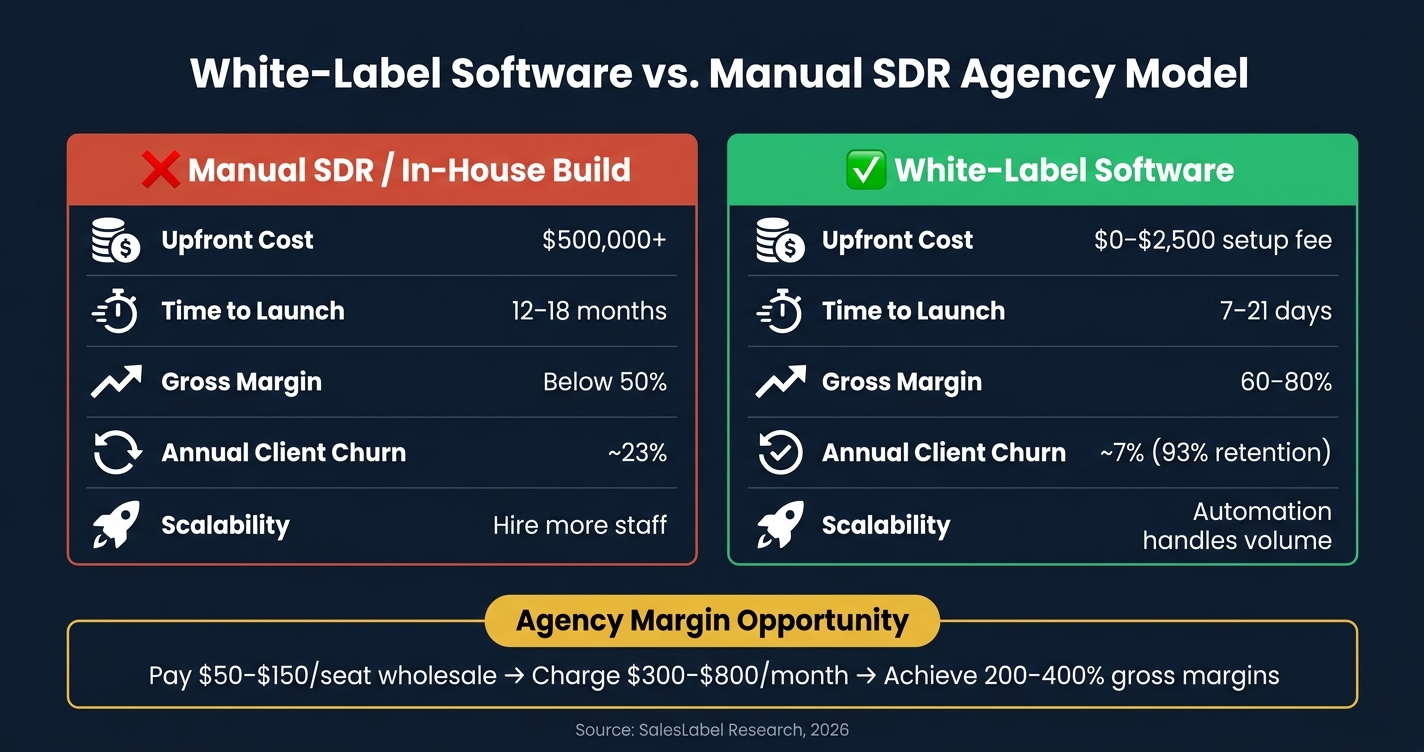
White-Label Software vs. Manual SDR: Agency Cost & Performance Comparison
White-label software doesn’t just streamline operations - it also brings compelling financial advantages.
Software Costs vs. SDR Team Costs
Building an outbound infrastructure from the ground up can cost over $500,000 and require 12–18 months of engineering work [6]. A white-label solution, on the other hand, can get your agency up and running in as little as 7 days, with subscription costs starting at just $799 per month [10].
Traditional SDR-driven agencies often struggle with gross margins below 50% due to rising labor costs as they scale. White-label software flips this model:
Metric
Manual SDR / In-House Build
White-Label Software
Upfront Cost
$500,000+
$0–$2,500 setup fee
Time to Launch
12–18 months
7–21 days
Gross Margin
Often below 50%
60–80%
Annual Client Churn
~23%
~7%
Scalability
Hire more staff
Automation handles volume
Manual agencies often face a 23% annual churn rate[3]. When results are inconsistent, clients leave. But with white-label software delivering predictable outcomes, client retention can climb to 93%[3]. These efficiencies lead directly to improved margins, as shown below.
Improving Margins and Revenue Per Client
Agencies leveraging white-label software pay $50–$150 per client seat at wholesale rates but charge clients $300–$800 per month, creating gross margins of 200–400% [6][13].
"Agencies reselling white label outreach software typically charge $300–800/month per client seat while paying $50–150 wholesale. That is 40–80% margins on a recurring basis, with no additional delivery cost once the setup is done." - SalesMind AI [13]
A common pricing approach is to aim for a 3x to 5x markup on platform costs. For instance, if a client seat costs $500 per month, pricing it at $1,200–$1,500 ensures coverage for strategy, optimization, and profit [4]. Agencies managing more than 10 clients often adopt a hybrid model, combining a base retainer with performance bonuses. This approach can boost margins to 60–120% and improve client retention by up to 40%, compared to using a pure retainer model [12].
How to Run Agency Operations with White-Label Software
Building a Repeatable Lead Generation Workflow
Having a standardized lead generation process is key to scaling quickly. Agencies that approach lead generation as a productized service - complete with clear steps, templates, and timelines - can launch campaigns up to three times faster and generate 47% more leads in their first month compared to starting from scratch [9].
Here’s a typical five-phase launch process, spanning 21–35 days:
Week
Phase
Key Activities
Week 1
Setup & ICP Alignment
Configuring domains, branding, CRM integration, and defining the target list [9][6]
Week 2
Sender Warm-up
Setting up and warming 5–10 LinkedIn and email sender accounts simultaneously [6]
Week 3
Sequence Calibration
Uploading the initial 200–500 prospects and A/B testing message copy [6]
Week 4
Launch & Training
Training the team and launching the first client campaign [9][6]
Week 5+
Optimization Loop
Weekly reviews, fine-tuning reply rates, and scaling campaigns [9][6]
One common mistake agencies make is underestimating the importance of the sender warm-up phase. Skipping this step often leads to long-term issues, as burned sender reputations can take over 90 days to recover [6]. Another critical step is agreeing on what constitutes a "qualified lead" with each client - document this definition before launching any campaign. Misaligned expectations at the outset are a frequent cause of disputes over results.
Once this repeatable workflow is in place, even lean teams can handle larger client portfolios with ease.
Structuring a Lean Team for Multiple Accounts
White-label automation can drastically simplify operations, allowing a single person to manage multiple accounts. When the platform handles tasks like sourcing, outreach, follow-ups, and even drafting replies, the workload becomes much more manageable.
"At scale, hire an onboarding specialist, create SOPs for campaign setup (reduce setup from 4 hours to 45 minutes), and build automated campaign health checks." - SalesLabel [4]
Once your agency is managing 10+ active clients, the most impactful hire isn’t another salesperson - it’s an onboarding specialist. This role focuses on configuring campaigns and ensuring client success. Pair this hire with detailed SOPs, and you can cut the campaign setup time from about 4 hours to just 45 minutes per client[4]. This operational efficiency allows small teams to handle a much larger client base without sacrificing quality.
As your client list grows, it’s crucial to maintain high standards of quality and compliance. Efficient workflows and lean teams only work if you have strict guardrails in place.
Scaling up doesn’t mean you have to compromise on quality. However, it does require sticking to a few key practices:
Keep daily LinkedIn activity 30–40% below platform thresholds. For warmed sender accounts, this means staying within 50–80 connection requests and 80–120 messages per day[6].
Avoid running multiple clients through the same sender pool - this can quickly lead to account restrictions.
Use residential proxies instead of datacenter IPs to maintain account integrity on LinkedIn [3].
Rely on cloud-based infrastructure, which is more stable than browser extensions for automation at scale.
Randomize inter-message delays to 30–90 seconds to minimize platform flags [3][6].
"SalesLabel has transformed our lead generation process. The platform's intuitive interface and smart automation features have significantly boosted our sales efficiency." - Svit Babarovic, Chief Operating Officer, Mountaindrop [3]
sbb-itb-a781ab9
Platform Capabilities That Support Agency Growth
Efficient workflows and streamlined operations lay the foundation for agency growth, but advanced platform features take scalability to the next level.
AI and Automation Tools
Automation is a game-changer for agencies looking to grow beyond 10–15 clients and scale to 30 or more. Consider this: without automated lead scoring, sales teams spend nearly 40% of their time chasing unqualified leads, and agencies risk losing up to 30% of warm leads due to delayed follow-ups [2].
Modern platforms tackle these inefficiencies with layered automation. AI tools identify leads that match a client’s Ideal Customer Profile (ICP), fill in missing contact details, and create outreach messages tailored to each prospect’s LinkedIn profile, headline, and recent activities. These personalized messages - crafted with AI - are far more effective, generating three times more replies compared to generic templates [2].
Inbox automation also saves time by flagging important responses. Platforms like SalesLabel offer two modes: Autopilot (fully automated conversations) and Copilot (AI drafts responses for human review). These tools categorize leads as Interested, Meeting, or Cold, ensuring sales teams focus on high-priority prospects. This dual approach balances efficiency with accuracy, reclaiming hours every week for more strategic tasks [8].
Integrations and Data Flow
Automation works best when data flows smoothly between systems. For instance, integrating your CRM ensures leads are automatically added, eliminating tedious manual data entry.
Start by connecting your CRM - platforms like HubSpot or Pipedrive can be linked during setup to create a seamless lead-to-deal pipeline from day one [9]. As SalesLabel puts it: "Interested leads are pushed to your calendar and CRM automatically."[5] Beyond CRM tools, integrating billing systems like Stripe simplifies retainer management as your client base grows. Similarly, project management tools like Notion or ClickUp help keep campaign setups consistent by housing your standard operating procedures (SOPs) [4].
"The marginal cost of adding a new client is low once your systems are in place." - SalesLabel [7]
This interconnected data flow not only saves time but also enables smarter reporting that drives ongoing improvements.
Reporting and Analytics
Real-time, branded dashboards are a powerful way to build trust with clients. By showcasing metrics like open rates, reply rates, and meeting-booked rates, these dashboards reduce administrative workload while ensuring transparency. Agencies relying on manual outreach often lose about 23% of their client base annually due to inconsistent results [3]. Transparent reporting flips that script, fostering client confidence and retention.
These analytics tools also support continuous improvement by providing clear, actionable insights. Platforms like SalesLabel consolidate these features, enabling agencies to refine their strategies using per-client data. For example, regular analysis can pinpoint which messaging sequences and industries perform best. In May 2026, SalesLabel’s research across 100 agencies revealed that well-executed white-label outbound operations generated an average monthly pipeline of $180,000, with net service margins ranging from 25–40% [6].
How to Implement White-Label Software in Your Agency
Checking If Your Agency Is Ready
Before diving into white-label software, it’s important to assess if your agency is prepared for the transition. This step is crucial to streamlining operations and setting the stage for growth. Some clear signs your agency might be ready include spending too much time on manual list-building tasks[5], clients leaving due to inconsistent results[3], or having clients request lead generation services that you currently can’t deliver efficiently.
Your agency's operational maturity is just as important as client demand. As noted by SalesLabel Research:
"Software resale outperforms service resale 5–10× on margin, but requires 3× the operational maturity." [6]
Ask yourself: Can your agency add value through detailed reporting, refining your ICP (Ideal Customer Profile), or integrating CRM tools? Also, consider whether you have enough working capital to bridge the gap between paying software providers (often upfront or on Net-15 terms) and collecting payments from clients (typically Net-30 or Net-45). If cash flow is tight, you might want to consider a hybrid model that combines retainers with SaaS offerings to reduce financial risks[6][14].
Once you’ve determined your readiness, the next step is creating a clear implementation plan to ensure a smooth transition.
Building an Implementation Roadmap
Launching white-label software typically takes 21–35 days from signing the contract to booking your first meeting[6]. Rushing this process, especially skipping the sender warm-up phase, can hurt performance and lead to poor results in the following months.
Agencies that stick to a structured onboarding process often launch three times faster and retain 2.4 times more clients in their first year compared to agencies that try to figure it out on their own[9]. Additionally, using pre-built templates designed for specific industries can increase lead generation by 47% in the first month versus starting from scratch[9].
With a solid roadmap, you’ll be better equipped to scale campaigns and achieve sustainable growth.
Scaling in Phases for Long-Term Growth
Start small with a single pilot client, offering a slight discount to test your workflow. Once the pilot campaign proves successful, replicate the setup for additional clients. Standardizing processes early on saves time as you bring on more clients, allowing you to scale without needing to expand your team[4].
As your client base grows, the upfront effort pays off. Agencies running white-label outbound campaigns at scale are expected to generate an average pipeline of $180,000 per month by 2026, with software resale margins reaching between 200% and 400% gross[6]. The key is to take it step by step, ensuring each phase builds a strong foundation for the next.
SalesLabel builds upon its platform capabilities and operational frameworks to help agencies grow without expanding their team size. Its integrated features are designed to maximize efficiency, allowing agencies to scale effectively.
Core Features of SalesLabel
SalesLabel empowers small agencies to manage outbound campaigns across multiple clients without the hassle of manual work. The platform automates the entire lead generation process, including prospect sourcing, contact enrichment, personalized outreach, follow-ups, and response management - all from one centralized dashboard.
Each client benefits from dedicated and branded assets, which agencies can manage in a single location. This setup enables agencies to replicate successful campaign templates quickly and efficiently. The platform's white-label functionality - custom domain, logo, and color scheme - ensures the agency's branding remains front and center, helping justify premium retainers while keeping the technology behind the scenes.
SalesLabel also leverages AI to craft personalized messages based on prospect data, moving beyond generic templates. Agencies that use AI-personalized openers and multi-channel sequences report a 42% reply rate[6], significantly outperforming the 8–12% reply rate typically seen with single-channel outreach.
What Scaling Looks Like with SalesLabel
SalesLabel's centralized automation and white-label features translate into tangible results for agencies. With the platform, a single campaign strategist and operations specialist can manage 8–15 outbound clients simultaneously. Each client can run one to three campaigns targeting different audience segments[2]. By automating tasks like list building, email drafting, follow-up sequencing, and inbox management, the platform frees up valuable time for the team to focus on strategy, client relationships, and campaign optimization.
Agencies using SalesLabel report an average 30-day trailing pipeline of $180,000 per month and a 93% client retention rate[3]. Standardized workflows also significantly reduce campaign setup time - from about 4 hours to just 45 minutes - supporting a lean and efficient team model[4].
SalesLabel Pricing and Plans
SalesLabel offers tiered pricing designed to accommodate agencies at various stages of growth. This ensures the platform remains cost-effective as agencies scale their operations.
Plan
Price
LinkedIn Accounts
Best For
Starter
$799/mo
Up to 30
Solo consultants or small teams
Growth
$1,279/mo
Up to 99
Boutique agencies managing 5–15 clients
Scale
$1,999/mo
Unlimited
Larger agencies with multi-niche clients
The Starter plan includes AI prospecting, white-label branding, AI-driven replies, and setup assistance, making it ideal for agencies piloting outbound campaigns. The Growth plan adds features like a branded Chrome extension, priority support, and a monthly strategy call - perfect for agencies managing multiple client retainers. For larger teams, the Scale plan provides a dedicated success manager, bi-weekly strategy calls, and an extensive documentation center to support agencies running dozens of accounts.
From a financial perspective, agencies on the Growth plan ($1,279/month) managing eight clients at $3,000/month retainers can generate approximately $24,000 in monthly revenue. The platform's cost represents a small portion of total income, and agencies often experience 200–400% gross margins on resold software, achieving positive ROI with just one or two additional clients[6].
Conclusion and Next Steps
White-label software eliminates the common misconception that growing your client base requires increasing your team size. By leveraging AI-powered white-label platforms, agencies can achieve better client retention and deliver consistent, scalable outcomes. These results create a foundation for immediate, growth-focused action.
To capitalize on these efficiency gains, the next steps are clear. Begin with a 30-day pilot program at 50% off for your initial clients. This approach helps you build valuable case studies to attract higher-value retainers. Make sure to complete the 21–35 day sender warm-up process before starting any outreach campaigns. Additionally, standardize your workflows and adopt a hybrid pricing model (combining retainers with per-seat SaaS fees) to maintain healthy margins while ensuring reliable service delivery.
"The best tool out there to curate your audience on autopilot while focusing on higher leverage tasks." - Flo Decludt, Product Marketing, Clutch [3]
Structured onboarding processes and pre-built campaign templates provide a significant advantage, speeding up launches and boosting early lead generation performance.
With this roadmap in place, it’s time to transition from manual operations to a scalable white-label system. Ready to test the waters? Try SalesLabel's Starter plan at $799/month and see how it works with real clients.
FAQs
How do I know if my agency is ready for white-label lead gen software?
Your agency might be ready for white-label lead generation software if you're looking to grow your outreach efforts without adding more staff or building intricate systems. If you're still managing leads, reporting, or billing manually - using tools like spreadsheets - it’s a clear sign it’s time to upgrade. Platforms like SalesLabel can streamline everything from prospecting and enrichment to booking meetings, all while operating under your branding. This makes it much easier to handle anywhere from 10 to over 100 clients efficiently.
What’s the safest way to automate LinkedIn and email outreach without getting accounts flagged?
Automating LinkedIn and email outreach requires careful planning to keep your account safe and maintain its reputation. The key is to mimic natural, human-like behavior. Start by using residential proxies and cloud-based systems instead of browser extensions, which are more prone to detection. Gradually warm up accounts over 21–35 days to build credibility.
When it comes to activity, stay well within LinkedIn’s daily limits - aim for 30–40% below the maximum. Randomizing your interaction timings is another essential step to avoid triggering any red flags.
Tools like SalesLabel simplify this process by automating these safety measures. It integrates multi-channel sequencing with AI-driven personalization, ensuring your outreach remains effective while protecting deliverability and avoiding account issues.
How should I price a white-label lead gen offer to keep margins high?
To keep healthy margins when reselling white-label lead generation, aim for a markup of 3x to 5x on platform costs. This ensures you can cover essential aspects like consulting, campaign optimization, client management, and branding efforts.
You can explore different pricing models to suit your business and client needs:
Monthly retainers: Provide consistent revenue and predictability.
Per-lead pricing: Ideal for clients focused on performance and measurable outcomes.
Hybrid models: Combine elements of both for a balance of steady income and long-term value.
Be cautious about underpricing your services. Charging too little eats into your margins and may attract clients who are less likely to value your work.