When deciding how to source leads using AI, agencies have two main options: custom AI systems or pre-built tools. Here's what you need to know:
Custom AI: Tailored to your workflows and data, offering precise alignment and full data ownership. It’s ideal for complex industries or large-scale operations but comes with high costs ($600,000–$950,000 in Year 1) and long development times (6–18 months).
Pre-Built Tools: Ready-to-use SaaS platforms like SalesLabel are faster to deploy (days to weeks) and far cheaper (starting at $799/month). They handle the full lead sourcing process but lack the flexibility and exclusivity of custom systems.
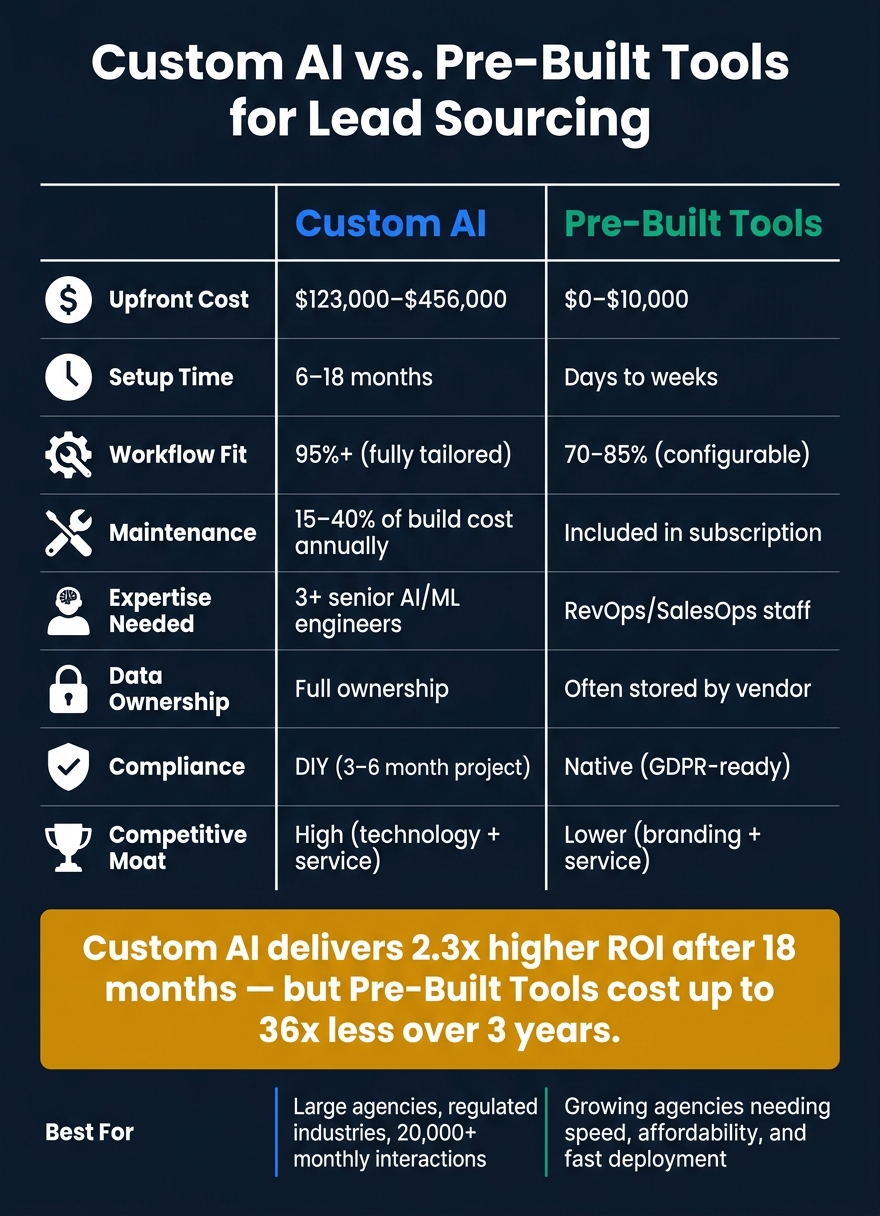
Quick Comparison
Factor
Custom AI
Pre-Built Tools
Upfront Cost
$123,000–$456,000
$0–$10,000
Setup Time
6–18 months
Days to weeks
Workflow Fit
95%+ (fully tailored)
70–85% (configurable)
Maintenance
15–40% of build cost annually
Included in subscription
Data Ownership
Full ownership
Vendor-controlled
Scalability
High (with investment)
Limited by the platform
Key takeaway: Pre-built tools are best for agencies needing speed and affordability. Custom AI is worth considering if you require deep customization and have the budget to invest. Platforms like SalesLabel offer a middle ground for those starting out.
Custom AI vs. Pre-Built Tools for Lead Sourcing: Full Comparison
Custom AI for Lead Sourcing
What is Custom AI?
Custom AI for lead sourcing is all about creating a tailored system that aligns perfectly with your agency's workflows, data, and specific needs. These systems are built using frameworks like LangGraph, CrewAI, or AutoGen. By tapping into historical data - such as past closed-won and closed-lost deals - they fine-tune lead sourcing to match your client base's unique demands [5][6].
Advantages of Custom AI
Custom AI offers unmatched precision, achieving over 95% workflow alignment compared to the 70–85% range seen with generic tools [5]. This level of accuracy is crucial when your lead sourcing involves complex logic, like managing data across multiple systems that don’t naturally integrate. It's also a game-changer for regulated industries like healthcare or finance, where standard tools often fall short in interpreting specialized data.
Another big plus? Full data ownership. Your proprietary data - whether it’s historical outcomes, client signals, or internal pricing strategies - stays entirely under your control. There’s no third-party vendor accessing or handling it, which is essential for agencies with strict compliance needs. Plus, owning the intellectual property (IP) means your competitors can’t license or replicate the same system.
"The real question is not 'custom or not' but 'where is my moat, and does an AI agent deepen it?' If the answer is yes, custom. If no, off-the-shelf." - Bananalabs [5]
Custom AI systems also deliver impressive returns. After 18 months, they achieve a 2.3x higher ROI compared to off-the-shelf solutions, and scaling custom agents can cut per-interaction costs by 40%[5]. However, these benefits come with a hefty price tag and significant development time.
Drawbacks of Custom AI
The cost of building a custom AI system is steep - ranging from $100,000 to $500,000 upfront, with total Year 1 expenses between $600,000 and $950,000, including engineering and infrastructure costs [4][7]. It takes anywhere from 6 to 18 months to develop a production-ready system [7].
Once operational, ongoing maintenance demands 1–2 dedicated engineers to monitor performance and retrain models as needed. For instance, if model scores shift by more than 10% month-over-month, immediate retraining is required [6]. Agencies often encounter a "month-nine" hurdle, where the initial system design needs a major overhaul to address issues like state management and scalability [4].
"The engineering cost of a production AI SDR system is consistently underestimated... Three months gets you a demo. Twelve gets you production." - Knowlee Team [4]
When Custom AI Makes Sense
Custom AI is ideal for industries like regulated healthcare, insurance, or legal services, where off-the-shelf tools struggle to meet specific requirements. It’s also a smart choice for agencies that have already validated their Ideal Customer Profile (ICP) and signal logic using pre-built tools and are now ready to scale with proprietary data.
The investment in custom AI pays off most when scale and specialization justify the cost. It becomes economically viable when monthly interactions exceed 20,000 to 50,000[5]. On the flip side, if your agency handles fewer interactions or lacks at least 1,000 historical lead records to train a reliable model, it’s likely too early to consider building a custom system [6].
sbb-itb-a781ab9
Pre-Built Tools for Lead Sourcing
What Are Pre-Built Lead Sourcing Tools?
Pre-built lead sourcing tools are SaaS platforms designed to handle lead generation tasks - such as sourcing leads, enriching contact information, automating outreach, managing follow-ups, and scheduling meetings - without requiring an in-house engineering team. Many of these platforms also offer white-label options, allowing agencies to rebrand the system with their own logo, domain, and pricing. This lets agencies market the platform as their own product, enabling them to scale operations more quickly [3][9].
Advantages of Pre-Built Tools
Speed is one of the biggest benefits of pre-built platforms. While custom AI solutions can take 12–18 months to develop, pre-built tools can be up and running in as little as 7–21 days [3][2]. The cost difference is also striking - custom solutions often exceed $500,000, while pre-built platforms typically start at just a few hundred dollars per month and often require no setup fees. Agencies reselling white-label software can enjoy strong profit margins on both the software and associated services [2].
These tools also streamline operations by automating time-consuming tasks. Manual prospecting limits agencies to managing around 10–15 clients, but AI-powered automation removes that cap. A single platform seat can handle tasks like lead research, multilingual outreach, intent detection, and calendar scheduling - work that would usually require a full SDR team costing $5,000–$8,000 per month[1]. Abdullah from UniReach shared his experience:
"Before, we reached 50–100 clients. Now it's 5–6x that. The AI understands what the client is saying and replies the proper way." [9]
Limitations of Pre-Built Tools
While pre-built tools offer convenience, they come with some trade-offs. Flexibility is often limited, as you're confined to the features provided by the vendor. If your workflow requires specific functionalities the platform doesn’t support, you’ll either need to adjust your processes or wait for updates. Customization options, such as retraining models with proprietary data or creating unique integrations, are generally restricted to what the platform's API allows.
Vendor dependency is another factor to consider. Any changes to pricing, feature availability, or platform stability can directly impact your operations. Additionally, since you don’t own the platform's underlying intellectual property, your competitive advantage lies in how effectively you use the tool rather than in the tool itself. Despite these challenges, pre-built solutions can still deliver impressive results, as shown in the case of SalesLabel.
SalesLabel is a standout example of a pre-built platform tailored for agencies. It offers comprehensive outbound automation, covering everything from lead sourcing and personalized messaging to follow-ups, real-time lead scoring, inbox management, and meeting scheduling - all under your branding [3][1]. This addresses key concerns like speed, cost, and functionality, which are often central to the choice between custom and pre-built solutions.
One of its standout features is the dual operating mode. Agencies can run campaigns on autopilot for straightforward outreach or use a copilot mode where the AI drafts replies for human review before sending. This flexibility is especially helpful when onboarding new clients and fine-tuning their tone and messaging [3][1].
The platform’s impact is clear. In May 2026, Henry F., an Enterprise Account Executive at Salesforce, shared that he was generating 4–5 responses per day within just 8 days of using SalesLabel - automating tasks that previously required days or weeks of manual effort [3]. Similarly, Svit Babarovic, COO of Mountaindrop, achieved a 90% reply rate using the platform's smart automation features [3][9].
SalesLabel’s pricing is structured to scale with the number of LinkedIn accounts managed:
Starter plan: $799/month for up to 30 LinkedIn accounts, including full AI prospecting and white-label capabilities.
Growth plan: $1,279/month for up to 99 accounts, adding a branded Chrome extension and monthly strategy calls.
Scale plan: $1,999/month for unlimited accounts, with a dedicated success manager and bi-weekly strategy sessions [3].
Custom AI vs. Pre-Built Tools: Side-by-Side
Factors Being Compared
Deciding between custom AI and pre-built tools boils down to practical considerations like flexibility, cost, performance, scalability, and time to market. Each option has its strengths and weaknesses, depending on your agency's size, technical expertise, and growth objectives. Understanding where each approach shines - and where it might fall short - can make the decision clearer. Here's a comparison to highlight the key differences.
Comparison Table
Custom AI provides a tailored solution with long-term benefits but comes with a hefty upfront investment. On the other hand, pre-built tools prioritize affordability and speed, though they may lack the flexibility of a fully customized option.
One standout statistic: custom AI can deliver 2.3× higher ROI compared to pre-built tools after 18 months [5]. However, this advantage hinges on the agency's ability to manage the significant upfront costs and ongoing maintenance.
"White-label AI is a fast path to revenue. Custom AI is a longer path to a defensible position." - RaftLabs [7]
These factors are essential when evaluating how SalesLabel fits into the pre-built tools category.
Where SalesLabel Fits
SalesLabel positions itself as a pre-built solution that balances affordability with functionality. While most pre-built tools offer a workflow fit of around 70–85% [5], potentially requiring manual adjustments, SalesLabel narrows this gap by including configurable AI modes. Features like an autopilot for high-volume campaigns, a copilot for hands-on reviews, real-time lead scoring, and white-label branding allow agencies to rebrand the platform to suit their needs.
For agencies that don’t require proprietary models or custom algorithms, SalesLabel provides a practical alternative to expensive custom builds. The cost difference is striking: while custom AI might demand an initial investment of $123,000–$456,000 [12], SalesLabel plans start at $799 per month. This includes maintenance, model updates, and compliance, all managed by the vendor, making it a cost-effective choice for many agencies.
How to Choose the Right Approach for Your Agency
Key Decision Factors
The right approach for your agency depends heavily on your budget and technical expertise. If your budget is below $50,000 and you need to launch within 12 months, a custom AI solution is simply not practical. Technical expertise is another critical factor. A custom solution requires a dedicated team of 2–3 AI/ML engineers working full-time for over a year. General developers without specialized AI experience won’t be enough to pull this off[4].
Then there’s the 80% rule: if a pre-built tool can handle 80% or more of your workflow needs, it’s usually more cost-effective to configure the remaining 20% than to build a tool from scratch[14]. Custom AI makes sense only when the gap between what’s available and what you need is large enough to justify a complete overhaul.
"If closing the gap requires changing how your team works to fit the SaaS rather than how the SaaS works to fit you, that's your signal to evaluate custom." - Anil Gulecha, Kalvium Labs[14]
Agency Profiles and Recommendations
Agencies generally fall into two categories when deciding between pre-built and custom solutions:
Agencies with limited resources: These agencies lack dedicated engineering teams. For them, custom builds are often too expensive. Over a 36-month period, the total cost of ownership (TCO) for a custom system ranges from $200,000 to $650,000, compared to $18,000 to $180,000 for a pre-built solution[13]. The economics simply favor pre-built tools for these organizations.
Agencies with proprietary data and complex workflows: If your agency uses four or more internal systems - such as a CRM, Snowflake, and internal databases - and has a stable engineering team, a custom build might be worth considering. However, even with these resources, custom solutions often require mid-cycle overhauls as unforeseen issues arise during production[4].
"The TCO conversation changes the moment you show a CTO the year‑2 and year‑3 maintenance numbers for custom agents. The build cost feels manageable. It is the compounding maintenance that catches teams off guard." - Hardik Shah, Founder, ScaleGrowth.Digital[13]
Starting with SalesLabel
For agencies unsure about committing to a custom build, starting with a 60-day pilot using a pre-built platform is a smart, low-risk option[4]. Tools like SalesLabel are designed for quick deployment - often within days - and cost significantly less than building custom infrastructure. This pilot phase allows agencies to gather valuable data on what works: the signals that drive responses, the types of prospects that engage, and the sequences that lead to replies.
SalesLabel provides an affordable way to test the waters. At $799 per month for the Starter plan, agencies can validate their lead generation strategies, generate revenue, and build a data foundation before taking on the high costs of custom development. Agencies using platforms like SalesLabel report an average monthly pipeline of $180,000 and top-quartile reply rates of 42%[2].
Should You Build or Buy Your AI SDR Agent? Key Factors to Consider
FAQs
How do I know if I have enough data to justify custom AI?
Building custom AI hinges on a few key factors: the amount of data you have, your technical resources, and whether the workflow gives you a competitive edge. For example, if you're tackling lead scoring, you'll need a minimum of 1,000 high-quality historical leads, with at least 10% of those converting into closed-won deals.
If you're running an agency and looking to scale without the expense and hassle of developing custom AI, SalesLabel provides a white-label AI platform tailored for lead generation. This option eliminates the need for costly development and ongoing maintenance.
When does custom AI become cheaper than a pre-built tool?
Custom AI solutions often come with hefty initial costs, ranging from $100,000 to $500,000 due to development expenses. While this investment might seem steep, the long-term savings can be substantial as increased usage reduces the cost per interaction. For agencies looking to sidestep these upfront expenses, platforms like SalesLabel provide a ready-made, AI-driven lead generation tool. This solution handles tasks like sourcing, enrichment, and outreach seamlessly, offering efficiency without the financial burden of building custom AI from scratch.
What lead-sourcing tasks can SalesLabel automate end-to-end?
SalesLabel streamlines the entire lead-sourcing process, all while operating under an agency's branding. Its AI takes care of everything - from lead research and data enrichment to crafting personalized outreach, handling follow-ups, and even booking meetings. The platform also features real-time lead scoring and manages inbox replies to gauge interest effectively. Agencies can opt for copilot mode, where they approve messages before sending, or autopilot mode, which delivers a fully automated experience.