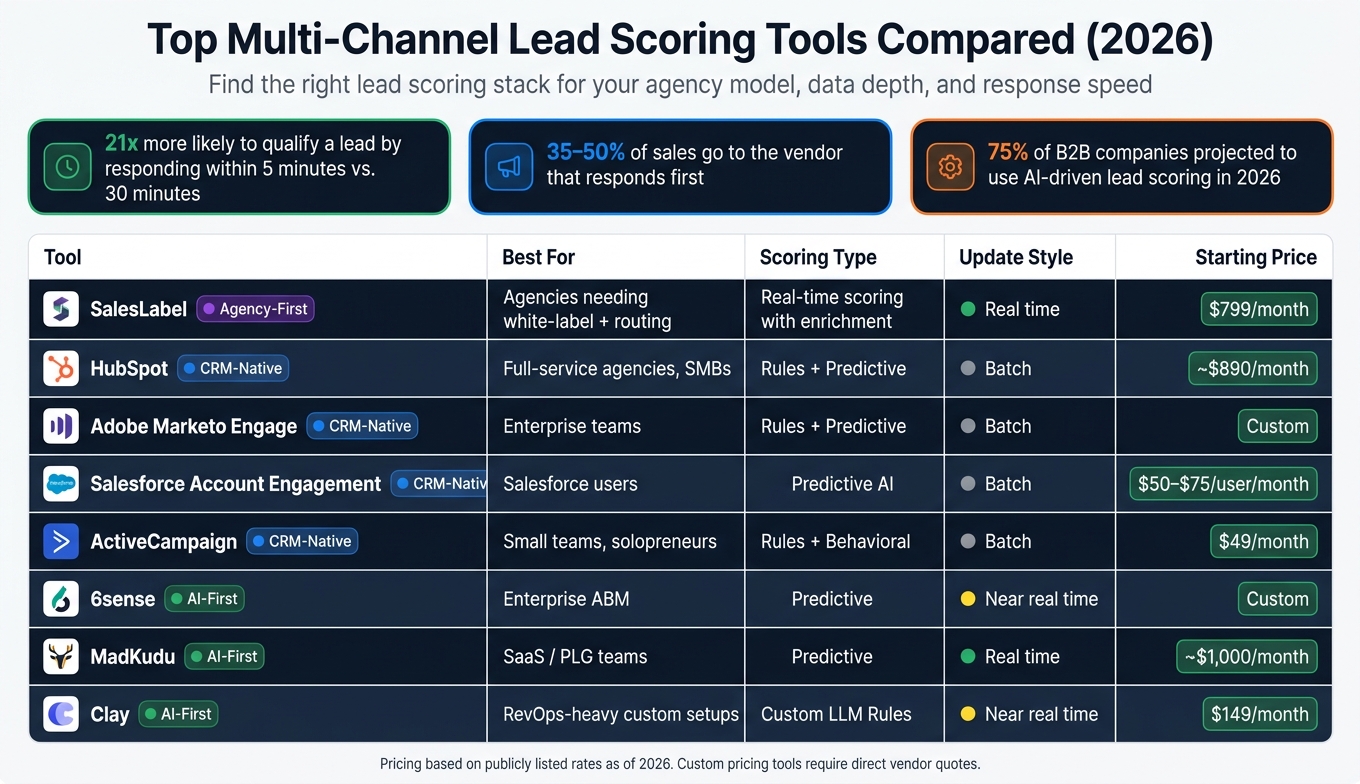
If I had to sum it up in one line: the best lead scoring tools in 2026 help me rank leads across email, web, CRM, chat, and intent data and push hot leads to sales right away.
Buyers do a lot of research before they ever talk to sales. The article makes one point clear: if I score leads from only one channel, I miss intent. And if I wait too long to respond, I lose deals. The strongest options fall into three groups:
Agency-first tools for white-label workflows and client account management
Speed matters: replying within 5 minutes can make qualification 21x more likely than waiting 30 minutes
Not every team needs AI first: if I do not have enough clean history, rules-based scoring is often the better starting point
Explainable scores matter: if sales cannot see why a lead scored high, they may ignore the score
Fit + intent beats surface engagement: pricing-page visits, replies, and demo requests should count more than opens and clicks
In short, this article is a guide to picking the right lead scoring setup based on agency model, client volume, data depth, and response speed.
How We Evaluated the Top Lead Scoring Tools
To compare the tools fairly, we used the same yardstick for every platform. That matters because not every lead scoring tool works well for agency use. A platform can do fine for one in-house sales team and still fall apart when you're juggling multiple clients, different ICPs, and uneven lead volume.
Core Evaluation Criteria
We scored each tool based on channel coverage, scoring model, real-time updates, automation depth, and explainability. We put extra weight on tools that pull signals together across the full buyer journey, including email, web, social, and messaging.
We also looked at scoring model types: rules-based, predictive AI/ML, and hybrid. Rules-based models are fast to set up. Predictive models can get better over time, but they need enough clean historical data to work well [3][11].
Real-time score updates were non-negotiable [6][2]. We also reviewed workflow automation depth. In plain English: can the tool send a hot lead to the right rep, trigger a Slack alert, or kick off a nurture sequence the second a score crosses a set threshold?
We also gave a lot of weight to explainability. If a score jumps, teams should be able to see why. So we leaned toward tools that show which actions pushed the score up or down.
After that, we adjusted the weighting based on how agencies use these tools across many client accounts.
Agency-Specific Considerations
Beyond the core criteria, we looked at the stuff agencies deal with every day. Multi-client management was a big one, especially whether the platform supports separate workspaces, permissions, and pipelines for each client.
White-label support and API flexibility mattered too. If an agency wants to offer lead scoring as part of a branded service, the tool needs enough API depth and workflow control to build custom setups or client-facing experiences on top of it [10].
We also checked scale across a broad range, from 5,000 to 500,000+ leads, to spot where performance starts to dip or pricing stops making sense [3][7]. And since agencies need clean numbers for client proposals, we compared public monthly pricing tiers based on listed pricing pages [8][3].
Next: SalesLabel, the white-label option built for agency workflows and real-time scoring.
SalesLabel for White-Label, Real-Time Lead Scoring
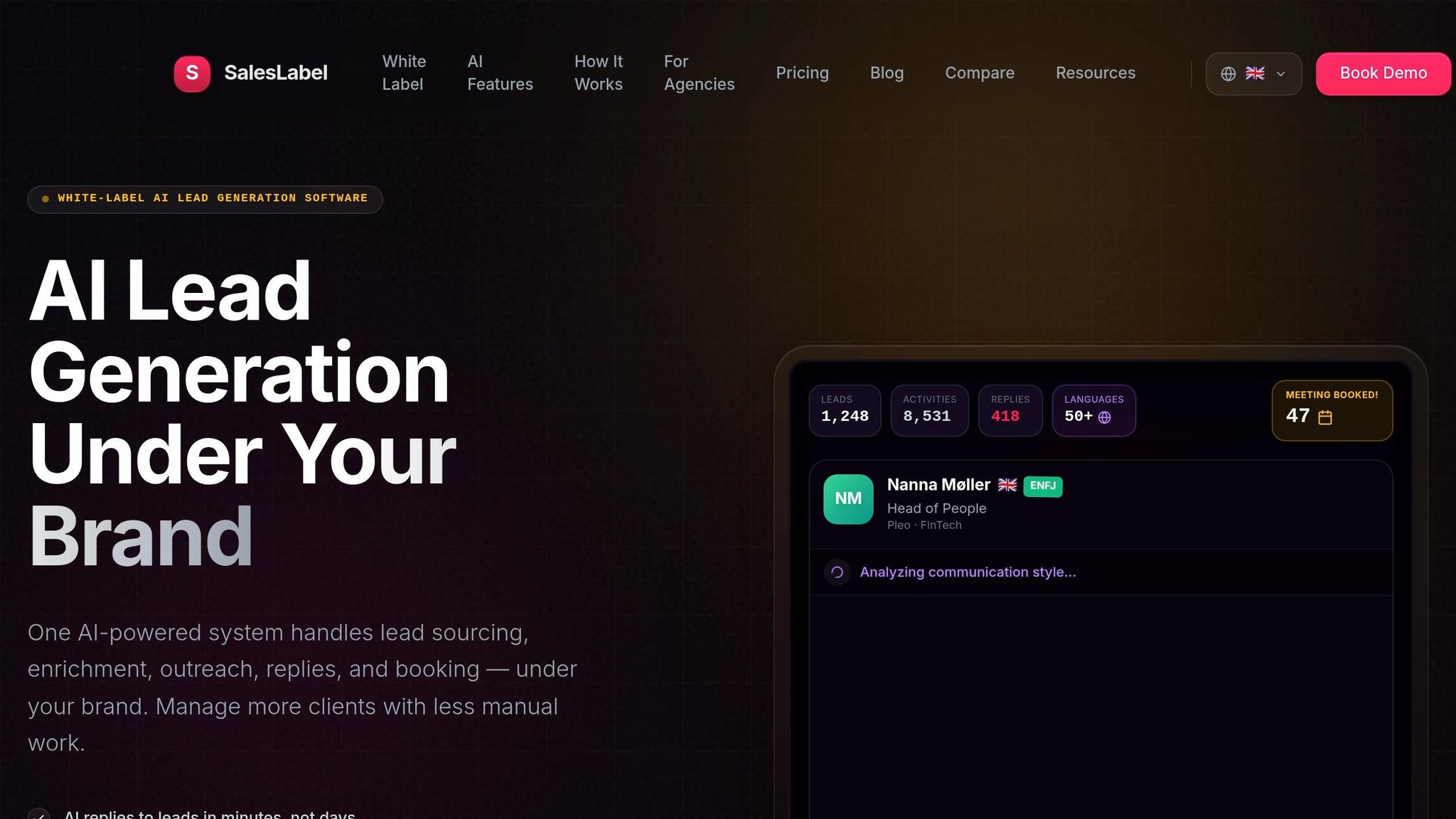
SalesLabel is built for agencies that want to offer glossary">lead generation and scoring under their own brand. It combines white-label branding with real-time scoring, enrichment, and automated follow-up. That mix helps when lead scoring needs to kick off action fast across client campaigns.
The main pitch is straightforward: score leads in real time, then send them to the next step without forcing the agency team to leave its workflow.
Key Lead Scoring Features
SalesLabel’s real-time lead scoring helps agencies spot sales-ready leads across email, website behavior, and social activity. That matters for a simple reason: 35–50% of sales go to the vendor that responds first [12].
The platform combines enrichment with firmographic and behavioral signals to speed up qualification. AI replies, automated follow-ups, and booking activity help keep hot leads moving toward conversion.
It also lines up with the criteria above by mixing real-time updates, automation, and client-level visibility. Shared inbox management across clients gives agency teams one central place to review and route high-intent leads.
For agencies, SalesLabel works as more than a scoring tool. It also acts as a workflow hub.
Best Fit and Pricing
SalesLabel fits agencies that want white-label lead generation, scoring, and outreach in one workflow.
Plan
Price/Month
Best For
Starter
$799
Boutique agencies testing AI-driven lead gen
Growth
$1,279
Mid-sized agencies scaling outreach automation
Scale
$1,999
Large agencies with high lead volumes
Growth adds a branded Chrome extension, priority support, and monthly strategy calls. Scale adds unlimited LinkedIn accounts, a documentation center, bi-weekly calls, and a dedicated success manager.
Top Tools for Multi-Channel Lead Scoring in 2026
Using those criteria, these tools land in two main groups: CRM-native platforms and AI-first scoring layers.
Marketing Automation and CRM Platforms
HubSpot makes sense for full-service agencies and mid-market teams. Breeze AI helps keep setup simple, and predictive scoring starts with Marketing Hub Enterprise at $3,600/month[3].
Adobe Marketo Engage is better suited to larger teams running global campaigns. Lenovo used it to standardize lead scoring across North America, EMEA, and Asia-Pacific. That shift replaced fragmented manual processes with an automated global framework and sped up responses to high-intent leads [1]. It’s powerful, but it also brings enterprise-level complexity and pricing.
Salesforce Account Engagement is a natural choice when a client already runs on Salesforce. Einstein Lead Scoring looks at 100+ signals per lead and explains each score in plain language. The catch is that updates run in batch cycles, which can slow speed-to-lead. Pricing usually falls between $50 and $75 per user/month as an add-on to Sales Cloud [3].
ActiveCampaign is a solid pick for solopreneurs and smaller agencies. Lead scoring is included in the Plus plan at $49/month, covering email and web behavior with rules-based and behavioral scoring [3]. If your campaigns are pretty straightforward, it gives you a lot for the money.
AI-First and Predictive Scoring Tools
These tools push past CRM-native scoring. They pull in third-party intent signals, product usage data, and public behavior cues, often before a lead ever fills out a form.
6sense is built for enterprise ABM. Instead of scoring one contact at a time, it scores entire buying committees. It pulls in intent data from sources like Bombora and G2, along with anonymous website behavior. Setup usually takes 8–16 weeks, and pricing starts at about $25,000 to $100,000+ per year[14].
MadKudu is aimed at SaaS-focused agencies running product-led growth motions. One thing teams like is how open the model is: it shows which signals drove the score, such as pricing page visits, trial activity, and CRM history. That makes predictive scoring easier to trust [14].
Clay works more like a DIY enrichment and scoring layer. It pulls from 150+ data sources and lets RevOps teams build custom scoring logic powered by LLMs. Pricing starts at $149/month. It’s a strong fit for teams that want maximum control, though it also asks for the most setup work [14].
Feature and Fit Comparison Table
Use the comparison below to narrow your shortlist by setup speed, data depth, and agency fit.
Tool
Channel Coverage
Scoring Type
Real-Time Updates
Setup Complexity
Typical Agency Fit
Starting Price (USD/mo)
HubSpot
CRM, Email, Web
Rules + Predictive
Batch
Low
Full-service / SMB
From about $890/month
Salesforce Account Engagement
CRM, Email
AI Predictive
Batch
High
Enterprise
$50–$75 per user/month
Adobe Marketo Engage
Email, Web, CRM
Rules + Predictive
Batch
High
Enterprise / Global
Custom
ActiveCampaign
Email, Web
Rules + Behavioral
Batch
Low
Solopreneur / SMB
$49
6sense
Intent, Web, ABM
Predictive
Near real time
Very High
Enterprise ABM
Custom
MadKudu
Product, CRM, Web
Predictive
Real time
Medium
PLG / SaaS
~$1,000
Clay
150+ Data Sources
Custom LLM Rules
Near real time
High
RevOps-heavy
$149
How to Choose the Right Tool for Your Agency
The comparison table above is a good starting point. But the best pick comes down to how your agency runs day to day, not just which feature list looks strongest. Use the rules below to line the tool up with your agency model.
For Agencies Focused on Scaling Lead Generation
For high-volume agencies, scoring and routing should happen in the same system. If they live in separate tools, delays creep in and data gaps start to show.
If you manage multiple client accounts, SalesLabel is a strong fit for agencies that want real-time scoring, outreach, follow-up, inbox management, and white-label branding in one workflow.
It also helps to model pricing at 2x and 5x your current volume. Per-contact and per-seat fees tend to scale the fastest [5].
For Full-Service Agencies and Solopreneurs
If your agency runs lean, the trade-off changes. It’s less about speed and more about keeping things simple.
If you’re adding lead generation as a client service without a dedicated RevOps team, all-in-one platforms that bundle CRM, email, and behavioral scoring can cut integration overhead for lean teams [3].
A score only matters if reps can explain it. If clients can’t read the score, they won’t trust it. That’s why it makes sense to use tools that show the reasoning behind each score, not just a number.
Best Practices for Building a Strong Scoring Model
Once you’ve picked a tool, the scoring model is what decides whether it actually improves pipeline quality. A model only works if it reflects fit, intent, and what happens over time.
Balance Fit and Engagement Signals
Treat fit and intent as two different things, then combine them. A smart way to do this is to multiply fit and intent instead of adding them. That keeps a high-intent lead with poor fit from bubbling up as a top priority [15].
For fit, score factors like title, company size, industry, geography, and technographics. For intent, put more weight on replies, demo requests, pricing-page visits, and trial activity than on opens, clicks, and blog views [4][13][16].
Negative scoring matters just as much. Take points away for competitor email domains, student or academic roles, unsubscribes, and job titles that sit outside your ICP [19].
Once those fit and intent weights are set, timing rules help keep scores from going stale.
Use Real-Time Triggers and Score Decay
When a lead crosses your threshold, route it right away. Waiting costs conversions [19].
Old scores can keep dead leads floating around your system. Cut behavioral scores by 50% after 30 days of inactivity, or drop them by 10 points for each 30-day window[17][4].
Then check if those scores line up with revenue.
Check Scores Against Pipeline Outcomes
Test the model against closed revenue, not guesswork. Your A-tier leads should convert at 3 to 5 times the rate of D-tier leads [13][19]. If that gap isn’t there, adjust your signal weights or take another look at your ICP.
A simple gut check is to backtest your last 100 wins and 100 losses. Aim for 70% to 80% correct ranking[17][18]. From there, review the model monthly, recalibrate quarterly, and retrain AI models once a year, or sooner if conversion rates start to drift [17][4][1].
Pros and Cons of the Main Tool Categories
Now that the tool types are on the table, the next step is picking the one that fits your agency. There’s no one-size-fits-all option here. The right choice depends on your data maturity, client mix, and how fast you need to get live.
CRM-native tools make sense when your multi-channel data already sits inside the CRM. They’re usually easier to roll out because your team already knows the platform. The catch? Predictive scoring is often locked behind higher-priced tiers, and the scoring logic can feel like a black box. If reps don’t understand what the score means, usage tends to slip.
AI-first predictive platforms fit best for high-volume teams with a lot of data. If you have enough cross-channel intent data, these tools can learn from it and get better over time. But they usually need at least 6 months of historical data and enough closed-won deals to train in a reliable way. That can be a problem if your pipeline is thin or your tracking has gaps.
Agency-focused platforms put more weight on real-time scoring, routing, and branding than deep enterprise machine learning. They work well when scoring, routing, and client branding all need to happen inside one workflow. That’s a big deal for agencies that don’t want to stitch together five different systems just to move a lead from intake to handoff.
Use the table below to compare setup effort, strengths, and best-fit agency type at a glance.
Pros and Cons Comparison Table
Tool Category
Main Strengths
Main Limitations
Ideal Agency Type
Setup Effort
Agency White-Label
Scoring and distribution in one system; real-time quality control; white-label branding
Narrower focus; less depth in enterprise machine learning features
Lead gen, PPL, and performance marketing agencies
Low to Moderate
CRM-Native
No extra integration; lives where reps already work; familiar UI
Predictive features gated behind high tiers; opaque scoring logic
Full-service agencies on HubSpot or Salesforce
Low to Moderate
AI-First Predictive
Finds hidden patterns; improves as more data comes in; best fit for high-volume, data-rich teams
Requires significant historical data; high cost; complex setup
Data-rich agencies with high-volume enterprise clients
High
Conclusion: Building a Smarter Lead Scoring Stack in 2026
No single tool category works for every agency. The right stack depends on how mature your data is and how fast you need leads to move from signal to sales conversation. From there, focus on speed, clear scoring, and enough data to back the model.
Real-time scoring matters more than ever. Buyer interest fades fast, and batch updates often miss the moment that leads to a conversion. Agencies that respond to a high-intent lead within 5 minutes are 21x more likely to convert than those that wait 30 minutes [14]. If your current setup can’t trigger action the second a signal appears, that’s the first problem to fix.
Unclear scores get ignored. Reps won’t trust a score they can’t explain, even if the model is accurate. Tie explainability straight to adoption: if reps can’t read the score, they won’t use it.
If you don’t yet have six months of clean conversion data, start with rules-based scoring and move to predictive AI when volume is there to support it [3][4][6]. That makes a real-time, agency-ready workflow the most practical next step. SalesLabel brings together real-time scoring, automated outreach, follow-ups, bookings, and white-label branding in one system.
With 75% of B2B companies projected to use AI-driven lead scoring in 2026 [9], agencies that act now are in a better spot to turn signals into action across channels. In 2026, the strongest scoring stacks turn multi-channel signals into immediate action.
FAQs
How much historical data do I need for predictive lead scoring?
You’ll usually need 6 to 12 months of CRM data, along with clear deal outcomes like won and lost.
A good place to start is about 500 closed deals. But in many cases, models work better when they can train on at least 1,000 closed opportunities.
What signals should count most in a multi-channel lead scoring model?
Use a mix of fit and real-time intent signals.
Prioritize:
Firmographic fit, like job title, company size, and industry
Behavioral signals, especially pricing page visits, demo requests, and product questions in chat or messaging apps
Context and timing signals, like engagement velocity and buying committee complexity
How can I tell if my lead scores match pipeline results?
Compare your scoring thresholds with actual conversion data. If leads in a lower score range convert at about the same rate as leads in a higher range, your thresholds may be set too high.
Check your CRM on a regular basis to make sure deal outcomes are logged correctly and your scoring model matches current conversion trends. SalesLabel helps with real-time lead scoring and automated engagement.