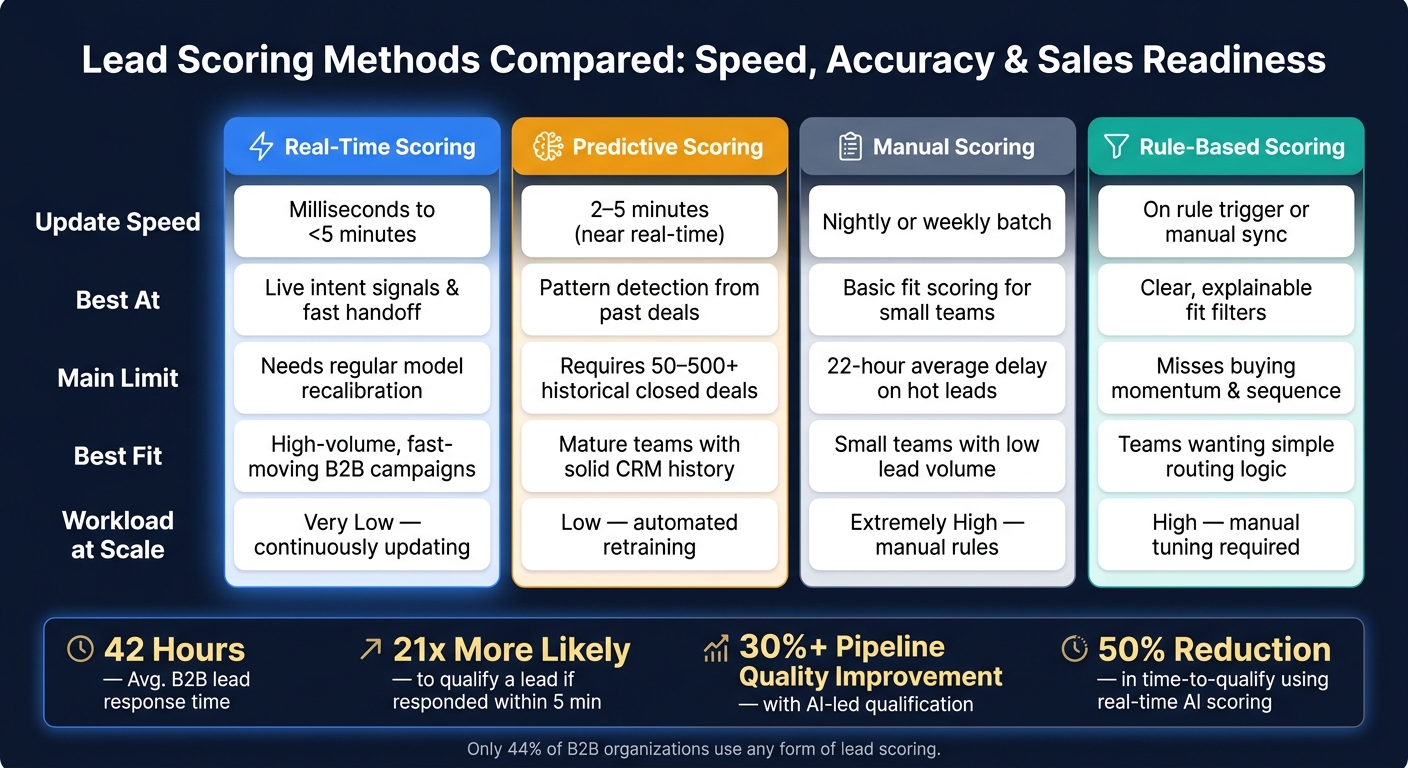
If your team waits hours to score and route inbound leads, you are likely losing deals. In this comparison, I look at real-time lead scoring, manual lead scoring, predictive lead scoring, and rule-based lead qualification through the three things that matter most: speed, prioritization, and sales readiness.
Here’s the short version:
Real-time lead scoring is the best fit when buyer intent changes fast and lead volume is high.
Predictive lead scoring works well when I have enough past win/loss data and want pattern-based scoring.
Manual lead scoring is easier to start with, but delays handoff and loses value as lead volume grows.
Rule-based qualification is clear and easy to explain, but fixed logic can miss buying momentum.
A few numbers make the case clear:
The average B2B company takes 42 hours to respond to an inbound lead.
Responding within 5 minutes makes a company 21x more likely to qualify that lead.
Only 44% of B2B organizations use any form of lead scoring.
AI-led qualification can improve pipeline quality by 30%+ and cut time-to-qualify by 50%.
What I see in this article is simple: manual and rule-based methods are fine for low-volume, high-touch sales, while predictive and real-time methods fit faster pipelines better. If I need to act while a buyer is still active, real-time scoring stands out because it turns live intent signals into immediate sales action.
Quick Comparison
Method
Update speed
Best at
Main limit
Best fit
Real-Time
Milliseconds to under 5 minutes
Live intent and fast handoff
Needs regular model review
High-volume, fast-moving B2B campaigns
Manual
Nightly or weekly
Basic fit scoring
Long delay between action and follow-up
Small teams with lower lead flow
Predictive
Near real-time to a few minutes
Pattern detection from past deals
Depends on enough historical data
Mature teams with solid CRM history
Rule-Based
On rule trigger or sync
Clear fit filters
Misses momentum and sequence
Teams that want simple routing logic
If I had to reduce the whole article to one point, it would be this: the gap between buyer action and sales response is where deals slip away, and real-time scoring closes that gap better than the other three methods.
Real-Time vs Manual vs Predictive vs Rule-Based Lead Scoring: B2B Comparison
From 12% to 40% Close Rate: The Smart CRM Lead Scoring System Every B2B Company Needs
sbb-itb-a781ab9
1. Real-Time Lead Scoring
Real-time lead scoring updates a prospect's score the moment a new signal shows up - like a pricing page visit, demo request, or form fill - instead of waiting for a batch run. For B2B campaigns, that timing can make all the difference when inbound interest is still fresh.
Update Speed
Real-time systems recalculate scores in milliseconds to under 5 minutes [6][2]. That matters because the average B2B company takes 42 hours to respond to an inbound lead, and responding within 5 minutes makes a company 21 times more likely to qualify that lead than waiting 30 minutes [6].
Put simply, speed changes the game. But this works best when the scoring model looks at multiple signals instead of treating one click like a green light. A single action can be random. A pattern is much more useful.
Data Inputs
Strong real-time scoring blends firmographic fit, behavioral signals, and intent data [4][1]. The best models give more weight to high-intent actions like pricing page visits, demo requests, and multiple sessions in a single day. They also watch third-party research activity and competitor mentions [6][4].
Why does that matter? Because stacked signals tend to be more dependable than one-off events, which can add noise and send reps chasing the wrong lead.
Sales Handoff Timing
When a lead crosses a hot-lead threshold, teams should trigger immediate Slack or SMS alerts so reps can jump in while the prospect is still active on the website [2][6]. Timing is only part of it, though. Context matters just as much.
Alerts should explain why the lead is hot - for example, which pages they visited or whether the company recently announced funding. That kind of detail can cut rep prioritization time from about 20 minutes to 2 minutes [11]. And when handoff happens fast, there’s less room for the lead to cool off.
"In 2026, competitive advantage lies in reducing time-to-conversation. The system that gets the right context to a human or AI rep fastest wins." [8]
Maintenance Effort
Real-time models are not set-and-forget. They need quarterly recalibration and regular false-positive and false-negative reviews so score weights stay tied to actual conversion outcomes [10][2]. Teams also need decay logic that lowers scores for inactivity, unsubscribes, or no-shows, so stale leads don’t clog the pipeline [10][7].
That upkeep is the main tradeoff compared with more manual qualification methods.
2. Manual Lead Scoring
Compared with real-time scoring, manual lead scoring is simpler, but that simplicity comes at a cost. It assigns points on a set schedule, usually nightly or weekly, based on predefined rules. That makes it a better fit for fit-based prioritization than for judging live sales readiness. And when buyer intent shifts fast, that delay can hurt.
Update Speed
The biggest drawback is timing. A demo request that comes in at 9:47 a.m. may not land with a rep until 8:00 a.m. the next day, which creates a 22-hour gap[2]. In that kind of window, high intent can cool off fast.
"Batch scoring creates a structural disadvantage that no amount of rep hustle can overcome." - Bitscale [2]
Data Inputs
Manual models usually track 10 to 15 variables before things start to get hard to manage [12]. Most of those inputs are static, such as job title, company size, industry, email domains, whitepaper or ebook downloads, and email opens.
The problem? These models often miss stronger intent signals, including pricing-page visits, competitor comparisons, technical-doc views, and engagement from several stakeholders [13][5]. Put simply, manual scoring tends to measure fit better than urgency.
Maintenance Effort
Manual models also wear down over time. Without regular upkeep, they lose 2–3% accuracy every month[13]. Leave them alone for a year, and their predictive value drops hard [13].
That upkeep adds up. Every new product launch, pricing change, or content update means someone has to adjust the rules. In mature setups, manual models can require 50 to 200 rules[13], which brings a steady drain on time and missed chances. On top of that, sales reps spend 13.5 hours a week on leads that never convert [4].
3. Predictive Lead Scoring
Manual scoring works from fixed rules. Predictive lead scoring does something different: it learns from what has already happened.
It uses machine learning trained on past win/loss data to spot patterns tied to closed deals. That matters because manual rule sets often miss signal combinations that don't look obvious at first glance.
Update Speed
When predictive systems run on streaming infrastructure, score updates can happen in milliseconds or with sub-second latency [3][9].
In day-to-day B2B sales work, that usually means a rep sees the new score within 2 to 5 minutes after a prospect takes action [2].
Data Inputs
Predictive scoring looks at signal combinations that manual systems often overlook. Instead of checking a small set of rules, it can process hundreds of signals at once[1][4].
That can include:
Behavioral patterns, such as engagement velocity
Firmographic data, such as company size and revenue
Technographic data, such as the current tech stack
Third-party intent signals
This is where predictive models start to pull away from manual scoring. A single page visit might not mean much on its own. But a pattern across timing, company profile, tech stack, and outside intent data can tell a much clearer story.
Sales Handoff Timing
Those added signals often lead to faster routing.
If a lead crosses a high-priority threshold - often 80 or above - or shows combined intent signals like a pricing page visit plus a demo request, the system can trigger immediate routing, Slack alerts, or automated calendar links. Leads in the 60–79 range can move into a fast-track sequence within 1 hour[2][3].
Maintenance Effort
The tradeoff is upkeep.
Predictive models can retrain on new win/loss data, but teams still need quarterly recalibration. In plain English, that means reviewing the last 90 days of win/loss outcomes to keep score weights lined up with current sales results [4][5][7][10][15].
Skip that step, and performance can slide fast. Without recalibration, accuracy can drop 30% to 40% within six months[10].
4. Rule-Based Lead Qualification
Predictive scoring learns from past outcomes. Rule-based qualification works in a much simpler way: it uses fixed filters.
That usually means scoring and routing leads based on set criteria like industry, company size, revenue, geography, or job seniority. The upside is clear: you can see exactly why a lead got a certain score. The downside is just as clear. It tends to work best for static fit signals, not for fast-moving buying intent.
Update Speed
Rule-based systems update only when a prospect triggers a predefined rule or when someone manually edits the model [1]. They don't keep recalculating in the background, which means new activity can go unnoticed until the next sync.
That delay can be a problem. If buyer intent is shifting day by day, or even hour by hour, a stale score can send the wrong message to sales.
Data Inputs
Since people have to set up and maintain the rules, most rule-based models stay limited to about 10 to 20 criteria [1]. That's fine for basic fit scoring.
But it starts to fall short when behavior gets messy. These systems can count events, but they don't understand sequence or momentum. So they may treat casual browsing and active buying as if they're roughly the same thing.
Sales Handoff Timing
Fixed thresholds can create handoff problems because the model can't read momentum. A common setup is a hard cutoff, like 100 points. On paper, that sounds clean. In practice, it can create a cliff effect: a lead at 99 points may be ignored despite strong intent [13].
A better move is to route leads based on signal combinations, not just one total score. For example:
A pricing page visit plus a demo request
A product page visit plus repeat return sessions
High-fit firmographic data plus bottom-funnel activity
That kind of combo helps sales act when intent is clear, even if the lead hasn't crossed an arbitrary line [2].
Maintenance Effort
Rule-based systems also need regular upkeep. Every product launch, pricing change, or ICP shift means someone has to go back in and edit the rules by hand.
Recalibrate quarterly [17][16], and review false positives and false negatives every 4 to 6 weeks [2]. That's where the cost starts to add up over time. Each change in your offer, pricing, or target account profile has to be translated into new logic manually.
Pros, Cons, and Tradeoffs by Method
No single lead qualification method works best in every case. The right fit depends on your team size, how mature your data is, and how fast buyers tend to act. The table below pulls the main tradeoffs into one place.
Method
Follow-up Speed
Routing Accuracy
Intent Adaptability
Data Dependence
Workload at Scale
Manual
Slow (Days)
Low - subjective
Low
Low (CRM fields)
Extremely High
Rule-Based
Slow (Batch/Daily)
Moderate - static
Low
Moderate (CRM/MAP)
High - manual tuning
Predictive
Near-real-time to batch
High - past conversion data
Moderate - backward-looking
High (Historical data)
Low - automated
Real-Time
Near-instant
Very High - live intent signals
High
High (Live signals)
Very Low - continuously updating
The biggest gap comes down to response time. The faster the signal, the better the handoff tends to be. That’s the clearest line between these methods. Real-time scoring is built to shrink that gap, cutting first-response time from hours to minutes. Put simply: real-time scoring stands out on urgency, predictive scoring stands out on pattern recognition, and manual and rule-based methods mostly stand out for being simple.
Speed isn’t the only issue. Model decay matters too. Older scoring setups lose accuracy if no one keeps them in shape, which means reps spend time on leads that were never a good fit. Manual and rule-based models fade the fastest. Predictive models hold up longer, but they still need retraining.
Predictive scoring is a step up, but it still leans on the past. It tends to work best for mature organizations that have enough closed deals to train the model - usually 50 to 500 at minimum [4][14]. The tradeoff is trust. Reps often can’t see why a lead scored high, and that can chip away at confidence in the system over time [1][6].
Real-time AI systems work differently. They score leads using live behavioral sequences instead of old proxy signals, and they adjust on their own without manual retraining [1][13]. Organizations using AI for lead qualification report a 30% or higher improvement in pipeline quality and a 50% reduction in time-to-qualify[13].
Conclusion
Pick your scoring method based on lead volume and speed.
Manual and rule-based scoring work best for lower-volume, high-touch deals. Real-time and predictive scoring make more sense when you're dealing with faster sales cycles and more leads. But once volume starts to climb and buyer intent shifts from hour to hour, older methods leave a gap that reps can't fix just by working harder.
That’s why real-time scoring matters. It turns intent into action while the lead is still active. This isn’t a small lift. It solves a structural delay between signal and response. Predictive scoring can shrink that delay, but it still leans on past data and may fall behind what buyers are doing right now.
For agencies, there’s another layer to this. Clients often expect leads to be qualified and handed off instantly under the agency’s own brand. That makes real-time scoring especially important in white-label managed glossary">lead generation. When leads need to be routed right away without breaking the client experience, platforms like SalesLabel support that model.
If your pipeline moves fast and buyer interest fades quickly, real-time scoring is the best fit. It closes the gap between interest and urgency before that delay costs you the deal.
FAQs
How do I know if real-time lead scoring is worth it for my team?
Real-time lead scoring makes sense when your team has two common problems: slow follow-up and poor prioritization.
If leads sit in a queue for hours, they can go cold fast. A response within 5 minutes can lift qualification rates in a big way. Batch-based scoring often slows that down, which means reps may miss the short window when a prospect is most ready to talk.
It also helps when sales reps waste time on low-intent leads or don't have a clear view of current buying signals. Instead of guessing who matters most, they can focus on high-fit accounts that are showing active intent right now, such as pricing page visits.
What data do I need for accurate real-time lead scoring?
Accurate real-time lead scoring depends on three main data types:
Firmographic signals, such as company size, annual revenue, industry, funding stage, and tech stack
Behavioral signals, like website visits, time on page, content engagement, and demo requests
Third-party intent data, including research activity and industry publication engagement
For the best results, connect your CRM, marketing automation platform, and enrichment data - and audit them on a regular basis.
How often should a lead scoring model be reviewed or updated?
Lead scoring models need regular reviews and updates. If you leave them untouched, accuracy can slip fast. In many cases, uncalibrated models lose 30% to 40% of their accuracy within six months.
AI-driven systems may retrain daily as new conversion data comes in. Rule-based or more manual models don’t do that on their own, so they need hands-on recalibration.
The best way to think about scoring is simple: it’s an iterative process, not a set-it-and-forget-it task. Check your scoring thresholds against actual win/loss data so the model keeps pointing you to the right prospects.