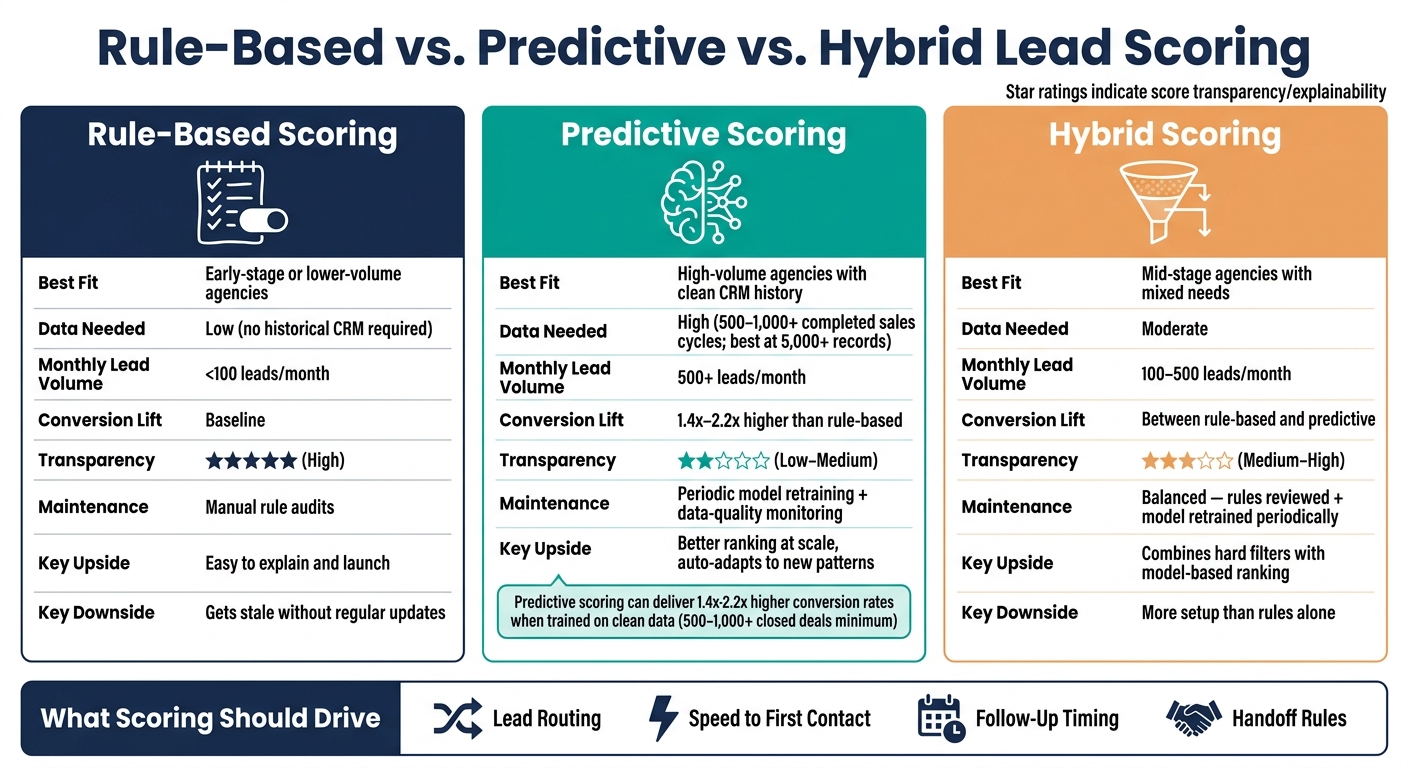
If I have limited CRM history, I’d start with rule-based scoring. If I have clean data and high lead volume, I’d use predictive scoring. If I need both control and better ranking, I’d go hybrid.
Here’s the short version: this choice comes down to data quality, lead volume, explainability, maintenance, and how scores affect routing and follow-up. Rule-based scoring is easier to launch and explain. Predictive scoring can beat fixed rules when it has enough labeled data - often 500 to 1,000 completed sales cycles, with better results around 5,000+ records. Some teams see 1.4x to 2.2x higher conversion rates from predictive scoring when the data is clean.
Before I pick a model, I’d ask:
Do I have enough closed-won and closed-lost history?
Is my CRM clean, with clear stages and timestamps?
Do clients want to see exactly why a lead scored high?
Am I handling fewer than 100 leads a month, 100–500, or 500+?
Do I need fixed filters, machine ranking, or both?
Lead scoring usually looks at three signal types:
Firmographic: company size, industry, revenue, location, tech stack
Hybrid: rules filter leads first, then a model ranks what’s left
Quick Comparison
Model
Best fit
Data needed
Main upside
Main downside
Rule-based
New or lower-volume agencies
Low
Easy to explain and launch
Gets stale unless reviewed
Predictive
High-volume agencies with clean CRM history
High
Better ranking at scale
Harder to explain
Hybrid
Mid-stage teams with mixed needs
Medium
Combines control with model-based ranking
More setup than rules alone
I’d treat the score as more than a dashboard number. It should drive lead routing, speed to first contact, follow-up timing, and handoff rules. That’s where scoring starts to affect pipeline, not just reporting.
Rule-Based vs. Predictive vs. Hybrid Lead Scoring: Which Model Fits Your Agency?
Setting Up Predictive Lead Scoring Using Machine Learning
sbb-itb-a781ab9
How Rule-Based Lead Scoring Works
For agencies, rule-based lead scoring usually comes down to a fixed point system. You assign points to lead traits and actions, add them up, and use the total to decide what happens next.
This model runs on fixed rules, not learned patterns. So when a lead passes a set score threshold, the system takes action: route the lead to a rep, start a follow-up sequence, or flag it for review.
Common Rule-Based Scoring Criteria
Agencies often split scoring into two buckets: fit and engagement. For a U.S.-focused B2B agency, a typical setup might look like this:
Negative scoring can also come into play. If a lead is a poor fit or goes inactive, points can be subtracted.
Strengths of Rule-Based Scoring
The biggest upside is transparency. A person sets every rule, so the logic is easy to explain. You can point to the score and say exactly why a lead ended up there.
It’s also fast to set up. You don’t need thousands of past leads to get started. You just need a clear ICP and some sales judgment. That makes this model a good fit for a new agency or a campaign moving into a new market. In many cases, you can get a working model live within days.
There’s another practical plus: reuse. Teams can take a scoring template that already works, then make small vertical-specific changes instead of starting from scratch every time.
Limitations of Rule-Based Scoring
The same human judgment that makes rule-based scoring easy to understand is also where it can fall short. Point values come from assumptions, not statistical proof. Two strategists can look at the same lead trait and assign very different weights.
The bigger issue is drift. Markets change. Buyer behavior changes too. But the rules stay the same unless someone updates them.
Say webinar attendance starts to signal buying intent more strongly than before. Or a job title that once lined up with closed deals stops mattering as much. A rule-based model won’t notice on its own. It keeps scoring leads the old way, even when the market has moved on. If no one checks it on a regular basis, the score starts to drift away from actual conversion patterns.
That fixed logic is the main tradeoff compared with predictive scoring, which learns from past outcomes.
How Predictive Lead Scoring Works
Rule-based scoring uses fixed weights. Predictive scoring does something different: it learns those weights from results.
Predictive lead scoring uses machine learning to estimate how likely a lead is to convert. It looks at past CRM outcomes - especially closed-won and closed-lost deals - and finds the patterns most tied to revenue. For agencies with enough clean CRM history, this often beats manual scoring. It can also spot patterns a hand-built ruleset may miss.
What Data Predictive Models Use
These models usually pull from a few data sources at once:
Data Category
Specific Signals
Use
CRM History
Closed-won vs. closed-lost records, sales cycle length
Defines what a winning lead looks like
Account Attributes
Industry, company size, annual revenue, location
Measures ICP fit
Engagement Patterns
Email opens, link clicks, content downloads, webinar attendance
Job title, seniority, department, buying committee role
Identifies decision-makers
Data quality matters a lot here. The model needs clearly labeled outcomes, consistent stage definitions, and accurate timestamps. If your CRM has vague statuses or missing fields, the model learns from noise instead of signal.
Most models also need enough labeled history to learn well. In practice, a reliable model usually needs at least 500 to 1,000 completed sales cycles, with stronger results often showing up at 5,000 or more labeled records.[8][5][9][10][7]
Strengths of Predictive Scoring
The biggest day-to-day win is prioritization at scale. If you're sorting through thousands of leads, a predictive model can rank them automatically so your team spends time on the top tier.[5][4][9]
Predictive scoring can drive 1.4x to 2.2x higher conversion rates than rule-based threshold scoring when it's trained on enough clean data.[4][1][6] At high lead volumes, that kind of lift adds up fast.
These models can also adjust over time. With regular retraining, they can pick up new patterns faster than a manual ruleset can be revised. And with real-time scoring, routing and follow-up can change as new signals come in.
Limitations of Predictive Scoring
The biggest limit is simple: data. Without enough closed-won and closed-lost history, the model may not have enough signal to generalize well.[5][9][10][7]
There’s also a feedback loop to watch for. If sales reps only work the highest-scoring leads, the model gets very little outcome data from lower-scored leads. That makes retraining tougher.
Another issue is explainability. Many predictive models are hard to unpack, so agencies usually need scoring logic that shows the top signals behind each score.
That tradeoff becomes easier to see in a side-by-side look at rule-based scoring.
Predictive vs. Rule-Based: Key Differences
Rule-based scoring gives leads fixed points based on criteria your team sets by hand. Predictive scoring works differently. It learns from past CRM outcomes, especially closed-won and closed-lost deals. Reviews cited here show that predictive scoring tends to deliver better conversion rates and better accuracy, if the data is clean and complete.[12][4]
The bigger issue, though, is practical: which system can your agency run well without things falling apart? That’s where the gap between the two gets more obvious.
Dimension
Rule-Based Scoring
Predictive Scoring
Scoring method
Manual point assignment based on predefined criteria
Machine learning model trained on historical CRM outcomes
Data requirements
Low - can work with a basic CRM and a small set of tracked behaviors
Higher - needs enough clean historical data to learn reliably
Accuracy
Can work well in simple funnels, but depends on rule quality
Usually stronger once enough data is available
Scalability
Harder to scale across many clients or verticals because rules multiply fast
Strong - models can be retrained and re-scored as new data comes in
Transparency
High - every point value is visible and easy to explain
Lower - often needs reason codes or feature importance to interpret
Maintenance
Manual rule audits and ongoing updates
Periodic retraining and data-quality monitoring
Rule-based scoring is usually easier to walk through in client reviews because every point is visible. Predictive scoring often needs reason codes or feature importance so people can see why a lead scored the way it did and what to do next.
In plain English, the choice usually comes down to three things: data depth, lead volume, and how much explainability your clients need.
Which Model Fits Your Agency Stage
Your agency stage should shape the model you use.
Early-stage agencies with limited CRM history and lower lead volume are usually better off with rule-based scoring. If you don’t have enough closed-deal history, you can’t train a model you trust. In that case, a clean ruleset built around ICP fit works better for client clarity. That usually means scoring for target industry, company size, decision-maker title, and key intent behaviors.
Growing agencies with several active verticals and more CRM history should start adding predictive scoring on top of their current rules. The rules can handle basic qualification. Then the predictive model can sort the qualified leads by conversion likelihood. That setup fits a stage where clients start pushing harder for measurable ROI.
Mature agencies handling high lead volume across multiple markets should make predictive scoring the main model. Rules still matter, but more as hard filters. Think region restrictions, minimum contract value, and compliance requirements. After that, the model does the heavy lifting.
When a Hybrid Approach Makes Sense
For a lot of agencies, this isn’t an either-or decision.
A hybrid setup combines rule-based filters with predictive ranking. The rules handle the front end by removing leads that fail hard requirements, like the wrong industry, personal email domains, or leads outside the target geography. After that, predictive scoring ranks the remaining leads by likelihood to convert. Reason codes behind the score help sales teams and clients understand the result without needing to dig into the model itself.
This setup tends to work well for agencies dealing with multi-channel lead sources. Paid, outbound, and inbound leads often start with different baseline quality. Rules keep the process consistent across sources, while the predictive layer handles the nuance. SalesLabel supports this workflow with real-time scoring, inbox management, AI-driven replies, and automated follow-ups.
Operational Considerations for AI-Powered Agencies
The day-to-day impact shows up in routing, follow-up, and handoffs.
How Scoring Affects Routing and Follow-Up
Each score band should map to a clear owner and a set response window. That keeps handoffs steady across client accounts and makes SLA enforcement easier.
Rule-based queues don't change unless someone updates the rules. Predictive queues shift as new signals come in. That can make teams more responsive, but it also means you need to watch queues more closely.
In a rule-based setup, a handoff happens when a lead crosses a fixed point threshold based on explicit criteria. In a predictive setup, the handoff happens when the model's conversion probability moves past a set threshold.
Both models also depend on solid disqualification workflows. This matters just as much as routing. When non-ICP or low-intent leads move automatically into suppression or re-engagement lists, SDR inboxes stay cleaner, and reps spend less time on leads that aren't likely to convert.
Using Real-Time Scoring in Agency Delivery
Nightly scoring creates blind spots. Event-driven scoring closes that gap by updating scores as soon as a lead replies, clicks, or visits pricing pages [13][14].
SalesLabel updates scores in real time and can move leads from outreach to booking when intent goes up. At that point, SDRs can step in when a conversation actually needs a human touch.
For agencies managing several client accounts, this kind of setup helps keep routing, follow-up, and booking workflows tied to live intent signals instead of yesterday's data. In many cases, that real-time flow is what decides which scoring model makes more sense for the agency.
Choosing the Right Lead Scoring Model
Lead scoring affects routing and follow-up, so the model you pick should match how your team works day to day, not just what looks good in a dashboard. Go with the model your team can run without friction. That means looking at CRM data quality, conversion history, lead volume, team bandwidth, and how easy the model is to explain to clients.
Use predictive scoring only when your closed-won and closed-lost data are clean and consistent. [15][17][3] If that data is messy, the model can point you in the wrong direction.
Rule-based scoring is much easier to check during client reviews because every point links to a clear trait or action. That matters for SDR routing decisions and client approval cycles. Predictive models often weigh dozens of variables at once, and that logic can be tough to explain in plain English. When sales teams can't see how scores are produced, trust can drop. [15][16][11] If you need both clear fit filters and machine-ranked priority, a hybrid model usually makes the most sense.
Factor
Rule-Based
Predictive
Hybrid
CRM data quality needed
Low to moderate
High
Moderate
Conversion history needed
Minimal
Extensive
Moderate
Monthly lead volume
Low (<100 leads)
High (500+ leads)
Moderate to high (100–500 leads)
Team capacity
Higher manual effort
Lower manual effort
Balanced
Score auditability
High
Low to medium
Medium to high
Once you've made the choice, assign clear ownership and set a review cadence. After launch, track MQL-to-SQL rate, speed to first contact, and SQL-to-opportunity rate. Don't stop at score distribution alone.
For rule-based systems, review scoring rules from time to time against current ICP criteria and feedback from sales. For predictive systems, check whether top-ranked leads still convert at a higher rate, and keep an eye on model drift as lead sources change. [18][2]
Conclusion: Main Takeaways
After you weigh data depth, lead volume, and explainability, the choice is usually pretty clear.
Rule-based scoring works well for early-stage agencies that don't have much history yet and need logic they can explain without friction. It's easier to defend in client reviews, and it makes sales handoffs a lot smoother.
Once your agency has enough clean historical data, predictive scoring starts to make more sense. At that point, predictive models can drive a 1.4x to 2.2x conversion lift over static rules by spotting signals that manual scoring often misses.[4]
If you want both transparency and stronger prioritization, a hybrid model is often the most practical option. Use rules as hard filters, then rank the leads that pass with predictive scoring. That's usually where things click. But the score can't just sit in a dashboard. It needs to connect to routing and follow-up.
That link matters most in day-to-day agency work. SalesLabel fits this setup by combining real-time lead scoring with automated outreach and follow-ups, so teams can move on priority leads faster.
Start with rules when clarity matters most. Shift to predictive when scale and data support it. Use hybrid when you need both. Revisit the model as your ICP, data quality, and lead volume change.
FAQs
How do I know if my CRM data is clean enough for predictive scoring?
Check whether your CRM records are consistent, high quality, and validated against actual conversion metrics. Your data should also line up with your Ideal studies">Customer Profile (ICP) fit and engagement scores.
Regular audits against real conversion outcomes help you confirm whether your inputs are accurate enough for predictive scoring. SalesLabel supports this by combining real-time CRM and intent data to keep information clean and actionable.
What should I do if my lead volume is too low for a predictive model?
If your lead volume is too low to train or use a predictive model well, switch to a rule-based scoring framework.
Set lead scores by hand based on ICP fit and engagement signals. It’s a simple way to make sense of early-stage lead flow without waiting for more data.
As your agency grows and lead volume goes up, you can add time-decay factors and slowly layer in AI-driven predictive insights to improve scoring accuracy.
How often should I review or retrain my lead scoring model?
Check your lead scoring model on a regular basis against conversion data so it stays on track. A model that worked a few months ago can drift fast, especially when your Ideal Customer Profile changes or your conversion numbers start moving in a new direction.
If you use SalesLabel, its AI looks at real-time signals from your CRM, website, and inbox. That helps keep scores dynamic instead of static. With steady validation, your team can prioritize leads better and focus outreach where it’s most likely to pay off.