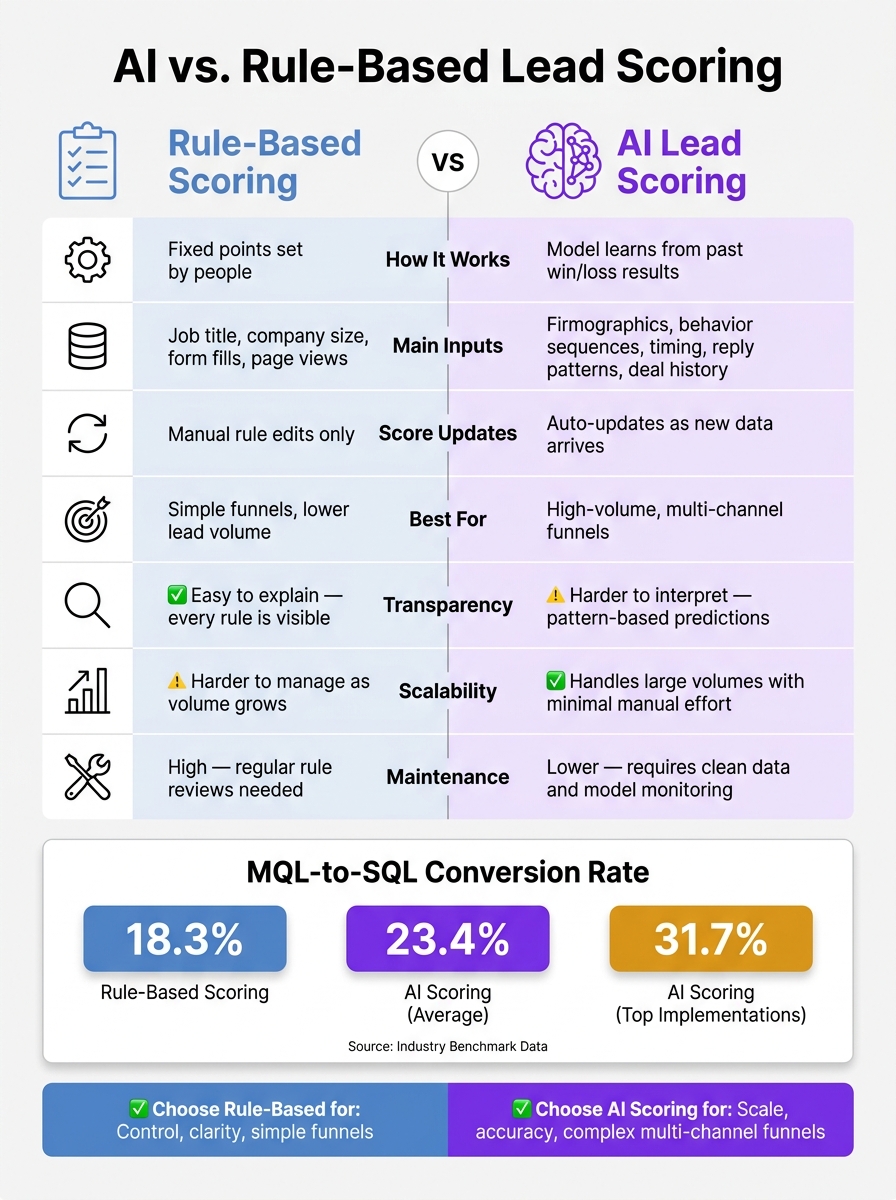
If your team scores leads by hand, AI usually wins once lead volume gets high and buyer paths stop looking simple.
I’d sum it up like this: rule-based scoring uses fixed point rules, while AI scoring uses past win/loss data to predict who is most likely to convert. The tradeoff is simple too: rule-based models are easier to explain, but AI models often do a better job when you have more channels, more signals, and more leads to sort.
Here’s the short version:
Rule-based scoring uses set points for things like job title, company size, page visits, and demo requests
AI scoring uses the same types of inputs, plus outcome data like closed-won, closed-lost, deal size, and sales cycle data
Rule-based models are easier to audit, but they can drift when buyer behavior changes
AI models can spot signal combinations that fixed rules often miss
Lower volume, simple funnels often work fine with rule-based scoring
High-volume, multi-channel funnels often get better results from AI scoring
One benchmark in the article shows 23.4% MQL-to-SQL for AI scoring vs. 18.3% for rule-based scoring, with top AI setups reaching 31.7%
What this means for you: if your sales team can still review leads without much delay, fixed rules may be enough. If your pipeline moves fast and lead review is slowing people down, AI scoring starts to make more sense.
AI vs. Rule-Based Lead Scoring: Side-by-Side Comparison
Lead Scoring vs Signals and Why AI Signals Work Better Than Traditional Lead Scoring Algorithms
sbb-itb-a781ab9
Quick Comparison
Criteria
Rule-Based Scoring
AI Scoring
How it works
Fixed points set by people
Model learns from past results
Main inputs
Fit + engagement signals
Fit, behavior, timing, reply data, deal history
Score updates
Manual rule edits
Auto score changes as new data comes in
Best for
Simple funnels, lower lead volume
Busy funnels, mixed channels, more data
Main strength
Clear logic
Better prediction in harder funnels
Main limit
Can miss pattern combinations
Harder to explain
Upkeep
Rule reviews and edits
Data quality checks and model tracking
I’d read the choice this way: pick rule-based scoring for control and clarity; pick AI scoring for ranking accuracy at scale.
How Rule-Based Lead Scoring Works
Rule-based scoring runs on manual rules set up inside a CRM or marketing automation platform. The team picks the signals that matter, gives each one a point value, and applies that same logic to every lead.
Rule-Based Scoring Structure
Most rule-based models use two buckets: fit scoring and engagement scoring.
Fit scoring gives points based on how closely a lead matches the ideal studies">customer profile. That can include company size, industry, job title, geography, or tech stack.
Engagement scoring gives points for intent signals, such as email clicks, website visits, pricing page views, or demo requests. Higher-intent actions get more points. Negative signals, like bounces or unsubscribes, take points away.
From there, teams set an MQL threshold and fine-tune it based on conversion data and feedback from sales.
For example, a mid-market SaaS lead might get points for:
Company size
U.S. location
Senior title
Pricing page visits
Demo requests
At the same time, bounces and unsubscribes would subtract points.
Strengths of Rule-Based Scoring
The main upside of rule-based scoring is transparency. Every point connects to a written rule, so sales reps can see exactly why a lead scored the way it did.
That makes this approach easy to explain and useful for smaller databases or simple buyer journeys.
But there’s a catch. Those strengths start to fade when buyer behavior shifts and the number of signals grows.
Limits of Manual Scoring
The big issue is that the rules are fixed. When buyer behavior changes, fixed rules don’t change with it. So the model can keep rewarding old signals until someone steps in and updates it by hand.
Manual models also start to strain as things get more complex. A basic point system often misses how signals work together, like company size plus repeat product-page visits plus activity from several stakeholders. At scale, the scoring can drift unless teams keep revisiting the logic.
That’s where machine learning starts to beat fixed rules.
How AI Lead Scoring Works
AI lead scoring uses past CRM results - closed-won, closed-lost, and no-response leads - to predict which new leads are most likely to convert. In plain English, it takes historical outcomes and turns them into a live conversion score.
It looks at many of the same inputs as rule-based scoring. The difference is in how those inputs are weighted. Instead of assigning fixed points by hand, the model learns from outcomes and produces a score, often on a 0–100 scale.
How Machine Learning Builds the Scoring Model
The model reviews many signals at the same time, including company size, job title, industry, tech stack, engagement timing, and email reply behavior. Then it learns which mixes of those signals tend to line up with wins.
That matters because manual scoring often misses patterns that aren't obvious at first glance. A machine learning model can spot nonlinear relationships and hidden patterns that are hard to write into static rules.
For example, it may learn that three email opens within 24 hours, followed by a reply, is a stronger sign of a booked meeting than either action by itself. Fixed rules often treat those events as separate inputs. A model can read the combination and the timing together.
Once the model is trained, it updates scores as new activity comes in.
Data Processing and Automation
After deployment, the model scores leads automatically and refreshes those scores when new signals appear. An email reply, a pricing page visit, or a booked meeting can all shift a lead's score in near real time.
This cuts down on manual upkeep. Rule-based systems need people to revisit and adjust scoring rules by hand. AI scoring retrains on new outcome data instead. That said, agencies still need clean data and close monitoring of model performance, including precision, recall, and lift.
Why AI Scoring Matters for Agencies
Agencies running campaigns for many clients can generate thousands of leads each month, and manual triage starts to break down at that volume. AI scoring ranks leads by conversion likelihood automatically, so SDRs can spend their time on the contacts most likely to move forward while interest is still high.
For teams dealing with heavy lead flow, SalesLabel automates prioritization so reps can follow up while intent is still high. It combines real-time lead scoring with automated enrichment, personalized outreach, follow-ups, meetings, and inbox management under the agency's own branding.
When a lead replies positively or shows scheduling intent, the system can automatically increase that lead's priority and trigger immediate follow-up. That helps agencies move faster without losing the personal touch.
AI vs. Rule-Based Lead Scoring: Key Differences
The main difference is pretty simple: rule-based scoring follows fixed rules, while AI scoring learns from past results.
Comparison Table: AI vs. Rule-Based Lead Scoring
Here’s how the two approaches play out in day-to-day use.
Criteria
Rule-Based Scoring
AI Lead Scoring
Data Sources
Fixed inputs: job title, company size, form fills, page views
Broad inputs: firmographics, behavior sequences, timing, reply patterns, deal history
Scoring Method
Manual point assignment based on predefined rules
Machine learning trained on past outcomes
Adaptability
Static; rules only change when someone updates them manually
Dynamic; updates as new data arrives
Accuracy
Reliable for simple funnels with stable buying behavior; misses patterns that are hard to spot manually
Higher predictive accuracy on complex funnels
Scalability
Becomes harder to manage as lead volume and channels grow
Handles large lead volumes with little added manual effort
Maintenance Burden
High; requires regular rule reviews and cross-team coordination
Lower day-to-day upkeep; requires clean data and model performance monitoring
Transparency
Easy to explain to sales teams; every rule is visible
Harder to interpret; predictions come from pattern detection, not a simple formula
The table covers the mechanics. The next piece is the tradeoff.
Tradeoffs at a Glance
Rule-based scoring makes sense when your funnel is simple and your team needs to explain each score in plain English. It’s predictable, easy to audit, and easy to trace back to a rule. The catch? It only works inside the logic you set up.
AI scoring gives up some of that visibility for more prediction power. It can flag leads that don’t fit a neat checklist but still act like likely buyers. That’s a big deal when your team is buried in lead review and needs help deciding who gets attention first.
So which one wins? It depends on the shape of your funnel. Rule-based scoring fits simple setups. AI scoring fits high-volume funnels where triage starts to slow the team down.
Choosing the Right Lead Scoring Method
The right pick depends on three things: lead volume, how involved your sales process is, and how much past data you can lean on. For agencies, the main question is pretty simple: is the funnel clean enough for rules, or messy enough that machine learning earns its keep?
When Rule-Based Scoring Makes Sense
Rule-based scoring works best when the funnel is simple and your team has a clear idea of what a qualified lead looks like. It also works well when lead volume is low enough that manual review still feels realistic, not like a time sink.
Go with this route when transparency matters more than extra lift. You can see exactly why a lead got a certain score, which makes it easier to explain the system to clients or internal teams.
The catch is upkeep. Rules don't change on their own, so when your ICP shifts, someone has to go back in and adjust the scoring logic.
When AI Scoring Is the Better Fit
AI scoring is a better fit when lead volume gets too high for manual review, or when leads come in from several channels and move through different buyer journeys. That's usually the point where fixed rules start to miss signals that matter.
Machine learning improves accuracy because it learns from outcomes. In plain English, it looks at which signals actually lead to conversion, not just which ones sound right on paper. But there's a catch: it needs clean conversion history and steady tracking across touchpoints.
When that setup is in place, AI scoring can beat fixed rules. One benchmark reports a 23.4% MQL-to-SQL conversion rate for AI scoring versus 18.3% for rule-based systems, with top implementations reaching 31.7%[2].
For agencies that want AI scoring built into outreach, SalesLabel fits that setup. It's a white-label platform that brings together real-time lead scoring, AI replies, inbox management, outreach, and follow-ups under your agency's branding.
That means teams can keep lead prioritization fast and scale work across multiple client accounts without juggling a pile of separate tools.
Conclusion
Rule-based scoring is easier to explain. AI scoring does a better job of spotting conversion patterns and adjusting as those patterns shift over time. That gap starts to matter more as lead volume grows and the data gets messier.
For agencies, the main question is simple: can manual rules still keep up with lead volume and channel mix? When the answer is no, fixed rules start missing signals that matter. That’s usually the point where machine learning starts to make sense. Benchmarks show stronger conversion performance for AI-scored leads [2]. But that edge depends on the quality of the data going in.
AI scoring needs clean, consistent outcome data. Once that base is in place, automation is the next logical move. Lead scoring is moving toward models trained on conversion outcomes that update automatically as buyer behavior shifts. The result is faster prioritization, less manual review, and better follow-up timing. For agencies that want all of that in one workflow, SalesLabel combines real-time scoring with outreach and follow-up [1].
FAQs
How much data does AI lead scoring need?
AI lead scoring works best when the dataset blends three things: demographic data, behavioral patterns, and intent signals. That mix helps the model predict which leads are more likely to convert.
SalesLabel helps make that possible with real-time inbox analytics and conversation tracking. For agencies, that means the scoring engine can keep pulling in live buyer intent signals as prospects engage, reply, and move through the pipeline.
The result is pretty practical: teams can focus sales effort on the leads that are showing active interest instead of treating every contact the same.
Can small teams start with rule-based scoring first?
Yes. Small teams can start with rule-based scoring by setting fit and engagement scores around their Ideal Customer Profile.
It’s a solid starting point for sorting leads and keeping the pipeline in order. But as a team grows, manual models often start to show cracks. That’s usually when predictive AI and time-decay factors come into play.
SalesLabel supports that move with real-time AI-powered lead scoring that helps automate qualification and push hot leads to the top.
How do you know when it’s time to switch to AI?
It’s time to switch to AI-powered lead scoring when you need to scale outreach without adding more people to the team. If your team is stuck doing manual outreach, getting low reply rates, or trying to handle a large flow of leads, AI can take over much of that work and cut wasted time.
For agencies, SalesLabel can automate the full process - from sourcing and real-time scoring to personalized outreach and booking - so you can scale operations with less manual effort.