White Label Reseller Agreement: What to Put in the Contract
A clause-by-clause guide to the white label reseller agreement: branding rights, pricing, support, data ownership, SLAs, termination, and where you actually have leverage.
SalesLabel Team
Growth Expert • 16/08/2026
Share:
Procurando uma solução pronta?
SalesLabel automatiza a prospecção do início ao fim — IA encontra prospects, envia mensagens personalizadas e agenda reuniões sob sua marca.
A whitelabel reseller agreement is the contract that decides whether your reselling business scales cleanly or turns into a support-and-dispute headache. When you resell software under your own brand, your clients never see the vendor behind the curtain, which is exactly the point, and exactly why the paperwork matters. If the agreement is vague on branding, pricing, data, or termination, the gaps show up at the worst possible time: a churned client, a billing fight, or a vendor change. This guide walks through what to put in a white label reseller agreement, clause by clause, so you can protect your brand and your margin before you sign.
Why the agreement is your real product
As a reseller, you are not selling code you wrote. You are selling a promise: that the product carries your name, works reliably, and stays yours to price and support. The reseller agreement is where that promise is made enforceable. Get it right and you can build recurring revenue on top of software you never had to develop. Get it wrong and you inherit the vendor's limitations without any of the control. Treat the contract as the product you are actually buying.
The clauses your white label reseller agreement must cover
Use the checklist below as your review pass. Every clause here maps to a real way reseller deals go sideways.
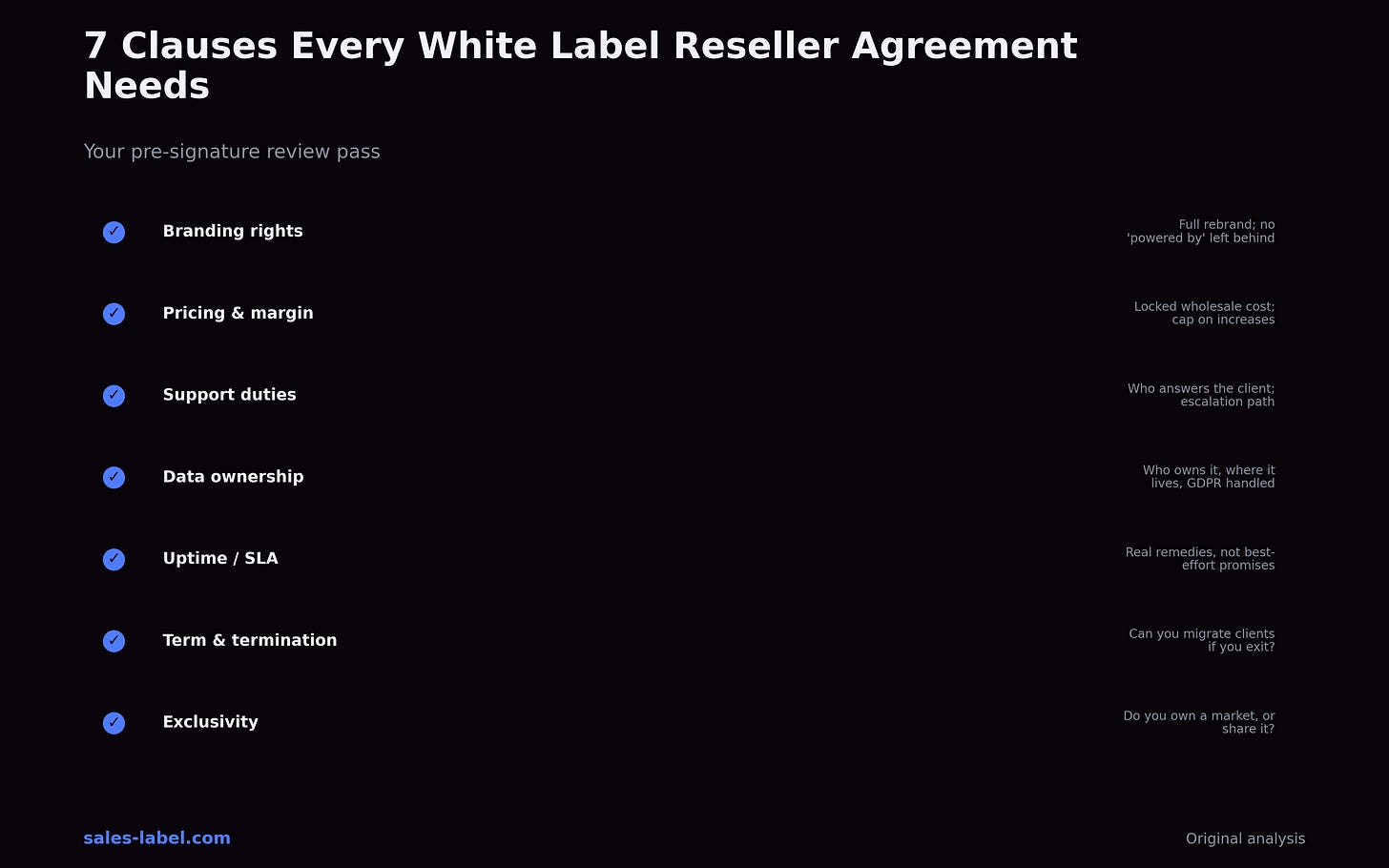
The seven clauses to check before signing — original analysis by SalesLabel.
1. Branding and white-label rights
Spell out exactly what you can rebrand: the product name, the dashboard, the domain, the emails, the documentation. Confirm the vendor's branding is fully removable and that there are no "powered by" marks left in the client-facing experience. Ambiguous branding rights are the fastest way to lose the illusion that the product is yours.
2. Pricing and margin control
You set the client price; the vendor sets your wholesale cost. The agreement should lock your cost for a defined term and cap how fast it can rise, so a mid-contract wholesale hike does not erase your margin overnight. Watch for minimum volume commitments that force you to buy seats you have not sold yet.
3. Support responsibilities
Define who answers the client. In most white-label deals you are the front line and the vendor is your escalation path. Nail down response times, escalation channels, and what happens during an outage, because your clients will judge you on support you may not fully control.
4. Data ownership and privacy
Clarify who owns the client data, where it is stored, and how privacy rules like GDPR are handled. Your clients are trusting you with their prospects and customers; you need contractual proof that the underlying vendor treats that data correctly and that it stays yours if you leave.
5. Service levels and uptime
A written uptime commitment protects you when the product goes down and your name is on it. Ask for a terms">service-level clause with real remedies, not just a best-effort promise. Downtime is a vendor problem that becomes a reseller reputation problem in seconds.
6. Term, renewal, and termination
Know how long you are committed, how renewal works, and how either side can exit. The most important line is what happens to your clients if you terminate: can you migrate them, do you keep the accounts, and is there a transition period? An exit clause that strands your clients is a trap.
7. Exclusivity and territory
Decide whether you have exclusive rights in a market or vertical, or whether the vendor can sign competing resellers next door. Exclusivity is not always necessary, but you should know the answer before you invest in building the brand.
The mistakes that cost resellers the most
The biggest one is signing on wholesale price alone and ignoring the exit terms. Resellers who cannot migrate their own clients are locked in, and the vendor knows it at renewal. The second is leaving support boundaries fuzzy, so every client escalation becomes a fight about whose job it was. The third is skipping the data clause, then discovering during a client audit that you cannot actually prove where the data lives. None of these show up in a demo. All of them show up in the contract, which is why the contract deserves as much scrutiny as the software.
How to evaluate a vendor before you sign
Read the agreement as if a client just churned and you need to move them. Can you? Read it as if the vendor just doubled your wholesale cost. Are you protected? Read it as if the product went down for a day. What do you owe your clients, and what does the vendor owe you? A reseller-friendly vendor writes these answers into the contract without being pushed. A good white-label platform, like a white-label lead generation platform built for partners, should make branding, pricing control, and clean exit terms easy to see rather than buried. If you want to understand how the product itself resells, the how-it-works overview and the AI features show what your clients would actually experience under your brand.
Where you actually have negotiating leverage
New resellers often assume the vendor holds all the cards. You have more room than you think, especially before you sign, because a vendor wants your distribution as much as you want their product. Push hardest on three things. First, a price lock: ask for your wholesale cost to be fixed for the initial term, with any increase capped and notified in advance. Second, a clean exit: ask for a written client-migration path so you can move accounts if the relationship ends, which removes the vendor's biggest source of leverage over you at renewal. Third, support clarity: get response times and escalation routes in writing, not in a sales conversation. If a vendor resists all three, that resistance is information. The best partners treat these terms as normal because they plan to keep you happy for years, not lock you in for one.
Frequently asked questions
What is a white label reseller agreement?
It is a contract that lets you sell another company's software under your own brand. It defines your branding rights, your wholesale cost, support duties, data ownership, and how the relationship starts and ends.
Do I need a lawyer to review it?
For a first reseller deal or a large commitment, yes. A lawyer catches the termination and liability traps that cost the most. For smaller deals, use a checklist like this one and focus hardest on exit terms and pricing.
What is the single most important clause?
Termination and client migration. Everything else affects your margin; this clause decides whether your business is portable or captive. If you cannot take your clients with you, you do not really own them.
Can I set my own prices as a reseller?
Yes, that is the point of white-label reselling. The vendor sets your wholesale cost, and you set the client-facing price. Make sure the agreement locks your cost so your pricing stays profitable.
Build your reseller offer on solid terms
The right agreement turns reselling into durable recurring revenue instead of a liability. If you want to see how a partner-first white-label platform handles branding, pricing, and clean exit terms, book a demo and become a partner to review the details before you commit.