White Label Reseller: How the Model Works and How to Choose a Vendor in 2026
A white label reseller sells software under their own brand. See how the model and margins work, the 7 checks before you pick a partner, and a 30-day launch plan.
SalesLabel Team
Growth Expert • 30/08/2026
Share:
Procurando uma solução pronta?
SalesLabel automatiza a prospecção do início ao fim — IA encontra prospects, envia mensagens personalizadas e agenda reuniões sob sua marca.
Becoming a white label reseller is one of the fastest ways for an agency to add software revenue without building software. You take a proven product, put your brand on it, and sell it to your clients as your own. Done well, it turns a service business into a recurring-revenue business. Done badly, it locks you into a vendor that embarrasses you in front of clients. This guide explains exactly how the model works, what margins to expect, and the seven checks that separate a good white label partner from a risky one.
If you already resell hosting, ads, or design, you understand the idea. The twist with software is that your brand is now attached to a product you did not build — so the vendor you choose is not a supplier, it is a silent partner in every client relationship.
What a white label reseller actually does
A white label reseller sells another company's product under their own brand. The vendor builds and maintains the software; you own the customer, the pricing, and the relationship. In lead generation, that usually means:
You offer a prospecting or outreach platform to your clients as "your" tool.
The vendor runs the technology, updates, and infrastructure behind the scenes.
You set the retail price, keep the margin, and handle the client relationship.
Your clients see your logo, your domain, and your support — never the vendor's.
The client never knows a third party is involved, which is the whole point. Your agency looks like a software company, and the recurring subscription revenue shows up on your books, not someone else's.
Reseller vs affiliate vs white label: know the difference
These get mixed up constantly, and the difference decides how much you earn and control.
Affiliate: you send a referral, the vendor closes and owns the customer, you get a one-time or thin recurring cut. Lowest effort, lowest control, weakest brand.
Reseller: you resell the vendor's branded product and take a margin, but clients still see the vendor's name.
White label reseller: you resell the product under your own brand. Highest control, best margins, and the customer relationship is fully yours.
If you want to build enterprise value — a book of recurring revenue you could one day sell — the white label route is the only one of the three that builds an asset you own.
How white label reseller pricing and margins work
Most white label programs use one of two pricing shapes. In a wholesale model, you pay the vendor a fixed per-seat or per-account rate and mark it up to your clients; your margin is the spread. In a revenue-share model, you and the vendor split what the client pays on an agreed percentage.
Wholesale usually gives resellers more room, because you control the retail price. A common pattern: the vendor charges you a flat platform fee plus a per-seat cost, and you bundle the tool into a monthly retainer where the software is one line item among strategy, setup, and management. That bundling is where agencies make real money — the client is buying an outcome, not comparing your seat price to a public rate card. Whatever the shape, model your unit economics before you sign: platform fee, per-seat cost, expected clients, and your target retail price.
The 7 checks before you pick a white label partner
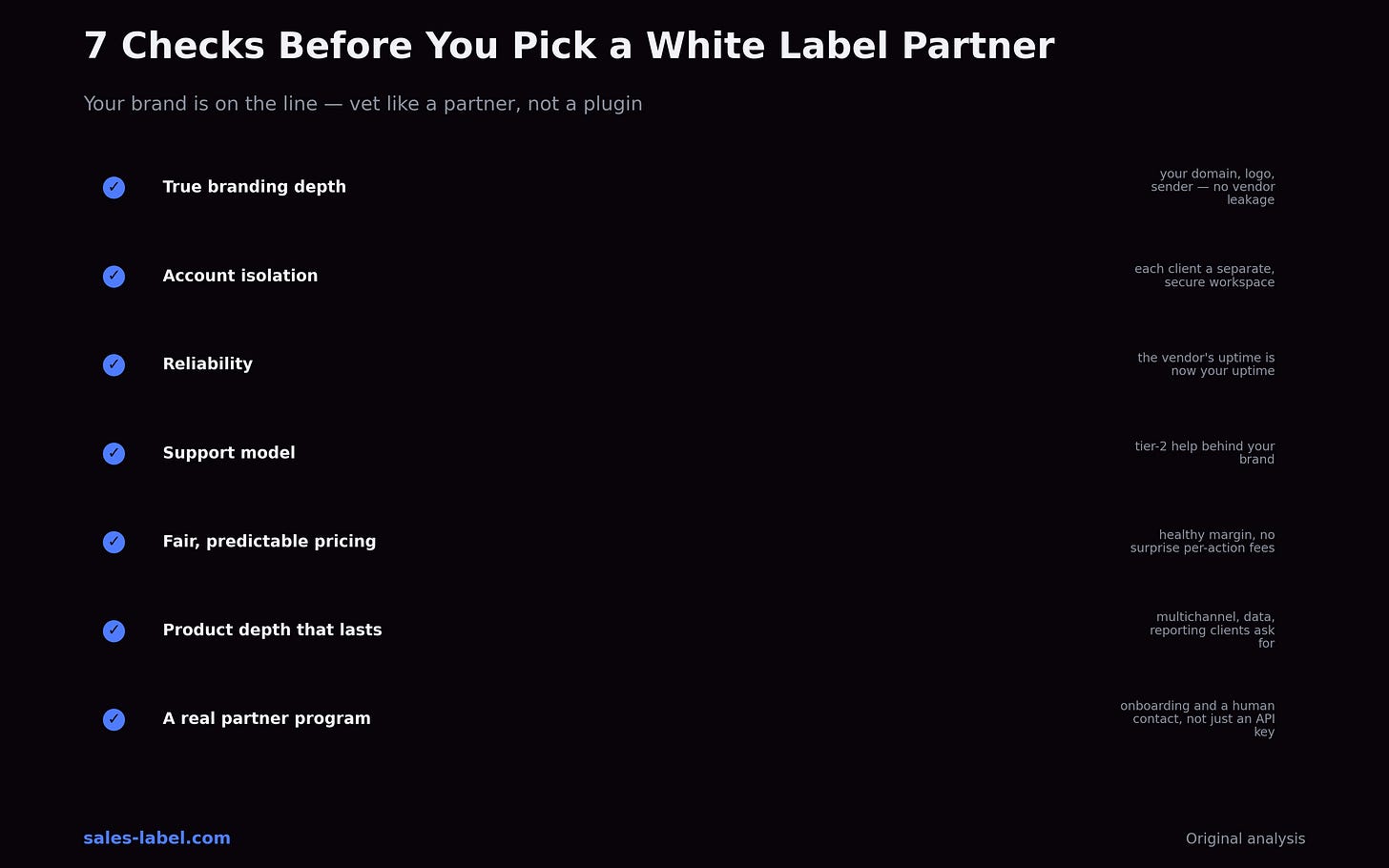
Your brand is on the line, so vet the vendor like a partner, not a plugin.
The seven checks that separate a safe white label partner from a risky one.
True branding depth. Can you use your own domain, logo, colors, and email sender — or does the vendor's name leak into URLs, notifications, or invoices? Shallow branding gets you caught.
Account isolation. Each client should be a separate, secure workspace. One client seeing another's data is a business-ending mistake.
Reliability. The vendor's uptime is now your uptime. Ask for real status history, not a promise.
Support model. Decide who talks to clients. Good partners give you tier-2 support behind your brand so clients never see theirs.
Fair, predictable pricing. Wholesale rates that let you keep a healthy margin, with no surprise per-action fees that erode it.
Product depth that lasts. A tool you will not outgrow in six months — multichannel outreach, data, and reporting your clients will actually ask for.
A real partner program.Onboarding, documentation, and a human contact — not just an API key and good luck.
Score any candidate against all seven. A vendor that fails even one of the first three (branding, isolation, reliability) is a hard no, no matter how good the demo looks. You can compare how a purpose-built program handles these on the white label overview and see the setup flow on how it works.
How to launch your white label offer in 30 days
You do not need a big bang. The fastest resellers launch narrow and expand:
Week 1: pick your partner, set up branding (domain, logo, sender), and price one packaged offer.
Week 2: build a simple sales page and a demo account. Decide your retainer bundle.
Week 3: pitch three existing clients who already trust you — expansion revenue is easier than new logos.
Week 4: onboard your first client, document the playbook, and templatize it for the next ten.
Selling to current clients first is the cheat code. They already believe in you, so a branded tool feels like a natural upgrade, not a new vendor risk. Once the playbook is repeatable, adding clients becomes a copy-paste exercise.
The mistakes that sink new resellers
Two errors show up again and again. The first is competing on price. If you position your branded tool as "the cheap option," you attract clients who churn the moment someone cheaper appears, and you throw away the margin the model exists to protect. Sell the outcome and the done-for-you setup instead. The second mistake is choosing a partner on the demo alone. A slick demo hides the things that actually break a reseller relationship: shallow branding, weak isolation, and slow support. Score every candidate against the seven checks above before you sign, not after your first client complains.
Frequently asked questions
How much can a white label reseller earn?
It depends on your pricing model and client count, but the recurring nature is the point. If you keep a healthy margin on each seat and bundle the tool into a retainer, a handful of clients can add meaningful monthly recurring revenue that compounds as you grow.
Do I need technical skills to be a white label reseller?
No. The vendor runs the technology. Your job is branding, pricing, sales, and client relationships. A good partner handles product and infrastructure so you can focus on selling.
What is the difference between a white label reseller and an affiliate?
An affiliate refers customers to a vendor for a commission and never owns the relationship. A white label reseller sells the product under their own brand, sets the price, keeps the margin, and owns the customer — building an asset instead of earning a referral fee.
How fast can I launch?
With a ready partner, many agencies brand and price an offer in a week and onboard their first client within a month by starting with existing clients.
Ready to resell a prospecting platform under your own brand? Become a partner or book a demo to see the white label platform in action.
Written with AI assistance and reviewed by the SalesLabel team.