White-Label Lead Generation in 2026: How Agencies Sell Done-For-You Pipelines Under Their Own Brand
White-label lead generation lets your agency resell a full done-for-you pipeline under your own brand. Here is how the model works, what to look for in a partner, and how to price it.
SalesLabel Team
Growth Expert • 31/07/2026
Share:
Procurando uma solução pronta?
SalesLabel automatiza a prospecção do início ao fim — IA encontra prospects, envia mensagens personalizadas e agenda reuniões sob sua marca.
White-Label Lead Generation in 2026: How Agencies Sell Done-For-You Pipelines Under Their Own Brand
White-label lead generation lets your agency deliver a full lead-gen service to clients under your own name, without building the technology or the team from scratch. You keep the client relationship and the margin. A behind-the-scenes partner powers the software, the data, and often the outreach. In 2026, this model is how lean agencies compete with big firms and add recurring revenue fast.
This guide explains how white-label lead generation works, what to look for in a partner, and how to price it so it actually grows your agency. It was written with AI assistance and carefully reviewed by our own partnerships team.
What white-label lead generation actually means
"White-label" means a product built by one company is rebranded and resold by another. Applied to lead generation, it means you offer prospecting, outreach, and booked meetings to your clients as if you built the whole engine, while a partner runs the platform under the hood.
Your client sees your logo, your dashboard, and your account manager. They never see the vendor. You set the price, own the contract, and keep the difference between what the partner charges you and what you charge the client. That spread is your margin, and it can be significant.
Why agencies choose the white-label route
Building a lead-gen product in-house is slow and expensive. You would need engineers, a data pipeline, deliverability infrastructure, and months of testing. A white-label lead generation agency model skips all of that. Here is what agencies gain:
Speed to market. Launch a branded service in days, not quarters.
Higher margins. You resell at your price and keep the spread.
Focus. You do strategy and client success; the partner handles the tech.
Scale. Add clients without adding headcount for every account.
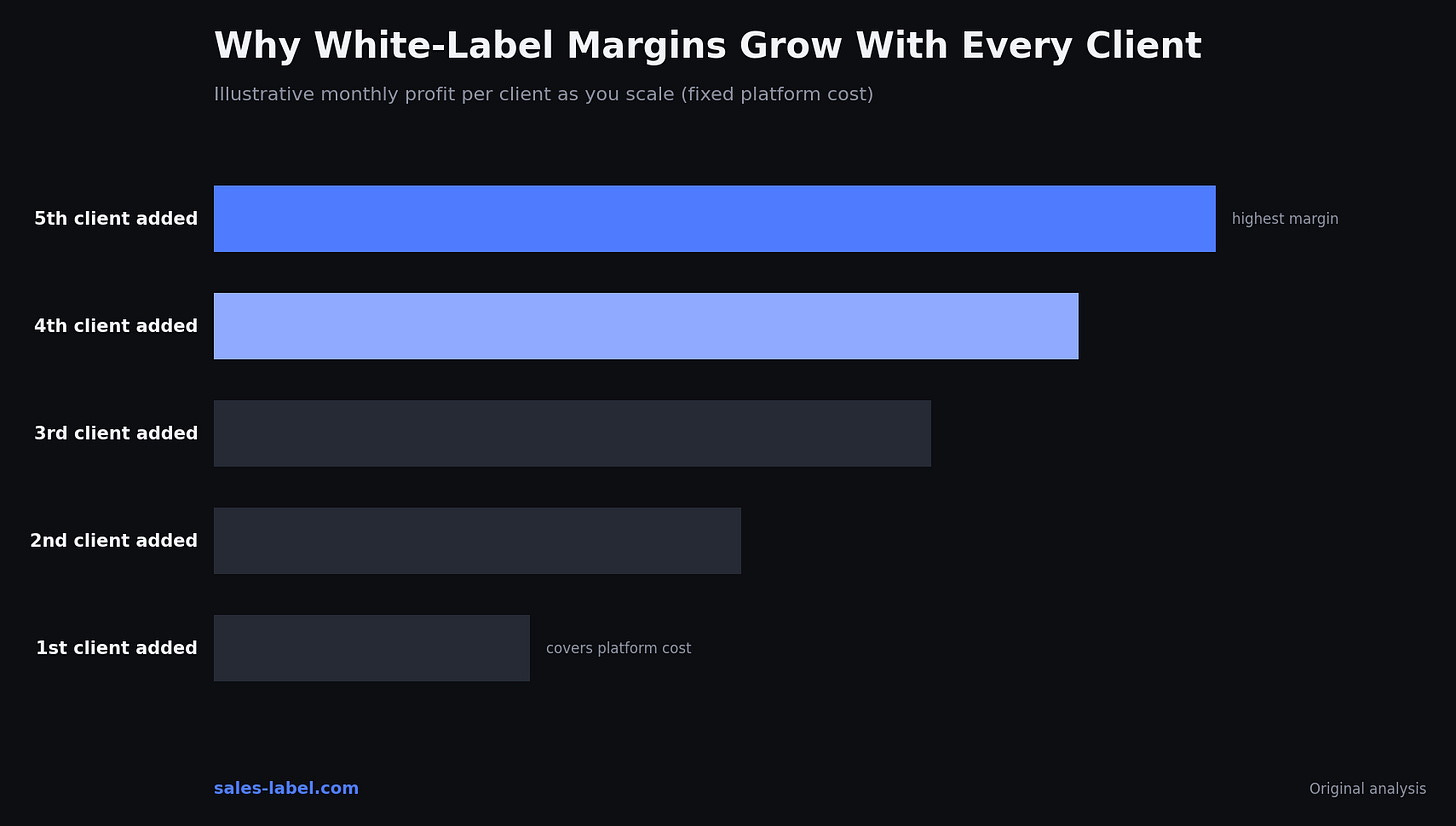
The chart above shows why the numbers work. When the platform cost is fixed and you add clients on top, each new account drops far more into your pocket than a service you deliver by hand.
How a white-label lead generation partnership works
The mechanics are simpler than most agencies expect. A strong partner gives you a branded platform, the data to find ideal customers, and the automation to reach them.
1. You brand the platform
Your logo, your colors, your domain. Clients log in to what looks like your own software. Our white-label platform is built to disappear behind your brand so the experience feels native.
2. The engine finds and reaches leads
The platform builds targeted prospect lists, then runs personalized outreach across email and LinkedIn. Replies and booked meetings flow into a dashboard your client checks anytime. The AI features handle the heavy lifting of targeting and personalization.
3. You own the relationship and the margin
You handle onboarding, reporting, and strategy calls. You bill the client directly. The partner stays invisible. See exactly how the model runs on the how it works page.
The agencies that win with white-label do not sell software. They sell outcomes, booked meetings, and let the platform stay invisible.
How to price white-label lead generation
Pricing is where agencies leave money on the table. A simple, healthy structure has three parts:
Setup fee. A one-time charge to onboard the client, define the ideal customer, and warm up sending. This covers your upfront work.
Monthly retainer. Your recurring price for managing the campaign. This should comfortably exceed your platform cost per client.
Performance upside. An optional bonus per qualified meeting or closed deal, which aligns you with the client's growth.
A common mistake is pricing on cost plus a small markup. Price on the value of a booked meeting to your client instead. If one closed deal is worth thousands to them, a retainer that reliably books meetings is an easy yes.
What to look for in a white-label partner
Not all partners are equal. Before you sign, check these five points:
True branding control. Can you fully remove the vendor's name from every screen and email?
Data quality. Are the leads accurate and compliant, or a stale list?
Deliverability. Does the partner protect sending reputation so your clients' messages land?
Support. Will they help you when a client has a hard question?
Fair pricing. Does the wholesale price leave you a real margin at a price clients will pay?
Get these right and the partnership runs itself. Get them wrong and you inherit the vendor's problems in front of your clients.
Which clients are the best fit for white-label lead generation
Not every client is a strong match, and picking the right ones early keeps your delivery smooth. The best-fit clients share a few traits. They sell to other businesses, so targeted prospecting works. They have a clear ideal customer, so the engine has something to aim at. And they value a booked meeting highly enough that a retainer is easy to justify.
Professional services firms, B2B software companies, consultancies, and other agencies are classic fits. They need a steady flow of qualified conversations but rarely want to build an in-house prospecting team. That is exactly the gap your branded service fills.
Two mistakes to avoid when you launch
Mistake one: promising volume instead of quality. New agencies sometimes sell "hundreds of leads a month." Buyers do not want raw leads; they want meetings with the right people. Anchor your offer on qualified conversations, not list size, and you will keep clients far longer.
Mistake two: underpricing to win the first deal. A retainer that barely clears your platform cost leaves no room for you to deliver great service. Price for the value of the outcome from day one. It is much harder to raise a price later than to set it correctly now. A confident, value-based price also signals that you deliver a premium service, which is exactly the impression you want a new client to have.
Frequently asked questions
Is white-label lead generation profitable for a small agency?
Yes. Because the platform cost is fixed, margins improve with every client you add. Many small agencies reach strong recurring revenue within a few months.
Will my clients know I use a partner?
Not if the partner offers true white-labeling. The platform, dashboard, and emails all carry your brand, so the client only ever sees you.
How fast can I launch a white-label lead generation service?
With a ready platform, most agencies launch a branded service in days. The slow part is defining your offer and price, not the technology.
What is the difference between white-label and reselling?
Reselling passes along another company's branded product. White-label lets you rebrand it as your own, so the value and the client trust build under your name.
The bottom line
White-label lead generation is one of the fastest ways for an agency to add recurring revenue without building software or hiring a big team. Pick a partner with real branding control, clean data, and strong deliverability, price on value, and the model compounds. To see how a branded engine could work for your agency, explore how it works or book a demo to become a partner and start adding recurring revenue this quarter.