Package white-label SaaS as agency subscriptions: run a paid pilot, price for platform + delivery and support, and scale only after renewals.
SalesLabel Team
Growth Expert • 4.11.2026
Share:
Szukasz gotowego rozwiązania?
SalesLabel automatyzuje prospecting od początku do końca — AI znajduje potencjalnych klientów, wysyła spersonalizowane wiadomości i rezerwuje spotkania pod Twoją marką.
White-label SaaS lets you sell software under your own brand without building it - but monthly revenue isn’t the same as profit. I’d start with one 30- to 60-day paid pilot, define what’s included, and price it to cover software, labor, usage, and support.
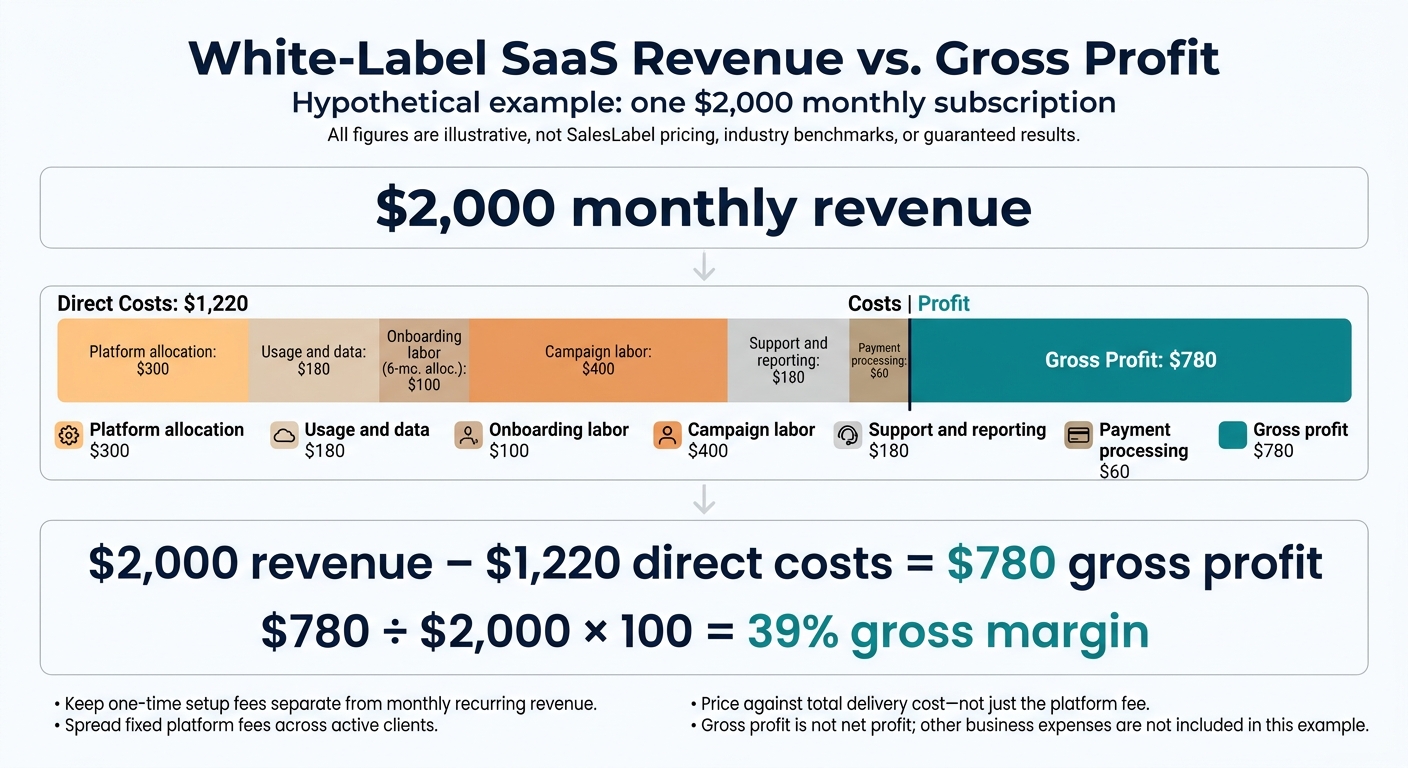
The math matters: in the article’s hypothetical example, a $2,000 monthly subscription with $1,220 in direct costs leaves $780 in gross profit - a 39% gross margin.
Here’s the approach I’d use:
Set the offer: Choose software access, software plus support, or a managed service. Separate setup fees from recurring charges.
Check SalesLabel: Confirm features, branding, resale rights, account limits, pricing, and support terms in writing.
Run the pilot: Agree on targeting, outreach limits, approvals, reply handling, reporting, and cancellation terms.
Protect the client relationship: Follow outreach rules, control data access, and test exports before relying on the provider.
Scale only after renewals: Track results, delivery costs, and support hours - not just subscription sales.
My rule: <u>prove the service earns renewals and leaves a margin before adding clients</u>. Building your own software can wait until you know what you need to control.
How White-Label SaaS Supports Agency Subscriptions
White-label SaaS turns software access into subscription revenue when your agency bundles it with setup, support, and reporting. Keep one-time setup fees separate from monthly recurring revenue.[5][6] From there, define your pricing, scope, deliverables, and usage limits.
What the Provider and Agency Handle
The provider runs the core application, infrastructure, updates, integrations, and technical maintenance. Your agency handles sales, pricing, permitted branding, onboarding, frontline support, performance reviews, and renewals. Put simply: the provider owns the platform; your agency owns the client relationship.[6]
Before you sell, get written confirmation of resale rights under the provider’s branding and resale terms, account limits, billing authority, data ownership, and support commitments. Document who handles outages, integration failures, data requests, and cancellations. Don’t promise clients more support or uptime than the provider agreement allows.[5][6]
White-Label Resale vs. Referrals and Internal Use
The difference comes down to what you sell and who manages the software relationship. Buying a software account doesn’t automatically give you resale rights. The contract determines how you can use it.
Model
Client relationship
Branding
Billing
Support duties
Revenue model
White-label resale
Agency usually manages the commercial relationship
Agency branding where permitted
Agency generally bills clients and pays the provider
Recurring subscriptions, plus optional setup or service fees
Affiliate referrals
Provider usually manages the software account
Provider branding
Provider bills clients
Provider usually handles product support
Referral commission or revenue share
Internal software use
Agency manages the service relationship; clients may not get software access
Agency sells its service, not a rebranded platform
Agency bills for service delivery
Agency supports clients and escalates software issues
Retainers, project fees, or outcome-based fees
What Clients Pay for Each Month
With those roles settled, spell out what clients get each month. For a SalesLabel-based offer, that includes sourcing, enrichment, outreach, follow-up, meeting booking, and reporting.
Set limits for seats, campaigns, contacts, and messages, along with overage charges and rollover rules. Specify the support channel, business hours, response targets, and escalation path. Report activity and outcomes separately.[5][6]
sbb-itb-a781ab9
Design and Price Your Subscription
White-Label SaaS Revenue vs. Gross Profit
Turn the monthly deliverables from the previous section into clear billing terms. Each line in your scope sheet should help protect your recurring margin.
Define Scope, Deliverables, and Usage Limits
Create a scope sheet for each subscription. Spell out usage limits, overage rates, and whether unused capacity expires or rolls over. Set approval deadlines, and bill extra work before it starts.
Custom integrations, extra campaigns, and work beyond usage limits need written rates or a separate quote. Keep modules separate, and leave ad spend client-paid.
Hypothetical packaging example: A $1,500-per-month managed lead-generation subscription could include one branded workspace, up to 2,500 contacts sourced monthly, enrichment, three outreach sequences, AI-assisted reply triage, inbox monitoring, and a monthly report. The client approves targeting and messaging, provides sender-domain access, and handles qualified sales calls; CRM migration, custom integrations, appointment-closing services, and sales compensation are excluded.
Compare Subscription Service Levels
Subscription level
Delivery effort
Client duties
Value delivered
Gross-margin drivers
Complexity
Software-only
Workspace setup, branding, and documentation
Configure campaigns, manage data and inboxes, and interpret results
Access to branded tools and basic automation
Provider fee, usage, payment processing, and occasional support
Lowest; needs self-service workflows
Software-plus-support
Periodic optimization, office hours, and reporting
Run campaigns and handle most replies
Tools plus periodic optimization and guidance
Platform, support labor, meetings, and usage
Moderate; guidance demand can exceed assumptions
Managed service
Targeting, campaign setup, monitoring, optimization, reply triage, and reporting
Approve positioning, provide access, and handle qualified conversations
Done-for-you execution and an operating process
Platform, usage, onboarding, campaign labor, support, and payment costs
Highest; needs capacity planning, quality controls, and escalation rules
Choose your service level, then price it against the total delivery cost.
Calculate Delivery Costs and Gross Margin
Your monthly price needs to cover recurring delivery - not just the platform fee.
In a hypothetical $2,000 monthly subscription, direct costs could total $1,220: $300 platform allocation, $180 usage and data, $100 onboarding labor allocated across the first six months, $400 campaign labor, $180 support and reporting, and $60 payment processing. Gross profit is $2,000 − $1,220 = $780; gross margin is $780 ÷ $2,000 × 100 = 39%.[9][10][11]
Spread fixed platform fees across active clients. Before setting prices, model low-, expected-, and high-volume scenarios.
Set Monthly and Annual Billing Terms
Term
Monthly billing
Annual billing
Payment timing
Customer pays each month before or at the service period
Customer may pay the full term upfront or on an annual schedule
Cash flow
More predictable recurring collections but slower cash accumulation
Stronger upfront cash flow when prepaid
Commitment
Lower commitment and easier initial purchase
Higher commitment and fewer renewal events
Discounts
Usually no commitment discount or a smaller one
May include a discount that compensates for commitment
Cancellations
Define notice periods, pauses, refunds, and failed-payment handling
Define early termination, refunds, and whether unused service is forfeited
Renewals
Monthly renewal or automatic renewal each month
Annual renewal notice, renewal date, and price-change process
Show the implementation fee separately from the recurring charge:
Example: A $750 setup fee plus $1,500 per month.
A prepaid annual fee gives you cash upfront, but revenue is recognized over the service period.[7][8]
Use these pricing terms to check whether SalesLabel fits your target service level and margin.
Check your subscription scope to see whether SalesLabel supports the service level you’ve priced.
SalesLabel offers white-label, AI-powered software for agencies selling recurring lead-generation services. Your agency still owns strategy, client communication, and service quality. SalesLabel supplies the delivery infrastructure; it doesn’t guarantee revenue or booked meetings.[1]
Match SalesLabel Features to Client Deliverables
Match each feature to a clear client deliverable. Lead sourcing and enrichment support researched prospect profiles. Personalized outreach and follow-ups support approved sequences. AI replies and inbox management help handle active inbox conversations. Real-time lead scoring helps prioritize replies, while meeting booking supports scheduling and handoffs.[1]
You still need to review targeting, data accuracy, messaging, sensitive replies, qualification decisions, and compliance. Confirm feature availability and approval controls before putting them in a client contract.[1]
Plan Branding and Client Workflows
SalesLabel says agencies can use their own custom domain, logo, colors, and client-facing pricing.[1] Build your workflow around those options, from branded intake and written approvals to reporting, support, and offboarding.
Before selling dashboard access, ask SalesLabel to show you client separation, reporting permissions, inbox roles, and approval workflows. Check notifications and client-facing pages for provider branding, too. Don’t assume every touchpoint is white-labeled. Verify that these controls fit your delivery process before pricing the offer.
Compare SalesLabel Plans and Pricing
Compare plans against your delivery capacity, approval process, and support workload. The details below come from the supplied materials, but account limits differ across sources. Get current limits in writing before committing.[2][3]
Plan
Listed monthly price
Listed LinkedIn-account capacity*
Listed features
Starter
$799/month
Up to 30
Full AI prospecting system, agency branding, AI replies, setup help, email support
Growth features, documentation center, biweekly strategy calls, dedicated success manager
*LinkedIn-account capacity is not client capacity. Verify current prices, usage limits, and fair-use rules before choosing a plan.
Once the plan fits your scope and margin, move to a paid pilot with one client.
Launch Your Offer and Retain Clients
Test One Offer With a Paid Pilot
Start with one segment that has recurring demand, a clear buyer, accounts you can reach, and budget. Before pitching, ask about deal value, sales-cycle length, past outreach results, and the sales team’s capacity to follow up.
Sell a 30- to 60-day paid pilot. Define the audience, contact cap, approved messages, who handles replies, reporting schedule, and cancellation terms. Agree on success measures before launch: qualified replies, sales-accepted leads, meetings booked, and response time. Assess the pilot by its performance and delivery cost - not promises of guaranteed leads, meetings, or sales.
Standardize Onboarding and Service Delivery
Collect the client’s legal name, audience criteria, exclusions, suppression lists, and approved claims. Get the required access to inboxes, the CRM, and calendars.
Use one delivery checklist: verify data, get campaign approval, launch a limited test, monitor deliverability, review replies, qualify prospects, and hand off meetings. Every handoff should include conversation history, qualification notes, a meeting time, and an owner.
Report booked and attended meetings separately. Requests outside the agreed scope need a change order.
Measure Revenue and Service Performance
Use pilot data to check whether the subscription still meets the margin built into your price. Track MRR, gross margin, customer churn, renewal rate, CAC, ARPA, meetings booked, qualified-lead rate, and support hours per account. Use one fixed denominator for qualified-lead rate so comparisons stay consistent.
Review these metrics monthly to spot delivery problems before they eat into recurring revenue.
Problem signal
Metrics to inspect
Corrective action
Low reply rates
Delivered messages, positive-reply rate, bounce rate, and unsubscribe rate
Refine the segment and offer, improve data quality, test messaging, and check deliverability
Poor lead quality
Qualified-lead rate, disqualification reasons, sales-accepted rate, and meeting-attendance rate
Tighten audience filters, revise qualification rules, and retrain reply handling
Missed responses
Median response time, unanswered-reply count, and follow-up completion rate
Assign an owner, configure alerts, and set an escalation procedure
High support effort
Support hours per account, tickets by category, rework hours, and gross margin
Reduce customization, add usage limits, improve onboarding, or reprice the service
Client churn
Logo churn, revenue churn, renewal rate, usage, unresolved issues, and outcome attainment
Conduct a recovery review, correct delivery gaps, adjust scope, or stop serving poor-fit accounts
Review Results Before Renewals
At least two weeks before billing, review the paid pilot’s agreed success measures to decide whether to renew, reprice, or exit. Check lead quality, service usage, client sales follow-up, and unresolved issues.
Compare performance by segment, message, and month. Review rejected or disputed leads, then confirm whether the client’s sales team contacted prospects and recorded outcomes.
If results are weak, find the cause before suggesting an upgrade. The issue could be poor targeting, an unclear offer, deliverability problems, slow client responses, insufficient sales capacity, or expectations that don’t match the scope. Clients may need qualification training, response-time guidance, or a revised handoff process.
Price scope changes separately, including added segments, inbox management, CRM work, or higher contact volume. Upgrades can help retain clients only when they address a documented need. Don’t use them to hide poor performance or avoid fixing service failures.
Manage Outreach Compliance and Client Data
Require human review of sensitive AI messages, keep approval records, and limit access. Set rules for data retention, deletion, and access revocation. Review provider terms covering subprocessors, security, breach handling, and permitted data use.
For email, follow CAN-SPAM: use accurate headers, clear subject lines, a physical address, a working opt-out, and process opt-outs within 10 business days.[4][13][14] Keep suppression lists synchronized across parties, and maintain opt-out mechanisms for at least 30 days after sending the message.[13][14] Apply the rules for each channel, recipient, and jurisdiction.[12]
Scale Delivery and Manage Provider Risk
Confirm Delivery Costs Before Expanding
A profitable pilot is the starting point - not a green light to add clients. Scale only after one offer proves profitable and repeatable. Check added staffing costs, onboarding capacity, and usage charges first. Delivery costs must still leave room for margin and support client retention at higher volume.
Watch support hours, usage against limits, and utilization. When they climb, review pricing or capacity rather than upgrading automatically. Delegate only documented tasks that run without constant founder input. If scope grows, adjust the price instead of absorbing the extra work.
Review Provider Reliability and Exit Terms
Once delivery is repeatable, check the provider contract before taking on more clients. With SalesLabel, get written confirmation of resale rights, branding permissions, usage charges, account limits, price-change notice, uptime terms, support hours, and escalation routes.
Uptime claims matter only when the contract spells out measurement, exclusions, and remedies. Track outreach deliverability separately: monitor bounce rates, complaints, opt-outs, domain reputation, and delivery interruptions.
Test exports before expanding. Confirm who owns the data, available export formats and fees, access to activity history and suppression lists, data retention and deletion terms, and termination assistance. Keep recent exports, configuration records, a manual fallback, and a client-notification process. Protect those exports and fallback processes so switching providers doesn't interrupt client service.
White-Label SaaS vs. Building Your Own Software
Once the model works, decide whether to keep renting software or build your own. Base the choice on what your agency needs to control - not price alone. Treat proprietary software as a later-stage capital decision, after the subscription model proves viable. White-label SaaS cuts core engineering work, but you're still responsible for delivery and provider management.
Factor
White-label SaaS
Building your own software
Launch speed
Existing platform; setup required
Design, development, testing, and deployment
Initial cost
Subscription, setup, integrations, and training
Engineering, infrastructure, security, and testing
Customization
Within supported features, APIs, and branding rules
Limited by allowances, account limits, and delivery capacity
Limited by architecture, infrastructure, and staffing
Differentiation
Expertise, configuration, service, and client experience
Can add proprietary capabilities
Risk exposure
Outages, price changes, restrictions, and export limits
Staffing gaps, technical debt, security, and upkeep
Conclusion: Test One Subscription Before Scaling
A white-label SaaS subscription takes more than branded software. You need a recurring client problem, clear monthly deliverables, and pricing that covers software, delivery, and support. Choose the platform to fit those needs - not the other way around.
Ready to test the model? Start with one 30- to 60-day paid pilot with SalesLabel for recurring lead generation. Before launch, define prospect criteria, outreach volume, who handles follow-ups, reporting, and support limits.
Track qualified replies, booked meetings, delivery costs, support hours, and margin to judge whether the offer earns a renewal. At renewal, pinpoint which results made clients want to continue. Expand only when clients renew and margins stay healthy. Otherwise, revise the offer before adding accounts.
FAQs
How many clients do I need to break even?
One or two clients can typically deliver a positive return on investment. A single client’s monthly retainer can cover your fixed software fee, helping you break even on the tool. Each client after that adds to your agency’s profit and growth.
Because platform costs stay fixed, your margins improve as you add accounts. Most agencies build strong recurring revenue within a few months by charging 3–5 times the platform’s wholesale costs.
How can I stand out with white-label software?
Deliver the full service under your brand, with a custom domain, logo, and client-facing dashboard. Automate sourcing, enrichment, outreach, follow-ups, and meeting booking to scale without adding headcount. Stand out with targeting based on your ideal customer profile, messaging that fits your brand, and documented standard operating procedures.
Build your offer around booked meetings and regular reporting, not just software access. Set your own pricing to protect your margins.
What if my pilot ends before leads convert?
Use SalesLabel’s real-time analytics to spot bottlenecks in reply rates, meeting volume, and lead quality. Let the data guide changes to your ideal customer profile, messaging templates, or outreach sequences.
Write standard operating procedures for follow-ups and lead handoffs so potential leads don’t slip through the cracks. Once the pilot delivers a clear win, turn it into a case study that shows future clients what you can do.