Use white-label lead-gen software to make results visible, reduce churn, increase MRR and turn services into recurring revenue.
SalesLabel Team
Growth Expert • 1.07.2026
Share:
Szukasz gotowego rozwiązania?
SalesLabel automatyzuje prospecting od początku do końca — AI znajduje potencjalnych klientów, wysyła spersonalizowane wiadomości i rezerwuje spotkania pod Twoją marką.
If I want to cut client churn, I need clients to depend on a system, not just my monthly work.
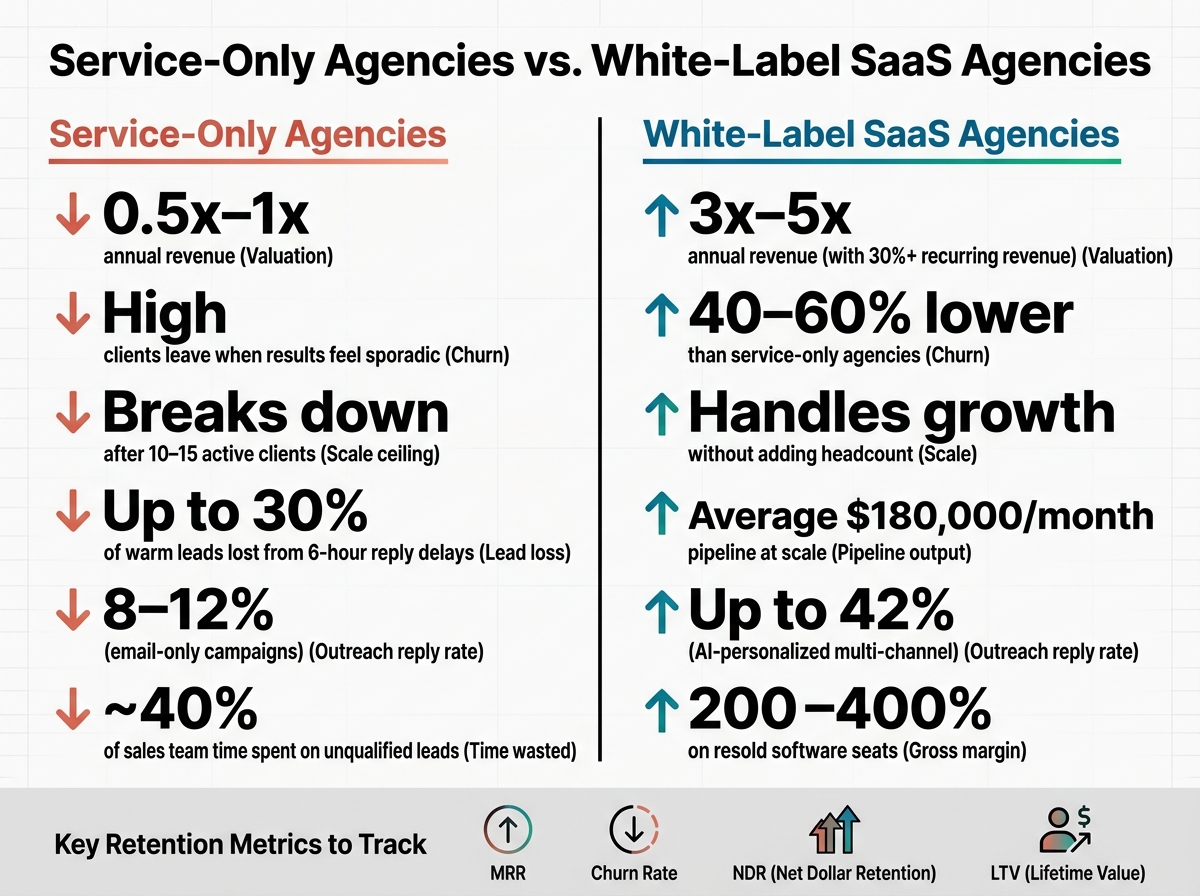
This article’s main point is simple: agencies that add white-label software to their service offer tend to keep clients longer because clients can see activity, use the platform, and tie results to a repeatable process. The article says service-only agencies often deal with shaky results, slow follow-up, and weak visibility. By contrast, agencies using white-labeled SaaS report 40%–60% lower churn, and firms that depend more on recurring revenue can reach 3x to 5x annual revenue in valuation, versus 0.5x to 1x for project-based shops.
Here’s the article in plain English:
I keep more clients when I give them a branded platform they log into, not just reports they read once a month.
Manual outreach often breaks down after 10–15 active clients, which can hurt delivery and client trust.
A 6-hour reply delay can cost up to 30% of warm leads.
Automated sourcing, follow-ups, booking, and inbox handling help keep pipeline activity steady.
Branded dashboards, custom domains, and role controls make my agency harder to replace.
Better retention improves MRR, LTV, and NDR, and makes revenue easier to predict.
I should watch churn signals like lower dashboard usage, slower lead response, more no-shows, and repeat support questions.
In short, I would read this article as a case for turning lead generation into a recurring software-backed offer, where clients stay because the system is part of how they run sales.
Service-Only Agencies vs. White-Label SaaS Agencies: Retention & Revenue Stats
The Client Retention Problem for Modern Agencies
How Churn Damages Recurring Revenue
High churn turns growth into replacement work. Instead of building monthly recurring revenue, agencies end up spending too much time filling holes left by departing clients.
That makes MRR much harder to forecast and grow. When churn stays high, planning gets messy too. Hiring, staffing, and expansion start to feel like guesswork. A pipeline that looks healthy one month can feel shaky the next.
Why Manual Outreach Does Not Scale
These retention issues often start with workflow limits.
Manual prospecting usually caps agencies at 10–15 active clients before service quality starts to slip [10]. Push past that range, and the cracks tend to show fast: slower turnaround times, missed follow-ups, and messaging that feels generic.
The follow-up issue is a big one. A 6-hour delay can cost up to 30% of warm leads[10]. On top of that, manual methods eat up about 40% of a sales team's time on unqualified leads because there's no automated scoring in place [10].
When the workflow starts breaking down, results often slip with it. Clients may not always know the exact reason, but they feel it.
Why Clients Leave When Value Feels Sporadic
Capacity limits also show up as inconsistency, and clients notice that right away.
They leave when progress feels hard to see. They leave when the work starts to feel uneven.
"Retention is mostly about confidence: the client believes progress is steady, quality is consistent, and priorities are being led - not improvised." - Ada Ani, Geeks for Growth [6]
That quote gets to the heart of it. Clients want to feel that the agency is steering the ship. If updates are vague or reactive, confidence drops. And when deliverables don't connect to a clear roadmap, the agency can start to feel replaceable.
Here's how common operational gaps show up on the client side:
Operational Gap
How It Affects the Client
No visible progress
Client feels momentum has stalled; anxiety rises [6]
Inconsistent delivery
Quality swings and slipped timelines create distrust [6]
This is the pattern agencies have to fix. Not with more patchwork, but with a system that keeps progress visible, delivery steady, and communication clear.
sbb-itb-a781ab9
How White-Label Lead Generation Software Supports Retention
What White-Label Lead Gen Software Does for Agencies
White-label lead generation software gives agencies a platform they can present as their own: custom logo, custom domain, and custom pricing. Behind the scenes, the software handles sourcing, enrichment, outreach, follow-ups, and booking, so the agency can deliver more without adding headcount.
That shifts the agency's role. Instead of looking like just another vendor, the agency becomes the system the client's sales pipeline runs on. And that makes the agency much harder to swap out. This matters most when those features lead to steady, visible pipeline activity that clients can see for themselves.
How Always-On Lead Delivery Keeps Clients Longer
Retention gets better when clients can see movement every week, not just during monthly reporting.
Software doesn't forget follow-ups. It doesn't slow down when the team gets slammed. Clients keep seeing booked meetings, pipeline movement, and live data week after week. That kind of steady output, paired with visible pipeline activity, lowers the odds of cancellation.
"Marketing agencies with a white-labeled SaaS product report 40–60% lower client churn rates than service-only agencies. Once a client's pipeline and automations live in your platform, cancelling means losing everything." - LeadSpheres [5]
That's the part that keeps clients paying: the work keeps moving, and the client can see it.
SalesLabel is one example of how this model works in practice.
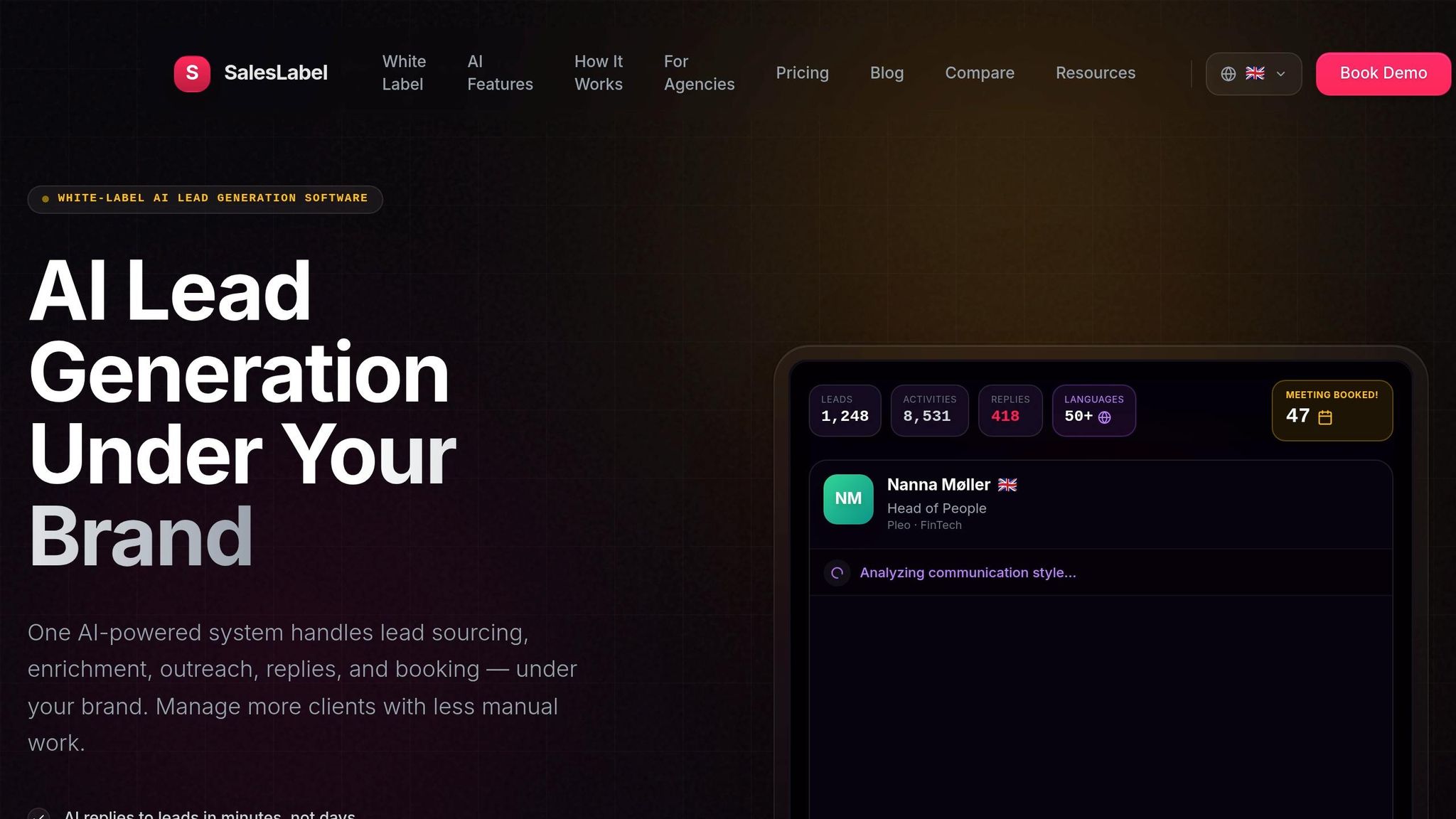
SalesLabel is an AI-powered lead generation platform that agencies launch under their own brand. Its retention value comes from always-on automation, branded client-facing dashboards, and multi-channel outreach across email and LinkedIn. Clients see pipeline activity under the agency's name, which keeps results visible and makes the agency harder to replace. AI-powered lead generation can lift average retainers by 40–80% [12].
Its retention value comes from the specific functions that keep delivery consistent and measurable.
Platform Features That Directly Affect Client Retention
Automated Sourcing, Enrichment, and Personalized Outreach
Once clients can see the work happening, the next step is keeping that work steady. Retention tends to improve when clients see pipeline activity month after month, not just in short bursts. Automated lead sourcing keeps qualified prospects coming in, enrichment adds the contact and firmographic details needed for relevant outreach, and personalized messaging helps each email or LinkedIn message feel like it was written for a person, not blasted to a list.
That shows up in performance. AI-personalized multi-channel sequences can reach 42% reply rates in top-performing campaigns, while email-only campaigns often level off at 8–12%[8]. Clients notice that difference fast when they review monthly reports. If the pipeline keeps moving and the numbers trend up, renewal talks get a lot less tense.
SalesLabel includes sourcing, enrichment, verification, multi-channel outreach, reply handling, booking automation, reporting, and branded client dashboards [3]. Agencies running white-label outbound at scale average $180,000 in pipeline per month, with 25–40% net margin on the service side [8].
Follow-Ups, Booking, and Inbox Management
The next big lever is speed. Replies, bookings, and inbox handling all shape whether momentum turns into meetings or fizzles out.
Automated follow-up sequences shorten the gap between a prospect's reply and the agency's response, which cuts the odds of a lead going cold. Booking automation turns a positive reply into a scheduled meeting without waiting on a person to jump in. Reply classification sends messages to the right person on its own, so nothing gets lost in a shared inbox. And centralized inbox handling lets one team manage multiple client accounts from a single view, which keeps things tidy as the agency grows.
Clients can see these functions at work in real time. More replies keep moving, more meetings get booked, and fewer conversations slip through the cracks. That matters because dropped conversations don't just hurt results - they also chip away at trust.
"When clients see consistent meetings booked, they don't leave." - SalesMind AI [12]
Branding, Access Control, and Pricing Flexibility
Workflow matters, but branding and account control also make a platform tougher to swap out. A custom domain, the agency's logo, and a fully branded client dashboard make the setup feel like the agency's own system. Clients aren't logging into some outside tool with someone else's name on it. They're using your system, and that tends to pull the relationship closer while making a switch feel more costly.
Role-based access controls keep client accounts separate and cut down admin work as more accounts come on board. Agencies can sell the platform as a retainer, a per-seat subscription, or a hybrid offer [8]. SalesLabel lets agencies choose their own pricing and keep 100% of the margin they charge clients [3]. Those features matter most when the agency turns them into a repeatable model clients can stick with.
How to Build White-Label Lead Generation Into a Retention System
Bundling Retainers with Platform Subscriptions
Once the platform is live, retention comes down to packaging, launch, and review.
A smart move is to bundle branded software access into the retainer. That way, clients aren’t just paying for execution. They’re also paying for the platform they use month after month. A simple place to start is with three tiers: an infrastructure tier, an automation tier, and a full revenue OS tier. Each one maps to a different pipeline goal, and each one gives the client a clear result [5].
"The opportunity isn't 'sell software because SaaS is hot.' It's simpler than that. If your agency keeps delivering the same operational outcome for clients, white label SaaS lets you package that outcome into something scalable, branded, and much easier to defend." - Double My Leads [7]
Onboarding Clients for Fast Early Results
The first 30 days shape the whole client relationship. If the start feels slow or messy, churn can show up fast. That’s why onboarding needs to move with purpose and show visible progress early.
A structured 21–35 day launch sequence works well: define the ICP and build the target list, set up and warm up email and LinkedIn accounts at the same time, load the first 200–500 prospects into the system, run A/B copy tests, and hit daily outreach targets so meetings are booked by week four [8].
In the first week, a quick lead audit can do a lot of heavy lifting. It shows clients where leads are slipping through the cracks. Then, when you attach the software service that fixes those gaps right away, clients have a concrete reason to stay engaged before the pipeline is fully in motion [2]. Those early wins make the platform feel hard to replace.
That early traction also sets up the monthly review cadence.
Running Monthly Reviews Around Pipeline Results
Once the system is running, the monthly review becomes the main retention lever. When handled well, it moves the client’s focus away from “what does this cost?” and toward “what is this producing?”
The most useful reviews split activity metrics from pipeline metrics. Activity metrics include sends, opens, and replies. Pipeline metrics include positive replies, meetings booked, opportunities created, and cost per meeting. Activity numbers show that the system is running. Pipeline numbers show that it’s helping the client’s business. When agencies connect both inside their branded platform, clients get a clear monthly view of ROI [4].
Starting in week five, a steady optimization loop helps keep results moving in the right direction. That includes reply-rate tuning and industry-specific copy updates between reviews [8]. Those performance changes feed the retention metrics used to guide renewals and pricing decisions.
Tracking Retention and Recurring Revenue Over Time
The Revenue Metrics That Matter Most
Once clients start using the branded platform, you need to watch the numbers that hint at renewals before renewal talks even start.
Focus on four core metrics: MRR, churn rate, NDR, and LTV.
MRR gives you a steady baseline for recurring income. Churn rate shows how fast revenue or accounts are slipping away. NDR folds in both expansion revenue from upsells and losses from cancellations, so it’s one of the best ways to see whether recurring revenue is stacking up over time. LTV changes how you look at acquisition cost and renewal value. When retention gets better, the projected value of each account goes up too.
AI-native companies can reach 132% NDR; median gross revenue retention in SaaS is 92%[14].
Those numbers give you the big-picture view. After that, the job is to spot accounts that are starting to drift.
How to Spot At-Risk Accounts Before They Churn
The clearest red flag is a drop in dashboard usage.
But that’s not the only thing to watch. Inside the client dashboard, pay attention to three signals: response times climbing above 5–30 minutes[9], no-show rates increasing without recovery follow-up [9], and more repeated setup or support questions [7]. In many cases, those signs point to weak adoption, not a hard product problem.
The table below shows the main indicators to track by category:
It also helps to set up automated churn-risk alerts inside the CRM. Triggers like login drops or falling lead-to-opportunity conversion can flag trouble early, before a client brings it up on a renewal call [9].
Using Performance Data to Refine Pricing and Retention
Platform data does more than prove ROI. It can also show when a pricing tier no longer fits how the client uses the product.
Usage data helps you spot the right time for an upgrade and avoid plan mismatch. If a client on a Starter tier keeps hitting outreach limits and booking more meetings than the plan can support, that’s a natural opening for an upgrade talk. It’s also a retention issue, because when clients outgrow a plan, they need a clear next move.
You should also keep an eye on margin creep. Agencies running white-label software often see 200–400% gross margins on resold software seats [8]. But those margins can shrink fast when a small number of clients need constant custom setup or support [7]. Looking at support ticket volume against each client’s revenue contribution can help you spot accounts that cost a lot to run compared with what they pay.
White Label Your Own High Level/ LeadConnector App for Maximum Client Retention
Conclusion: Making Lead Generation Software a Retention Asset
The shift is simple: retention gets better when clients rely on the platform, not just the service.
Agencies that stop selling hours and start selling a branded operating system change the game. They no longer compete on deliverables alone. They compete on infrastructure. When a client's pipeline, outreach sequences, and performance data all sit inside your platform, leaving isn't just a vendor change. It means giving up the system they use to generate leads and book meetings.
That’s why this model sticks. Agencies with a white-labeled SaaS product report 40% to 60% lower client churn rates than service-only firms [5]. And as repeat usage goes up, revenue gets more predictable and easier to value.
The math is hard to ignore. Firms with at least 30% recurring revenue are valued at 3x to 5x annual revenue, while project-based shops are valued at only 0.5x to 1x[13].
That kind of stickiness does more than cut churn. It increases the agency’s value. Building recurring revenue through a platform like SalesLabel - which handles sourcing, enrichment, personalized outreach, follow-ups, and meeting bookings under your brand - can increase what your agency is worth, not just what it brings in each month.
Winning agencies sell outcomes: a full pipeline, booked meetings, and a system that runs without constant manual oversight.
White-label lead generation turns client retention into infrastructure, recurring revenue, and higher agency value.
FAQs
How does white-label software reduce churn?
White-label software can cut churn because it puts your brand inside a client’s day-to-day work. Once clients use your branded platform for lead generation, CRM data, and reporting, replacing your agency isn’t a simple swap. It means messing with core parts of how they operate.
That changes your position, too. You’re no longer just a service provider they can drop and replace. You become an embedded tech partner tied to the systems they use every day. And when that happens, switching costs go up while your long-term value becomes much harder to ignore.
Tools like SalesLabel help make this stick with automated outreach and lead scoring.
When should an agency add a branded platform?
An agency should add a branded platform when it keeps solving the same workflow problem for clients over and over, like lead generation, outreach, or pipeline management.
That’s usually the signal: the work is no longer just a service. It’s a repeatable system.
This move makes the most sense when the agency wants to shift from a transactional service provider to an embedded platform partner. Done well, it can improve retention, help the agency scale operations without adding headcount at the same pace, and create recurring subscription revenue.
Which retention metrics should I track first?
Start with the metrics that show both campaign performance and client value:
Lead conversion rates
Meeting-booked rates
Reply rates
Then track churn and recurring revenue stability. If SalesLabel becomes part of a client’s daily workflow, it can increase switching costs and support stronger long-term retention.