Stop treating all clients the same—rank accounts by buying intent with a simple Hot/Warm/Cold score to boost cross-sell revenue and protect retention.
SalesLabel Team
Growth Expert • 31.7.2026
Share:
Leter du etter en ferdig løsning?
SalesLabel automatiserer utgående prospektering fra A til Å — AI finner potensielle kunder, sender personaliserte meldinger og booker møter under ditt merke.
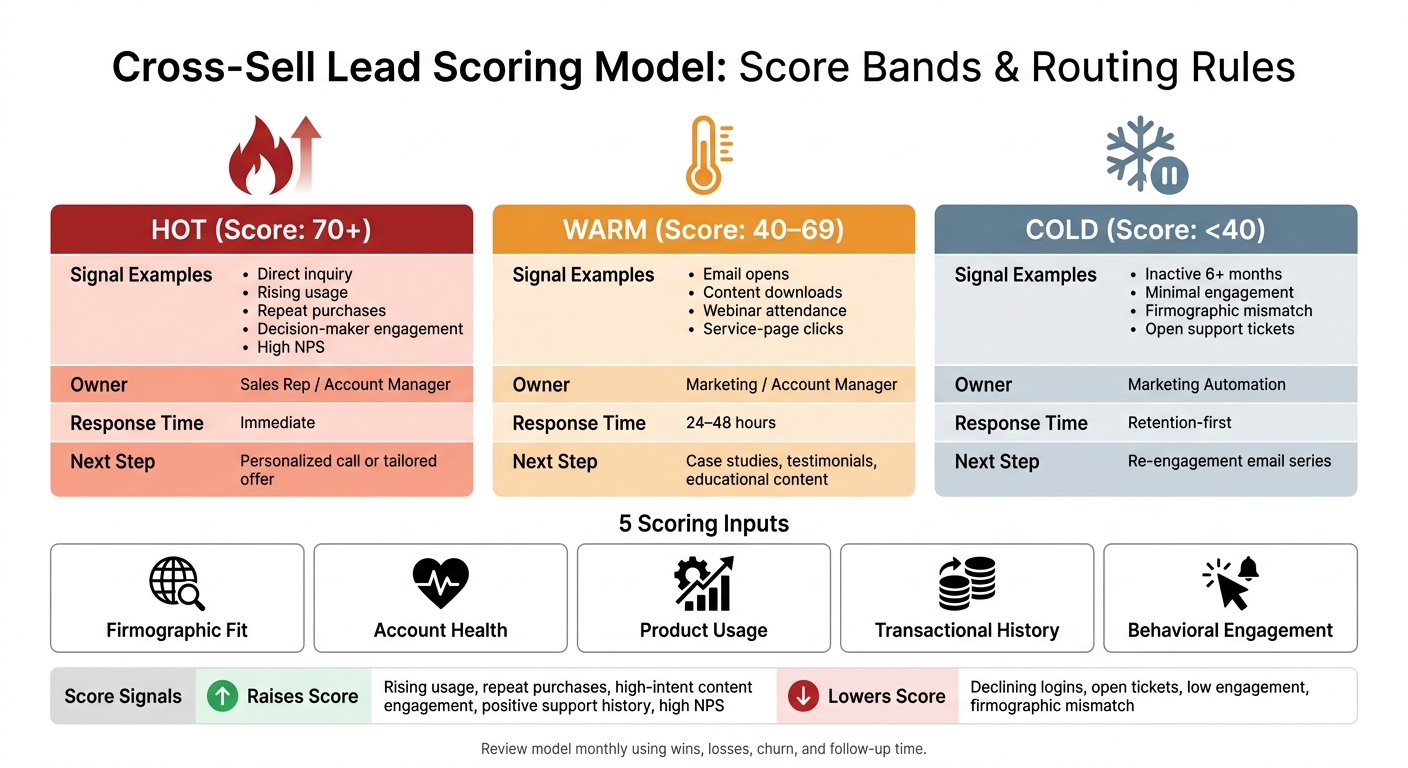
Most agencies miss cross-sell revenue because they don’t rank current clients by buying intent. I’d fix that with a simple scoring model that sorts accounts into Hot (70+), Warm (40–69), and Cold (<40) based on five inputs: fit, account health, usage, purchase history, and engagement.
Here’s the short version:
Score what matters most: rising usage, repeat purchases, service-page clicks, webinar attendance, NPS, and support history
Lower the score when usage drops, tickets stay open, engagement is low, or the client is a poor fit
Route each score band to one owner with one next step
Move fast: follow up with Hot accounts right away, Warm accounts in 24–48 hours, and Cold accounts with re-engagement
Review the model every month using wins, losses, churn, and follow-up time
In plain English: I wouldn’t treat every client the same. I’d focus on the accounts already showing buying signals, pause sales pushes when retention risk is high, and use CRM rules so no account gets missed.
A few numbers from the article matter most:
3 score bands keep the process simple
5 input groups shape the score
24–48 hours is the target window for Warm-account follow-up
6+ months inactive is a common Cold-account sign
The goal is simple: better timing, better routing, and more expansion revenue from the clients you already have.
Cross-sell propensity scoring made easy
sbb-itb-a781ab9
Why Cross-Sell Opportunities Are Hard to Spot
Agencies are usually pretty good at scoring new leads. Existing clients? That’s where things often fall apart.
In many teams, there isn’t one shared definition of a cross-sell opportunity. There’s no scoring rubric, no common way to mark when an account is ready to grow, and no clear process for what happens next. That gap leads straight to missed cross-sell revenue.
Common Gaps in Existing Client Workflows
Purchase data, upgrade data, and engagement data often sit in different systems. So account managers end up seeing only part of the picture.
Then there’s the handoff issue. Sales and account management both interact with the client, just at different stages of the relationship. But the person who owns cross-sell opportunities is often unclear. And when ownership is fuzzy, signals slip through the cracks.
Support data is another major blind spot. Feature requests, repeat complaints, and unresolved tickets can point to very real pain points. But that info usually doesn’t make it to the account manager in time to act on it.
How Poor Prioritization Affects Retention
When teams have no way to rank accounts by readiness, they fall back on treating every client the same.
That creates a pretty common problem: high-intent accounts get the same generic outreach as low-intent accounts. As you’d expect, that leads to slower decisions, missed timing, and weaker retention.
Poor prioritization also burns time. A scoring system helps teams separate low-intent accounts from clients that are ready to expand, so they can focus on the right accounts first.
Once those blind spots are out in the open, the next move is to score the signals that matter most.
Lead Scoring Inputs for Cross-Sell Readiness
Not every signal deserves the same weight. A client who opens one email is not in the same bucket as a client whose usage is climbing and who’s showing interest in a related service.
That’s the whole point of a cross-sell score: separate accounts that may be ready now from accounts that should wait. A simple way to do that is to look at five inputs:
Firmographic fit
Account health
Product usage
Transactional history
Behavioral engagement
From there, the job is to assign more weight to the signals that point to buying intent and less weight to weak or noisy activity.
Signals That Raise a Score
The strongest inputs usually show two things: adoption and intent.
Rising product usage is one of the clearest signs. More logins and more feature adoption often mean the client is getting real value from what they already use. And when that happens, an added service can feel like a natural next step instead of a forced upsell.
Transactional patterns matter too. Repeat purchases, larger order size, and higher purchase frequency all suggest a client is leaning in. Those actions show momentum.
Behavior adds another layer. High-intent engagement with service-specific content - like clicking related service emails, attending webinars, or downloading case studies for a service they don’t yet use - can signal active interest, not casual browsing.
Account health also plays a big part. A client with few unresolved tickets and positive sentiment is usually in a much better place for an expansion conversation.
Signals That Lower a Score
Some signals say the opposite. They don’t mean “never.” They mean not now.
Declining usage is one of the clearest warning signs. If a client is logging in less often or using fewer features than they were six months ago, they likely haven’t gotten full value from what they already have. Pushing a cross-sell at that point can hurt retention instead of helping growth.
Support history matters for the same reason. An account with open complaints or repeated tickets needs a retention conversation before it needs a sales pitch. If the house is on fire, you don’t offer a room addition.
Low engagement across channels should also pull the score down. The same goes for firmographic mismatch. Accounts that are inactive or a poor fit are often better served by re-engagement work than by an immediate cross-sell push.
As Aditya Anand, MBA | Ex-Consultant @ Accenture, puts it:
"Cold leads have the lowest scores and are not likely to buy from you; they have shown little or no interest or fit with your offerings." - Aditya Anand, MBA | Ex-Consultant @ Accenture [1]
Here’s the scoring logic in one view:
Signal
Category
Score Impact
Rising usage / feature adoption
Product Usage
↑ Raises score
Repeat purchases, larger order size, higher frequency
Transactional History
↑ Raises score
High-intent engagement on service-specific content
Behavioral Engagement
↑ Raises score
Positive support history, high NPS
Account Health
↑ Raises score
Declining logins or feature usage
Product Usage
↓ Lowers score
Open or unresolved support tickets
Account Health
↓ Lowers score
Little or no engagement across touchpoints
Behavioral Engagement
↓ Lowers score
Firmographic mismatch (industry, company size)
Firmographic Fit
↓ Lowers score
Once these inputs are set, the next move is to turn them into score bands and thresholds.
How to Build a Cross-Sell Scoring Model
Cross-Sell Lead Scoring: Hot, Warm & Cold Account Routing Guide
Use the signals above to turn account readiness into a clear routing rule. A cross-sell model gives weight to account health, product usage, purchase history, and timing to show expansion readiness. That way, teams can act before account health starts to slip.
The good news? This doesn't need to get complicated. Start with a simple setup that tells your team exactly what to do next.
Define Score Bands and Thresholds
You only need three bands to get started: Hot, Warm, and Cold. Accounts scoring above 70 are Hot, scores from 40 to 69 are Warm, and anything below 40 is Cold. [1]
Hot accounts show strong fit and clear intent. That can mean strong account health, rising usage, repeat purchases, or engagement from decision-makers. These accounts are ready for a direct, personalized offer.
Warm accounts show interest, but the timing isn't there yet. They often need nurturing and education first, like case studies, testimonials, or webinars, before a pitch makes sense.
Cold accounts show little interest or weak fit. Hard-charging outreach here usually burns time, so it's better to focus on re-engagement or keep an eye on them until conditions shift.
The aim is simple: this score triggers this action. As Judith Breisch, Analytics and Business Intelligence Professional, puts it:
"For cross-sell/up-sell, I'd first start with account scoring/health and second, the best decision-makers/buying group." [1]
Use Past Outcomes to Improve Accuracy
Past results are one of the best inputs in a cross-sell model. Closed-won expansions and lost reasons can show which signals actually connect to revenue. [1][3]
Pay attention to product pairings and timing patterns that show up again and again in your data. If clients keep mentioning a future need in reviews or support calls, that signal should carry more weight. If renewal dates or annual reviews keep opening the door to new services, treat those lifecycle moments as triggers. [3]
"Monitoring and optimizing the lead scoring system is crucial for its effectiveness... Feedback from the sales team and customers helps align the scoring system with expectations." - Wasif Khan, Commercials Leader [1]
Sales team feedback matters just as much. They're in these conversations every day, so they'll spot gaps between the score and what's happening on the ground much faster than a report can.
Automate Scoring with the Right Tools
Once your bands are in place, make the score update on its own so outreach follows the signal, not a spreadsheet. Automating scoring helps account teams see current priorities and next steps without manual spreadsheet updates.
SalesLabel can automate real-time scoring, follow-ups, inbox management, and branded outreach. That helps keep client follow-up timely and consistent under your agency's own brand.
Cross-Sell Priority Rules and Outreach Routing
A score only helps if it leads to a clear owner and a set response time.
That’s the whole point. If a team sees a score but doesn’t know who should act or how fast they should move, the score is just noise. Weak accounts should shift to retention-first handling before anyone pushes a cross-sell. And the score should do one more job: tell the team when to pause expansion and protect retention instead.
Who Owns Each Score Band
Ownership should match both the score band and the account’s complexity.
Hot accounts should go to a sales rep or account manager for fast, personal outreach. Warm accounts usually fit better with marketing or an account manager who can keep the relationship moving with educational content. Cold accounts should remain in automated re-engagement until intent gets stronger.
Account health and contact engagement matter too. A high-scoring account with simple needs may not need a rep at all. In that case, sending it into a self-service flow keeps things efficient and makes the buying experience feel smooth.
Follow-Up Actions by Score Range
Each score band should map to one owner and one next action.
Use the CRM to create tasks, update stages, and stop duplicate outreach after a reply or booked meeting. In other words, the CRM should route the next step - not just sit there as a place to store the score.
Retention Impact and Performance Review
A scoring model only matters if it helps your team grow accounts and keep customers longer. Once scores start driving routing, check the numbers and see if they’re moving expansion and retention in the right direction.
Core Metrics to Track
Focus on five metrics: expansion conversion rate, average revenue per account, retention rate, CLV, and speed to follow-up.
Expansion conversion rate tells you whether high-scoring accounts are turning into expansion wins. Average revenue per account shows whether current customers are spending more over time. Retention rate and CLV give you a better read on long-term account health and churn risk. Speed to follow-up also matters. A high-priority account can cool off fast if the team waits too long.
It also helps to watch referral rate and sentiment. Those signals can tell you whether your cross-sell efforts feel useful or too aggressive.
"The real profit comes from expansion revenue - upselling existing clients to higher tiers as they grow." - SalesLabel [2]
Why Regular Model Calibration Matters
When the numbers shift, the model can drift with them.
Scoring models change in accuracy as client behavior and service mix change. One thing to watch closely is false positives: accounts that score high but never convert. Check CRM lost-reason data for high-scoring accounts that went cold. If the same objections keep popping up, there’s a good chance one of your scoring signals carries too much weight.
You should also look for missed opportunities: accounts that converted without ever reaching a high score. That usually means the model still isn’t picking up enough buying behavior. Review conversion data and sales feedback each month so you can spot drift early. Then adjust weights and thresholds when needed.
"Regular updates ensure the scoring system remains relevant to changes in the market, products, or customer behavior." - Wasif Khan, Commercials Leader [1]
Conclusion: Build a Smarter Cross-Sell System
Once your scoring model and routing rules are set, the last piece is consistency. A lot of agencies lose cross-sell revenue for a simple reason: the signals are spread across tools, inboxes, and notes [3]. A scoring model pulls those signals into one clear process that teams can use again and again.
The goal isn’t more activity. It’s better timing. When scores guide routing and teams follow up fast, cross-selling starts to feel less reactive and a lot more predictable.
SalesLabel helps make that happen by combining real-time scoring with routed follow-up in one branded workflow. That means high-scoring accounts can get routed and contacted fast, without extra back-and-forth.
Start with the workflows that matter most:
Cross-sell follow-ups
Account-routing alerts
Renewal-triggered outreach
From there, keep the model tight, review results often, and let the highest-value accounts move first.
FAQs
How do I choose weights for each scoring input?
Set weights based on how much each input matters in your sales process. Put more weight on criteria that line up with your ideal customer profile and the value your product offers.
For example, assign more points to leads with a purchase history or clear product interest. Those signals often point to cross-sell potential.
Check performance on a regular basis, get input from your sales team, and adjust weights and thresholds as customer behavior and market trends shift.
When should I pause cross-sell outreach and focus on retention?
Pause cross-sell outreach for cold leads. They usually show low interest, weak fit, or both, which makes them far less likely to convert.
A better move is to re-engage inactive leads or open up new sales chances. SalesLabel helps agencies sort this work by automating lead sourcing and scoring, so teams can spend more time on higher-intent prospects while also supporting client retention.
What CRM data should feed a cross-sell score?
Use CRM data from four main areas:
Demographic and firmographic data, such as industry, company size, and job title
Behavioral data, like website visits, email engagement, and content downloads
Transactional data, including purchase history, order frequency, and product usage patterns
Psychographic markers, such as pain points and goals
Taken together, these data points help you spot fit, gauge interest, and match people with the most relevant complementary offerings.