Use AI behavioral scoring to rank high-intent leads from real-time site, email, and intent data—boost conversions and save sales time.
SalesLabel Team
Growth Expert • 25.5.2026
Share:
Leter du etter en ferdig løsning?
SalesLabel automatiserer utgående prospektering fra A til Å — AI finner potensielle kunder, sender personaliserte meldinger og booker møter under ditt merke.
AI behavioral scoring is transforming how sales teams prioritize leads by analyzing real-time actions like website visits, email clicks, and content downloads. Unlike traditional lead scoring, which relies on static data (e.g., job titles or company size), behavioral scoring focuses on what leads do, offering a dynamic view of their buying intent. This approach improves lead qualification accuracy from 10–15% to 35–50%, saving time and boosting conversions.
Key Takeaways:
What It Does: Tracks real-time behaviors (e.g., pricing page visits, demo requests) to identify high-intent leads.
Why It Matters: Reduces wasted effort on unqualified leads; sales teams save up to 40% of their time.
How It Works: Combines data sources like website activity, email engagement, and third-party signals to score leads dynamically.
Lead Tiers: Scores classify leads as Hot (SQL), Warm (MQL), or Cold, guiding outreach strategies.
Data Privacy: Ensure compliance with US regulations like CAN-SPAM, TCPA, and CCPA/CPRA.
This method allows agencies and sales teams to focus on leads most likely to convert while scaling personalized outreach efficiently.
Core Components of AI Behavioral Scoring Models
Key Data Sources for Behavioral Scoring
The effectiveness of AI behavioral scoring hinges on the quality and variety of data it uses. The best models pull from multiple sources to create a comprehensive view of a lead's buying journey.
Website activity is often the most telling data source, especially when it involves high-intent pages like pricing, demo requests, ROI calculators, or technical documentation. Email engagement comes next, tracking metrics like opens, clicks, replies, and even negative signals like unsubscribes or spam complaints. Beyond these, social signals - such as LinkedIn activity, recent posts, or interactions with company executives - add another layer of insight. Additional key inputs include meeting and event interactions (like webinar attendance or questions submitted during live sessions) and third-party intent data, which tracks research behavior across platforms like G2 or publisher networks [4][3].
For agencies managing campaigns across multiple clients, firmographic triggers are invaluable. These include external events like funding announcements, hiring for specific roles, or changes in a company's tech stack. Such signals often reveal buying opportunities that on-site data alone might miss [4][8]. Together, these diverse data sources fuel AI models, enabling them to deliver actionable lead scores in real time.
How AI Models Process and Score Behavior
After collecting the data, AI models don’t just tally up points - they dig deeper into the sequence, frequency, and recency of actions to gauge intent. For instance, a single visit to a pricing page is noteworthy, but a lead who reads a blog post, downloads a case study, and visits the pricing page twice within 48 hours sends a much stronger signal.
Machine learning techniques, like XGBoost and logistic regression, assign weights to these patterns based on their historical connection to closed deals [7][10]. These scores update in real time, ensuring sales teams always have the latest insights. However, managing score decay is crucial. Without it, outdated engagement data can inflate scores and clutter the pipeline with inactive leads. Typically, scores decrease by 10–20% every 30 days of inactivity [6][3].
Lucas Correia, CEO & Founder of BizAI GPT, explains this process succinctly:
"Behavioral lead scoring AI is the real-time GPS for your sales pipeline... analyzing a prospect's digital body language to predict their likelihood to buy with startling accuracy." [7]
What makes these models stand out is their ability to improve over time. By comparing predicted scores with actual outcomes, they refine their logic and uncover patterns that human analysts might overlook. Translating these scores into clear tiers allows teams to prioritize outreach effectively and allocate resources where they matter most.
Lead Scoring Tiers: Hot, Warm, and Cold
Behavioral scores become actionable when leads are grouped into tiers, each tied to specific outreach strategies. Most agencies use three main tiers:
Lead Tier
Score Range
Typical Behaviors
Recommended Action
Hot (SQL)
70–100
Visits to pricing pages, demo requests, views of integration docs
Immediate sales follow-up; aim for a 5-minute response time
Warm (MQL)
40–69
Case study downloads, webinar attendance, email opens
Enter into active nurture campaigns; provide tailored follow-up content
Cold
Below 40
Blog reads, homepage visits, social media clicks
Place in long-term nurture sequences or suppress from active outreach
These thresholds aren’t arbitrary - they’re defined collaboratively by sales and marketing teams to ensure alignment and trust in the scoring process. When definitions are unclear, the entire system risks falling apart. As House of MarTech notes: "If you are only tracking MQL volume, you are optimizing for the wrong thing. Volume without quality just burns SDR time."[3]
A useful enhancement is account-level aggregation. Instead of scoring individual contacts in isolation, combine signals across all stakeholders in the same organization. For instance, if three people from one company visit the pricing page within a week, that account should be flagged as "Hot", even if individual scores don’t reflect it [3][6].
sbb-itb-a781ab9
Setting Up Your Agency for Behavioral Scoring
Centralizing Your Data and Tools
To get started, gather all interaction data from your CRM, marketing automation tools, website analytics, and other platforms into a single, unified source. This consolidated view ensures your AI scoring system captures and processes every prospect interaction consistently and accurately [7]. Make sure every tool in your tech stack offers API connectivity, as this is essential for your AI system to ingest and standardize data effectively [7][4]. Take the time to audit your tech stack and confirm that all customer touchpoints are API-enabled.
Lucas Correia, CEO & Founder of BizAI GPT, emphasizes the importance of this integration:
"The mistake I made early on... is treating AI as a separate 'project.' It's not. It's the new central nervous system for your revenue operations." [7]
To enhance your scoring accuracy, link your CRM data with product usage metrics, support tickets, and billing information. Research shows that when multiple individuals from the same account engage simultaneously, conversion rates can increase by 3x to 5x [2]. By centralizing your data, you can track meaningful interactions across all channels with confidence.
How to Set Up Event Tracking Across Channels
Once your tools are connected, focus on tracking high-value intent signals like visits to your pricing page, demo requests, and trial sign-ups. Avoid logging every single click, as this can lead to unnecessary noise [11][2]. Use an event layer, such as a Customer Data Platform (CDP) or data warehouse, to normalize your data before pushing it into your CRM or marketing automation tools [11]. This event layer should use a primary key, like a CRM contact ID or email, to link anonymous interactions with known user profiles [11]. These key signals will feed directly into your AI scoring model and enable timely, personalized outreach.
Make sure your signal pipeline refreshes every 15 to 60 minutes to engage leads during their decision-making window [4]. Keep in mind that intent signals lose their value quickly, so speed is critical [4].
Data Privacy and Compliance in the US
After integrating and tracking your data, it’s crucial to stay compliant with US privacy regulations, especially when dealing with large volumes of lead information.
Email Outreach: Compliance with the CAN-SPAM Act requires truthful headers, a physical mailing address, and an easy-to-use opt-out mechanism [15][16].
Voice Campaigns: If you’re using AI-generated voices in campaigns, be aware of the FCC’s February 2024 ruling. This regulation classifies all AI-generated voices as "artificial" under the Telephone Consumer Protection Act (TCPA). You’ll need prior express written consent before making any marketing calls. Violations can result in fines ranging from $500 to $1,500 per call, with no cap on total damages [12][13].
For agencies targeting California-based leads, additional rules apply under the CCPA/CPRA, which grants consumers the right to opt out of behavioral data sharing. Starting in January 2026, California’s Delete Act will require data brokers to participate in a centralized deletion system, letting consumers delete their data across all registered brokers with a single request [14]. To stay compliant, scrub your lead lists against the National Do Not Call Registry at least every 31 days [15][17]. Also, ensure that any third-party consent records include a timestamp, IP address, source URL, and the exact disclosure language naming your agency [17].
Lead Scoring vs Signals and Why AI Signals Work Better Than Traditional Lead Scoring Algorithms
Building and Tuning Behavioral Scoring for Outreach
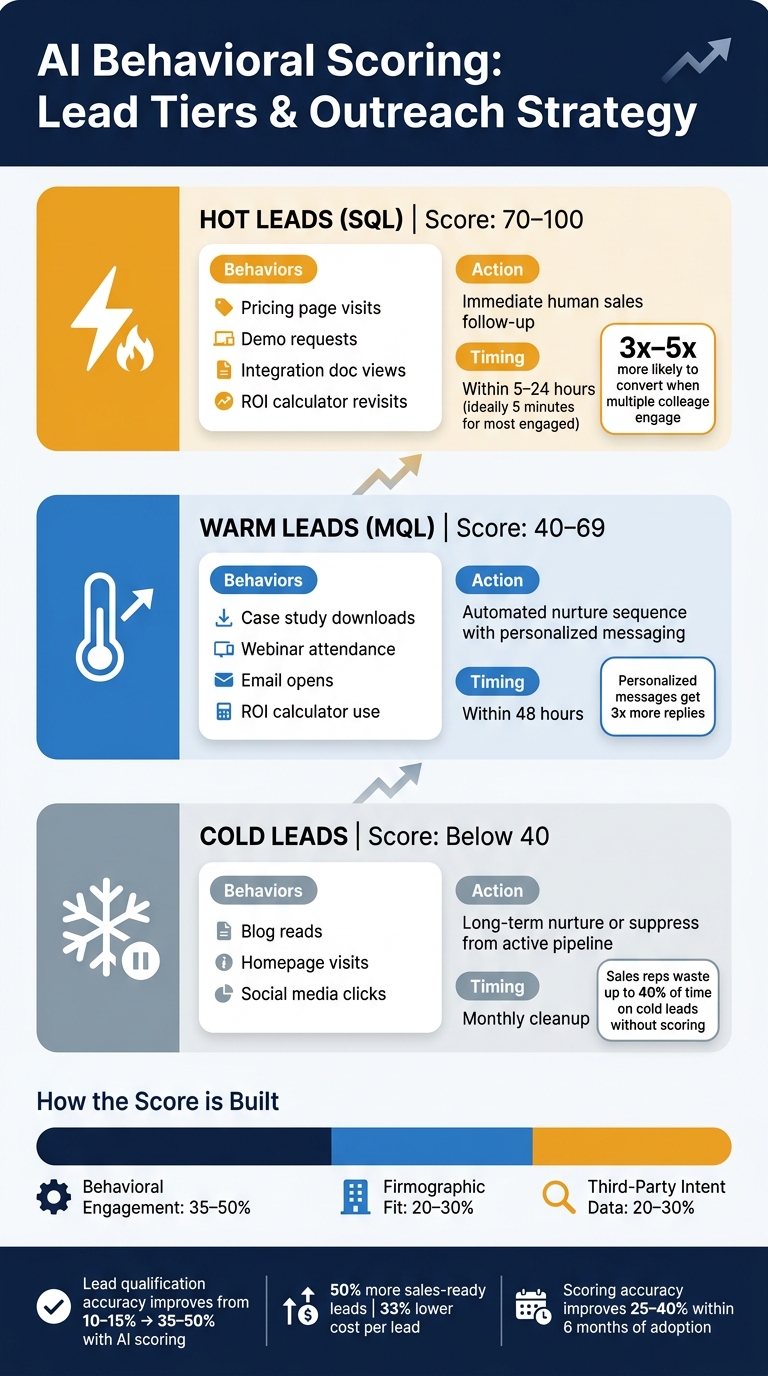
AI Behavioral Scoring: Lead Tiers, Score Ranges & Outreach Strategy
Identifying High-Intent Lead Behaviors
When it comes to pinpointing leads most likely to convert, focus on behaviors that signal genuine buying interest rather than casual browsing. The most telling actions include multiple visits to your pricing page, downloading implementation or security documents, revisiting ROI calculators, or responding directly to outreach emails. These behaviors suggest a lead is actively considering a purchase, not just exploring options [18][3].
In B2B outreach, the "colleague signal" is especially powerful. This happens when multiple people from the same company engage with your content. Research shows that if one person at a company converts, others from that organization are 3 to 5 times more likely to follow suit [2]. Additionally, unique patterns - like moving from a blog post to API documentation and then to the pricing page - are strong indicators of buying intent. This makes tracking activity at the account level just as crucial as monitoring individual leads [2][4].
Matteo Mirabelli, Founder of Knowlee, explains this shift in approach:
"The list is no longer the input - the trigger is. An account enters the queue the moment it does something that suggests it is moving." [4]
At the same time, it's important to watch for negative signals. Deduct points for actions like visiting competitor domains, unsubscribing from emails, having job titles without purchasing authority, or experiencing bounced trials [2][3].
Setting Score Thresholds for Each Lead Tier
Once you've identified key signals, the next step is creating a scoring framework. A 100-point composite scale works well for most teams, blending firmographic data (20–30%), behavioral engagement (35–50%), and third-party intent data (20–30%) [19][3][9].
Here’s a simple structure to guide your scoring process:
Tier
Score Range
Recommended Action
Timing
Hot (SQL)
70–100
Custom research and direct outreach; route to sales
To keep scores relevant, implement score decay. For example, reduce a lead’s score by 50% after 30 days of inactivity. This ensures recent actions carry more weight than older ones.
A well-calibrated model should result in a 25–45% MQL-to-SQL conversion rate [3]. If your rate is below 25%, you may be passing unqualified leads to sales. If it’s over 45%, you might be too restrictive and missing opportunities.
With thresholds in place, align your outreach strategy to match the intent level of each lead tier.
Adjusting Messaging and Timing Based on Lead Scores
Tailor your outreach based on the lead's score to maximize engagement. Personalized, signal-driven messages perform far better than generic templates - receiving 3x more replies[1]. The key is to respond quickly and align your message with the specific behavior that triggered the score.
For hot leads (70–100), speed is everything. If a lead requests a demo or repeatedly visits your pricing page, respond the same day - ideally within 5 minutes for the most engaged leads [3][5]. Reference their specific action, highlight how you can meet their needs, and include a clear next step. This might involve routing the lead to a sales rep or using AI-driven tools for instant engagement.
For warm leads (40–69), use a structured sequence. Instead of a one-size-fits-all message, create modular templates that address specific behaviors. For instance, if they’ve used your ROI calculator, mention it directly ("We noticed you explored our ROI calculator - many teams use it to benchmark before purchasing"), and explain how it connects to their potential needs [5].
For interested leads (30–39), take a long-term approach. Use nurturing campaigns and keep monitoring their score for any changes [20]. For cold leads (below 30), suppress outreach and clean up your pipeline regularly [3][20].
Platforms like SalesLabel make this process easier by offering real-time lead scoring and automated responses. This allows teams to focus on high-priority leads without manually managing every interaction.
"If a rep cannot explain in one sentence why this account is in market now, it should not be sales-ready." - Reachly [5]
This principle applies to automated outreach, too. If your message doesn’t directly relate to a specific signal, it’s not ready to send.
Running Behavioral Scoring Across Client Campaigns
For agencies juggling multiple clients, having a consistent scoring framework makes personalized outreach more manageable. This is where AI-driven behavioral scoring shines. By refining your scoring model, you can scale outreach efforts effectively across various campaigns.
Creating Reusable Scoring Templates for Clients
A standardized approach is essential for efficiency. Use a three-pillar composite model: Behavioral Signals (50 points), Firmographic Fit (30 points), and Intent Signals (20 points) [3]. Adjust the weight of each pillar based on the client’s industry and sales cycle. For instance, a SaaS company might prioritize visits to API documentation, while a professional services firm could value webinar attendance more.
Don’t forget to include hard disqualifiers. Subtract 50 to 100 points for leads from competitor domains, irrelevant industries, or regions outside your service area [3]. Tools like SalesLabel make it easier to manage scoring and outreach for multiple clients, offering a unified dashboard for streamlined deployment.
Reviewing and Refining Scores Over Time
Scoring models aren’t static - they require regular updates. Aim to revisit them every 90 days with your marketing and sales teams. Analyze the last 50 to 100 closed-won and closed-lost deals to identify patterns in behavior that led to successful conversions [21].
For example, in 2025, a B2B SaaS agency discovered that leads who visited integration documentation after the pricing page were five times more likely to convert. Automating alerts for this sequence resulted in a 38% increase in sales-accepted opportunities in just one quarter [7].
Additionally, keep an eye on your re-disqualification rate. If a large number of leads are downgraded after initial conversations, it’s a sign that your behavioral thresholds might need adjustment [3].
"A scoring system that gives your sales team the same conversion rate as random ordering is not a scoring system. It is a random number generator with a nice UI." - Kumo.ai [2]
A well-calibrated model ensures your team focuses on the leads that matter most.
Using Scores to Prioritize Outreach and Allocate Resources
Once your scoring model is fine-tuned, use it to sharpen your outreach strategy. Behavioral scoring helps focus your sales team’s efforts on high-intent leads. Without it, sales reps can waste up to 40% of their time chasing leads that never convert [1].
Here’s how to allocate resources effectively:
Hot leads: Route them to immediate human outreach.
Warm leads: Place them in automated nurture sequences.
Cold leads: Deprioritize to maintain a lean pipeline [3].
Set up real-time alerts - via Slack, SMS, or your CRM - for key behaviors like multiple pricing page visits within 48 hours. Quick follow-ups are crucial, especially since the average B2B response time is about 42 hours [22].
At the account level, aggregate scores across contacts to assess overall interest from a buying committee. While a single warm lead is useful, multiple high scores from key stakeholders indicate a serious opportunity. Shifting focus to account-level signals, rather than individual leads, is a hallmark of a mature scoring strategy.
Conclusion: How AI Behavioral Scoring Drives Agency Growth
AI behavioral scoring transforms how agencies approach lead qualification. It allows teams to focus their top talent on leads most likely to convert, while automation takes care of less promising opportunities.
The advantages go far beyond just identifying leads. Agencies leveraging AI-driven scoring reach high-priority prospects 50% faster compared to those using manual methods [23]. And when it comes to conversions, speed can make all the difference.
AI models also become smarter over time. Within just six months of adoption, scoring accuracy improves by 25–40% as the system learns from each interaction [23]. The results? Companies with well-developed scoring systems see 50% more sales-ready leads while cutting the cost per lead by 33%[2]. This level of precision creates more effective and personalized outreach - critical for driving growth.
"Competitive advantage in sales won't come from having more leads; it will come from understanding them better and faster than anyone else." - Lucas Correia, CEO & Founder, BizAI GPT [7]
For agencies juggling multiple clients, tools like SalesLabel offer a seamless solution. Their white-label platform combines real-time lead scoring, AI-powered outreach, and automated follow-ups, enabling agencies to scale without losing the personal touch.
These innovations set the stage for long-term success. As Darwin AI puts it, "The teams that are growing fastest in 2026 are not the ones with the biggest SDR rosters. They are the ones with the smartest scoring models and the tightest feedback loops" [24].
FAQs
How do I choose which behaviors should increase a lead’s score?
Pay attention to actions that clearly indicate buying intent and strong engagement. These include visiting pricing or demo pages, downloading key resources, or participating in webinars. When evaluating these behaviors, place a higher priority on recent and high-value actions, as they’re more likely to signal genuine interest compared to older or less impactful ones.
For example, actions like requesting a demo should carry more weight in your scoring system. To make this process even more precise, consider leveraging AI-driven analysis. By examining historical conversion data, you can fine-tune your scoring criteria, ensuring it accurately reflects the behaviors most likely to lead to conversions.
What’s the best way to set and adjust Hot/Warm/Cold score thresholds?
To fine-tune your Hot/Warm/Cold scoring thresholds, start by analyzing your historical conversion data. This helps you establish score ranges for each category, such as Hot: 80–100. Once defined, these thresholds should be validated and adjusted through continuous monitoring.
Keep an eye on key performance metrics like MQL-to-SQL conversion rates and overall lead engagement. Incorporate strategies like score decay (gradually lowering scores for inactive leads) or negative scoring (penalizing disengaged behaviors) to ensure your thresholds stay in sync with actual lead behavior and sales outcomes. Regular reviews and adjustments will help maintain accuracy and effectiveness.
How can I use behavioral scoring without violating US privacy laws?
You can safely use behavioral scoring within the bounds of US privacy laws by sticking to first-party data collected with clear and informed consent. Make sure your practices are transparent - this means clearly explaining data usage in your privacy policy and steering clear of third-party or cross-site tracking.
To stay compliant, implement a strong consent management platform (CMP). A CMP helps you track user preferences, adhere to regulations like CCPA and GDPR, and provide easy opt-out options. This not only ensures compliance but also builds trust with your audience.