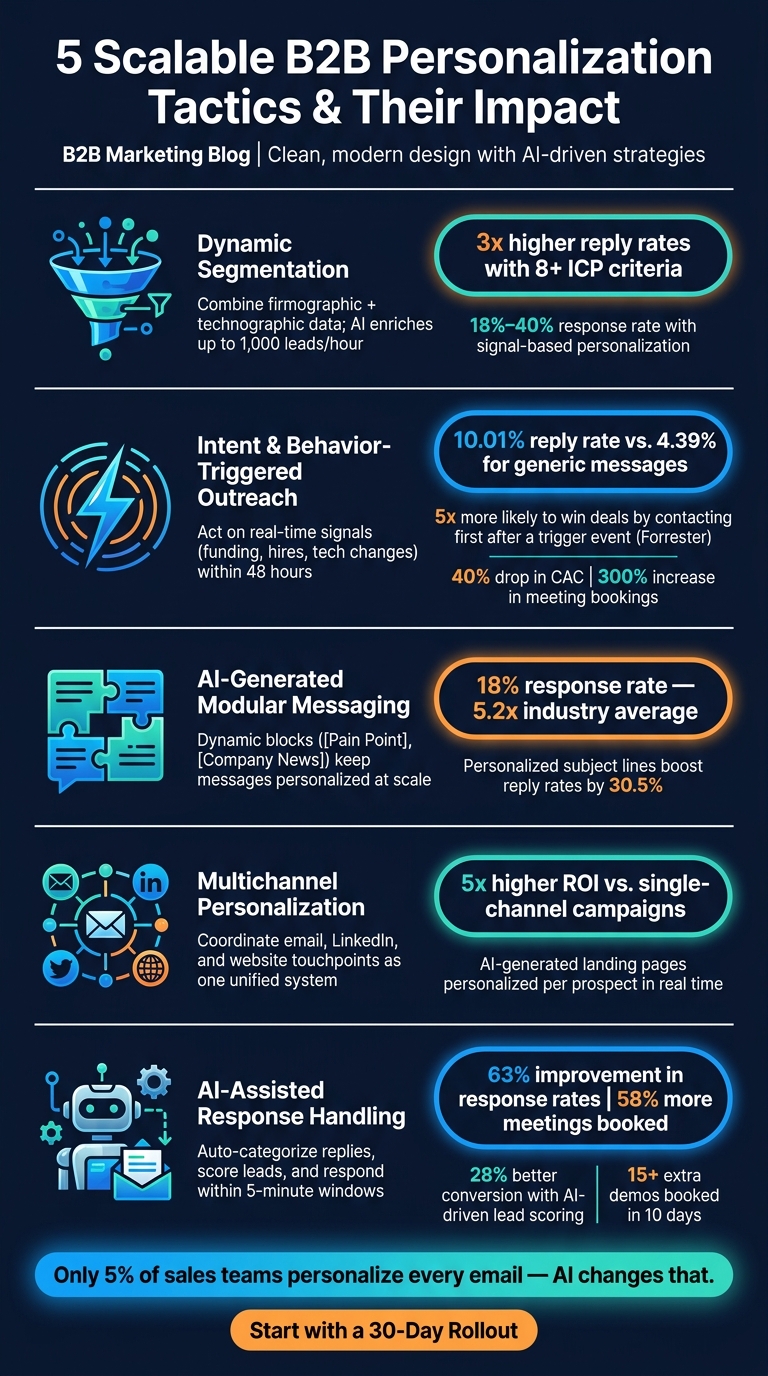
Scaling B2B personalization: use AI to target high-priority accounts, trigger timely outreach, craft modular messages, coordinate channels, and automate responses.
SalesLabel Team
Growth Expert • 5/20/2026
Share:
Looking for a done-for-you solution?
SalesLabel automates outbound end-to-end — AI finds prospects, sends personalized messages, and books meetings under your brand.
Personalization in B2B marketing is no longer optional - it’s critical to success. However, scaling it effectively can be a challenge. This article outlines five tactics that help agencies deliver relevant, personalized messaging across hundreds of prospects, saving time and increasing response rates. Here’s a quick summary:
Dynamic Segmentation: Use firmographic and technographic data to identify high-priority prospects and update segments in real-time with AI.
Intent-Triggered Outreach: Act on signals like funding rounds or leadership changes to time your outreach perfectly.
AI-Generated Modular Messaging: Combine consistent templates with dynamic personalization blocks for tailored, efficient communication.
Multichannel Personalization: Coordinate messaging across email, LinkedIn, and websites for a seamless experience.
AI-Assisted Response Handling: Automate reply categorization, lead scoring, and follow-ups to handle conversations at scale.
These strategies leverage AI to cut down manual work, improve engagement, and deliver results like 18%-40% response rates - far above industry averages.
5 B2B Personalization Tactics: Key Stats & Impact at a Glance
Personalization at Scale: Tools and Techniques
sbb-itb-a781ab9
1. Dynamic Segmentation Using Firmographic and Technographic Data
Most agencies stick to basic filters like industry, company size, or location when building prospect lists. While these filters are a good starting point, they only scratch the surface. Dynamic segmentation takes things to the next level by combining firmographic data (like company size and location) with technographic insights (the tools and technologies a company uses). Even better, AI ensures these segments are updated in real time.
Instead of relying on static lists that only provide basic information, dynamic segmentation uncovers actionable, real-time signals. Think about recent leadership changes, a company's use of tools like HubSpot without outbound automation, or news of a recent funding round. These insights create natural opportunities for personalized, relevant outreach.
AI makes this process scalable. Manually researching each account could take 30–60 minutes, but AI tools can enrich up to 1,000 leads per hour[3]. These tools pull data from CRMs, LinkedIn, news feeds, and third-party sources. Agencies that define eight or more Ideal Customer Profile (ICP) criteria before configuring their AI agents report three times higher positive reply rates compared to those using three or fewer criteria [5].
A powerful way to leverage this data is through technographic scoring - ranking prospects based on their tech stack. For example, a company using Salesforce but missing outbound automation tools could be flagged as "High Priority." Why? Because it has the budget and a clear technology gap that aligns with your offering [5]. This approach removes guesswork, focusing your efforts on accounts with the highest conversion potential.
The results speak for themselves. Emails personalized with specific signals achieve an 18% response rate, while referencing multiple real-time signals can push reply rates to 25%–40%[1]. That’s a game-changer for the same amount of outreach effort.
Tools like SalesLabel make it even easier by automating dynamic segmentation. They ensure your prospect lists are always enriched and precisely targeted, helping agencies stay ahead in their outreach strategies.
2. Intent and Behavior-Triggered Outreach Flows
Dynamic segmentation helps identify who to target, but intent signals uncover when to act. Timing is everything. By connecting real-time events with outreach efforts, you can significantly improve response rates.
Intent signals are generally grouped into three levels of urgency. Tier 1 signals - like new executive hires, funding announcements, or earnings calls mentioning transformative strategies - demand action within 48 hours. Tier 2 signals, such as job postings for roles tied to your offering, provide a slightly longer window of one to two weeks. Tier 3 signals, including changes in a company’s tech stack or executives appearing on podcasts, are valuable for adding depth to Tier 1 or Tier 2 outreach. The real trick is linking these signals to a business need. For example, a Series C funding round often signals rapid scaling, which could create operational challenges.
Messages tied to recent events perform better. Timeline-based openers achieve a 10.01% reply rate, compared to just 4.39% for generic messages [1]. And as Forrester Research points out:
"The first seller to contact a prospect after a trigger event is 5x more likely to win the deal." [1]
Here’s where AI steps in to streamline the process. Researching triggers manually takes 15–20 minutes per prospect, but AI cuts that down to just 2–3 minutes [6]. This efficiency allows reps to send over 100 personalized messages daily, compared to the 20–30 they could manage before.
The results speak for themselves. Agencies using autonomous AI tools have seen a 40% drop in Customer Acquisition Cost (CAC) and a 300% increase in meeting bookings by shifting from calendar-based outreach to event-driven strategies [8].
A useful framework here is the 15-5-1 Rule: out of every 15 signals flagged by your AI, 5 are worth pursuing, and 1 deserves highly personalized attention [1]. Tools like SalesLabel’s real-time lead scoring help focus your team on high-priority accounts, ensuring you engage with prospects who are ready to move forward.
3. AI-Generated Message Frameworks with Modular Personalization Blocks
When it comes to scaling outreach, balancing personalization and efficiency is tricky. Writing a unique message for every prospect is impossible at scale, but overly generic templates tend to flop. The sweet spot? Modular personalization frameworks. These frameworks allow AI to customize specific parts of a message while keeping the overall structure intact.
Think of it as a smarter version of a fill-in-the-blank system. Instead of just using placeholders like [First Name], these frameworks incorporate dynamic blocks such as [Recent Company News], [Specific Pain Point], and [Relevant Social Proof][9]. The core message remains consistent, but the personalized elements are freshly generated for each recipient. For context, AI can craft five personalized opening lines in under 20 seconds - a task that would take a human about 5 minutes per profile [9].
The key is depth. Strong personalization goes beyond surface-level details. Here's how different levels of personalization stack up:
Level
Example
Impact
Weak
"I see you're based in Austin."
Low - feels generic
Better
"I noticed you're hiring 5 new sales reps."
Moderate - shows some research
Strong
"Hiring 5 reps often creates pipeline bottlenecks."
High - demonstrates understanding
Best
"Your hiring pace mirrors what [similar company] faced before we helped them cut ramp time by 40%."
Highest - builds credibility
Messages that perform best tie a specific trigger (like hiring activity) to a clear pain point and back it up with a proof point. This structured approach works seamlessly alongside other AI-driven personalization techniques.
To ensure accuracy and brand consistency, storing approved value propositions and case studies in a central repository is crucial. This way, AI pulls reliable, fact-based content instead of guessing or fabricating details. Tools like SalesLabel's personalized message generation follow this model, enabling agencies to scale outreach across hundreds of accounts without sacrificing quality or consistency.
The results speak for themselves. Emails enhanced with modular personalization frameworks achieve an 18% response rate - 5.2x the industry average[1]. Even small tweaks, like personalized subject lines, can boost reply rates by 30.5%[4]. Layering in real-time signals further amplifies these results, far outperforming the 1–5% response rates typical of generic outreach [1].
"Personalization is a capacity problem disguised as a copywriting problem." - Ameya Deshmukh, EverWorker [7]
This perspective shifts the focus from writing better individual emails to building a scalable system that consistently delivers high-quality, personalized messages. It's about creating a machine that does the heavy lifting for you.
4. Multichannel Personalization Across Email, LinkedIn, and Website Touchpoints
To make the most of advanced AI personalization, it’s crucial to create a consistent experience across multiple channels like email, LinkedIn, and websites. These are platforms prospects often interact with throughout their day. If your messaging feels disconnected across these touchpoints, it can leave prospects feeling confused and diminish their trust in your brand.
The key is to treat these channels as a unified system rather than separate silos. For instance, imagine a prospect receives a LinkedIn connection request mentioning a recent leadership change, and then your follow-up email references the same event. This coordinated approach shows you’ve done your homework and creates a level of credibility that no single interaction could achieve on its own. Research backs this up - multi-channel campaigns deliver nearly 5x higher ROI compared to single-channel efforts [11]. Instead of running parallel sequences, use conditional workflows that adapt to the prospect’s behavior. For example, if a LinkedIn request is accepted, follow up with a personalized LinkedIn message. If it’s ignored, pivot to email instead [12]. Tools like SalesLabel make this kind of dynamic, AI-powered logic simple, ensuring you avoid generic follow-ups and keep each interaction relevant. This level of coordination naturally extends to your website as well.
Your website can play a pivotal role in personalization. Let’s say a prospect clicks a custom link in your email - AI can instantly generate a tailored landing page that greets them by name and addresses their specific industry challenges. No more generic homepages [11]. This kind of 1:1 web experience can turn a casual visit into a meaningful buying opportunity.
"The difference is not AI versus human. It is relevant versus irrelevant." - Semir Jahic, CEO & Co-Founder, Salesmotion [1]
To make it all work smoothly, every interaction - whether it’s a LinkedIn visit, an email open, or a reply - should be automatically logged in your CRM [12]. Without a centralized system, you risk sending conflicting or redundant messages. A clean, unified record ensures your multichannel efforts are trackable, easy to optimize, and free from missteps.
5. AI-Assisted Response Handling and Lead Qualification
Getting a reply from a prospect is just the beginning. What happens next - how quickly you respond, how tailored your follow-up is, and whether you prioritize the right leads - makes all the difference in turning that reply into a scheduled meeting. For many agencies, this stage can become a major bottleneck as the volume of conversations grows.
AI is changing the game for response handling. Tasks that used to take 15–20 minutes per reply can now be completed in just 2–3 minutes with AI - and across hundreds of conversations at once [1]. AI tools can instantly categorize replies as "interested", "not interested", or "out-of-office", allowing sales teams to focus on high-priority leads [10]. Since responding within a critical 5-minute window significantly boosts meeting bookings, AI ensures this pace can be maintained no matter the volume [10]. This speed also sets the stage for automated lead qualification.
But it doesn’t stop there. AI continuously tracks new signals like funding announcements, leadership changes, and job postings, updating follow-up messages in real time [6][13]. For lead qualification, AI compares response data against your Ideal Customer Profile (ICP) criteria, scoring and prioritizing prospects so your sales team knows exactly where to focus first [7][3]. The results speak for themselves: AI-driven lead scoring has been shown to improve conversion rates by 28% [3].
To manage responses at scale, a tiered approach works best. For high-value accounts, you can use a Human-in-the-Loop model: AI drafts the reply, and a sales rep spends 60 seconds adding a personal touch before hitting send [13]. For standard ICP and lower-priority accounts, AI can handle replies autonomously using pre-set rules [10]. Tools like SalesLabel are designed for this kind of workflow, combining AI-powered replies, real-time lead scoring, and inbox management to scale response handling without increasing headcount.
The impact is clear. Companies that use AI for personalization see response rates improve by 63% and book 58% more meetings [6]. Some agencies have even reported scheduling 15+ extra demos in just 10 days by automating reply classification and eliminating delays [10]. With output at this level, the challenge shifts from managing capacity to refining strategy, giving your team more time to focus on high-value activities.
Conclusion
The five strategies discussed - dynamic segmentation, intent-triggered outreach, AI-generated modular messaging, multichannel personalization, and AI-assisted response handling - work together as a cohesive system. Each approach adds a layer of precision and effectiveness to the one before it.
The days of generic outreach are behind us. Simply increasing the volume of emails won’t solve the problem; the real solution lies in sending the right message to the right person at the right time. This approach is not just sustainable - it’s essential.
This shift in strategy is already showing results. Emails personalized using signal-based data achieve an impressive 18% response rate, which is 5.2 times higher than the industry average [1]. When outreach incorporates references to two or three real-time events, reply rates can soar to between 25% and 40% [1].
AI plays a central role in making this level of personalization scalable. By reducing research time and automating tasks like reply triage, AI ensures that messaging stays aligned with real-time data and customer needs.
Companies using platforms like SalesLabel to automate tasks such as data enrichment, outreach, and inbox management are already seeing tangible results. These include a 57% increase in open rates and an 82% jump in response rates compared to traditional, generic campaigns [2].
For those ready to act, a focused 30-day rollout is a great starting point. With only 5% of sales teams currently personalizing every email individually [1], there’s a clear opportunity for agencies to gain a strong competitive edge by adopting these systems.
FAQs
What data do I need to start dynamic segmentation?
To kick off dynamic segmentation, you need reliable, detailed data. This includes firmographics (like company size or industry), demographics (age, location, etc.), technographics (technology usage), behavioral data, and external signals such as recent company news or emerging market trends. These elements work together to build precise, scalable audience segments, enabling tailored and effective outreach.
Which intent signals are most reliable for outreach timing?
When it comes to identifying intent signals, some of the most reliable indicators include recent funding rounds, product launches, leadership changes, and hiring surges. These events often point to shifting priorities and create opportunities for engagement. Timing is crucial - reaching out within 24 to 48 hours of these developments can significantly boost your chances of connecting with prospects while the information is still fresh and relevant.
How can I make AI personalization feel authentic?
To make AI-driven personalization feel authentic, prioritize precision, relevance, and thorough human oversight. Incorporate specific, verifiable details, such as recent company updates or notable events, rather than falling back on vague or generic statements. Steer clear of overused phrases like “I noticed you…” that can come across as impersonal or forced. Always take the time to review AI-generated content to fine-tune the tone, fix any mistakes, and ensure it aligns with your brand's voice. Consistent monitoring helps maintain outreach that feels genuine, relatable, and credible.