AI transforms sales by automating repetitive tasks like lead generation, qualification, follow-ups, and deal management. This frees up sales teams to focus on building relationships and closing deals. Key takeaways include:
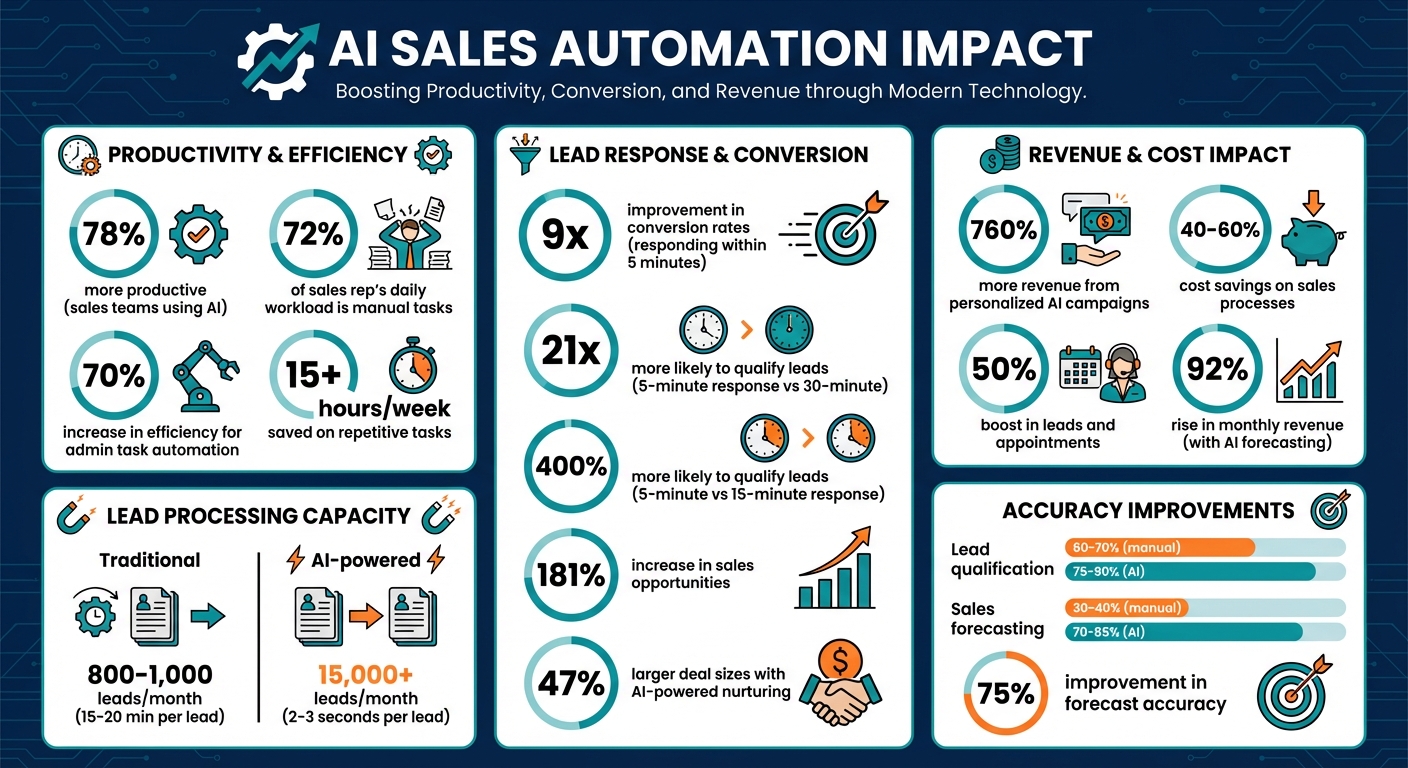
Efficiency Boost: Sales teams using AI report being 78% more productive.
Faster Lead Response: AI enables instant follow-ups, improving conversion rates by up to 9x when responding within 5 minutes.
Higher Conversions: AI-powered lead nurturing increases deal sizes by 47% and sales opportunities by 181%.
Cost Savings: Businesses save 40–60% on sales processes with AI.
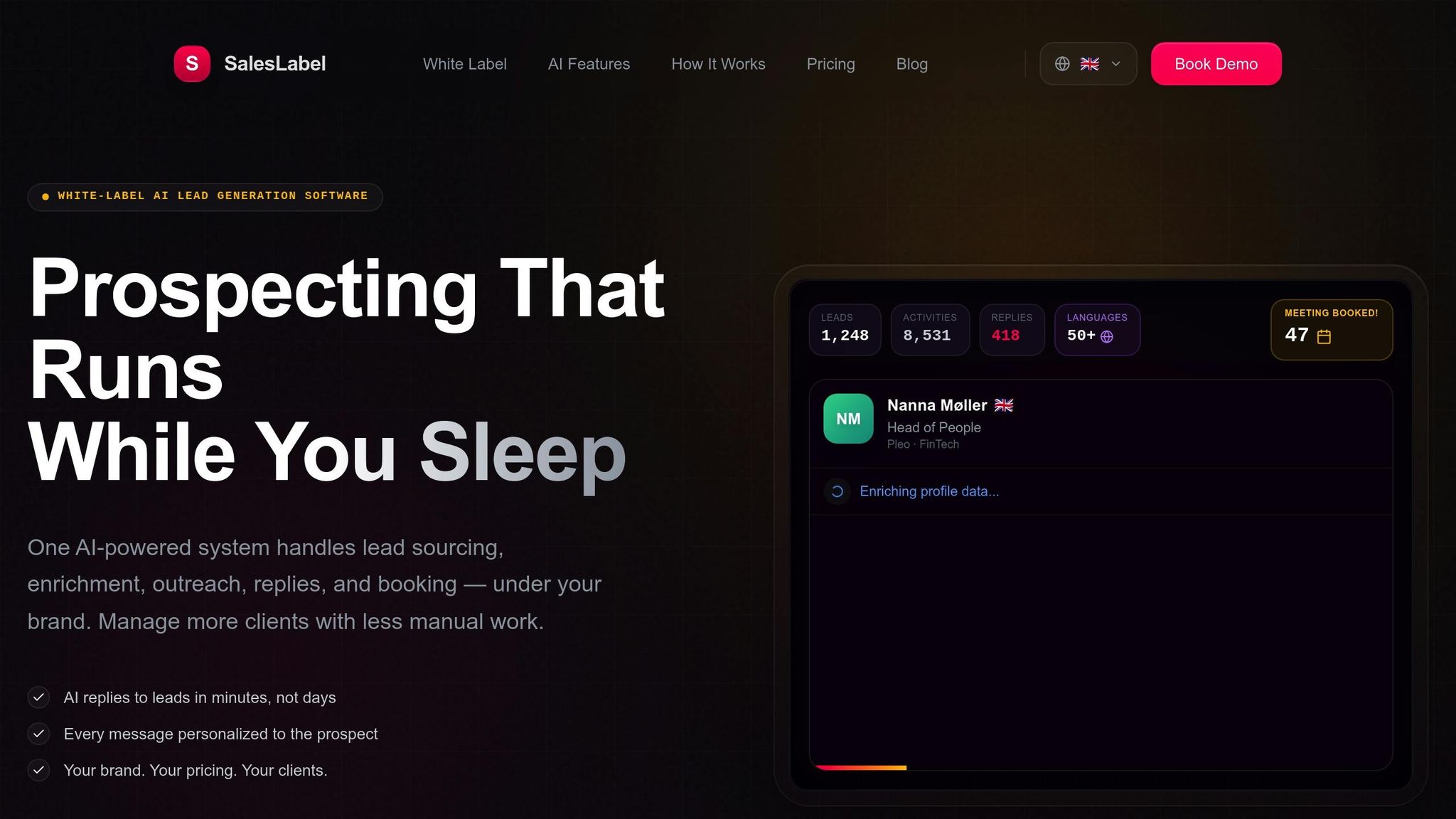
AI handles everything from finding leads to crafting personalized messages, scoring prospects in real time, and automating follow-ups. Tools like SalesLabel simplify this process by offering an all-in-one platform for AI-driven sales automation, starting at $799/month.
AI doesn’t replace salespeople - it removes administrative burdens, enabling teams to focus on what matters most: closing deals.
AI Sales Automation Impact: Key Statistics and ROI Metrics" >
AI Sales Automation Impact: Key Statistics and ROI Metrics
How To Get Clients With AI, Automation & Sales Funnels
sbb-itb-a781ab9
Automating Lead Generation and Awareness
AI is changing how businesses approach the early stages of their sales funnel. In the past, lead generation involved hours of manually building lists and scraping data. Now, AI handles this by scanning public data, intent signals, and enrichment feeds to identify contacts that match your Ideal Customer Profile (ICP) in real time [11]. What used to take hours of research now takes AI just minutes to analyze thousands of prospects [8].
How AI Finds Leads
AI doesn’t just wait for leads to appear - it actively searches for them. Autonomous prospecting systems monitor real-time behaviors like website visits, content downloads, and social media activity to detect buying intent [8]. For example, if someone repeatedly visits your pricing page or downloads a competitor comparison guide, AI flags them as a high-priority lead. This speed matters: companies that follow up with leads within five minutes are 400% more likely to qualify them compared to those that wait 15 minutes [9]. AI also deciphers digital body language - such as scroll depth and time spent on key pages - to transform anonymous visitors into actionable leads [2].
Enriching Lead Data with AI
Raw lead data - like just a name and email address - won’t close deals. AI takes this basic information and builds complete profiles by adding firmographics, technographics, and verified contact details [8][9]. Using a process called "waterfall enrichment", AI queries multiple data sources sequentially to ensure maximum accuracy [9]. This happens in mere seconds after a form submission, allowing for instant routing if the lead fits your ICP. AI also identifies intent signals by tracking third-party research topics and competitor comparisons, giving your team a deeper understanding of prospects before reaching out. As Elizabeth Gerbel, CEO, notes:
"Now we have a lot less data, but it's quality data. That change allows us to use AI confidently, without second-guessing the outputs" [8].
Generic outreach is no longer effective. AI dives into LinkedIn profiles, company updates, funding news, and leadership changes to craft messages tailored to specific prospect activities [12]. In 2025, Pynest Co-Founder Andrew Romanyuk used AI agents to analyze open-source data, including publications and tech stacks, to qualify leads. This reduced lead screening time by 32%, allowing the team to focus on high-priority accounts [1]. AI’s personalization goes beyond adding a name - it adapts tone and style based on behavioral psychology and predictive personality insights [3][5]. The impact is clear: AI-driven, personalized campaigns generate 760% more revenue [2].
The real game-changer? AI doesn’t just fill in gaps; it provides meaningful context. As Cade McNelly, Content Marketing Manager at Outreach, explains:
"The difference between 'I saw you're hiring' and 'I noticed you posted three AE roles this month, which typically indicates 40% growth targets' separates templates from insights" [12].
After AI identifies and enriches your leads, the next step is figuring out which ones deserve immediate attention. Traditional manual lead qualification takes about 15–20 minutes per lead, which means most teams can only handle around 800–1,000 leads a month[13]. AI, however, can analyze hundreds of data points in just 2–3 seconds, allowing teams to process over 15,000 leads monthly[13].
Real-Time Lead Scoring
AI doesn't just track leads - it evaluates their behavior as it happens. Imagine a prospect visiting your pricing page at 2:00 AM, downloading a case study, or opening multiple emails within 48 hours. With AI, their lead score updates instantly based on these actions[13,20]. This dynamic scoring approach, which considers the speed and frequency of interactions (engagement velocity), is far better at predicting intent than looking at isolated actions.
The system evaluates over 100 variables, from website activity and email engagement to firmographic details, technographics, and even sentiment from form submissions[13,21]. By analyzing past "closed-won" and "closed-lost" deals, machine learning identifies patterns that signal potential conversions. For instance, if data shows that prospects who visit a competitor comparison page three times within 48 hours convert at an 80% rate, the AI flags similar behaviors in future leads[13,18].
Companies using AI for lead qualification report a 181% increase in sales opportunities, with accuracy rising from a manual average of 60–70% to as high as 75–90%[22,21]. monday.com highlights this advantage:
"AI doesn't just speed things up; it catches patterns humans miss that actually predict who is going to buy." [10]
Building on these insights, predictive analytics further sharpens lead prioritization.
Using Predictive Analytics to Prioritize Leads
Predictive analytics takes lead scoring further by forecasting which prospects are most likely to close. The process starts by feeding the system 2–3 years of historical CRM data, covering both successful and unsuccessful deals, to help it recognize what a "winning" customer looks like[9]. From there, the AI creates weighted scoring models, often assigning 35% to intent signals, 30% to demographic fit, 25% to behavioral engagement, and 10% to timing factors[13].
It also tracks a prospect's "digital body language" - things like the sequence of pages visited, time spent on pricing pages, and overall content engagement. This behavioral data is up to three times more predictive of conversion than static details like job titles[14]. When a lead meets the threshold, AI automatically routes it to the most appropriate sales representative, factoring in territory, expertise, or workload[12,13].
By automating much of the process, teams can reduce manual lead evaluation by up to 80% and shorten sales cycles by roughly 30%[21,24]. Kyle Dorman, Department Manager at Ray White, shared his experience:
"There's probably about a 70% increase in efficiency in regards to the admin tasks that were removed and automated, which is a huge win for us." [10]
This system gets smarter over time. By reviewing leads that scored highly but didn’t convert - and feeding that data back into the AI - teams can adjust the model to account for changes in buyer behavior and market trends[13,12].
Automating Follow-Ups and Lead Nurturing
Once leads are qualified and scored, keeping them engaged becomes the next big challenge. This is where AI steps in, ensuring consistent communication to nurture potential customers through the sales funnel. Here’s a striking fact: most prospects need 5–12 touchpoints before they commit to a purchase. Yet, 44–48% of salespeople stop after just one follow-up[16]. AI helps bridge this gap by automating follow-ups and tailoring outreach based on each prospect's behavior, moving seamlessly from qualification to personalized engagement.
AI-Powered Follow-Up Sequences
AI keeps a close eye on a prospect's actions - like visiting a pricing page, downloading a whitepaper, or opening an email - and adjusts follow-ups in real time[15][4]. For instance, if a lead repeatedly visits a pricing page, AI might trigger a relevant case study to highlight value. On the other hand, if someone opens multiple emails but doesn’t respond, AI can shift tactics - perhaps offering a new perspective or reaching out through a different channel, like LinkedIn or SMS[17].
AI also pulls insights from resources like 10-K filings, LinkedIn profiles, or recent company updates to craft messages that align with a prospect’s specific challenges and goals[17][19]. This level of personalization yields response rates of 35–40%, far outpacing the 5–8% seen with generic outreach[16].
B2B sellers using AI tools are 3.7 times more likely to meet their quotas[20], largely because AI takes over repetitive tasks that would otherwise eat up more than 15 hours a week[15].
Timing Your Outreach for Better Results
The timing of your message can make or break engagement. AI analyzes prospect behavior to pinpoint the best time to reach out - whether it’s early Tuesday morning or mid-afternoon on Friday[15][16]. By studying open rates, click patterns, and time zone data, AI ensures your message arrives at the ideal moment.
Speed also matters. Businesses that respond to leads within five minutes are 21 times more likely to qualify them than those who wait 30 minutes[21]. AI enables instant follow-ups triggered by high-intent actions, like revisiting a pricing page or downloading a case study[18][4]. SMS follow-ups, another AI-managed tool, can achieve open rates as high as 98%[21].
Managing Inboxes with AI
As outreach scales, managing responses efficiently becomes essential. AI can classify replies by intent, categorizing them as "interested", "not interested", "out of office", or requests for more information[16]. It also uses sentiment analysis to detect urgency or frustration, escalating these leads to human reps for immediate attention[15][18]. Plus, once a prospect replies, AI removes them from automated sequences to avoid redundant communication[18][17].
For lengthy email threads, AI condenses conversations into brief summaries, giving sales reps a quick overview of the prospect’s journey[21][15][19]. This smooth handoff between AI-driven engagement and human interaction ensures no critical detail slips through the cracks.
Automating Conversions and Deal Closing
Once leads are nurtured and primed, AI steps in to speed up deal closures while reducing manual effort. Companies using AI in sales report a 50% boost in leads and appointments alongside 40–60% cost savings[3]. These tools build on earlier AI-driven processes, creating a seamless transition toward closing deals.
Customizing Proposals with AI
AI takes personalization to the next level by pulling data from CRM systems, purchase histories, and even call transcripts to craft proposals tailored to each prospect's unique needs. Using Natural Language Generation (NLG), AI drafts professional content that mirrors the prospect's tone - whether casual or formal - and addresses pain points identified during earlier conversations[22][23]. Proposals can include dynamic content like industry-specific case studies, relevant product suggestions, and custom pricing sourced directly from CPQ systems[22][23].
For instance, in 2025, Lattice's sales team used Dock's AI to analyze Gong call recordings and create business cases that reflected prospects' priorities. This approach led to a 25% year-over-year increase in late-stage win rates[1]. Similarly, Pynest deployed AI agents to track company behavior, such as job postings and tech stacks, boosting pipeline velocity by 22%[1].
AI doesn't stop there - it also tracks engagement patterns. If a prospect stops responding or a key stakeholder disengages, the system alerts the team to adjust their strategy before losing the opportunity[1]. This proactive approach ensures proposals stay relevant and timely, addressing any emerging concerns.
Automated Meeting Scheduling
After proposals are in place, AI simplifies the scheduling process, eliminating the hassle of back-and-forth emails. By using Natural Language Processing (NLP), AI can interpret requests like "Schedule a product review next Tuesday" and handle everything from time zone calculations to resolving conflicts[24]. It even suggests optimal meeting times based on historical attendance data.
This automation cuts down scheduling time by 60–80%[24][26]. Teams using tools like Microsoft 365 or Google Workspace report 25–40% productivity gains[24]. A great example comes from Flowla’s Founding Account Executive, Edward Arnold, who used AI to generate post-demo follow-ups that analyzed call transcripts for key pain points. This saved 30 minutes per call and increased demo-to-deal conversion rates by 12%[1].
"The Ask Apollo AI feature feels like having ChatGPT inside my meetings, delivering precise, actionable insights on the fly." - Ryan Weathington, Director of Strategy & Business Development, Do Process®[25]
AI also enriches meetings by adding firmographic data beforehand and generating summaries that include action items and next steps. These updates sync directly into the CRM, ensuring everyone stays aligned[12][25][27].
Forecasting Sales with AI
AI doesn't just streamline processes - it also predicts outcomes. By analyzing historical data and real-time signals, AI forecasts deal outcomes with 70–85% accuracy, compared to the 30–40% accuracy of manual methods[8]. Companies leveraging AI for forecasting have seen a 75% improvement in accuracy and a 92% rise in monthly revenue[27].
AI pinpoints high-priority opportunities by recognizing patterns like frequent visits to pricing pages or engagement with webinars. It also flags deals at risk of stalling due to gaps in communication or missing decision-makers[28][1]. For example, Pynest’s AI workflow identified high-intent accounts and estimated closure probabilities, leading to a 22% boost in pipeline velocity[1].
"AI forecasting is designed to complement traditional sales strategies rather than replace them. AI provides data-driven insights that enhance decision-making, while traditional strategies like relationship building... add the human touch." - Outreach Blog[28]
SalesLabel takes the strategies of AI-powered automation and packages them into a streamlined, white-label platform tailored for agencies. Instead of juggling multiple tools or investing time and resources into custom-built solutions, agencies can implement a fully functional AI sales funnel branded as their own.
SalesLabel Features Overview
SalesLabel simplifies every stage of the sales funnel with automation. For lead sourcing, AI pinpoints prospects that align with your ideal customer profile. Once identified, automated enrichment gathers critical firmographic data, contact details, and behavioral insights. From there, personalized outreach creates messages tailored to each prospect's industry, challenges, and engagement history.
The system doesn’t stop at outreach. AI-driven follow-ups monitor engagement and automatically adjust timing, ensuring messages are sent when prospects are most likely to respond. Real-time lead scoring ranks prospects by their likelihood to convert, directing your team’s attention to the most promising opportunities. Additionally, the inbox management system categorizes responses, flags high-priority inquiries, and drafts replies that align with your brand’s tone. To streamline scheduling, automated meeting booking syncs calendars and proposes optimal times based on past data.
SalesLabel also offers pricing plans that cater to various agency needs, providing flexibility as your business scales.
SalesLabel Pricing Plans
Plan
Price
LinkedIn Accounts
Key Features
Starter
$799/mo
Up to 30
Full AI prospecting system, white-label branding, AI replies, setup assistance, email support
Everything in Growth, documentation center, bi-weekly strategy calls, dedicated success manager
The Growth plan, priced at $1,279 per month, is a popular choice for agencies, offering enough LinkedIn accounts for multiple clients and including monthly strategy sessions to fine-tune campaigns. For larger operations managing 10+ clients or high-volume campaigns, the Scale plan provides unlimited accounts, bi-weekly strategy calls, and a dedicated success manager for $1,999 per month.
Once you select a plan, SalesLabel’s onboarding process ensures a smooth integration of AI-driven automation into your agency’s workflow.
Getting Started with SalesLabel
SalesLabel implementation unfolds in three key phases:
Phase 1: Foundation and Planning
Start by auditing your current sales funnel. Identify gaps or bottlenecks that could be streamlined with AI [7]. Make sure to consolidate your data sources and set quality benchmarks so the AI can work with accurate, clean information [7].
Phase 2: Tool Selection and Integration
Connect SalesLabel to your existing systems - such as your CRM, email platform, and calendar - using its API. This integration removes the need for manual data entry across lead qualification, nurturing, and deal management [7][3]. The platform’s automation blueprints simplify this process.
Phase 3: AI Training
Customize the AI by training it on your agency’s communication style and client preferences. Use examples of effective outreach, follow-ups, and deal-closing techniques. Over time, the system refines itself based on engagement data, continuously improving its performance.
Conclusion
AI automation is reshaping every stage of the sales funnel by taking over time-draining manual tasks, which can account for as much as 72% of a sales rep's daily workload [1][5]. Features like real-time lead scoring slash screening times by 32% [1], and companies that adopt AI report impressive results - 50% more leads and appointments while cutting costs by 40–60% [7].
Beyond saving time, AI opens the door to scalable growth. Personalized nurturing sequences lead to 47% larger deal sizes, and segmented campaigns drive 760% higher revenue [2]. AI-powered agents ensure critical responses happen within five minutes, boosting conversion chances by up to 9× [6]. On top of that, predictive analytics help spot potential churn before it becomes an issue.
For agencies ready to embrace these benefits, SalesLabel offers a white-label AI platform that integrates all these automation tools under your branding. From lead sourcing and enrichment to follow-ups and meeting scheduling, the platform empowers small teams to manage hundreds of interactions while maintaining a personal touch. Pricing starts at $799 per month, with options scaling up to $1,999 per month for unlimited accounts - delivering AI automation without the need for custom development.
Start by evaluating your current funnel to pinpoint areas for improvement. Introduce AI to one stage at a time, measure its impact, and expand from there. Combining AI-driven efficiency with human connection creates a sales process that’s both personal and scalable.
FAQs
How does AI enhance lead qualification and scoring in the sales funnel?
AI takes the guesswork out of lead qualification and scoring by analyzing massive amounts of data in real time. It examines factors like behavioral patterns, intent signals, and demographic details to pinpoint high-intent prospects with greater accuracy. The result? Faster response times - shifting from hours to just seconds - and improved conversion rates.
By automating these tasks, AI frees sales teams from manual processes, letting them focus on connecting with the most promising leads. This speeds up the sales cycle while delivering a more tailored and efficient experience for potential customers.
What are the cost-saving advantages of using AI for sales automation?
AI-driven sales automation offers businesses a way to cut costs by taking over time-consuming tasks like data entry, lead follow-ups, and scheduling. By automating these repetitive processes, sales teams can shift their focus to what really matters - closing deals and building strong customer relationships. This shift not only enhances productivity but also drives revenue growth.
One standout benefit of AI is its ability to improve response times dramatically. Studies reveal that leads contacted within five minutes are significantly more likely to convert. With AI, response times can drop to less than 90 seconds, giving businesses a competitive edge. This kind of efficiency reduces the need for larger sales teams and ensures fewer missed opportunities, which translates to higher conversion rates and happier customers. Companies leveraging AI in their sales strategies often report noticeable growth in leads and measurable improvements in overall performance.
How does AI create personalized outreach and follow-up messages?
AI leverages advanced data analysis to create highly customized outreach and follow-up messages for each prospect. By examining details like past interactions, preferences, and behavior patterns, it produces content that feels relevant and engaging to recipients, boosting interaction and connection.
On top of that, AI handles tasks like managing replies and ensuring emails are delivered successfully. This frees up sales teams to concentrate on building genuine relationships while still maintaining a personalized approach on a larger scale. The result? Better response rates and a smoother, more efficient sales workflow.
 AI Sales Automation Impact: Key Statistics and ROI Metrics" >