AI has transformed how businesses communicate with regional audiences by tailoring messages that align with local preferences. Instead of generic outreach, AI uses data like geolocation, behavioral patterns, and language nuances to craft messages that resonate with specific regions. This approach saves time, improves engagement, and boosts revenue.
Key Takeaways:
AI reduces campaign creation time from 6–12 hours to 30 minutes.
AI adapts messaging based on local customs, holidays, and even preferred payment methods.
Tools like SalesLabel automate regional personalization, optimizing send times, tone, and compliance for different markets.
Practical Benefits:
Geolocation Data: AI groups leads by location and schedules messages during peak hours, improving open rates by 20%.
Behavioral Insights: AI analyzes regional communication styles, ensuring messages fit local expectations.
Natural Language Processing (NLP): Messages are refined for tone and intent, avoiding mismatches across cultures.
Localized Details: AI adjusts formats for currency, dates, and measurements, ensuring messages feel region-specific.
How AI Analyzes Regional Data for Personalization
AI takes the concept of regional personalization and turns it into action by analyzing data to create locally relevant communication. Instead of relying on generic outreach, it uses real-world data to uncover regional preferences. By combining insights from multiple sources, AI builds detailed regional profiles and identifies the best times to engage, ensuring messages resonate with local audiences.
Using Geolocation Data
Geolocation data is where it all begins. AI combines location signals with firmographic details - like company size, industry, and headquarters location - to group leads into the right regional segments. It also schedules outreach during peak local hours, typically between 8:30 and 10:30 a.m., which has been shown to increase open rates by 20% [3]. Additionally, AI ensures compliance by attaching the correct legal footers based on jurisdiction, such as CAN-SPAM for U.S. contacts or CCPA for California leads. This geographic segmentation not only improves email open rates by 14%, but it also boosts click-through rates by over 100% [3].
Understanding Regional Behavioral Patterns
AI goes further by analyzing how people in different regions communicate, make purchases, and engage with content. For instance, U.S. audiences often prefer direct, results-focused messaging, while other regions might respond better to a formal or collaborative tone [3].
To fine-tune outreach, AI uses a method called Cultural Relevance Scoring. This process evaluates assets like copy, calls-to-action, and visuals against local factors such as holidays, seasonal trends, and branding expectations [1]. If an asset scores below a certain threshold, AI flags it for adjustment or removal to avoid missing the mark with local audiences.
Natural Language Processing for Local Nuances
Natural Language Processing (NLP) takes these insights a step further by tailoring messages to fit the local context. It’s not just about translating words - it’s about adapting tone and intent. For example, a pitch that works in the U.S. might come across as too assertive in Japan or too casual in Germany. NLP fine-tunes the messaging to align with these cultural differences [5].
"The future of global marketing isn't just about scaling content - it's about scaling context." - Aarshiya Khandelwal, MarTech AI, HubSpot [4]
AI can also enforce specific language rules, like using formal address forms in French B2B communications or avoiding gendered adjectives in Spanish [4]. It ensures that U.S.-centric references are replaced with locally relevant ones when targeting European markets [3]. This level of customization helps brands connect with audiences in a way that feels personal and authentic.
sbb-itb-a781ab9
Key Regional Personalization Tactics
These strategies show how AI insights can be transformed into practical actions that resonate with specific regions, turning data into meaningful engagement.
Language and Dialect Adaptation
AI goes beyond simple translation - it reshapes messages to match the intended emotional and psychological tone for different audiences. Instead of just swapping words, it adjusts for cultural nuances. For example, prompts can specify language rules like, "Always use 'vous' for French B2B messages" or "Avoid gendered adjectives in Spanish copy." This ensures the output feels natural and culturally appropriate, avoiding awkward or robotic phrasing.
But it’s not just about words. Incorporating local customs into communication builds a deeper connection with the audience.
Referencing Local Customs and Events
Generic messaging often misses the mark when it overlooks regional traditions or events. For instance, referencing the Fourth of July or the NFL may resonate with U.S. audiences but would feel irrelevant in DACH or APAC regions. AI identifies such mismatches and replaces them with locally meaningful references, ensuring the message aligns with regional norms before it’s sent.
"The efficacy of business communication relies heavily on the receiver's perception of cultural alignment." - ScienceDirect (via ScaliQ) [5]
Region
Cultural Values
AI Adaptation Strategy
DACH
Formality, precision, credentials
Use formal "Sie", reference titles, highlight security/efficiency [5]
LATAM
Relationships, warmth, rapport
Use friendly greetings, focus on relationship-building before pitching [5]
Nordics
Egalitarian, direct, low-context
Avoid overly flowery language or aggressive sales tactics [5]
APAC
Hierarchy, humility, respect
Use honorifics, avoid exaggeration, and maintain a humble tone [5]
Timing and communication channels also play a critical role in reaching audiences effectively.
Choosing the Right Channels and Send Times
Preferences for communication platforms and optimal times vary across regions. AI evaluates regional behavioral patterns to determine the best times to send messages and the most effective channels - whether LinkedIn, email, or SMS. This ensures the message not only reaches the audience but does so when they’re most likely to engage.
Localizing Currency, Dates, and Measurements
Details matter. A U.S. recipient expects pricing in $1,500, dates formatted as MM/DD/YYYY (like 05/13/2026), and distances in miles. Deviating from these norms can make the message feel disconnected. AI uses CRM data to apply the correct regional formats automatically. It also ensures compliance with local regulations by including the appropriate legal footers, such as CAN-SPAM for U.S. contacts, CCPA language for California prospects, or GDPR-compliant options for EU audiences [3].
These tactics bring together AI insights and human-like precision, creating communications that feel personal and regionally relevant - laying the groundwork for the platform features discussed next.
SalesLabel takes regional insights and scales them into automated, personalized outreach using its AI-powered infrastructure. By combining advanced technology with local relevance, it ensures every interaction feels tailored and meaningful.
AI-Powered Message Generation
SalesLabel crafts personalized, context-aware messages by pulling data from LinkedIn profiles, company websites, and even local news. This approach ensures every message resonates with a prospect's regional context. Using natural language processing (NLP), it integrates local pain points or industry trends directly into the opening lines, making outreach feel thoughtful and relevant.
The platform also optimizes message timing by automating send windows based on the recipient's time zone. On top of that, it analyzes a prospect's LinkedIn activity to assess their communication style, creating messages that feel more like genuine conversations than cold outreach.
"The AI sometimes answers better than I would. It analyzes the website and profile of the person." - Mike R., SalesLabel User [7]
Real-Time Lead Scoring and Inbox Management
Generating personalized messages is just one part of the equation - managing responses efficiently is equally important. SalesLabel simplifies this with Intent Scoring, which evaluates replies in real time and updates lead statuses automatically. This way, your team can quickly identify interested prospects without manually reviewing every response.
To streamline follow-ups, Autopilot Mode handles routine replies from start to finish. For regions where tone and nuance are critical, Copilot Mode drafts responses for team review before sending. This feature is especially useful when entering unfamiliar markets, as it allows teams to validate the AI's understanding of regional subtleties before fully automating. When a prospect shows interest, the system takes it a step further by sending a calendar link and scheduling the meeting directly.
White-Labeling for Agencies
SalesLabel offers agencies the ability to deliver region-specific, personalized messages while maintaining their own branding. Operating as an invisible infrastructure layer, it allows agencies to deploy the platform under their own brand, complete with a custom domain (e.g., app.youragency.com), logo, color scheme, and even a branded Chrome extension. This feature is available on the Growth plan for $1,279 per month.
Clients interact with a fully branded dashboard that displays leads, replies, and booked meetings in real time, with no indication of SalesLabel's involvement. This setup enables agencies to scale from managing 15 clients to over 100 without adding extra staff [7]. With support for 50+ languages, agencies can run campaigns tailored to North America, Europe, and APAC markets simultaneously, all while maintaining a unified brand experience. Most agencies can get everything up and running in just 7 days[6].
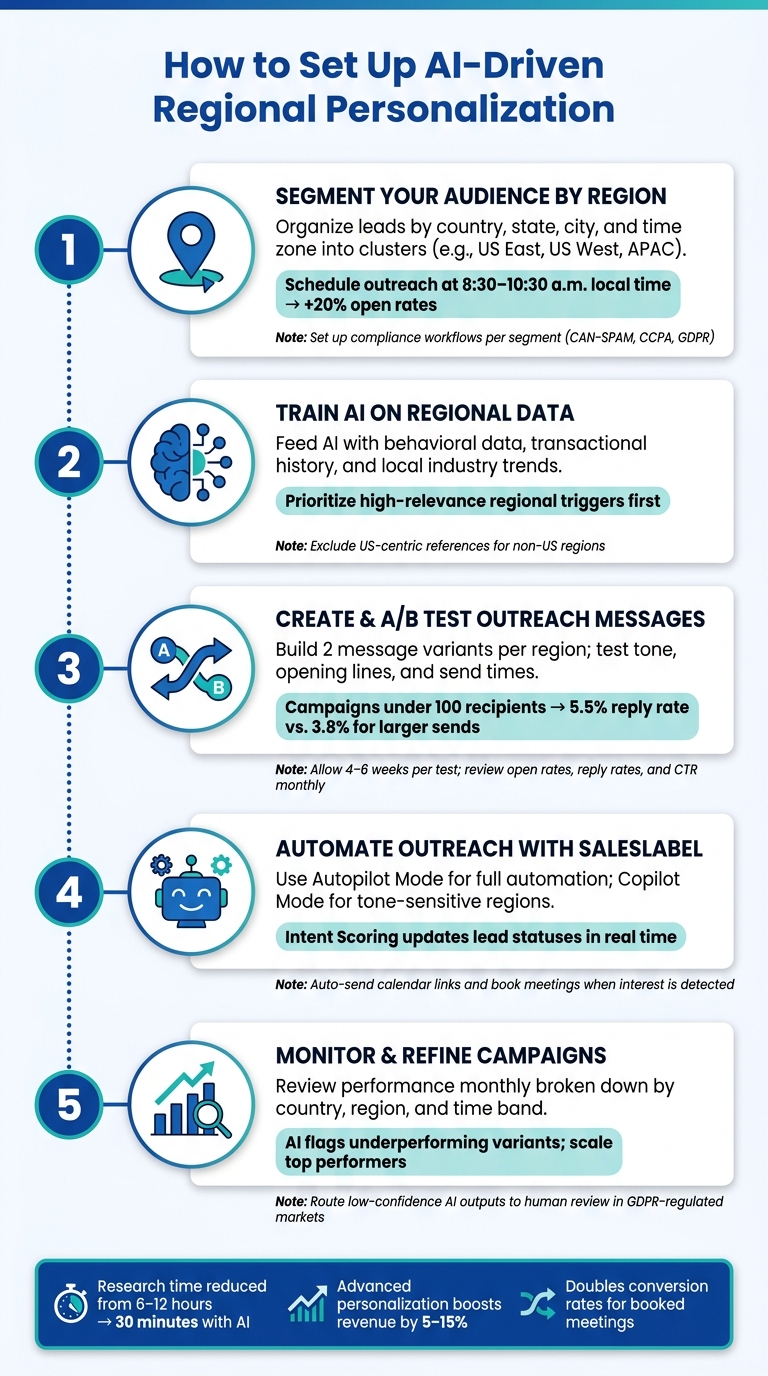
How to Set Up AI-Driven Regional Personalization: 5-Step Guide
Implementing AI-driven regional personalization can transform your outreach efforts. By leveraging AI, you can cut down manual workflows significantly - reducing research time from 6–12 hours to just 30 minutes[1]. Here's how to get started:
Step 1: Segment Your Audience by Region
Begin by organizing your audience based on their location - country, state, city, and time zone. Group these into clusters such as US East, US West, or APAC. This allows you to schedule outreach during local peak hours, typically 8:30–10:30 a.m., which has been shown to boost open rates by up to 20%[3].
Don't forget to ensure compliance with local regulations. Each segment should have its own dedicated workflow for handling opt-outs and maintaining regional compliance standards.
With these segments in place, you can move on to equipping your AI with the data it needs.
Step 2: Train AI on Regional Data
Now that your audience is segmented, feed your AI with relevant regional insights. Include first-party behavioral data (like website activity), transactional history, and contextual information such as local industry trends or events. Focus on regional triggers with the highest relevance first, and layer in broader signals as necessary [8].
For non-US regions, make sure the AI avoids US-centric references to keep messaging locally relevant and culturally appropriate.
Step 3: Create and A/B Test Outreach Messages
Develop two message variants for each region and test them. Experiment with different tones, opening lines, and sending times - early morning versus late afternoon can yield very different outcomes depending on the audience. Smaller, targeted campaigns (under 100 recipients) tend to perform better, achieving reply rates of 5.5% compared to 3.8% for larger, less focused campaigns [3].
Allow 4–6 weeks to assess the performance of each message variant. Monthly reviews of metrics like open rates, reply rates, and click-through rates (broken down by region) will help you identify what works and what needs adjustment.
Once you've fine-tuned your messaging, you can move toward automating the entire process.
Step 4: Automate Outreach with SalesLabel
SalesLabel simplifies the execution of your outreach campaigns. After optimizing your segments and messages, SalesLabel takes over. Its Autopilot Mode manages all follow-ups automatically, while Copilot Mode drafts responses for review in regions where tone and nuance are more critical.
The platform's Intent Scoring feature keeps track of lead engagement, updating statuses as replies come in. When a lead expresses interest, the system can send out a calendar link and book a meeting automatically, eliminating the need for manual intervention.
Step 5: Monitor and Refine Your Campaigns
Keep improving your campaigns by reviewing performance data every month. Break down the data by country, region, and time band to gain deeper insights. Use AI to flag underperforming message variants and scale the ones that drive the best engagement.
For regulated markets, such as those under GDPR, route low-confidence AI outputs to a human reviewer before sending. This ensures compliance while still letting automation handle the bulk of routine tasks.
Conclusion
AI has revolutionized outreach by enabling a deeper level of personalization that goes far beyond simple name changes. It integrates local language, regional nuances, and precise timing to create outreach efforts that resonate on a personal level. By automatically reflecting a prospect's language, cultural context, and business environment, AI delivers a level of customization that manual efforts simply can't match.
Research indicates that advanced personalization can boost revenue by 5–15% and double the conversion rates for booked meetings [2]. These numbers highlight how AI not only enhances performance but also adapts and improves with each interaction.
With every engagement, AI refines its approach, sharpening regional targeting and providing agencies with a lasting competitive advantage [9].
FAQs
What data do I need to personalize outreach by region?
To connect with audiences in different regions, it's crucial to understand their local preferences, behaviors, and norms. This includes paying attention to language nuances, seasonal trends, holidays, preferred payment methods, and brand expectations. These details help ensure your messaging feels relevant and relatable.
AI tools can play a big role here. They can analyze regional data, predict how adjustments will perform, and simplify the process of tailoring your approach. For example, they can help identify the right tone, imagery, or offers that align with specific cultural or regional expectations.
By aligning your communication style and business practices with local norms, you can create messaging that truly resonates. This not only improves engagement but also boosts response rates, making your outreach efforts far more effective.
How can I avoid cultural or tone mistakes in different regions?
To ensure your messaging resonates and avoids cultural missteps, consider using AI tools to analyze local preferences and cultural cues. These tools can identify important factors such as language nuances, regional holidays, and preferred communication styles (like high-context versus low-context cultures). By using these AI-driven insights, you can adjust your tone and content to better match regional expectations. This approach not only minimizes the risk of misunderstandings but also enhances audience engagement.
How do I measure if regional personalization is working?
To measure how well regional personalization is working, focus on key performance indicators (KPIs) like open rates, click-through rates, and response rates before and after rolling out your strategy. Dive deeper into metrics such as lead quality, deal closure rates, and the time spent on content broken down by region.
Don’t stop at numbers - get qualitative input too. Talk to your sales teams and customers to understand how well the content aligns with regional preferences and expectations. By blending hard data with real-world feedback, you’ll get a clearer picture of how effective your approach truly is.