Compare five hybrid pricing models for lead-gen agencies that pair base fees with performance pay—retainers, pay-per-lead/appointment, subscription usage, and commissions.
SalesLabel Team
Growth Expert • 2/6/2026
Share:
Looking for a done-for-you solution?
SalesLabel automates outbound end-to-end — AI finds prospects, sends personalized messages, and books meetings under your brand.
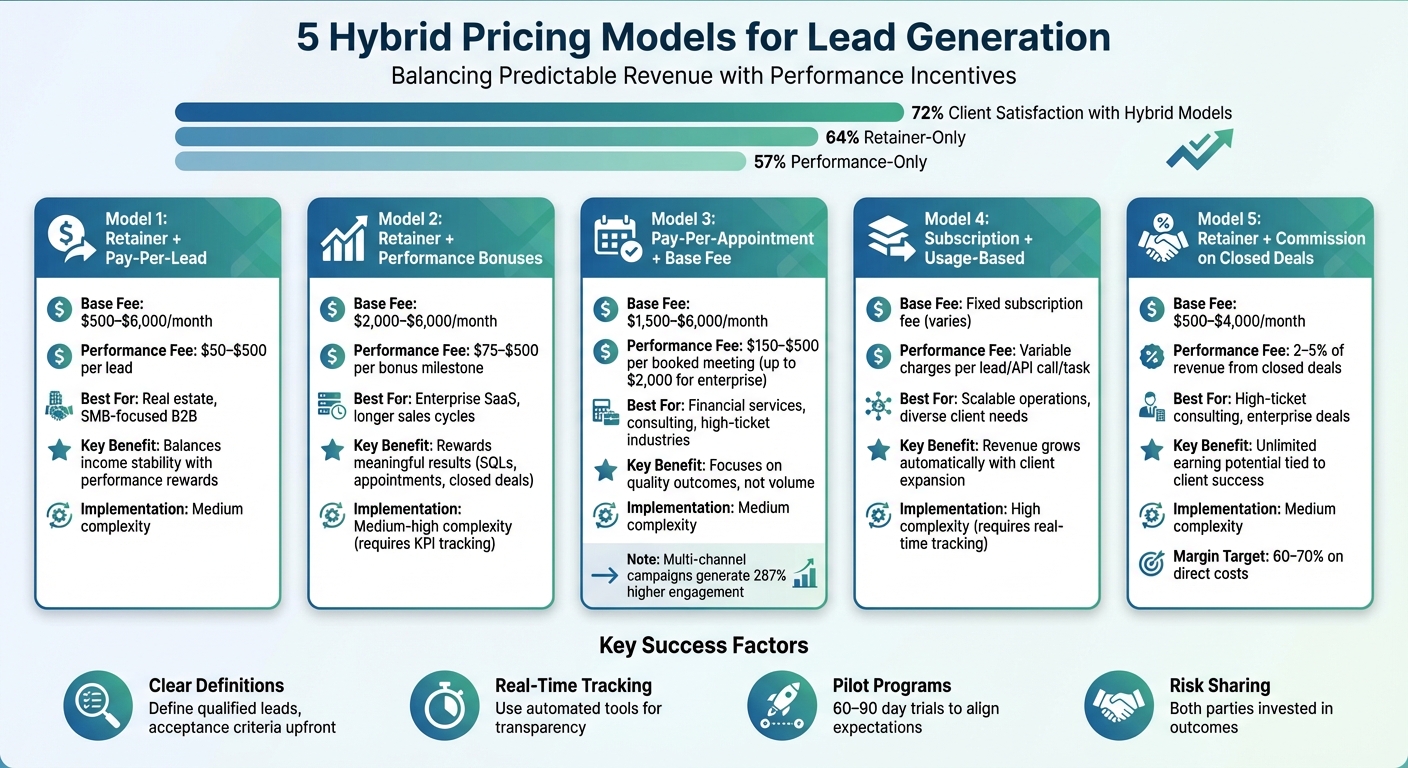
Hybrid pricing models combine steady income with performance incentives, offering a win-win for agencies and clients. These strategies blend base fees with results-based rewards, ensuring predictable revenue while driving accountability. With 72% client satisfaction - higher than retainer-only (64%) or performance-only (57%) models - hybrids are gaining traction. Here's a quick overview:
Retainer + Pay-Per-Lead: Fixed monthly fee ($500–$6,000) + $50–$500 per lead. Balances income stability with performance rewards.
Retainer + Performance Bonuses: Monthly fee ($2,000–$6,000) + bonuses ($75–$500) tied to results like appointments or deals.
Pay-Per-Appointment + Base Fee: Base fee ($1,500–$6,000) + $150–$500 per booked meeting. Focuses on quality outcomes.
Subscription + Usage-Based: Fixed subscription fee + variable charges (e.g., per lead or API call). Scales with client needs.
Retainer + Commission on Closed Deals: Fixed fee ($500–$4,000) + 2–5% of revenue from closed deals. Aligns agency-client goals.
Each model suits different industries and growth stages. Tools like SalesLabel simplify tracking and billing, making hybrid models easier to manage.
5 Hybrid Pricing Models for Lead Generation Agencies Compared
How Much To Charge for B2B Lead Generation | Pricing & Offer Guide
sbb-itb-a781ab9
1. Retainer Plus Pay-Per-Lead
This pricing model combines a fixed monthly retainer with an additional fee for each qualified lead. Smaller agencies typically charge between $500 and $1,500 per month, while larger ones may range from $2,000 to $6,000, plus an extra $50 to $500 per lead [7][2]. It strikes a balance between predictable income and performance-based rewards.
The monthly retainer covers essential tasks like campaign setup, list building, customer profiling, and software expenses. This ensures a steady revenue stream, even during slower months [7]. On the other hand, the per-lead fee incentivizes delivering tangible results, allowing your earnings to grow as you fine-tune your systems.
"This model keeps everyone accountable. It ensures the vendor doesn't just send emails - they're focused on driving outcomes. And for clients, there's skin in the game." - Irina, VP of Business Development, SalesAR [4]
For clients, this approach minimizes upfront financial risk. They pay a smaller retainer while gaining access to dedicated resources, sharing the risk with the agency. This setup ensures clients aren’t paying solely for activity but for actual outcomes.
The success of this model hinges on clearly defining what constitutes a qualified lead from the outset. This includes specifics like firmographics, job roles, and intent signals. Using a real-time tracking system to monitor lead delivery is essential [7][2]. Tools like SalesLabel offer features such as real-time lead scoring and tracking, fostering transparency and building trust between agencies and clients.
2. Retainer Plus Performance Bonuses
This pricing model combines a fixed monthly retainer ($2,000–$6,000) with performance bonuses ($75–$500) tied to specific results [2]. It offers a steady income base while rewarding agencies for delivering measurable outcomes.
The retainer covers essential operational costs, allowing agencies to maintain consistent staffing levels and avoid the ups and downs of irregular cash flow [8]. On the other hand, performance bonuses encourage a focus on meaningful results - like qualified leads or closed deals - rather than superficial metrics such as "emails sent." This balance has earned widespread approval within the industry.
Here’s how Monetizely describes the benefits of this model:
"Hybrid pricing works because it protects your base revenue with predictable workflow pricing while signaling to customers you're confident in outcomes through upside." - Monetizely [5]
Performance bonuses often hinge on key metrics like sales-qualified leads (SQLs), scheduled appointments, or closed sales. For example, an agency might receive a $250 bonus for every scheduled appointment beyond 20 per month. In 2025, Priya's agency implemented this model, charging a $3,500 monthly retainer plus $250 per appointment over 20, which added an extra $2,500–$3,750 to their monthly income [2].
The success of this approach depends on clearly defined metrics. Agencies need to establish precise acceptance criteria and use real-time tracking tools to ensure full transparency. Many agencies also start with a 60–90 day pilot period, setting pre-agreed performance benchmarks to align expectations before committing to a longer-term contract [5]. It’s a strategy that works - hybrid pricing models boast the highest client satisfaction rate at 72%, compared to 64% for pure retainers and 57% for performance-only models [1].
3. Pay-Per-Appointment with Base Fee
This hybrid pricing model combines steady revenue with performance-based incentives. It splits fees into two parts: a modest monthly base fee (ranging from $1,500 to $6,000) to cover foundational tasks, and a per-appointment charge (typically $150 to $500) for each qualified meeting booked [2][7]. The base fee supports key activities like ICP research, campaign setup, list building, messaging strategy, and data enrichment [2][4].
This approach shields agencies from the risk of "$0 months" during slower periods caused by longer sales cycles or market changes [5][7]. Clients only pay the per-appointment fee when actual results are delivered. As Unkoa explains, "The base fee plus performance pay splits the risk while keeping both sides motivated" [7]. This dual-fee system ensures that foundational work is funded while keeping performance incentives intact.
Revenue Predictability
The base fee not only covers direct costs like software and platform subscriptions but also indirect expenses such as administrative tasks, reporting, and labor [2]. On average, agencies require a base fee of about $3,576 per client to break even [2]. This steady income stream helps agencies maintain consistent staffing and operational stability, which can be challenging under pure pay-per-performance models prone to revenue fluctuations [7].
A good example of this model in action is BlueZebra Appointment Setting. They charge an initial $2,500 strategy development fee, followed by customized per-appointment fees tailored to the client's industry and objectives [2].
Alignment with Client Goals
The per-appointment fee structure ensures a focus on quality outcomes rather than sheer activity volume. It eliminates the temptation to rely on "volume cannons" that send out thousands of generic emails. Instead, agencies prioritize clean data and strict qualification standards to ensure booked meetings translate into a real sales pipeline [9]. Both parties agree upfront on what constitutes a qualified appointment - defining criteria like target roles, company size, meeting duration, and attendance requirements [7][9]. Without this clarity, as SalesHive cautions, "If the only thing you pay for is a calendar invite, you'll get calendar invites - not pipeline" [9].
Scalability for Agencies
The predictability of the base fee also supports scalability. It funds essential infrastructure like AI-driven personalization tools, multi-channel outreach (email, LinkedIn, phone), and automation systems. Meanwhile, performance bonuses offer a high-margin upside that can be reinvested into growth [5][7][10]. Multi-channel campaigns, for instance, are known to generate up to 287% higher engagement and 300% more conversions compared to email-only strategies [10].
For agencies targeting complex enterprise accounts or high-value sectors, per-appointment fees can climb to $500–$2,000 or more. Once processes are fine-tuned, this performance-based component becomes highly lucrative [9][10]. The model’s flexibility allows agencies to expand their client base without the rigid limitations of pure retainers, enabling them to adjust outreach efforts based on performance and market dynamics [4].
4. Subscription Plus Usage-Based
This model blends a fixed subscription fee with charges based on usage, such as per lead, API call, or completed task [3][13]. The subscription fee typically covers essential services like platform access, campaign infrastructure, and basic operations, while usage fees kick in when activity surpasses predefined thresholds. As Alguna puts it, "Hybrid pricing gives companies the flexibility to match value with revenue, but it only works when the right tooling is in place" [3].
For agencies, this setup ensures steady monthly recurring revenue (MRR) to handle overhead costs, while revenue grows automatically as clients expand - eliminating the need for frequent contract renegotiations [3][5][14]. Clients, on the other hand, benefit from predictable budgeting for core services while paying additional fees only when their lead generation efforts scale up [3][11]. This hybrid approach balances stable income with performance-driven growth.
Revenue Predictability and Scalability
The subscription component provides a stable financial foundation, making revenue forecasting more accurate and supporting better hiring and long-term planning. Meanwhile, the usage-based layer allows revenue to grow naturally alongside client needs [3][12][14]. For example, if a client’s lead requirement jumps from 200 to 500, the pricing adjusts automatically, eliminating the need for a formal upsell conversation.
Yousign, a European e-signature company, adopted a hybrid model combining per-user pricing with tiered API usage tied to signature volume. This allowed them to serve over 6,000 customers across various markets while maintaining predictable revenue streams [11]. During periods of rapid growth, usage spikes translated directly into higher revenue without disrupting the core subscription framework.
This dual-layer pricing structure not only improves revenue forecasting but also balances operational risks and adapts to client usage patterns.
Risk-Sharing and Client Alignment
In this model, agencies assume some risk if client activity declines [14]. However, the base subscription acts as a safety net, ensuring stable income, while clients avoid paying for unused capacity. As Chargebee explains, "Hybrid pricing models, combining fixed and usage-based components, align pricing with value while offering predictability, ensuring customers stay engaged and finance teams remain happy" [12].
To prevent unexpected overages during usage spikes, savvy agencies set up safeguards like soft alerts at 80% of quota or hard caps to limit excessive charges [13][14]. Clearly defining billable units - whether it’s a qualified lead, an automated ticket, or a scheduled meeting - is crucial for avoiding disputes [5][13]. Additionally, the base subscription should include enough usage to demonstrate immediate ROI before variable charges apply [13].
Platforms like SalesLabel can simplify this hybrid model by automating usage tracking and billing, ensuring that revenue growth aligns seamlessly with service delivery.
5. Retainer Plus Commission on Closed Deals
This model combines a monthly retainer with a percentage-based commission on deals closed from agency-generated leads. The retainer ensures operational costs are covered, while the commission provides unlimited earning potential tied directly to client success [15]. Unlike pay-per-lead models that might prioritize volume over quality, this approach emphasizes delivering high-quality leads and measurable results. It’s a structure designed to reward performance and foster long-term client relationships.
Revenue Predictability and Scalability
The monthly retainer offers a steady revenue stream, helping agencies maintain financial stability even during slower sales cycles. For solo or small teams, retainers typically range from $500 to $1,500, while more established agencies charge $1,500 to over $4,000 [1][2]. On top of this, a commission - usually 2–5% of revenue from closed deals - scales with the client’s growth, creating a win-win scenario without significantly increasing the agency's overhead. To maintain profitability, agencies should aim for a 60–70% margin on direct costs within the retainer [8]. This setup ensures that agency incentives are closely tied to client success, encouraging accountability on both sides.
Alignment with Client Goals and Risk-Sharing
Beyond revenue stability, this model fosters a shared sense of responsibility by aligning agency performance with client outcomes. Clients benefit from reduced upfront costs, while agencies take on some performance risk by tying earnings to results [1][7]. To avoid misunderstandings, it’s crucial to clearly define terms like "qualified lead" and "closed deal" in contracts, specifying criteria such as acceptance windows and attribution rules. Transparency is key, and shared dashboards - using tools like Notion or CRM systems - can provide real-time updates on lead status and conversion metrics [6].
For agencies leveraging platforms like SalesLabel, automated tracking and reporting simplify commission calculations, ensuring everyone stays focused on results rather than just activities. This approach builds trust and keeps both parties aligned on achieving shared goals.
Comparison of Hybrid Pricing Models
Hybrid pricing strategies come with their own set of advantages and challenges, balancing factors like revenue stability, ease of implementation, and suitability for specific clients. Choosing the right approach depends on an agency's resources and the market they serve. Here's a breakdown of some popular hybrid models:
Retainer Plus Pay-Per-Lead works well for agencies operating in industries with clear lead criteria, such as real estate or SMB-focused B2B. While it offers strong revenue opportunities, agencies must establish strict lead qualification standards to avoid disputes [2][7].
Retainer Plus Performance Bonuses is tailored for businesses with longer sales cycles, like enterprise SaaS. This model provides strong earning potential but requires advanced systems to track key performance indicators (KPIs) effectively [1][13].
Pay-Per-Appointment with Base Fee targets high-ticket industries like financial services and consulting. However, this approach carries more risk for agencies, as success depends on whether scheduled meetings lead to conversions [2][7].
Subscription Plus Usage-Based combines scalability with predictability through fixed subscription fees and usage charges. While promising, this model demands sophisticated real-time tracking systems, making it the most complex to implement [3][13].
Retainer Plus Commission on Closed Deals aligns agency goals with client success, making it a good fit for high-ticket consulting and enterprise-level deals. The downside? Agencies have limited control over their clients' ability to finalize sales [1][7].
"Hybrid pricing models show the highest client satisfaction rates at 72%, compared to pure retainer (64%) or pure performance (57%) models." – Monetizely [1]
Each model's success depends on an agency's ability to manage complexity and adapt to client needs. More intricate setups often require advanced tracking systems and pilot programs to prove their value before committing to long-term agreements. Agencies should carefully evaluate their operational capabilities and target industries to select the best fit [1][3].
Conclusion
Hybrid pricing strategies offer agencies a balanced approach, combining predictable revenue from base fees with growth potential through performance bonuses. By sharing the risk, these models help agencies cover their operational costs while keeping their focus on delivering results like booked meetings and qualified leads. With 72% client satisfaction rates, hybrid models outperform pure retainer (64%) and pure performance (57%) models. This is largely due to their transparency - clients understand what they’re paying for, and agencies show their commitment by linking compensation to measurable outcomes [1][4].
To make hybrid pricing work efficiently, automating tasks like usage tracking, billing, and performance reporting is key. Without automation, these models can become overly complex and lead to misunderstandings [3]. Tools like SalesLabel simplify the process by automating lead sourcing, enrichment, personalized outreach, and meeting bookings - all under your agency’s branding. This combination of automation and hybrid pricing ensures smoother operations and consistently drives client success.
FAQs
How can hybrid pricing models enhance client satisfaction in lead generation services?
Hybrid pricing models enhance client satisfaction by blending predictable costs with performance-driven flexibility. These models typically include a fixed base fee for consistent services, like lead sourcing, combined with additional charges tied to measurable results - such as the number of qualified leads or scheduled meetings. This setup ensures clients pay only for outcomes they can see and measure.
By linking costs to delivered value, hybrid pricing builds trust and openness, minimizing the chances of clients feeling overcharged. It also offers businesses the flexibility to adjust their spending based on their goals and the results achieved, making the pricing feel more tailored and fair. This structure promotes stronger, long-term partnerships and leaves clients feeling confident that their investment aligns with the value they receive.
What should my agency consider when selecting a hybrid pricing strategy for lead generation services?
When selecting a hybrid pricing strategy, aim to strike a balance between steady, predictable revenue (like flat fees or retainers) and flexible, performance-based charges that adapt to your clients' needs and usage. This approach helps ensure your pricing reflects the value you provide while keeping your financial foundation stable.
It's also important to think about how well the model can scale as your agency expands. Using trusted tools or software can make managing these more intricate pricing structures easier. This not only simplifies your operations but also creates a smoother experience for your clients.
How do automation tools improve hybrid pricing strategies for lead generation services?
Automation tools play a key role in fine-tuning hybrid pricing strategies by simplifying processes and boosting scalability. Tasks like lead sourcing, data enrichment, personalized outreach, follow-ups, and even scheduling meetings can all be automated. This allows agencies to manage a higher volume of leads without compromising on quality or the personal touch. The result? Less manual effort and consistent service delivery - both critical for hybrid pricing models that blend fixed fees with usage-based charges.
These tools also offer real-time insights, such as lead scoring and performance metrics, enabling agencies to adjust pricing based on actual outcomes. By optimizing how resources are used and enhancing customer satisfaction, automation tools make hybrid pricing models more accurate and effective at capturing value.
 Lead
Lead