How to reduce AI bias in lead sourcing: clean training data, limit proxy features, run segment checks and scheduled audits.
SalesLabel Team
Growth Expert • 24.07.2026
Share:
Cauți o soluție gata de utilizare?
SalesLabel automatizează prospectarea de la un capăt la altul — AI găseşte prospecți, trimite mesaje personalizate şi rezervă întâlniri sub brandul tău.
AI can help you source more leads, but it can also steer good leads out of your pipeline. In the source article, about 40% of companies using AI have already run into bias issues, and the FTC has warned that biased AI can create legal risk.
If I had to boil the whole piece down, I’d put it like this: clean the data, limit risky inputs, check segment-level score gaps, and review live results on a fixed schedule. That’s the core fix.
Here’s the article in plain English:
Past wins can skew future scoring. If your old deals leaned toward one industry, region, or company size, AI may keep pushing those groups to the top.
Neutral-looking fields can still cause problems. ZIP code, tech stack, and job title can act like stand-ins for sales coverage gaps.
Engagement can fool the model. Opens and clicks do not always mean a lead is a better fit, especially for slower enterprise deals.
You need checks before, during, and after launch. Review training data, test score gaps by segment, and monitor live pipeline mix.
Human review still matters. Low-confidence cases and segment-level drop-offs should not be left to the model alone.
Revenue and bias checks should be reviewed together. If a segment has low AI scores but strong sales acceptance, something is off.
What stands out most to me is this: a model can look accurate and still produce uneven results. So if you only watch top-line conversion numbers, you can miss the problem.
The article’s main message is simple: AI lead sourcing needs rules, review cycles, and clean inputs - or it will repeat old sales patterns at scale.
Lead Scoring vs Signals and Why AI Signals Work Better Than Traditional Lead Scoring Algorithms
sbb-itb-a781ab9
The Most Common Biases in AI-Driven Lead Sourcing
Most bias in AI lead sourcing comes from three places: old history, skewed inputs, and noisy engagement signals. In plain English, the model learns from what happened before, gets pulled off course by stand-in signals, and can mistake activity for buying intent.
Survivorship Bias and Historical Data Bias
When AI trains mostly on closed-won deals, it learns your old habits more than the full market. If 70% of past wins came from healthcare, the model can start treating healthcare as the default “good lead” profile and push other verticals lower. That means logistics firms, manufacturing accounts, and newer verticals may look weak on paper, even when your current go-to-market plan is trying to branch out.[1][3][4][5][6]
There’s another layer here: time. Models trained on older, SMB-heavy deals can keep favoring short sales cycles and miss the value of slower enterprise motion. In that case, the model is overfit to older deal patterns. So if your team now wants more enterprise accounts, the scoring can work against you unless those old win patterns are checked against current ICP goals.
Geographic, Firmographic, and Proxy Bias
This kind of bias is easy to miss because the inputs look harmless at first glance. ZIP code, industry, and job title seem neutral enough. But they can carry a lot of baggage.
Say East Coast deals dominated in the past because most reps sat in New York and Boston. A model trained on that data can start scoring East Coast ZIP codes higher by default. Then West Coast or Mountain state leads get pushed down, not because they’re worse prospects, but because the model learned where reps happened to spend time.[4][2]
The same thing happens with firmographic data. If past sales efforts centered on mid-sized SaaS companies using certain CRM tools, the model can start penalizing accounts outside that mold - larger enterprises, non-SaaS firms, or companies with different tech stacks - even when their budget and ICP match are strong.[3][4][2][5][6] Those inputs become proxies for past coverage gaps, not actual fit. And that leaves weaker coverage in the very segments the agency wants to grow.
Engagement and Messaging Bias
Activity signals are simple to track, so AI systems tend to lean on them hard. Opens, clicks, replies, and website visits all look like signs of interest. The catch is simple: fast engagement is not the same as high fit.[1][3][4]
Enterprise buyers often look quiet early on. They read, share internally, compare options, and do their homework before replying. That can push high-value accounts lower in the queue while faster, lower-value leads move up.[3][4][5][6] It’s a bit like judging a serious buyer by how fast they text back.
There’s a second issue tied to messaging. When AI-written outreach is tuned to the segments that replied most in the past, the copy can start drifting toward those audiences. It lands with quick-reply prospects, but misses slower, more consultative buyers - the same ones that often come with larger average contract values.[4][6]
These patterns can be fixed with cleaner inputs, tighter scoring rules, and post-launch audits. The first step is making sure the model is learning from the right signals instead of repeating old blind spots.
How to Reduce Bias in Lead Sourcing Systems
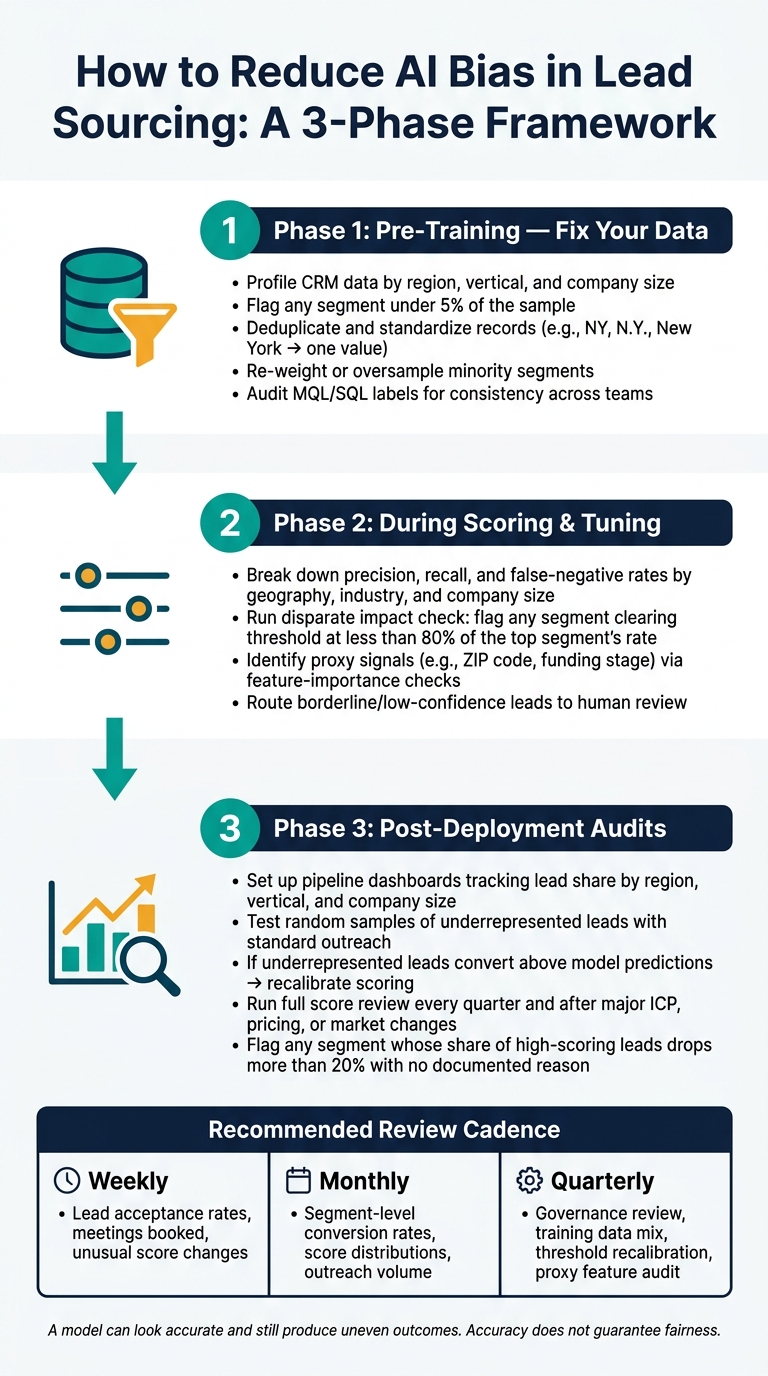
How to Reduce AI Bias in Lead Sourcing: A 3-Phase Framework
The cleanest way to cut bias is to deal with it at three points: before training, during scoring and tuning, and after deployment.
Fix Training Data Before the Model Learns
Start with the data itself. Profile CRM and campaign data by region, vertical, and company size, and flag any segment that makes up less than 5% of the sample.[2][11]
Then clean the data hard. Deduplicate records. Standardize entries like "NY", "N.Y.", and "New York" before scoring. If you skip this step, the model can treat the same thing as three different signals.
After that, re-weight or oversample minority segments so the model doesn't just lean toward the biggest group in the dataset.[11][15] It also helps to audit MQL and SQL labels for consistency. If teams label similar leads in different ways, the model learns that mess.
Once the dataset is clean, check whether the score still leans toward one segment.
Apply Fairness Checks During Scoring and Model Tuning
During tuning, don't just look at top-line model performance. Break down precision, recall, and false-negative rates by geography, industry, and company size.[11][17]
Run a disparate impact check too. If one segment clears the threshold at less than 80% of the top segment's rate, dig into it.[8][10] That's often where hidden problems start to show up.
Feature-importance checks can help you spot proxy signals like ZIP code or funding stage.[13][14] If a feature looks like a stand-in for something you don't want the model to favor or filter out, test it directly. And for borderline leads, send them to human review instead of letting the model make the final call alone.[9][16]
Then make sure the same pattern still holds once the system is live.
Audit Results After Deployment
After launch, track score drift.
Set up pipeline representation dashboards to monitor what share of sourced, scored, and contacted leads comes from each region, vertical, and company size. Then test a random sample of underrepresented leads with the same outreach, no matter what score they received. If those leads convert at higher rates than the model predicted, the live scoring system is under-ranking that segment and needs recalibration.[11][12]
Run a full score review every quarter and after major ICP, pricing, or market changes.[12][18]
For agencies, it makes sense to bake these same checks into weekly workflow reviews and owner assignments.
Bias Fixes for Agencies Running AI Lead Gen Workflows
Data cleanup helps, but it only sticks when an agency builds checks into day-to-day work. That means being clear about who reviews results, when those reviews happen, and what the team does when bias shows up. The goal is simple: make those checks part of a repeatable workflow.
Build a Simple Bias Audit Playbook
A bias audit playbook should be easy to run, not a giant process nobody wants to touch. At a minimum, spell out who runs the audit, how often it happens, which data gets reviewed, and what actions come next.
Each month or quarter, pull performance data broken out by region, industry, company size, and job function. Then compare leads sourced, outreach, engagement, meetings booked, and downstream conversions across those segments. If one segment lags behind similar groups and there’s no clear business reason, flag it.[24][26] Write down every finding, along with any changes made, so later audits can show whether the fix actually held.
Set Rules for Feature Use and Score Interpretation
Not every model input is safe to use. Agencies should keep a short approved feature list with inputs like role, employee count, tech stack, hiring patterns, and publicly stated business initiatives. Inputs that can act as stand-ins for demographics, such as detailed ZIP code patterns or inferred personal data, should be restricted or removed.[20][24][27]
Score interpretation should follow one plain rule: AI scores support decisions; they do not decide them. Sales teams and SDRs should check scores against firmographics before taking action. Low-confidence scores or segment-level deprioritization should trigger manager review.[7][25][26]
If your agency uses SalesLabel, these controls should live inside the platform workflow itself. Set quarterly checkpoints to review sourcing criteria, enrichment fields, outreach and follow-up cadences, and booking workflows. It also helps to check whether filters such as industry, region, company size, and job function are cutting out parts of the market you still want to reach.
Next, review which attributes feed SalesLabel's real-time lead scoring and AI-driven replies. Remove proxy or sensitive data, including neighborhood-level location signals and personal social data. Keep a change log for scoring and routing updates, and require approval before adding new data sources or filters. Then use segment-level views to compare lead volume, scores, outreach, replies, response time, and outcomes.[24][26]
Keep templates tied to role, department, tech stack, business model, and public goals. Review those templates and test variations to make sure any gains come from relevance, not bias.[19][20][21][22][23]
Measure Results and Keep Sourcing Fair Over Time
Once the system is live, review fairness and revenue in the same cycle. That matters because bias doesn’t sit still. Data changes. Campaigns change. Markets change. If you’re not watching on a regular basis, small problems can turn into expensive ones.
Track Fairness and Revenue Metrics Together
At the metric level, break results out by segment. That’s where issues tend to show up. A top-line number can look fine while one group gets favored and another gets left behind.
Track:
meetings booked
lead-to-opportunity conversion rate
pipeline value contribution (in USD)
win rate
lead acceptance rate
Cut those metrics by industry, region, and account size - for example, under $10M, $10M–$100M, and over $100M in annual revenue. If one segment beats similar groups and there’s no clear business reason for it, dig in.[30][32][36]
One pattern deserves extra attention: segments with strong sales acceptance rates but consistently low AI scores. That usually points to bias entering the scoring model through geography, firmographics, or engagement signals. Put simply, the model may be scoring leads too low that sales would otherwise accept.[4][2]
Use a Simple Review Cycle
A fixed review cadence makes drift easier to catch before it spreads. Use a weekly, monthly, quarterly cycle.
Weekly, check lead acceptance rates, meetings booked, and any unusual score changes the team has flagged.
Monthly, run a segment-level review. Compare conversion rates, score distributions, and outreach volume across industries and regions. If a segment starts to drift, adjust thresholds.[28][29][30][34]
Quarterly, run a governance review tied to metric drift. Recheck the mix of training data, recalibrate scoring thresholds, remove proxy features that may have slipped back in, and decide whether new markets need separate routing or scoring rules.[28][29][30][34]
During quarterly reviews, treat this as a clear warning sign: if any segment’s share of high-scoring leads drops by more than 20% and there’s no documented business reason, investigate it.[33]
Also, log every change - model updates, threshold changes, and new data sources - along with the reason for the change and a follow-up date. That record helps you separate planned strategy shifts from drift that crept in on its own.[31][35][37]
Conclusion: Better Lead Sourcing Requires Better Controls
AI bias in lead sourcing isn't the kind of problem you solve once and move on from. It sticks around unless you keep watch. That's why one fix here or one tweak there isn't enough. This is a governance issue, not just a one-time model problem.
The work is pretty straightforward, even if it takes discipline: clean your data, limit risky features, check fairness while scoring, and audit results after launch.
One fairness study makes the point clearly. It found that high predictive accuracy did not guarantee fairness - some disparities persisted after training, and reweighting improved some metrics but not all [38]. In plain English, a model can look accurate and still produce uneven outcomes. Accuracy does not guarantee fairness.
For agencies running this inside SalesLabel, those controls need to show up in day-to-day workflow rules. If you're using SalesLabel, set scoring rules with care, keep diverse segments in sourcing and routing, and review outcomes on a fixed cadence.
The loop is simple: improve data, control scoring, measure fairness, audit results, repeat.
Bias stays manageable only when controls stay active.
FAQs
How can I spot bias in lead scores early?
Validate automated lead scores against actual conversion results on a regular basis. Check how your system weighs ICP fit against engagement signals so you can spot bias toward certain segments or catch high-intent prospects that may be slipping through.
SalesLabel helps by making real-time lead scoring and qualification updates easier to see, so you can compare rankings with actual outcomes and keep scoring accurate and balanced.
Which lead data fields are most likely to cause bias?
The source material doesn’t list specific lead data fields. In AI-driven lead sourcing, bias is more likely to show up when models lean on demographic, geographic, or behavioral proxies that echo past inequities.
To lower that risk, teams using SalesLabel should tune ICP fit scores and validation metrics so scoring leans more on objective conversion data and less on demographic fields that can skew results.
How often should AI lead sourcing be audited?
Audit AI lead sourcing on a regular basis to check how well the model matches your ideal customer profile and conversion goals.
It also makes sense to review it any time you update lead scoring rules or change automated outreach workflows. That kind of routine check helps stop data drift, keeps the AI lined up with agency goals, and supports unbiased, scalable operations.