How agencies used AI to discover, enrich, personalize, and score B2B leads—tripling qualified prospects and boosting meetings.
SalesLabel Team
Growth Expert • 17.07.2026
Share:
Cauți o soluție gata de utilizare?
SalesLabel automatizează prospectarea de la un capăt la altul — AI găseşte prospecți, trimite mesaje personalizate şi rezervă întâlniri sub brandul tău.
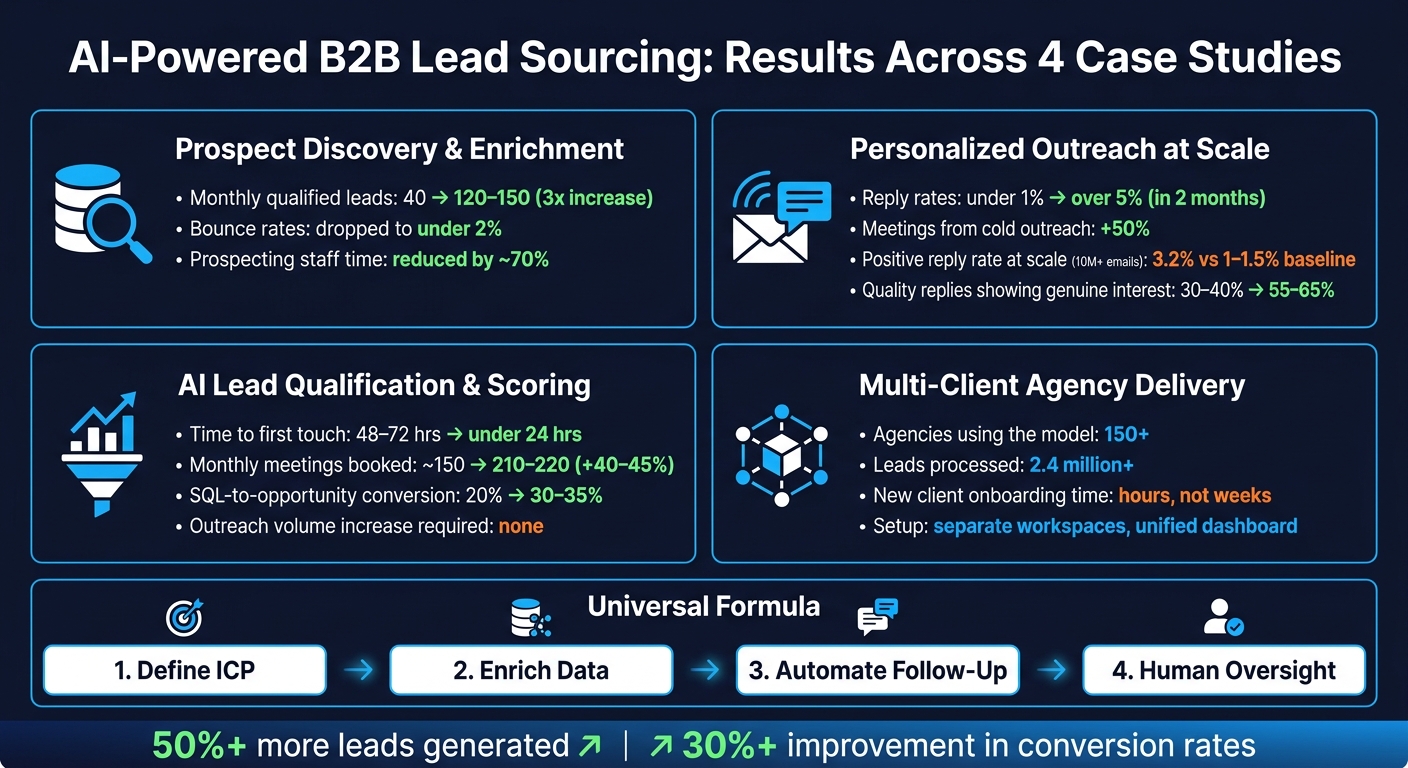
AI can help B2B agencies get more meetings with less manual work. In the cases covered here, teams moved from 12–15 booked meetings per week to 35–42, cut bounce rates to under 2%, and lifted monthly qualified leads from about 40 to 120–150.
Here’s the short version:
AI found and enriched leads using ICP rules like industry, company size, role, and U.S. location
AI wrote personalized outreach at scale, which pushed reply rates from under 1% to over 5% in one case
AI scored and ranked leads so reps could focus on the best accounts first
Agencies ran the same system across many clients by using separate workspaces, inboxes, and reports
The main point: I see the best results when AI handles the repetitive work and people handle targeting decisions, lead checks, and sales calls.
If you run a U.S. agency, the takeaway is simple: clear ICP rules, clean data, automated follow-up, and human review are the setup that shows up again and again in these examples.
AI vs Manual B2B Lead Sourcing: Key Results Across 4 Case Studies
How I Generate B2B Leads With AI Agents
sbb-itb-a781ab9
Case Study 1: AI Prospect Discovery and Enrichment
Before AI, most agency teams built prospect lists the hard way. They searched LinkedIn Sales Navigator, checked company websites and industry directories, and then copied contact details into spreadsheets by hand.
The Problem with Manual List Building
The main problem was scale. When teams applied ICP criteria by hand, off-fit contacts often made their way into campaigns. Data quality also took a hit. Duplicate records, missing contact details, old job titles, and unverified emails led to wasted outreach.[3][8]
How AI Handled Discovery and Enrichment
The shift began when teams turned the ICP into a clear set of filters: industry, employee range, U.S. geography, funding stage, tech stack, and role seniority. The ICP stopped being a loose idea and became a rule set. From there, AI agents used those rules to keep searching LinkedIn, funding databases, job boards, and industry directories for matching accounts.[5][3]
Enrichment worked the same way. For each account it found, the system pulled in company size, revenue band, tech stack signals, recent company news, and trigger events like funding announcements or hiring spikes. At the contact level, it added job titles, work emails, LinkedIn URLs, and role tags such as decision-maker, influencer, or user.[5][3][6][8]
People still stayed involved, just in a lighter way. Human review was used for spot checks, while strategists tuned the ICP and verified suppression lists before records moved into outreach.[8][7]
Before and After Results
The lift was hard to miss. In one documented case, monthly highly qualified prospects went from about 40 to 120–150 after AI-driven sourcing and enrichment replaced manual research.[3] In another case, prospecting staffing needs dropped by about 70%, which gave the team more time for conversations instead of list prep.[5] And because email verification was built into the enrichment workflow, bounce rates fell below 2%.[8]
That changed the day-to-day work for SDRs. Instead of starting with raw spreadsheets, they started with qualified records. That meant more time spent on high-intent accounts and more room to support extra clients without bogging the team down.
Once discovery and enrichment were automated, the next bottleneck was outreach quality.
Case Study 2: AI-Personalized Outreach at Scale
Once discovery and enrichment were automated, the next bottleneck was personalization.
How Personalization Was Automated
The agency ran each prospect through a standard data template that pulled in firmographic, technographic, intent, and trigger signals. That data then flowed into prompt templates. Copy strategists defined the core messages and the prompt rules, and the AI produced 2–3 email variants for each prospect.
To keep the output from sounding flat or generic, quality filters removed weak phrasing. The team also did human spot checks on batches of 50–100 emails to keep tone and positioning on brand. [11]
Effect on Replies and Meetings Booked
In one marketing agency case study, an AI Content Agent pushed reply rates from under 1% to over 5% in two months. It also increased meetings booked from cold outreach by 50%. [11]
The same pattern showed up at a much larger scale. Across 10 million+ B2B cold emails, AI-personalized campaigns hit a 3.2% positive reply rate, compared with the 1–1.5% baseline for template-based outreach. [10]
It wasn’t just about getting more replies. The replies got better as volume went up. The share of responses showing genuine interest moved from roughly 30–40% to 55–65%. [10]
As reply volume climbed, qualification became the next bottleneck.
Case Study 3: AI Lead Qualification and Scoring
At this level of volume, manual scoring fell apart. Reps were spending hours each week digging through LinkedIn profiles, CRM notes, and company websites just to figure out who deserved a call first. On top of that, there was no shared scoring model, so each rep leaned on different signals and forecasting became shaky. The team needed one rule set everyone could use.
The Qualification Logic Used
The AI used a multi-signal framework that pulled firmographic fit, behavioral engagement, and intent signals into a single score.[12][13][9]
Firmographic filters focused on companies with 50–500 employees, in sectors like SaaS or professional services, and with U.S.-based headquarters. Behavioral data tracked things like email opens, link clicks, repeat website visits, and time spent on case study or pricing pages. Intent signals came from public data, including recent funding rounds, job postings that mentioned sales development, and social activity tied to demand generation topics.
The system then assigned Tier 1, Tier 2, or Tier 3 labels, along with a short explanation for each score. In SalesLabel-powered setups, scores changed in real time as engagement shifted. So if a lead clicked a pricing link, that contact could jump to Tier 1 almost immediately.
Results in Pipeline Efficiency
This changed the rep workflow in a simple but important way: they started each day with a ranked queue instead of a flat list.
Time to first touch on top-scored leads dropped from 48–72 hours to under 24 hours. Meetings booked climbed from about 150 to 210–220 per month, a 40%–45% lift, without any increase in outreach volume. The pipeline also got cleaner. The SQL-to-opportunity conversion rate moved from about 20% to 30–35%, and forecasting became more dependable for client reporting.
Once the scoring model was standardized, the team could roll out the same setup across multiple client accounts.
Case Study 4: Running AI Lead Sourcing Across Multiple Client Accounts
When one account starts working, the next test is simple: can you do it again and again across many clients? After qualification, scale becomes the main issue. Each client has its own ICP, messaging, inbox, and reporting, so handling several accounts at once calls for a different setup.
How Agencies Turn This Into a Repeatable Service
Agencies that grow this model treat AI lead sourcing like a repeatable service, not a one-off job. They set a fixed workflow, then use it for each new client while only changing the targeting and messaging. That kind of setup can get a new account live in hours, not weeks. [17][18][19]
Each client is given a separate workspace with its own domains, inboxes, suppression lists, and analytics. [20][21][22][23][24] At the same time, agencies pull performance data into one dashboard so they can track open rates, reply rates, and meetings booked across all accounts. [17][18][19]
SalesLabel is built for this kind of multi-account work. It brings separate client workspaces, outreach, scoring, inboxes, and reporting into one white-label system. Clients sign in through a portal branded with the agency's logo and domain. [1][2][14][15][16]
"The AI sometimes answers better than I would. It analyzes the website and profile of the person." - Mike R., SalesLabel User [4]
More than 150 agencies have used the platform, and together they have processed over 2.4 million leads. [4]
Across accounts, the pattern stays the same: keep each client separate, run the same workflow, and track results from one place.
Patterns That Appear Across All Four Case Studies
Taken together, these four cases point to the same setup: AI handled the scale, while people kept control of the calls that mattered. The best results came when agencies treated AI lead sourcing like a repeatable system, with four pieces in place: clear ICP definitions, solid enrichment, automated follow-up, and human oversight.
Precise ICP definitions were a shared starting point. In each case, agencies spelled out target industries, company sizes, tech stacks, and negative filters before they built outreach. That upfront work is what kept AI targeting steady across accounts.
Enrichment quality shaped how well AI could perform. When lead records had validated contact data, firmographics, and intent signals, scoring and personalization worked better. When enrichment was thin, reply quality dropped and poor-fit contacts slipped into the pipeline.
Automated follow-up filled the gap that manual work often leaves behind. Multi-touch sequences kept steady pressure on prospects across all four cases. That consistency helped keep interest from dying after the first message.
Human judgment stayed where context mattered most. AI took care of discovery, enrichment, scoring, and draft outreach. People still defined the ICP, checked top-scored leads, and handled the actual sales conversations. In plain English, humans kept the wheel for ICP definition, lead review, and live conversations.
That pattern leads straight into the practical takeaway for agencies.
Conclusion: What Agencies Can Take Away from These AI Lead Sourcing Results
Those four patterns lead to one plain takeaway: AI does its best work inside a clear process. The strongest results came from agencies that had already set the inputs: ICP definition, enrichment quality, automated follow-up, and human oversight.
Teams that use AI in day-to-day work can generate 50%+ more leads, and AI-powered scoring can improve conversion rates by 30%+[25][26]. Those gains came from better targeting and faster follow-up.
For agencies that want to turn this into a service, the next step is to productize the workflow. Define the deliverables. Standardize execution. Launch each new account from the same playbook. That makes pricing, forecasting, and scaling across many accounts a lot simpler.
A white-label platform like SalesLabel supports that model by keeping sourcing, enrichment, outreach, follow-up, scoring, and reporting in one white-label workspace. That helps agencies keep delivery organized under their own brand.
The agencies that win are the ones with the tightest system around AI. Define the ICP. Enforce data quality. Automate repetitive work. Keep humans on judgment calls. That's the repeatable formula these cases show.
FAQs
How much human review does AI lead sourcing need?
AI lead sourcing cuts a lot of the manual work out of prospecting, data entry, and repetitive outreach. It automates lead discovery, personalized messaging, and meeting booking, which means teams spend less time stuck in execution and more time on strategy and B2B relationship-building.
With SalesLabel running these workflows on autopilot, human input moves away from day-to-day tasks and toward closing deals and sharpening agency strategy.
What data signals matter most for AI lead scoring?
The most important signals blend ICP fit with behavioral engagement data. That means looking at two things at once: how closely a lead matches your ideal client and what that lead is actually doing.
Agencies should also use time-decay factors so scores stay current as interest shifts. A lead who was active last week usually matters more than one who clicked around three months ago and then went quiet.
Predictive AI can help estimate future conversion potential. But it shouldn't run on autopilot. Teams need to check scores on a regular basis against actual conversion results, so the model stays accurate and in line with sales outcomes.
How can an agency roll this out across multiple clients?
Agencies can roll out AI-powered lead sourcing for multiple clients with a white-label platform like SalesLabel, which keeps everything under the agency’s own brand.
It handles prospecting, tracking, outreach, follow-ups, and meeting booking automatically. That means agencies can run campaigns for many clients from one dashboard, without adding more staff.