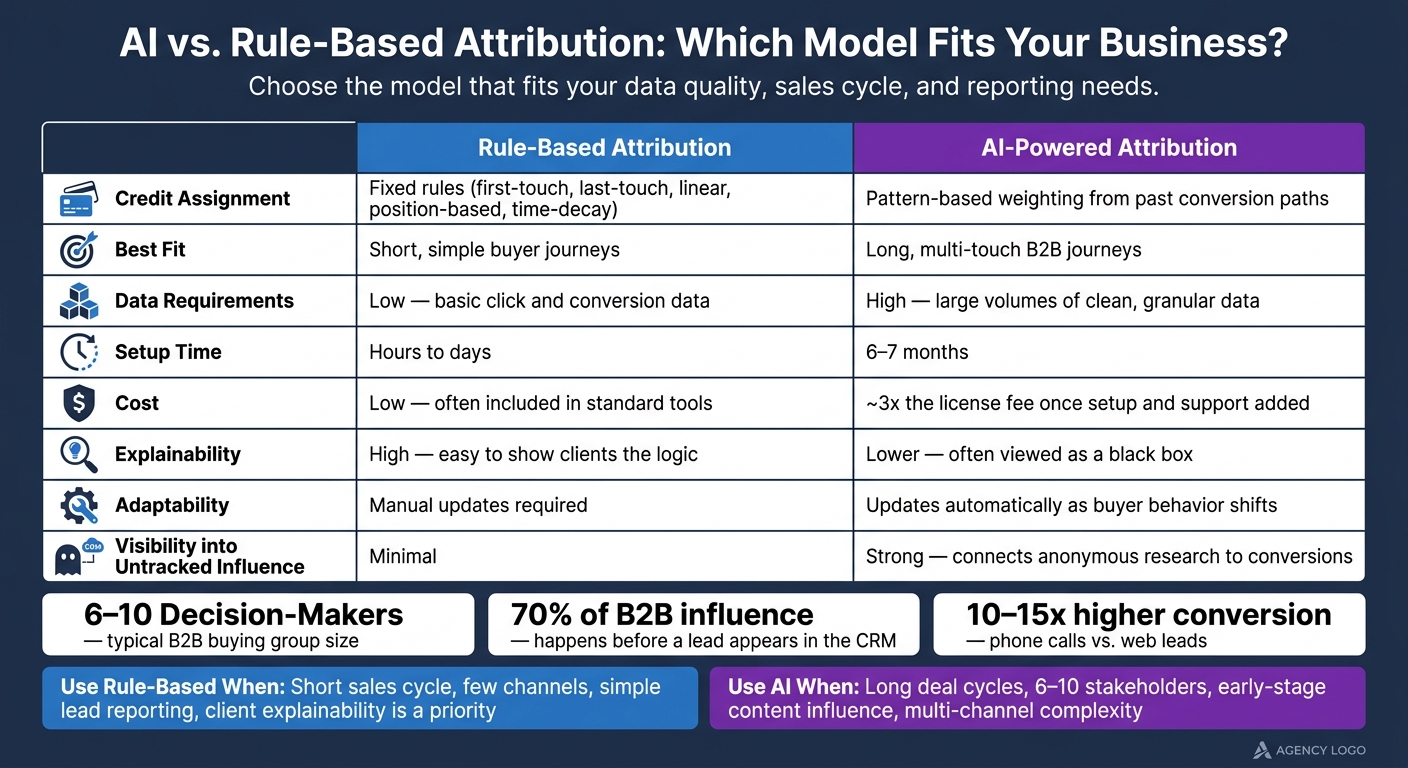
When to use rule-based vs AI attribution: simple rules for short lead-gen; AI for long, multi-touch B2B journeys with clean data.
SalesLabel Team
Growth Expert • 27.07.2026
Share:
Szukasz gotowego rozwiązania?
SalesLabel automatyzuje prospecting od początku do końca — AI znajduje potencjalnych klientów, wysyła spersonalizowane wiadomości i rezerwuje spotkania pod Twoją marką.
If I had to sum it up in one line: use rule-based attribution for simple lead-gen paths, and use AI attribution when your buyer journey is long, messy, and spread across many touches.
Here’s the short version:
Rule-based models are easy to set up and explain.
AI models can give a closer read on multi-touch revenue paths.
Bad data hurts both, but AI depends much more on clean tracking.
In B2B, buying groups often include 6–10 people, which makes fixed credit rules less useful.
About 70% of B2B buying influence can happen in places your CRM never sees.
Setup for AI can take 6–7 months and cost about 3x the software fee once setup and support are added.
Missed tracking can hide a lot of ROI, especially for phone calls, which can convert 10–15x more often than web leads.
If you want the plain answer, it’s this: the best model is the one that fits your data quality, sales cycle, and reporting needs. For many agencies, a position-based model is a good starting point. For large B2B programs with long deal cycles, AI may give a better view of what drove pipeline and revenue.
AI vs. Rule-Based Attribution: Side-by-Side Comparison
Quick Comparison
Criteria
Rule-Based Models
AI Models
How credit is assigned
Fixed rules like first-touch, last-touch, linear, position-based, and time-decay
Pattern-based weighting from past conversion paths
Best fit
Shorter, simpler journeys
Longer, multi-touch B2B journeys
Data needs
Lower
High
Setup
Fast
Slow and more involved
Explainability
Easy to show clients
Harder to explain
Cost
Lower
Higher
Flexibility when buyer behavior shifts
Manual changes
Model updates from new data
View of hidden or early influence
Limited
Better, if tracking is connected
I see this topic as a tradeoff between simplicity and precision. The article below breaks down where each model works, where it fails, and how attribution changes the ROI story you tell.
sbb-itb-a781ab9
Rule-Based ROI Attribution Models
Rule-based models use preset rules to assign conversion credit. That sounds clean on paper. But once a buyer interacts with your brand across search, ads, email, social, and sales touchpoints, those rules can start to feel a bit blunt.
The Core Models: First-Touch, Last-Touch, Linear, Position-Based, and Time-Decay
Each model answers the same question differently: which touchpoint gets credit?
First-touch gives 100% of the credit to the first touch. Use it when you want to spot the channels that spark awareness and bring in those first leads.
Last-touch gives 100% of the credit to the final touch before conversion. This model is useful for seeing which interaction closes short, direct-response journeys.
Linear splits credit evenly across every touchpoint. It gives every interaction a seat at the table, but there’s a catch: it treats a minor touch the same as a major one.
Position-based (also called U-shaped) gives 40% to the first touch, 40% to the conversion touchpoint, and spreads the remaining 20% across the middle interactions. That setup works well for B2B lead gen because it gives weight to both discovery and conversion.
Time-decay gives more credit to touchpoints that happen closer to conversion, using an exponential decay function. It tends to fit shorter cycles, though it can underweight early-stage content that helped start the journey.
Comparison Table: How Rule-Based Models Assign Credit
That’s the big weakness of rule-based attribution in multi-touch lead gen. Fixed rules can’t fully reflect how people move through a messy, non-linear buying path. That gap is exactly what AI-powered attribution aims to address.
How AI-Powered Attribution Works
That gap is exactly where AI attribution starts to matter. Instead of using preset credit splits, AI attribution weighs touchpoints based on their observed contribution. In plain English, it looks at what actually happened across past buyer journeys and assigns credit from those patterns, not from a fixed formula.
From Fixed Rules to Pattern Recognition
AI attribution uses algorithms like Markov Chains and Shapley Values to calculate how much each touchpoint contributes to revenue. Markov Chains estimate what happens if you remove a touchpoint from the journey. Shapley Values look at each touchpoint’s marginal contribution by assigning credit based on its effect on conversion probability. In both cases, the model relies on statistical patterns instead of static splits like 40/40/20.
One of the biggest gains shows up in activity that’s easy to miss: anonymous research, private social shares, and ungated content. Old-school models often dump that activity into “direct traffic” or miss it altogether. Research suggests that up to 45% of what shows up as direct traffic actually comes from dark social shares or anonymous research [5]. AI can tie those signals to later conversions, which helps teams spot early-stage content - like technical white papers or webinars - that lifts purchase probability even when the interaction happened months before a deal was created. That leads to cleaner reporting on content-influenced revenue.
A good example came from IBM in 2024. Through AI attribution, the company found that technical white papers influenced deals 3x more than earlier estimates showed [5]. Those papers were downloaded long before opportunities were created, so older models gave them too little credit.
Rule-based models stay the same until someone manually changes the rules. AI models, by contrast, are retrained on new journey data. So when buyer behavior shifts or a new channel starts driving results, the weightings can change on their own [2][1].
Comparison Table: AI Attribution vs. Rule-Based Attribution
Feature
Rule-Based Attribution
AI-Powered Attribution
Accuracy
Works best in simple journeys; weak in complex multi-touch paths [2][1]
Better on multi-touch paths; weights contribution statistically [1]
Rule-based models are simpler to explain in a meeting. AI output can be harder to defend if your tracking is messy or your data governance is weak. That tradeoff sets up the pros-and-cons discussion next.
Pros and Cons: AI vs. Rule-Based Attribution
Where Rule-Based Models Still Hold Up
Rule-based models still make sense for a lot of teams. They’re fast to get running, simple to explain, and don’t need much technical work. That matters in client reporting. If a client asks why a campaign got credit for a conversion, you can point to the rule used and explain it in plain English.
They also fit cases where the buyer journey is short and fairly straight. If the path from first touch to conversion is direct, AI attribution can be more work than it’s worth. In those cases, simple ROI reporting is often the main goal, and a fixed-rule model gets you there without much fuss.
Where AI Attribution Has the Edge
AI pulls ahead when the journey gets messy. Modern B2B purchases usually involve 6 to 10 decision-makers[5], and that’s where rule-based models start to strain. AI attribution is better at tying together touches from multiple people into one opportunity, which gives agencies a better read on what shaped revenue.
It also picks up revenue influence that fixed models often miss, especially across long, multi-touch journeys. That helps agencies see channel shifts before a campaign wraps up, which makes mid-cycle changes easier to justify. For agencies, that means revenue reporting that holds up better across longer sales cycles.
Limitations to Watch on Both Sides
Rule-based models have a common weak spot: they often give too much credit to the last touch and not enough to the touches that came earlier. That can leave reporting incomplete and push budget toward channels that close, while ignoring the ones that helped start or move the journey.
AI attribution has a different problem. The biggest one is data quality. Clean, connected data isn’t optional here. It’s the price of entry. If the data is messy, AI won’t fix it. It will just process bad inputs at scale.
Setup can also take more time and money than teams expect. A rollout often takes 6 to 7 months and can cost about 3x the license fee once integration, training, and support are added in [5].
Attribution improves ROI reporting only when the data underneath it is complete and connected. The next question is whether your data stack can support that level of accuracy.
How to Measure Lead Generation ROI Accurately
The Inputs That Shape Reliable ROI Reporting
Start by setting the time period and the campaigns you want to review. The math for ROI is simple: ((Attributed Revenue – Total Investment Cost) / Total Investment Cost) × 100[8]. The hard part isn't the formula. It's making sure your inputs are complete.
On the cost side, count everything tied to the work: media spend, software fees, and allocated labor. That includes tools like your CRM, marketing automation platform, attribution software, and call-tracking setup[8][9]. On the revenue side, use closed-won revenue from your CRM - not guessed lead values or rough projections[8][11].
If your sales cycle takes longer, don't stop at top-line ROI. Track the numbers that show how leads move toward revenue:
Lead volume alone can fool you. A campaign that drives a pile of low-intent leads may look busy, but it won't help much if those leads never turn into pipeline. That's why lead quality signals matter just as much. Track things like long calls, score-qualified leads, and responses that show buying intent. That keeps ROI tied to revenue potential instead of surface-level activity[8][9][10].
Better attribution can also change the picture in a big way. In some cases, reported ROI goes up by 40%–60% simply because more of the missed value gets counted[10].
Phone calls are a big blind spot for many teams. Calls convert to revenue 10–15 times more often than web leads, and callers convert 30% faster[9]. So if your setup doesn't connect inbound calls to the campaign that drove them, your ROI report may be lower than it should be.
All of this comes down to one thing: every touchpoint needs to connect back to the same lead and deal record.
How Attribution Affects Reported ROI
Even when the campaign data stays the same, the attribution model can change the ROI result. In plain English, the model you pick changes the story your report tells.
Last-touch tends to give too much credit to the touchpoint that closed the deal. First-touch leans too hard toward awareness-stage activity[1][11]. Both tell part of the story. Neither shows the whole path to revenue.
AI attribution changes the reported outcome by looking at which touchpoint sequences show up most often in closed-won deals. That can shift credit in ways rule-based models miss. In one 2024 example, Klarna used AI attribution to find that content and creative touches were the main drivers of pipeline, even though rule-based models had under-credited them - saving the company $10 million annually[5].
So yes, ROI accuracy depends on revenue and cost data. But it also depends on the credit model behind the report. Pick the wrong model, and you're not just reading results the wrong way - you may also put your next dollars in the wrong place.
That puts data quality and system integration front and center.
Data, Tracking, and Integration Requirements
The Basics: CRM, Contact-Level Tracking, and Cross-Channel Visibility
Attribution only works when your data is complete and connected. That’s the big thing. The model matters less than whether your systems actually talk to each other. Rule-based models can work with basic tracking. AI attribution, on the other hand, needs clean, connected data to do its job well.
The core setup stays the same no matter which model you choose: a CRM as your single source of truth, a marketing automation platform (MAP) to log digital interactions, and web analytics like GA4 to track anonymous early-stage traffic [1]. If you want rule-based reporting you can trust, you also need consistent UTM tagging, shared lead definitions like MQLs and SQLs, and call tracking through dynamic number insertion (DNI) [1][3].
Consistent UTM tagging across every campaign is essential[3][7]. If that breaks down, traffic often gets dumped into “Direct” or “Other,” and the referral path is gone [12][13]. That makes reporting messy fast. For businesses that rely on phone calls, DNI matters just as much. It changes the phone number shown on your site based on the visitor’s session, so each inbound call can be tied back to the campaign, keyword, or landing page that drove it [3][6].
Offline signals can throw off the whole picture if you don’t capture them. Calls, direct mail, and other offline touches often get missed, and when that happens, both AI and rule-based models tend to hand credit to the last visible digital touchpoint. That skews ROI reporting, and it hits AI harder because AI depends on complete closed-loop data [5][12].
Two-way CRM sync is also a must. Your tracking platform should send lead data into the CRM and pull closed-won revenue back into attribution reports [4][3]. It also helps to bring in sales leadership early when you’re setting milestone definitions, like the point when an “Opportunity” is officially created. If marketing and sales define those stages together, both teams are more likely to trust what the reports say [5][3].
Comparison Table: Data Conditions That Favor AI vs. Rule-Based Models
These data conditions decide whether your attribution reports are useful or misleading.
Data Condition
Rule-Based Attribution
AI-Powered Attribution
Data Volume
Works with low to moderate volumes; relies on fixed logic [1]
Requires high volumes of granular historical data to train algorithms [1][5]
Journey Complexity
Best for simple, linear paths with few touchpoints [1]
Built for complex, multi-stakeholder B2B journeys and long sales cycles [5]
Data Quality
Can function with inconsistent tagging, though accuracy suffers [12]
Requires high hygiene - consistent UTM structure and CRM sync are prerequisites [5]
Offline Integration
Often ignored or handled via manual reconciliation [12]
Thrives on closed-loop signals like call tracking and direct mail data [5]
Reporting Maturity
Good for early-stage teams focused on immediate conversions [1]
Better for advanced teams measuring incremental lift and untracked influence [5]
Implementation Time
Fast; works with basic tracking
Slower; requires clean data before launch
Transparency
"Glass box" - easy to see exactly how credit is assigned [1]
"Black box" - complex algorithms can be difficult for non-data scientists to interpret [1]
Once the stack is in place, the next step is picking the model that fits your reporting goals.
Choosing the Right Attribution Model for Agency Reporting
Once tracking is set up, the right model depends on three things: how messy the customer journey is, how clean the data is, and how exact the report needs to be.
When to Use Rule-Based Attribution
Rule-based models make sense when reporting is pretty straightforward. If a client has a short sales cycle, uses only a few channels, or mainly cares about awareness and lead volume, this route usually works well.
These models are a good fit when journeys are short, the channel mix is limited, and the goal is simple lead or awareness reporting. They’re also easy to explain to clients and fast to put in place. That matters more than people sometimes think. If a model takes 20 minutes to explain on every call, it can slow down reporting fast.
When AI Attribution Makes More Sense
AI starts to matter when simple rules stop telling the full story. This usually happens when early content touches and offline influence play a big part in revenue, but those touches don’t show up neatly in the data.
A common case is B2B sales with 6 to 10 decision-makers and long sales cycles. In those deals, about 70% of the influence happens in untracked early-stage activity before a lead identifies themselves in the CRM[5]. That’s a big gap. And it’s exactly where rule-based attribution can fall short.
When that happens, rule-based models often give too much credit to the last touchpoint and miss the earlier interactions that helped shape the deal. A webinar view, a LinkedIn post, a shared deck, or an offline conversation may have done a lot of the heavy lifting, even if the CRM only shows the final handoff.
The case for AI gets stronger when you need to measure the impact of content and creative touches - the interactions that move a buyer long before they appear in a pipeline report.
How SalesLabel Can Support Scalable Reporting Workflows
Reporting gets a lot easier when attribution and execution sit in the same workflow. SalesLabel brings outreach, lead scoring, follow-ups, and bookings into one white-labeled workflow, which makes revenue reporting easier to connect and present.
Conclusion: Simplicity vs. Precision in Attribution
After weighing the tradeoffs, the choice comes down to fit, not theory. Use the model that matches your data, your buyer journey, and the way your team reports.
Rule-based models are fast to set up, easy to explain, and often good enough for short sales cycles with a small channel mix. AI attribution makes more sense when the journey is long, involves many stakeholders, and includes early-stage touches that older models tend to miss.
A smart place to start is with your data. If your CRM, marketing automation, and analytics platforms aren’t connected the right way, no attribution model will give you numbers you can count on. And if your team isn’t ready for full AI rollout, a position-based model can be a solid middle ground.
The best report is the one your team trusts and uses. Match the model to the data you have now, not the setup you wish you had.
FAQs
How do I know if my data is clean enough for AI attribution?
Audit your CRM, marketing automation, and analytics platforms to make sure they’re connected the way they should be. Data needs to be clean, complete, and easy to use across teams, not stuck in separate systems that don’t talk to each other.
A few red flags tend to show up early:
Sales and marketing use different definitions for the same lead stages
There’s no clear review of data quality before teams start using it
People assume “plug-and-play” tools will just work out of the box
Your tracking also needs to cover the full customer journey. That means more than online form fills and page views. It should include offline conversions too, like phone calls, and your reporting setup should pass data between systems without gaps or mix-ups.
Which attribution model should I start with for B2B lead gen?
There’s no single best place to start with B2B lead generation. The right model depends on your sales motion and how mature your data is, so get leadership on the same page about which investments are tied to revenue.
Start with a quick audit of your data sources. Then make sure your CRM and marketing automation platforms are connected properly. If you’re new to attribution, begin with a pilot on one campaign.
Simple first-touch or last-touch models are easier to put into practice. But AI-driven models often give you a more accurate view of complex, multi-touch journeys.
How do phone calls affect ROI attribution?
Phone calls are a big blind spot in standard ROI attribution. Most models track online actions like clicks, page views, and form submissions. But they often miss the phone conversations those campaigns set in motion.
That gap can hide high-intent interactions and skew performance data. AI-driven call analytics help close it by linking calls to their sources, reading intent, and connecting phone interactions back to specific marketing touchpoints.