How agencies convert outbound into branded monthly retainers using white-label AI to boost margins, reply rates, and retention.
SalesLabel Team
Growth Expert • 28.08.2026
Share:
Szukasz gotowego rozwiązania?
SalesLabel automatyzuje prospecting od początku do końca — AI znajduje potencjalnych klientów, wysyła spersonalizowane wiadomości i rezerwuje spotkania pod Twoją marką.
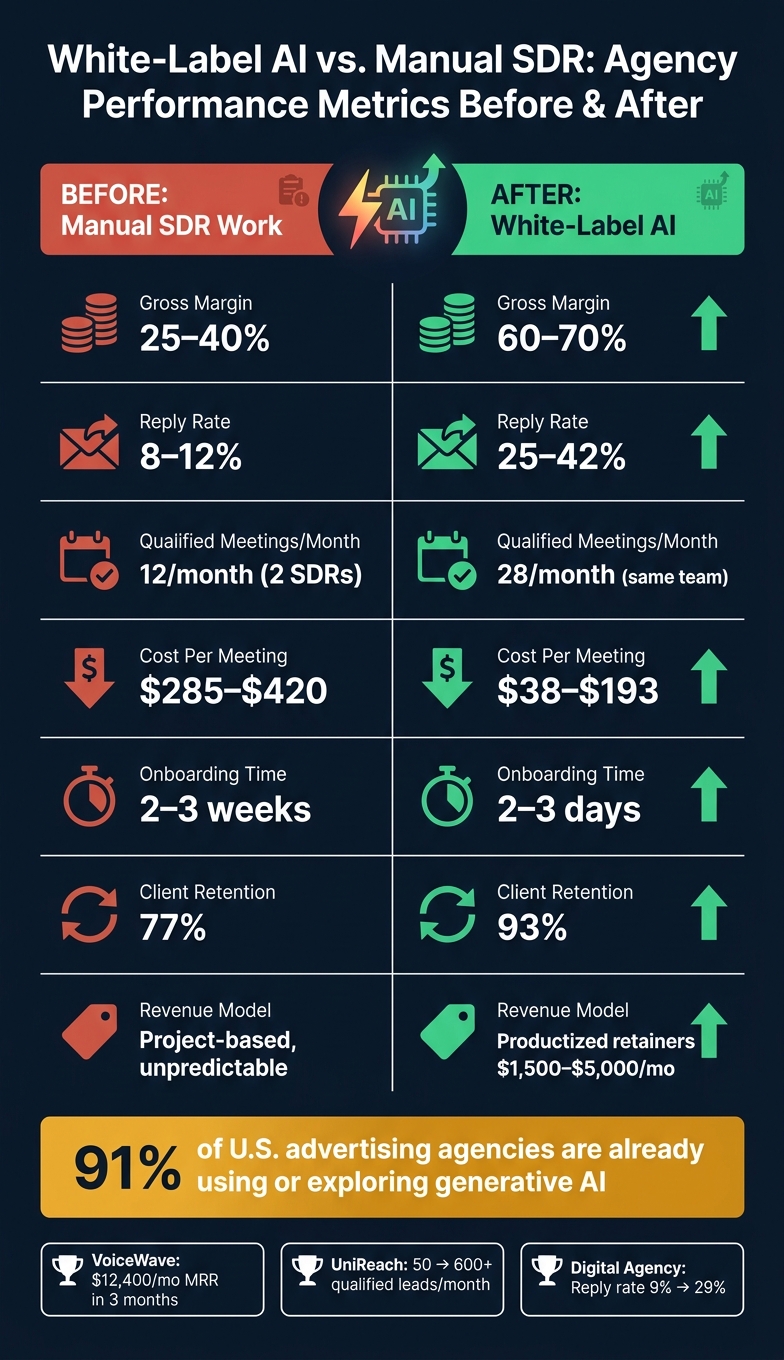
Agencies can add monthly revenue without hiring at the same pace. The core move is simple: instead of selling hours, I can sell a branded outbound service that runs on white-label AI. That shifts the model from labor-heavy work to monthly retainers, with reported gross margins moving from 25%–40% to 60%–70%, reply rates moving from 8%–12% to 25%–42%, and retention reaching 93%.
Here’s the short version:
I use white-label AI to offer lead sourcing, enrichment, outreach, follow-ups, and booking under my own brand.
I package that work into fixed monthly offers, often around $1,500 to $5,000 per month.
I keep platform costs mostly fixed while client revenue grows.
I cut manual SDR time by 50%–70%.
I can book more meetings with the same team, such as 12 to 28 meetings per month.
I can bring launch time down from 2–3 weeks to 2–3 days in some setups.
I can lower cost per meeting from about $285–$420 to $38–$193.
A few examples from the article make the point fast:
One agency reached $12,400 per month in recurring revenue within 3 months.
One lead gen agency went from 50 to 600+ qualified leads per month.
One team lifted reply rate from 9% to 29% and positive reply rate from 2% to 11%.
What changes
Before white-label AI
After white-label AI
Revenue model
Project work or labor-based retainers
Productized monthly retainers
Margin
25%–40%
60%–70%
Reply rate
8%–12%
25%–42%
Cost per meeting
$285–$420
$38–$193
Team load
Heavy manual work
AI handles much of the routine work
Retention
77%
93%
If I had to sum it up in one line, it would be this: white-label AI lets an agency turn outbound into a branded monthly service that can scale better than manual SDR work.
White-Label AI vs. Manual SDR: Agency Performance Metrics Before & After
I Built a $6K/mo AI Agency in 30 Days with 0 Experience (White-Label Tutorial)
sbb-itb-a781ab9
Where Agencies Start Before AI
Most agencies that sell lead gen or outbound services begin with a model that's tied to headcount. Founders and SDRs do the heavy lifting by hand: prospecting, outreach, follow-up, and booking meetings. And as long as the work stays manual, retainers stay packed with labor.
That creates a hard cap. If you want to serve more clients, you usually need more people.
Why Manual SDR Work Limits Growth
The bottleneck is pretty straightforward. Every new client brings the same stack of repeat tasks: more leads to research, more emails to draft, more replies to sort through, and more meetings to schedule. One SDR can usually handle about 15 new MQLs per day and 10–30 manual activities per hour[10]. It doesn’t take long for that capacity to max out.
Once an agency gets close to that limit, things start to slip. Manual, single-channel outreach often levels off at 8–12% reply rates[1]. Results can also swing from month to month because delivery depends so much on who’s available. If a rep takes PTO, gets sick, or quits, pipeline momentum can slow down fast.
That’s the weak spot in the model: revenue is only as stable as the people delivering it.
Key Metrics Agencies Track Before Making the Switch
These baseline numbers show why margins get squeezed before agencies move into automation.
The cost per qualified meeting is often the one that hits hardest. On the surface, it may not look too bad. But once you factor in SDR pay, benefits, software, data, and manager time, $300–$400+ per qualified meeting is a pretty normal starting point [11][9].
That’s the setup many agencies are working from before they change how delivery works. They’re not just trying to save time. They’re trying to add capacity without adding more headcount.
How White-Label AI Opens New Revenue Streams
When manual delivery starts to top out, agencies need a model that scales without piling on labor. That’s where AI-driven outbound shifts from a service into a recurring offer.
With white-label AI, an agency can sell outbound under its own brand while the platform runs the heavy lifting in the background: sourcing, enrichment, outreach, follow-up, and booking. The agency owns the client relationship and sells the outcome. SalesLabel is built around this setup, giving agencies one branded system to run those workflows across client accounts.
That setup can improve margin in a pretty simple way. If the platform runs on a flat monthly fee, the same system can support multiple clients. So as new retainers come in, revenue can grow while platform cost stays mostly flat.
Turning Services into Productized Monthly Retainers
The most practical way to make money with this model is to package AI-powered outbound into fixed monthly retainers. Instead of quoting custom projects every time, agencies can create a small set of standard offers with clear deliverables and steady pricing. One simple retainer structure looks like this [1]:
Tier
Monthly Price
What's Included
Starter
$1,500/mo
1-channel outreach, basic AI personalization, prospect list building, monthly reporting
Each tier ties to a defined set of deliverables, so clients know exactly what they’re paying for. That kind of predictability is what makes MRR work. Agencies stop pricing around hours and start selling clear outputs that the platform can support.
Of course, this pricing only holds up if delivery stays standardized and automated. If every client turns into a one-off build, the model starts to crack.
Where Platform Margin Comes From
Margin comes from fixed platform costs and repeatable fulfillment. In plain English: agencies can resell the same automated workflow across many accounts without adding the same amount of labor each time.
Traditional service retainers usually net 25–40% margin after SDR pay, data tools, and management time. By contrast, software resale can produce 200–400% gross margin relative to platform cost [1].
Once the workflows are in place, adding a new client is mostly a setup task, not a hiring decision. Automation can cut human time per new opportunity by 50–70%, which lets one strategist manage accounts that once would have needed a full SDR team [1].
That’s the core shift. The agency isn’t just selling outbound work anymore. It’s selling a repeatable system that can be rolled out across accounts with far less manual effort.
The next piece is how agencies put this model to work inside live client accounts.
Case Studies: Agencies Adding Revenue with White-Label AI
These examples show how white-label AI can turn faster delivery into recurring revenue. The pattern is pretty simple: agencies package AI as a branded service, then grow revenue without growing headcount at the same pace.
Marketing Agency Adds MRR with Branded AI Outbound
VoiceWave Marketing launched a branded AI voice outbound offer in just 7 days. Within three months, it grew to 15 clients and $12,400/month in recurring revenue, while average annual value increased from $1,500 to $6,000+[12][13].
That jump didn’t come from reinventing the service for every client. It came from standardized delivery. Once the offer was packaged in a repeatable way, the agency could roll it out across accounts without custom scoping each time.
The same kind of lift shows up when agencies use AI to take on more work, not just charge more.
Lead Generation Agency Cuts Costs Through Automation
UniReach, a B2B lead generation agency, scaled from 50 to more than 600 qualified leads per month between March and April 2026. That’s a 12x increase[4].
Abdullah explained how the platform handled buyer intent and replies:
"Before, we reached 50-100 clients. Now it's 5-6x that. The AI understands what the client is saying and replies the proper way." - Abdullah, UniReach [4]
Instead of relying on manual prospecting and inbox management, the team shifted that work to automation. The result: UniReach handled 12x more qualified leads without adding SDR headcount.
Specialized Agency Books More Meetings with AI Sales Workflows
A digital marketing agency using the same model saw meeting volume jump from 3 to 11 in its first week. At the same time, reply rate moved from 9% to 29%, and positive reply rate climbed from 2% to 11%[6][14].
In both cases, the gains came from two things working together:
tighter targeting
faster reply handling
Underneath those results is the same repeatable setup: a branded platform that agencies can resell as their own service.
SalesLabel turns this model into something agencies can sell under their own name. The pattern in the case studies above is pretty simple: standardized outreach, branded delivery, and recurring revenue. That shifts the platform from being just another tool to a system tied directly to monthly income.
How Agencies Run SalesLabel Under Their Own Brand
SalesLabel lets agencies set up custom sender domains, upload client ICP criteria, and run sequences under the agency's own branding. For the client, it feels like the agency's in-house system.
Autopilot handles simple conversations from start to finish. Copilot writes replies that a person can check before they go out. And because multiple client workspaces can run from one dashboard, a single team can manage more accounts without bouncing between tools.
How SalesLabel's Pricing Supports Agency Margins
SalesLabel uses a fixed monthly infrastructure cost, which makes planning a lot simpler for agencies.
The Starter plan at $799/month includes a full AI prospecting system with white-label branding.
The Growth plan at $1,279/month adds a branded Chrome extension and a monthly strategy call.
The Scale plan at $1,999/month adds unlimited accounts and a dedicated success manager.
Here’s what that can look like in practice: an agency on the Growth plan at $1,279/month could support three or four mid-market retainers priced at $4,000 to $6,000 per month each. That works out to $12,000 to $24,000 in MRR on a fixed platform cost, with gross margins in the 60% to 70% range [3]. That's a big reason agency margins stay easier to forecast.
Outcomes Agencies Look For from a Branded AI Platform
For agencies, the main numbers are reply rates, onboarding speed, and account capacity.
SalesLabel users report a 42% average reply rate on outbound campaigns [1]. That's far above the 8% to 12% range common with single-channel, email-only outreach. Onboarding speed matters too. When list building, sequencing, and inbox setup sit in one place, agencies can go from signed agreement to live campaigns in about 21 to 35 days[1]. Put simply, revenue can start sooner.
Client retention is another key number. Platform-wide retention sits at 93%[2], which lines up with what happens when the service feels like a natural part of the agency's own brand rather than a patched-together third-party setup.
These operating gains show up most clearly in the before-and-after metrics that follow.
Before-and-After Metrics That Show the Revenue Impact
Revenue, Efficiency, and Capacity: Before vs. After AI
Across these case studies, the story is pretty clear: more output, lower cost, and less hands-on work. White-label AI shifts agency economics in a big way, especially around revenue, speed, and team capacity.
Metric
Before AI
After AI
Recurring revenue
Project-based, unpredictable
Productized monthly retainers at $1,500–$5,000/month [1]
A few shifts stand out right away. Cost per meeting drops hard. Launch time shrinks from weeks to days. And reply rates climb, even without adding more people to the team.
That last point matters. Going from 12 qualified meetings per month to 28 with the same 2 SDRs [1] isn't just a nice bump. It changes how an agency can sell, staff, and price its services.
The best outcomes didn't come from automation alone. They came from pairing automation with tight targeting and a clear offer. That's the difference between sending more messages and getting more of the right replies.
Put simply, these numbers show how agencies can grow recurring revenue without hiring at the same pace. More monthly retainer income, less manual delivery, and better margins can change the math fast.
Conclusion: Moving from Labor-Heavy Services to Scalable Revenue
The case studies point to one clear pattern: manual fulfillment puts a ceiling on agency growth. More clients usually means more labor, more overhead, and tighter margins. White-label AI changes that equation.
Instead of selling hours, agencies can sell monthly subscriptions. Agencies built around AI-driven sales report 65%–75% gross margins, compared with 25%–30% for standard agencies [19]. They can also support 3x–6x ARR multiples, versus 0.5x–1.5x for project-based businesses [18]. That shift in economics matters even more as AI adoption keeps climbing.
In the U.S., 91% of advertising agencies are already using or exploring generative AI [5]. That means AI-powered delivery is moving fast from “nice to have” to standard practice.
For agencies that want to put that model into daily use, SalesLabel fits the workflow. SalesLabel gives agencies a branded system for lead sourcing, enrichment, outreach, follow-ups, and booking. In plain English, it helps turn service delivery into a repeatable workflow instead of a pile of one-off tasks.
The biggest upside comes from packaging AI into a branded, recurring offer, not from automating a few isolated tasks.
FAQs
How does white-label AI increase agency margins?
White-label AI helps agencies keep more of what they earn by swapping manual outreach for automated systems that scale without adding staff.
With SalesLabel, agencies can run prospecting, personalized messaging, and meeting booking under their own brand. That means they can take on more clients without increasing payroll and turn a time-heavy service into one with better margins.
What services can an agency sell with white-label AI?
Agencies can open up new revenue streams by selling AI-powered lead generation as a premium, productized service.
With SalesLabel, they can offer a fully branded system that handles the whole flow:
lead sourcing
enrichment
outreach
personalized messaging
meeting booking
lead scoring
client reporting
Teams usually sell these services through monthly retainers, per-lead fees, per-seat SaaS access, or a hybrid pricing model.
How quickly can an agency launch a branded AI outbound offer?
Agencies can launch a fully branded, white-label lead generation platform in as little as 7 days. In most cases, that just means uploading brand assets and connecting a domain.
The big win is simple: they can start onboarding clients without development work or infrastructure setup.
A full outbound program usually takes 21–35 days. That timeline includes the sender warm-up period, which helps protect sender reputation and supports long-term performance.