Intent-Based Scoring for Scaling Lead-Gen Agencies
Split fit and intent scores, use recency and account-level signals, and route high-intent leads for faster closes and higher win rates.
SalesLabel Team
Growth Expert • 24.6.2026
Share:
Leter du etter en ferdig løsning?
SalesLabel automatiserer utgående prospektering fra A til Å — AI finner potensielle kunder, sender personaliserte meldinger og booker møter under ditt merke.
Intent-Based Scoring for Scaling Lead-Gen Agencies
If I had to sum this up in one line: I’d say fit tells me who matches, but intent tells me who needs a call now.
Once lead volume climbs, manual review starts to slow teams down. And with cold outreach reply rates sitting near 2% in 2026, I can’t afford to treat every lead the same. The article’s core idea is simple: I need two separate scores: one for fit and one for intent. Then I use live behavior, outside signals, and timing to decide who gets routed now, who gets nurtured, and who should wait.
Here’s the short version:
Fit score = company and contact match
Intent score = buying activity happening now
Best inputs = firmographics, on-site behavior, and third-party intent
Best model setup = start rules-based, then move to a hybrid setup when data grows
Best workflow = attach each score change to one clear action in CRM and outreach tools
Best KPI = win rate by score band, not just lead volume
A few numbers stand out:
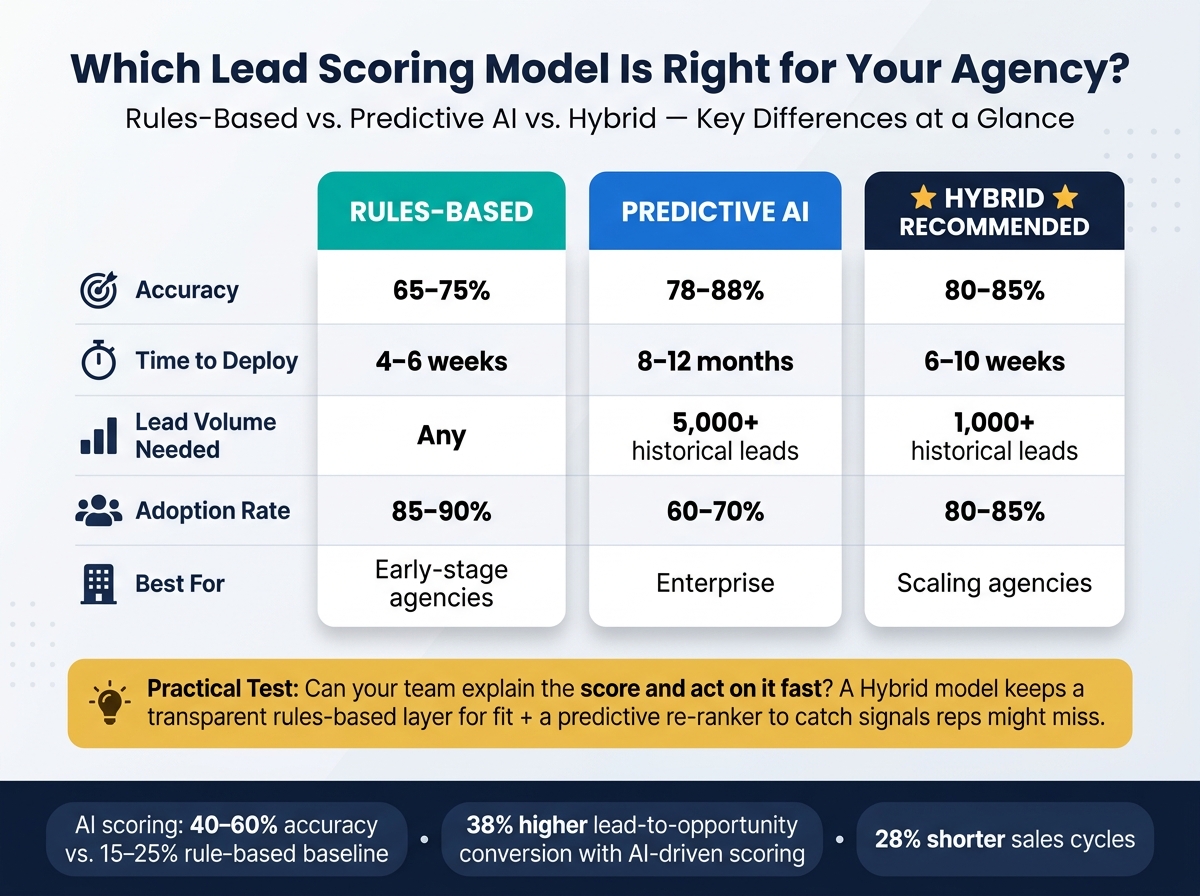
AI scoring models can hit 40% to 60% accuracy, vs. 15% to 25% for rule-based baselines
Teams using AI-driven scoring report 38% higher lead-to-opportunity conversion
Sales cycles can drop by 28%
Account-level engagement from multiple contacts can convert at 3x to 5x the baseline rate
Top score bands should close at 4x to 8x the rate of bottom bands
What I like here is the workflow logic. A pricing page visit from yesterday matters more than a blog view from last month. Sequence matters more than volume. And if a lead goes quiet for 14 to 30 days, the score should decay so old activity doesn’t crowd the queue.
Use recency decay and watch short bursts of activity
Routing
Send top-tier leads to reps fast, keep weaker leads in nurture
Measurement
Track close rates, SLA speed, MQL-to-SQL conversion, and pipeline movement
The main takeaway: I don’t scale lead-gen by scoring more leads. I scale it by sorting urgency well, then tying that score to clear follow-up rules.
That’s what this article gets right, and that’s the lens I’d use for the rest of it.
Actioning Intent Data: Step-by-step Strategies for Lead Generation Success in 2025
sbb-itb-a781ab9
The Core Inputs Behind Intent-Based Scoring
Use three inputs: fit data, behavioral data, and third-party intent.
Fit data is the static layer. It includes firmographics like industry, company size, revenue range, geography, and job title. Behavioral data is first-party. It shows what prospects do on properties you control, like visiting a pricing page, clicking through an email, or downloading a case study. Third-party intent is the outside layer. It includes signals from review sites, content consumption data, public filings, and hiring activity.
Once those input types are clear, the next move is simple: decide which actions should carry the most weight.
Fit Data, Behavioral Data, and Third-Party Intent
Add account-level colleague signals too. That means looking for multiple contacts from the same company engaging within a short window. In B2B, buying calls almost never come from one person acting alone.
Leads that show this account-level colleague engagement pattern convert at 3x to 5x the baseline rate[5].
Low-, Medium-, and High-Intent Signals to Track
A simple way to track intent is to group signals into three tiers: low, medium, and high.
Case study downloads, webinar attendance, repeat product page visits, relevant hiring activity
SDR review or targeted nurture sequence
Low Intent
Single email open, one blog post view, social media follow
Nurture only
Negative
Unsubscribes, 30+ days of inactivity, competitor mentions
Deprioritize or re-enrich
One practical rule: cap the points available from low-intent actions. If someone opens a few emails or reads one blog post, that soft activity should not outweigh a single high-intent move like a demo request. Otherwise, the score starts lying to you.
Recency, Timing, and Signal Noise
Timing changes the meaning of a signal. Recency matters more than raw volume. A pricing page visit from yesterday means far more than one from four months ago.
And here’s the part many teams miss: sequence is the signal. Three sessions in 48 hours is a much stronger sign of buying intent than 15 sessions spread across six months [4].
To keep scores useful over time, apply a decay schedule to intent points. A common B2B default is a 14–30 day half-life, where engagement from a month ago is worth roughly half its original value [5]. Models that skip this step lose 30% to 40% of their accuracy within six months[4].
Third-party intent data needs a sanity check too. It’s directional. It can help you spot accounts worth watching, but it should not be the only reason for a hard sales call. External intent is better used to build watchlists, not as a direct handoff trigger. Before you escalate, look for behavioral confirmation on your own properties.
Use sequence, not volume, to tell the difference between casual research and buying intent.
These inputs become the weighting rules in the scoring model next.
How to Build an Intent-Based Scoring Model for Agency Workflows
Intent-Based Lead Scoring: Rules-Based vs. Predictive AI vs. Hybrid Models
Now that you know which signals to track, the next step is turning those inputs into a model your SDRs, account managers, and clients can use day to day.
Start with a Dual-Score Framework
The biggest mistake is using one score for fit and intent. Fit should score company quality. Intent should score buying urgency. A lead with a score of 72 might be a perfect-fit company with no buying signals, or a low-fit company that just booked a demo. Those leads should not get the same response.
Keep Fit and Intent as two separate scores, then combine them into a simple 2x2 grid that guides rep action:
High Intent
Low Intent
High Fit
Immediate sales outreach (SQL)
Marketing nurture / ABM
Low Fit
Route to self-serve or disqualify
Ignore / suppress
This grid turns scores into action. It also gives every client a clear handoff rule that teams can repeat without guesswork.
That same split between fit and intent should drive CRM alerts, sequencing, and handoffs.
Rules-Based Scoring vs. Predictive AI Scoring
Start with rules-based scoring until you have enough historical data for predictive modeling. It’s simpler to explain to clients and reps, which matters a lot when people need to trust the score and act on it fast.
The practical test at each stage is simple: can the team explain the score and act on it fast? A hybrid model usually works well because it keeps a transparent rules-based layer for fit and basic behavior, then adds a predictive re-ranker on top to catch signal combinations reps might miss [4][8].
Once the model is chosen, the next step is setting the thresholds that trigger action.
Thresholds, Handoffs, and Model Governance
After the scoring logic is set, define exactly what score triggers what action. A simple three-tier structure works well in practice:
Tier
Score Profile
Action
Response SLA
Tier 1 (Act Now)
Strong ICP + Active Intent + Trigger Event
Immediate personal outreach
< 1 hour
Tier 2 (Warm)
Strong ICP + One signal (Intent or Trigger)
Sequence launch / personalization
24–48 hours
Tier 3 (Nurture)
Reasonable ICP + No current intent
Automated email nurture only
No urgency
Set a Tier 1 SLA of under 1 hour and trigger automated alerts the moment a lead crosses that threshold [9]. Add negative scoring for unsubscribes, competitor domains, and role mismatches.
Sales and marketing should define what "ready for sales follow-up" means before the model goes live [1][10]. Then run the model in shadow mode for 14 days before launch. Compare its output against human-defined rules so you can catch threshold problems early [4][8]. After launch, run weekly audits of scores against actual outcomes [1].
Once thresholds are live, the model can power real-time routing across every client channel.
Running Intent Scoring Across Multi-Channel, White-Label Campaigns
Once your thresholds are set, the next step is simple: the score has to trigger action across every channel.
Real-Time Routing and Outreach Prioritization
A score matters only if it changes what your team does next.
Use it to route leads the moment behavior changes. Top-tier leads should get same-day outreach. Mid-tier leads can go to SDR review. Low-intent leads should stay in nurture until they show stronger buying signals.
The channel should match the signal. If someone visits your pricing page, that calls for personalized outreach, not a generic sequence [3][11].
You can also layer in account-level colleague signals. If a second contact from the same company engages, increase the account score and trigger multi-threaded outreach. That gives reps a better shot at reaching the buying group instead of chasing just one person.
And if a lead goes quiet for 14 days, apply decay and take them out of the active queue [4][5]. No sense letting stale leads clog the pipeline.
Integrations, Automation, and Process Flows
Each signal should map to one automatic action inside your CRM, sequencer, and alerts stack. That keeps the process clean and easy to follow.
Here’s how signal changes can connect to immediate workflow actions:
When a lead crosses 80 points, the CRM should auto-route that person into a high-priority Action Feed for the assigned agency rep [3][12]. That way, reps don't have to guess who needs attention first. They open the queue, and the hottest client leads are already sitting at the top.
Trying to run this by hand across a long list of client accounts just doesn't work.
SalesLabel is a white-label lead-generation platform built to handle sourcing, enrichment, personalized outreach, follow-ups, AI-driven replies, inbox management, and meeting booking under your agency's brand.
That matters because agencies using manual prospecting lose up to 30% of warm leads due to slow follow-up [11]. This kind of features">automation closes that gap. It turns intent scores into branded, repeatable workflows your team can run across many accounts without dropping the ball.
Once routing is live, track which signals turn into meetings and pipeline, then tune the model. After that, back-test which signals lead to replies, meetings, and revenue.
Measuring Results and Refining the Model Over Time
The KPIs That Matter Most
Once scores start routing leads, judge them by revenue impact, not activity. What matters is simple: does the model help sales teams move faster and close better deals?
The main KPI is win rate by score band. If top-tier leads aren't closing at 4 to 8 times the rate of bottom-tier leads, the model needs work [1][2].
Beyond win rate, track these metrics on a steady schedule:
KPI
Target Outcome
Reporting Frequency
Win Rate by Score Band
Top band closes 4–8x higher than bottom band [1][2]
A lot of agencies miss one small but important point: reps need context. A raw score by itself doesn't help much. Show the top three signals behind each score so reps can see why a lead matters and act with more confidence.
Back-Testing, Calibration, and Client Feedback Loops
After launch, use closed-won data to check whether the model still predicts revenue. Back-test it against 12 to 24 months of historical closed-won and closed-lost data. If the signal weights don't line up with the actual revenue from that period, recalibrate before going live [1][2].
Client feedback matters just as much as model output. If sales reps reject more than 20% to 30% of your top-tier leads, your thresholds are tuned for volume instead of quality [2][4]. That rejection data is direct feedback. Use it to tighten the model.
One agency moved its close rate from 12% to 19% after retraining the model three times. That's the right mindset: retrain when lead quality shifts, not just because the calendar says it's time. Review performance weekly, and retrain when score drift starts to show.
When you keep those checks tight, the model gets better over time instead of slowly losing accuracy.
Conclusion: Building a More Predictable Agency Growth Engine
Intent-based scoring turns lead gen into a repeatable system for qualification, routing, and follow-up across every client account.
FAQs
How do I set fit and intent score thresholds?
Set fit and intent as separate signals, not one blended score. That keeps routing clean and makes it much easier to see why an account or lead should move to sales.
For fit, look at the last 24 months of closed-won and closed-lost deals. Use that data to weight factors like industry, company size, and tech stack. Then place accounts into clear score bands so teams can act without guessing.
For intent, score high-signal actions such as:
Pricing page visits
Demo requests
Apply time-decay so recent actions matter more than older ones. Then combine fit and intent in a 2x2 matrix. Review the thresholds quarterly against conversion data so the model stays tied to what’s happening in the pipeline.
When should I switch from rules-based scoring to a hybrid model?
Consider a hybrid model if you're a mid-market agency in the $10 million to $40 million ARR range and you have at least 1,000 historical deals to train a predictive model.
This setup keeps the clarity of rules-based scoring while letting predictive AI spot subtler, higher-value patterns that simple rules can miss. In most cases, teams use rules to score fit and basic intent, then apply predictive ML to re-rank leads.
How often should I update an intent scoring model?
Recalibrate your model quarterly to keep lead scoring on track. A model you set once and leave alone can lose 30% to 40% accuracy within six months. Updating it on a regular schedule, using actual win/loss data, also helps keep sales bought in and the pipeline in better shape.
It also helps to use automated decay rules. Intent data moves fast, so time-based decay keeps old signals from looking hot long after they’ve cooled off.