White Label Lead Generation Agency: How to Launch and Scale One
A white label lead generation agency resells booked meetings under your own brand. See what you resell, how the margins work, a 90-day launch plan, and the mistakes to avoid.
SalesLabel Team
Growth Expert • 12-8-2026
Share:
Op zoek naar een kant-en-klare oplossing?
SalesLabel automatiseert uw outbound volledig — AI vindt prospects, verzendt gepersonaliseerde berichten en boekt vergaderingen onder uw merk.
Lead Generation Agency" style="width:100%;height:auto;border-radius:8px;" />
A white label lead generation agency sells booked meetings and qualified leads under its own brand, while a behind-the-scenes platform does the heavy technical lifting. You own the client relationship, the pricing, and the logo on the dashboard. Your white-label partner runs the prospecting engine, the data, and the automation you’d otherwise spend months and a fortune building yourself. It’s the fastest way to launch a lead-gen business without becoming a software company first.
If you’re an agency owner, a freelancer, or a consultant weighing this model, the real questions aren’t “is it possible” — they’re “how do the margins work,” “what do I actually resell,” and “how do I launch without falling flat on my first client.” This playbook walks through all three, plus the mistakes that quietly kill white-label agencies before they scale.
What you're actually reselling
The word “white label” hides a lot. Under the hood, a white label lead generation agency resells some mix of four things: the technology (a prospecting and outreach platform your clients see with your branding), the data (verified contacts and buying signals), the execution (campaigns run for the client), and the reporting (a branded dashboard that proves results).
The magic is that your client never sees the machinery. They log into a portal with your colors and your name, they get a weekly report on your letterhead, and they book a call with your team. To them, you built all of it. That perception is exactly what you’re selling — and it’s why a strong white-label partner keeps its own brand invisible on purpose.
How the margins actually work
This is the part that makes or breaks the business. In a white-label model, you pay your partner a wholesale rate and charge your client a retail rate. The gap is your margin. Say your partner charges you a flat platform-and-execution fee per client seat; you package that into a monthly retainer priced on the outcome — meetings booked, pipeline created — not the tool cost.
Because clients pay for results, not software, you’re rarely competing on the sticker price of a tool. A retainer that delivers ten qualified meetings a month is worth far more than the underlying platform fee, and that spread is healthy when you price on value. The agencies that struggle are the ones who resell the tool as a tool and get dragged into a race to the bottom. Sell the result, keep the margin.
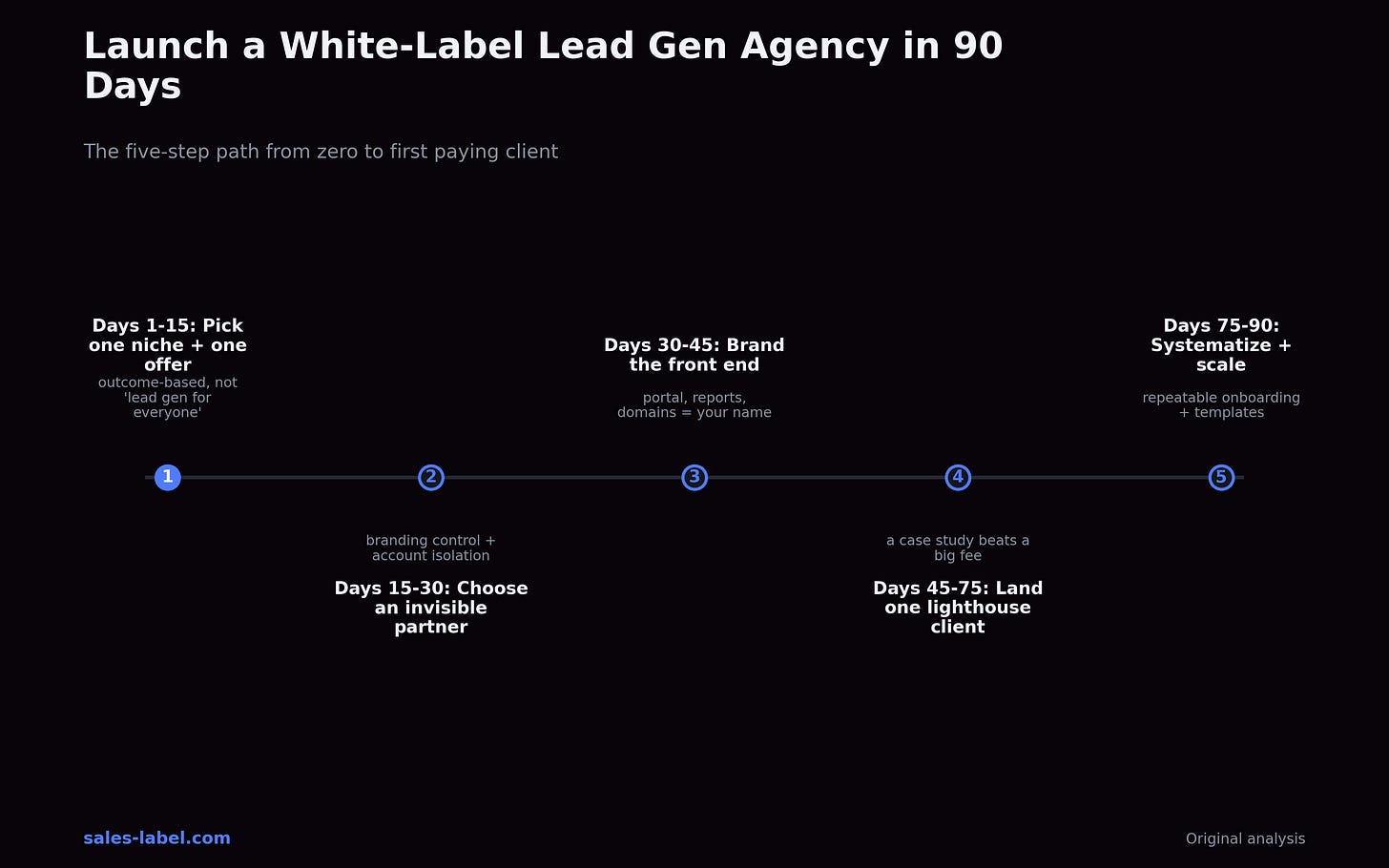
The 90-day launch path for a white-label lead gen agency. Source: sales-label.com analysis.
How to launch in 90 days
You don’t need a year or a dev team. A focused agency can go from zero to first paying client in about a quarter by running these five steps in order.
Pick one niche and one offer. “Booked sales calls for B2B SaaS companies” beats “lead gen for everyone.” A tight niche makes your outreach sharper, your case studies reusable, and your pricing easier to defend.
Choose a white-label partner that stays invisible. Vet for true branding control, account isolation between clients, data quality, and multi-channel reach. If the platform’s name leaks into a client dashboard or email, it isn’t truly white label.
Brand the front end. Set up your portal, your reporting template, and your domains so every client touchpoint looks like your company built it. This is a weekend of work, not a project.
Land one lighthouse client — even at a discount. Your first goal is a case study, not a fortune. One real result you can show turns cold pitches into warm ones.
Systematize, then scale. Turn what worked for client one into a repeatable playbook: the same onboarding, the same campaign templates, the same reporting cadence. Now every new client is a copy-paste, not a custom build.
The agencies that win at white label don’t sell software they didn’t build — they sell an outcome they can reliably repeat.
The mistakes that quietly kill white-label agencies
Most white-label agencies don’t fail because the model is broken. They fail because of avoidable errors that compound over the first year:
Picking a partner that isn’t really white label. If the underlying brand shows up anywhere the client can see, your credibility — and your pricing power — evaporates. Test this before you sign, not after.
Pricing on cost instead of value. Marking up a tool fee by a small margin leaves you fragile and forgettable. Pricing on booked meetings and pipeline lets you charge what the outcome is worth.
Taking every client. A grab-bag of unrelated industries means you rebuild your process for each one. Niche down and your delivery gets faster and cheaper with every client.
No account isolation. If one client’s data or outreach can bleed into another’s, you have a trust and compliance problem waiting to happen. Multi-tenant isolation isn’t optional at scale.
Is a white-label agency right for you?
This model fits if you’re strong on client relationships and sales but don’t want to build and maintain software. It fits freelancers who want to productize, consultants who want recurring revenue, and existing agencies adding a lead-gen line without hiring an engineering team. It fits less well if you want to own the technology itself — in that case you’re building a product company, which is a different journey entirely.
White label vs building your own platform
Every agency owner eventually asks: why not just build the tech myself and keep all the margin? On paper it looks appealing. In practice, building your own prospecting platform means hiring engineers, buying and maintaining data sources, solving email deliverability at scale, and keeping up with a market that shifts every quarter. That’s a multi-year, multi-hire commitment before you sign your first client — and it pulls your focus away from the thing you’re actually good at, which is winning and keeping clients.
White label flips the timeline. You inherit a working engine on day one, launch in weeks, and spend your energy on sales and delivery. The trade is a share of margin to your partner in exchange for speed, lower risk, and zero maintenance burden. For most agencies, that trade is overwhelmingly worth it — you can always revisit building later, once you have the revenue and the proof to justify it. Start by reselling; graduate to owning only if the numbers ever demand it.
Frequently asked questions
How much can a white label lead generation agency charge? Price on outcomes — meetings booked and pipeline created — not on tool cost. A results-based monthly retainer typically commands far more than the underlying platform fee, which is where your margin lives.
Do I need technical skills to run one? No. The point of white label is that your partner handles the technology, data, and deliverability. Your job is the niche, the offer, the client relationship, and the reporting story.
How do I keep my partner invisible to clients? Use a partner built for true white labeling: branded portals, custom domains, and reporting with no third-party logos. Confirm this in a live demo before you commit a single client.
How fast can I start? With a niche picked and a white-label partner in place, a first paying client in about 90 days is realistic. The gate is usually sales, not setup.
The takeaway
A white label lead generation agency lets you launch a real lead-gen business in a quarter, not a year, by reselling a proven engine under your own brand. Win by niching down, pricing on outcomes, keeping your partner invisible, and turning your first result into a repeatable system. Get those right and the margins take care of themselves.