Streamline lead handoffs with shared stages, fixed routing, 24-hour SLAs, CRM automation, and weekly reviews to boost conversions.
SalesLabel Team
Growth Expert • 23/09/2026
Share:
Cerchi una soluzione chiavi in mano?
SalesLabel automatizza la prospezione dall’inizio alla fine — l’IA trova potenziali clienti, invia messaggi personalizzati e prenota riunioni con il tuo marchio.
Bad lead handoffs cost time and deals. If you want more meetings and fewer dropped leads, I’d focus on four things first: shared lead stages, fixed routing rules, a 24-hour or less response SLA, and CRM-based automation with clean feedback loops.
Here’s the short version:
I’d define MQL, SAL, SQL, nurture, and disqualified the same way across teams
I’d route each lead to one owner only
I’d track time to assignment, time to first touch, and acceptance rate
I’d auto-send rejected leads back to nurture with a clear rejection reason
I’d stop duplicate outreach by syncing inbox activity back to the CRM
I’d review handoff results every week and fix weak spots fast
A few numbers make the case:
Manual prospecting can take 20+ hours per rep per week
An SDR often costs $5,000 to $8,000 per month
Following up within 24 hours can improve response rates by 60%
Contacting a lead within 1 hour can make qualification much more likely than waiting longer
If I had to sum up the whole article in one line, it would be this: a good handoff system moves the right lead to the right person fast, with full context and no guesswork.
This guide walks through the process from stage definitions and scoring to routing, CRM automation, SLAs, reporting, and agency scale.
The HubSpot Recipe for a Seamless Marketing-to-Sales Handoff
sbb-itb-a781ab9
Lead Handoff Fundamentals
Lead handoff usually falls apart for simple reasons: teams don't agree on stage names, who owns what, or when a lead should move.
Lifecycle Stages and Definitions
Most handoff issues start with language. Marketing may label someone a "qualified lead" that sales wouldn't touch. Sales may reject leads without saying why. And then the whole process gets muddy because no one agrees on what "ready" means.
The fix is simple: define the stages once, then use those same definitions everywhere.
Lead Stage
Definition
Next Step
MQL
High engagement, research phase (content downloads or resource exploration)
Marketing nurture or SDR initial outreach
SAL
Verified ICP fit, accepted by sales
SDR/sales owns follow-up
SQL
High intent - pricing or demo requests
Immediate discovery call
Nurture
Engaged but no direct response
Passive content nurturing
Disqualified
Not ICP fit or lacks buying authority
Removed from active sales flow
SAL is the sales team's formal acceptance of an MQL. Put plainly, it's the checkpoint where sales must approve or reject every marketing-sourced lead.
Those definitions only hold up if one team owns each handoff. If that part is vague, the labels don't help much.
Ownership and System of Record
When ownership gets fuzzy, leads sit there. Sometimes two reps contact the same person. Other times, nobody follows up at all.
Marketing should own MQLs. Sales should own SALs and SQLs. Your CRM should act as the single system of record. For agencies, that matters even more because client leads can easily end up scattered across inboxes, spreadsheets, and random tools. When there's no single source, duplicates slip in and good leads get missed.
If your agency runs outreach across more than one channel, it helps to keep LinkedIn and email in one unified inbox, then sync status updates and notes back to the CRM. That keeps the full conversation in one thread [3].
Once ownership is clear, the next move is to spell out the exact rules for accepting or rejecting a lead.
Current-State Audit Checklist
Most leaks come from messy handoffs, not bad software.
Use an audit to spot where things break before you automate anything. A solid audit should cover six areas:
Response time deserves extra attention. Following up within 24 hours can lift response rates by 60%[3]. If your audit shows leads sitting untouched for days after a status change, that's usually a sign of a routing or ownership problem.
Once you can see the current state clearly, you can set the rules that decide when a lead moves to sales.
Shared Qualification and Handoff Rules
Take the current-state audit and turn it into one shared rulebook. After the stages are set, every team needs to use the same qualification rules. Marketing, lead generation, appointment setters, and sales should all judge leads the same way. If they don’t, each team ends up running a different playbook.
Qualification should come down to two things: fit and intent. Fit covers firmographics. Intent covers what the prospect did and how recently they did it.
Score ICP fit and engagement together, then send leads with a score of 80+ to sales. Route everything else to nurture [3]. Companies that use lead segmentation this way are 7x more likely to generate higher-quality leads[3]. Use BANT only at the final SQL check.
Set Handoff Triggers and Required Context
Each handoff trigger should be a clear, automatic event that moves a lead to the next team. It shouldn’t depend on someone’s opinion. Hitting a lead score of 80+, requesting a demo, or asking about pricing are all clean triggers [3].
Just as important: what travels with the lead. Every handoff should include:
SLAs turn good intentions into actual commitments. Sales should have a set window - usually 24 hours - to accept or reject any lead passed from marketing or lead generation [3].
Rejection rules matter just as much. Without a set list of rejection reasons, sales can bounce leads back for almost any reason, and marketing gets no clear signal on what needs fixing. Create a short list of rejection codes, such as "No Authority", "Poor Fit", or "No Immediate Need", and require sales to choose one when returning a lead [3]. Over time, that data gives the lead generation team a clearer view of what’s going wrong.
Rejected leads should go back to nurture automatically. Set that rule in your CRM so no one has to handle it by hand.
Next, route each accepted lead to a single owner without delay.
Routing, Ownership, and Response-Time SLAs
Once qualification is done, routing answers two simple questions: who owns the lead, and how fast do they need to move?
That step matters more than a lot of teams think. After a lead clears qualification, speed becomes a deal issue. A first-hour response and same-day assignment help protect conversion. Every delay chips away at the odds of turning that lead into revenue.
Choose the Right Routing Model
Your routing model should match your lead volume, team setup, and account complexity.
Requires complex CRM mapping and matching contacts to the right accounts
Queue-Based
Teams requiring ordered handling or first-come, first-served
Highly controlled; ensures priority leads are hit first [4]
Can create bottlenecks if the top of the queue isn't cleared quickly
Tenant-Isolated
Agencies, multi-brand firms
Prevents cross-client lead leakage; maintains brand-specific routing [4]
Requires disciplined setup per tenant to keep routing rules aligned [4]
For agencies, tenant-isolated routing is especially useful because it keeps client leads separated.
Build Safeguards for Reliable Assignment
Even the best routing setup falls apart without backup rules. If the assigned rep is out, overloaded, or slow to respond, the system needs a clear next step.
Set a fallback owner. That can be a backup rep or team lead who gets the lead if the primary assignee doesn’t accept it inside your SLA window. Also, run automated deduplication before assignment so two reps never end up working the same contact at the same time [4].
There’s another easy miss here: reply handling. If a prospect replies on any channel, automation should pull them out of active sequences right away to prevent double outreach [3]. And when the SLA window runs out, the system should trigger an alert or auto-reassignment.
Track the Right Time Metrics
A single average for response time can make things look fine even when the handoff is messy. To see where leads get stuck, track these three metrics:
Time to assignment: How long a lead sits in the system before it's assigned to anyone
Time to first touch: How long before the rep actually reaches out [4]
Time to CRM sync: How long it takes for the lead to move from capture into the CRM [4]
That split matters. A lead can show a fast first touch while still sitting unassigned for too long beforehand. When you track all three, the weak spot gets easier to find. Slow assignment usually points to routing. Slow first touch usually points to rep follow-up. Slow CRM sync usually points to automation gaps.
CRM and AI-Powered Handoff Automation
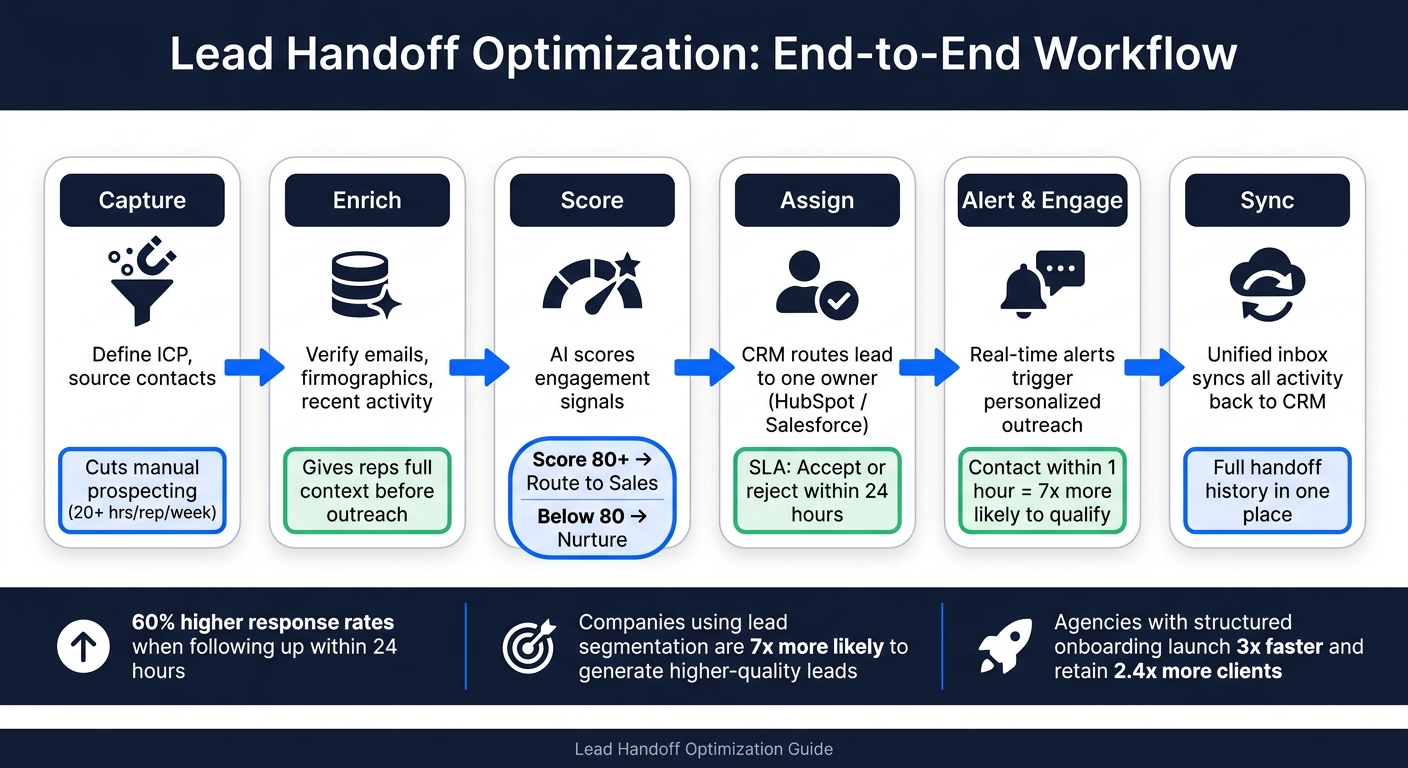
Lead Handoff Optimization: End-to-End Workflow
Once SLAs and routing rules are set, automation makes them stick. It turns a one-time plan into a process the team can run again and again. Each lead should move with the right context, at the right time, without anyone losing track of it.
Design the End-to-End Workflow
A solid handoff workflow usually follows the same path: capture the lead, enrich the record, score intent, assign the lead to the right rep, alert the team, and sync activity back to the CRM.
Enrichment is often where teams lose the thread. If a rep jumps on a call without recent activity or company context, that first conversation can feel flat. It also burns time. AI-driven enrichment fixes that by pulling in profile details, recent posts, and company updates automatically, so the rep shows up ready [3].
Use Automation to Prevent Lead Gaps
The most common failure isn't a bad routing rule. It's a lead that quietly gets ignored. No next step. No owner. No alert. It just sits there.
Automation helps close those holes with three core moves: alert, sequence, and sync. Real-time alerts let reps react fast when hot leads come in. Automated sequences keep follow-up moving when manual cadences slip. And once a prospect replies, they should come out of active sequences right away so no one sends a duplicate message [3].
That's the part many teams miss. The problem usually isn't effort. It's drift. A good system steps in before that drift turns into missed pipeline.
For agencies, this workflow gets more complex fast. One client may need one brand voice, one routing setup, and one follow-up path. Another client may need something completely different.
SalesLabel is built for that setup. It works as a white-label AI engine with real-time lead scoring, helping teams spot the highest-intent prospects automatically. Its AI-driven replies also help manage inbox volume without reps having to watch every conversation nonstop [5].
For high-value accounts, Copilot mode adds a human check before anything goes out. AI drafts the reply based on the prospect's profile and website data, then a person reviews it before sending [5].
In practice, SalesLabel fits this workflow by handling sourcing, enrichment, outreach, follow-ups, and meeting booking under the agency's branding.
Measurement, Feedback, and Continuous Improvement
Once automation is live, the job shifts from setup to proof. You need to know if the handoff is fast and if it converts. Use the same timestamps and SLA rules from the handoff workflow to score performance. And track speed alongside conversion. Fast handoffs that don't turn into meetings, SQLs, or pipeline just add noise.
Core KPIs to Track
Track the exact handoff stage where leads stall or drop out: assignment, acceptance, first touch, meeting booked, SQL, and pipeline.
Metric
What It Measures
Why It Matters
Assignment rate
% of eligible leads routed to a valid owner
Flags routing failures and CRM mapping issues
SLA compliance
% of leads assigned, contacted, or dispositioned within the agreed deadline
Shows whether process rules are actually being followed
Acceptance rate
% of routed leads that sales marks as valid and workable
Tests alignment between marketing qualification and sales expectations
Time to first touch
Median and 90th-percentile time from lead creation to first human or approved automated touch
Median alone hides serious delays - track both
MQL-to-SQL conversion
% of MQLs that become SQLs within a defined period
Measures how well qualification criteria translate to real sales interest
Meeting booking rate
% of accepted leads that book, hold, or cancel a meeting
Connects handoff quality to a concrete sales action
Rejection rate
% of leads rejected by sales, broken out by reason
Structured rejection data is one of the most useful feedback signals available
Pipeline contribution
Qualified pipeline and closed-won revenue from handed-off leads
Connects the handoff process to actual business outcomes
For each metric, define the numerator, denominator, time window, owner, and CRM source. That keeps reporting steady from one review to the next. Also, timestamp every stage change: lead creation, assignment, acceptance, first attempted contact, first two-way response, meeting booking, and opportunity creation.
Don't stop at rolled-up reporting. Break SLA compliance out by source, territory, segment, and owner. A blended number can look fine while one team or channel is quietly falling apart.
For example, a dashboard may show a 98% assignment rate but only a 62% acceptance rate. That usually means the routing system is doing its job, while qualification or targeting needs work. The point is simple: read the metrics together, not one by one.
Diagnose Common Failure Patterns
Once the scorecard shows the weak spot, the pattern often points straight to the cause.
A low assignment rate usually means routing trouble: broken rules, unmapped territories, inactive owners, or missing fields. A low acceptance rate usually signals a qualification mismatch, such as poor-fit accounts, duplicate records, or fuzzy MQL criteria.
If time to first touch is slow but assignment rates look normal, the problem is often rep bandwidth, time-zone gaps, or missing alerts. That's not the same as a routing issue. On the other hand, if acceptance is strong but meeting booking is weak, the problem is often outreach quality rather than lead quality. Generic messaging, weak calls to action, or low-intent contacts tend to show up here.
Contact within one hour is nearly seven times more likely to qualify an online lead than waiting one more hour, and more than 60 times more likely than waiting 24 hours or more. [6]
That drop-off happens fast. So don't treat response time as one big bucket. Split it into bands and compare outcomes across each one:
Under 5 minutes
5 to 30 minutes
30 minutes to 1 hour
1 to 24 hours
Over 24 hours
Then measure contact, qualification, meeting, and pipeline results for each band. That's how you find out whether your speed benchmark fits your own funnel or just sounds good in theory.
Before you send more volume into the system, test the cause. If rejection rates climb after you lower a scoring threshold, compare the before-and-after cohorts by source, segment, and representative.
Build a Review Cadence and Scorecard
The next step is turning these findings into a fixed review rhythm. Review weekly, monthly, and quarterly.
Weekly reviews should zero in on overdue leads: anything unassigned, unaccepted, untouched, or undispositioned. Look at actual records, not just charts. Monthly reviews should dig into acceptance rates, rejection reasons, MQL-to-SQL conversion, meeting booking, and early pipeline by source and rep. Pull a sample of records and check whether required fields and outreach notes are complete. Quarterly reviews should reset the SLAs themselves, including response deadlines, scoring thresholds, routing rules, and capacity assumptions, based on what the data says. And after major routing outages, integration failures, campaign launches, or unusually large SLA breaches, run a focused incident review.
A simple scorecard makes those reviews much easier to run on a steady schedule:
Keep sourced and influenced pipeline separate, and stick to one attribution model. Also set different targets for inbound, partner, outbound, and content leads. Each review should end with one clear call: what changes, who owns it, when it ships, and which KPI will show whether it worked.
Best Practices for Agencies Scaling Lead Delivery
Once routing and SLA rules are set, growth comes down to one thing: keeping each client's process steady without making it feel cookie-cutter. When volume jumps faster than process control, lead handoff starts to break. For agencies, the order matters. Start with repeatable rules, then add automation, then layer in personalization.
Standardize Before You Automate
If lifecycle stages, required CRM fields, qualification rules, and ownership logic aren't written down, automation just makes the mess move faster.
During onboarding, define each client's MQL, SAL, and SQL criteria. Document the ICP. Map the required CRM fields before launch. Agencies that finish structured onboarding launch 3× faster and retain 2.4× more clients in their first year [2].
Templates can help here, especially for:
Targeting criteria
Messaging sequences
Follow-up cadences
Once the process is locked in, the next problem shows up fast: outreach can start to sound generic.
Protect Personalization at Scale
Standardization shouldn't water down outreach. B2B buyers tend to respond when the message reflects their company, role, and account context. Use AI to pull account context from profiles and recent posts, then keep messages short and specific [3]. If a lead scores above 80, send it to human review before it goes out.
Once standardization and personalization are working together, the next move is to track whether the handoff is turning into actual conversions.
Conclusion: Build a Handoff Process That Converts
Once routing, scoring, and ownership are set, the last job is making sure the process stays tight enough to turn leads into deals. A handoff that converts comes down to three things: shared definitions, clear ownership, and fast routing. First-hour response time materially lifts conversion[3].
CRM sync and pre-handoff enrichment give reps clean, complete context. That gives them what they need for more relevant outreach and helps build buyer trust early [3].
The scorecard matters only if it changes behavior. Keep the system honest with weekly performance reviews and monthly scorecard updates. Use conversion data to fine-tune scoring, routing, and scaling decisions [2].
Treat handoff as a system, not a setup.
FAQs
What causes lead handoffs to fail?
Lead handoffs often break down because the process is still manual and scattered. People have to handle research, follow-ups, and calendar scheduling on their own. That opens the door to mistakes, like missed follow-ups or uneven data entry, which can throw off the handoff from one team to the next.
Problems also show up when lead scoring and lead-fit criteria aren't standardized. One team may treat a lead one way, while another sees it differently. Without automation at these key points, agencies can lose momentum, let leads slip through the cracks, and burn time on admin work.
How fast should sales follow up after a handoff?
Sales should follow up immediately after the handoff. As soon as the lead hits the sales queue, create the task and make the first touch. That cuts time to first touch and can improve conversions.
In practice, set an instant SLA - minutes, not hours - so sales can move while the lead signal is still fresh.
Which KPIs matter most for lead handoffs?
Focus on KPIs that track lead quality and process efficiency. The main ones are ICP-based fit scores, engagement scores, and conversion metrics. These show whether the handoff is surfacing high-intent prospects instead of passing along weak leads.
Real-time inbox signals and predictive AI can sharpen scoring, cut response time, and improve conversion rates. SalesLabel supports this with automated lead scoring and analytics.