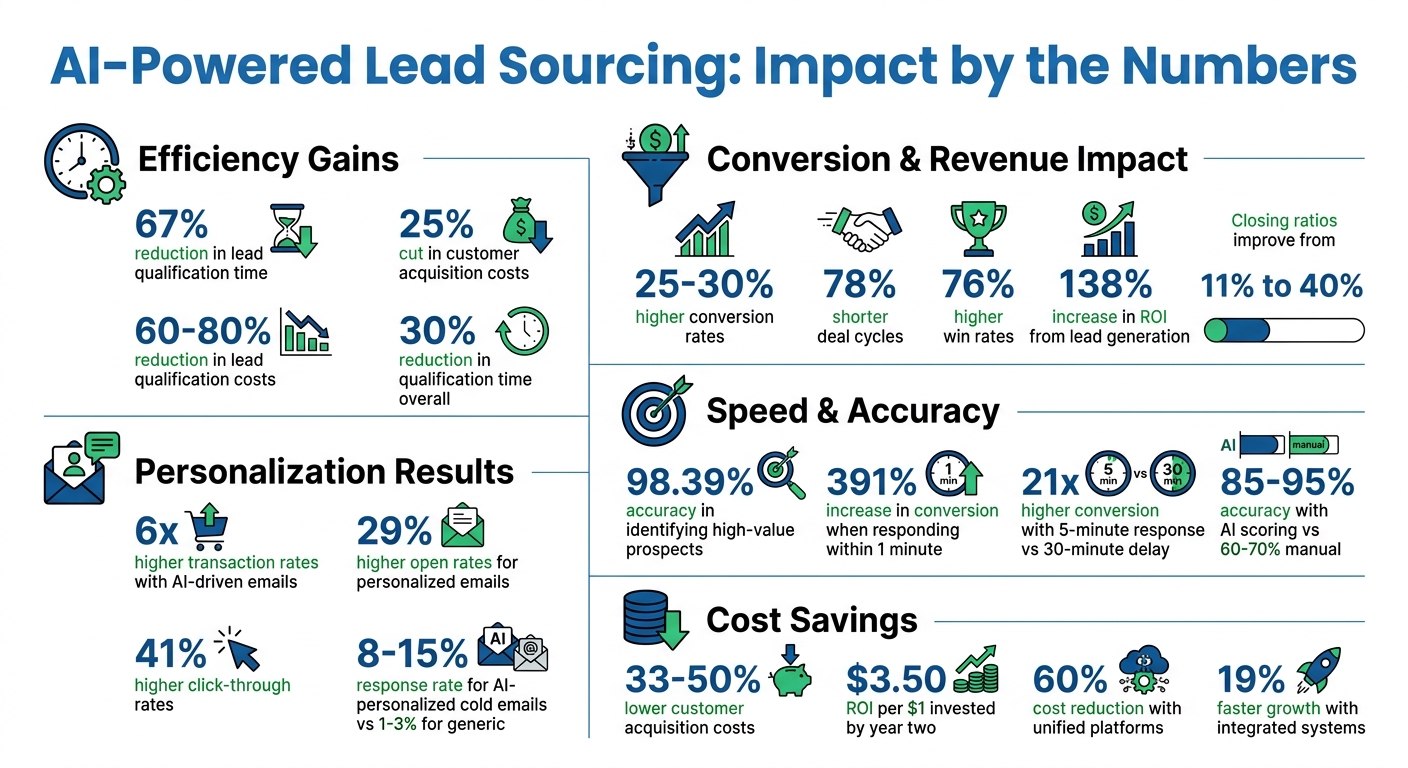
AI-driven lead sourcing streamlines B2C acquisition by scoring intent, enriching data in real time, and personalizing outreach at scale.
SalesLabel Team
Growth Expert • 11/05/2026
Share:
Cerchi una soluzione chiavi in mano?
SalesLabel automatizza la prospezione dall’inizio alla fine — l’IA trova potenziali clienti, invia messaggi personalizzati e prenota riunioni con il tuo marchio.
AI-powered B2C lead sourcing is transforming how businesses find and convert customers. By combining machine learning, predictive analytics, and real-time data, AI automates key processes like lead scoring, behavioral analysis, and personalized outreach. This approach saves time, reduces costs, and improves conversion rates significantly.
Key Takeaways:
Efficiency Boost: AI reduces lead qualification time by 67% and cuts customer acquisition costs by 25%.
Higher Conversions: Companies using AI see up to 25% higher conversion rates and 78% shorter deal cycles.
Personalization at Scale: AI-driven emails achieve 6x higher transaction rates compared to generic campaigns.
AI works by analyzing data, predicting customer intent, and automating multi-channel campaigns. To implement it successfully, businesses need clear goals, clean data, and integration with existing systems. Start small, test results, and regularly update your AI models for the best outcomes.
AI Lead Sourcing ROI: Key Performance Statistics and Benefits
How to Generate Sales Leads with AI (+3 Real-World Examples)
sbb-itb-a781ab9
Core Technologies Behind AI Lead Sourcing
AI-powered B2C lead sourcing thrives on combining several advanced, data-driven technologies into a cohesive system. At its heart are three key components: predictive lead scoring, behavioral and intent analysis, and real-time data enrichment. Each of these plays a critical role in identifying, prioritizing, and better understanding potential customers.
Predictive Lead Scoring
Predictive lead scoring uses data - both historical and real-time - to evaluate the likelihood of a prospect converting. Unlike traditional methods based on rigid rules (e.g., "assign 10 points for a VP title"), AI dynamically analyzes hundreds of variables at once and adjusts scores in real time as new information becomes available [7].
This approach is incredibly precise: AI models can pinpoint high-value prospects with up to 98.39% accuracy[2], leading to 25% to 30% higher conversion rates[2][8]. Additionally, businesses often report a 60% to 80% reduction in lead qualification costs after adopting this technology [7].
For B2C brands, the focus is on granular individual actions like product views, cart activity, coupon usage, and app engagement. AI can detect subtle patterns, such as a higher likelihood of conversion when someone visits a pricing page before checking out a product overview [5]. To keep insights fresh, a decay function reduces the weight of interactions older than 90 days by 50% [8][10].
"Lead scoring is no longer optional - it's the intelligence layer that determines whether your lead generation investments pay off." - Conversion System [2]
While lead scoring assigns a numerical value to potential, behavioral analysis goes one step further by uncovering real-time intent.
Behavioral and Intent Analysis
Behavioral and intent analysis builds on predictive scoring by analyzing "digital body language" - a prospect's actions like navigating a website, interacting with content, or engaging with emails. This helps gauge their readiness to buy [5]. AI categorizes intent into four types: Informational (research-focused), Evaluative (comparing options), Transactional (ready to purchase), and Competitive (weighing against rivals) [5].
Lead scores are updated instantly when key actions occur, such as visiting a pricing page, adding items to a cart, or requesting a demo. This allows businesses to reprioritize leads immediately [9][6]. Timing is vital here - responding to a lead within one minute can increase conversion rates by an astounding 391%[8]. Negative scoring is also applied, deducting points for factors like using a personal email address or being associated with a competitor’s domain [10].
Companies leveraging these techniques often achieve 30% higher conversion rates and a 138% increase in ROI from lead generation efforts [2][8]. With a well-tuned system, the MQL-to-SQL conversion rate can range from 25% to 45%[10].
Real-Time Data Enrichment
Real-time data enrichment fills in any missing pieces of information as soon as a lead enters the system. This includes automatically retrieving contact details (like email addresses and phone numbers) and firmographic data [11][12]. AI tools can even scan websites in real time to gather unique insights such as hiring trends, company growth, or recent news that static databases might miss [11].
These systems often operate using "waterfall" workflows, pulling data from multiple providers until complete and verified information is found. Some platforms can access 450+ unique data points from over 30 providers in a single workflow [11]. Combining enriched data with strong intent signals can improve lead scoring accuracy by 35%[12] and boost outreach response rates by 3–5x[12].
By integrating first-party data with real-time signals, AI ensures that high-intent leads are immediately prioritized [6]. For the best results, your CRM should maintain at least 95% completion on key data fields to provide a solid foundation for these systems [2]. This seamless integration enhances scoring precision and streamlines lead prioritization.
"The biggest gains come from connecting intent data, enrichment, scoring, and outreach into unified workflows rather than siloed tools." - Digital Applied [12]
Strategies for AI-Powered Lead Sourcing
To effectively use AI for lead sourcing, focus on these three approaches: personalized outreach at scale, automated lead qualification, and multi-channel campaign coordination. These strategies rely on a solid data-driven foundation, including predictive scoring, behavioral analysis, and real-time data enrichment.
Personalized Outreach at Scale
AI takes personalization to the next level by analyzing behavioral data to create context-rich messages. For example, when a prospect visits a pricing page, AI can instantly send a tailored message.
The results speak for themselves: personalized emails have a 29% higher open rate and a 41% higher click-through rate compared to generic ones [13][3]. Hyper-personalized campaigns can even boost transaction rates by six times [3]. In 2025, Landbase, a real estate tech company, used AI-driven hyper-personalization with demographic and psychographic data, achieving a 25% increase in lead conversion rates[13].
AI also automates dynamic content generation, crafting subject lines, email bodies, and message sequences customized to each prospect's industry, interests, and pain points. Timing is crucial - responding within 5 minutes increases conversion rates by 21 times, compared to a 30-minute delay [15].
"B2B asks, 'Can this company buy?' B2C asks, 'Will this person buy - right now?'" - Musa Bhat, Wati/Astra [15]
AI-powered chat agents further enhance efficiency by managing thousands of conversations simultaneously. These agents qualify leads through natural dialogue before handing them off to human teams. This approach significantly reduces qualification costs, and 62% of consumers prefer chatbots over waiting for human assistance [3].
Once personalized outreach captures attention, automated lead qualification ensures the right leads are prioritized.
Automated Lead Qualification
AI simplifies the time-consuming process of lead qualification, which traditionally consumes 67% of sales reps' time[1]. By analyzing hundreds of data points - like website activity, email engagement, and demographic fit - AI can instantly evaluate and score leads.
A common framework for lead scoring involves three key signals:
Behavioral Engagement (50%): Tracks actions like website visits and email clicks.
Demographic/Fit (30%): Considers factors such as location and income.
Intent Signals (20%): Monitors research activity and competitor comparisons [8][15].
This method achieves 85-95% accuracy, compared to the 60-70% accuracy of manual processes [15].
Lead Tier
Score Range
Action
Hot Leads
90-100
Immediate sales handoff / Instant notification
Warm Leads
70-89
Accelerated nurture sequence
Cool Leads
50-69
Standard nurture campaign
Cold Leads
Below 50
Educational content series / Low-priority automation
AI continuously updates lead scores based on high-intent actions, ensuring sales teams focus on the most promising opportunities. Companies using this approach report a 25% increase in conversion rates and a 30% reduction in qualification time. Some even see closing ratios soar from 11% to 40%[3].
AI also uses negative scoring to flag red flags, such as competitor domains or unsubscribes, and applies a decay function to older interactions, reducing their point value by 50% after 90 days[8].
Multi-Channel Campaign Coordination
Modern buyers interact with brands across multiple platforms - email, social media, SMS, and web - all in the same day. AI ensures these touchpoints are seamlessly integrated, creating a consistent customer journey. By eliminating data silos, it synchronizes messaging across channels.
AI tracks behavior across platforms and triggers follow-ups through the most effective medium. For instance, if a prospect engages with a social media post, AI might send a personalized email. If they visit a pricing page, it could trigger an SMS with a limited-time offer. Machine learning algorithms optimize timing, scheduling messages for peak engagement.
In 2023, Meta processed over 1.1 billion lead ad submissions, reflecting a 16.6% year-over-year growth[3]. Businesses integrating AI with CRM systems report up to 40% higher revenue growth compared to those using disconnected systems [14]. Additionally, companies using unified platforms for multi-channel coordination reduce costs by 60% and grow 19% faster than those relying on fragmented solutions [16][14].
AI chatbots also play a key role, providing 24/7 responses. Conversion chances drop by 98% if a lead isn’t contacted within 24 hours[16]. AI further streamlines operations by routing high-scoring leads to the right sales reps based on criteria like geographic territory or deal value.
"If your data is bad, AI is just going to magnify it and show how bad." - Tarun Sood, Chief Data and AI Officer, American Century Investments [16]
These strategies highlight the importance of clean, well-organized data. AI amplifies the quality of your baseline information, making data accuracy a critical factor for success.
For agencies aiming to integrate AI into B2C lead sourcing, platforms like SalesLabel offer a comprehensive, white-label solution. This tool combines personalized outreach, automated qualification, and multi-channel coordination under your brand.
How to Implement AI Lead Sourcing
Using AI for lead sourcing involves a thoughtful, step-by-step approach that blends advanced technology with human oversight. The process typically unfolds in three key stages: setting clear objectives, choosing the right tools, and integrating AI seamlessly with your existing systems.
Setting Goals and Success Metrics
Before diving into AI implementation, it's essential to define what success looks like. Start by building an AI-ready Ideal Customer Profile (ICP). Go beyond basic demographics to include factors like behavioral patterns, technology preferences, and key organizational triggers [18].
Break the process into manageable phases:
Foundation: Focus on defining your ICP and cleaning up your data.
Scaling: Increase outbound activity to reach more prospects.
Optimization: Integrate inbound channels and track full attribution [20][4].
Measure what matters. Some key metrics to monitor include:
MQL-to-SQL acceptance rates: Aim for 85% or higher [2].
Speed to lead: Respond to high-scoring leads within 5 minutes [20].
Lead-to-opportunity rates: Target a range of 20–35% [22].
AI-driven lead generation can significantly boost outcomes, delivering 76% higher win rates and reducing deal cycles by 78% compared to traditional methods [4]. A good benchmark is achieving a return on investment (ROI) of 3–5× from your AI tools [4].
"The businesses winning in 2026 are not the ones with the biggest sales teams. They are the ones with the smartest systems." – Daly Advertising [20]
Before implementing AI, conduct a data quality audit. Ensure that at least 80% of sales activities are logged and that 90% of your CRM's core fields are complete [18]. Studies show companies that respond to leads within an hour are nearly seven times more likely to qualify them than those that delay [17].
Once your goals and metrics are in place, you're ready to choose the right tools for the job.
Selecting the Right Tools
With your objectives clear, the next step is selecting tools that align with your needs. Look for AI platforms that meet these criteria:
Seamless integration: Ensure compatibility with your CRM and other systems.
Broad data access: The platform should pull from a wide range of data sources.
Cost considerations: Include setup, maintenance, and ongoing expenses [17][18].
Choose tools that support a "human-in-the-loop" approach. This setup lets AI handle repetitive tasks while humans oversee messaging and strategy. Transparency features like "run history" are also valuable for troubleshooting why certain leads were scored or routed in specific ways [18].
For agencies managing multiple clients, white-label platforms like SalesLabel are worth exploring. These tools combine lead sourcing, data enrichment, personalized outreach, automated follow-ups, and real-time lead scoring, all under your own branding.
"Your data is what turns generic AI algorithms... into differentiated and relevant capabilities that give your business a competitive advantage." – Scott Brinker, VP Platform Ecosystem at HubSpot [17]
Start small by piloting low-complexity use cases, such as qualifying inbound leads. Test the system with a limited audience or lead source before scaling to your full operation [17].
Connecting AI with Your Existing Systems
Once you've selected your tools, the next challenge is integrating them into your existing systems. This step is crucial for ensuring smooth operations and maximizing the benefits of AI.
Start by creating a centralized data layer. This layer consolidates information from all your applications, ensuring that data is clean, standardized, and ready for AI models to process [17]. A centralized setup also ensures that insights are accessible across your tech stack.
Real-time synchronization is a must. If your AI tool doesn’t sync instantly with your CRM, sales teams may miss critical insights when they need them most [19][20]. Reverse ETL processes can help by writing enriched data back into platforms like Salesforce or HubSpot [21].
Automate lead routing based on AI scores. For example, high-scoring leads can be routed to senior sales reps, or instant notifications can prompt immediate follow-ups [20]. Quick responses matter - 78% of deals go to the vendor who responds first [20].
Set up trigger events to hand off leads at the right moment. For instance, if a lead visits your pricing page twice, your system can automatically notify a sales rep [19]. Engage your IT team early to ensure the tools meet your security and technical requirements [17].
To build confidence in the system, run AI scoring alongside your manual processes initially. This dual approach allows you to fine-tune the AI's parameters and validate its accuracy [17]. Regular updates are essential - plan for monthly reviews and quarterly retraining of your AI models based on the latest data from won and lost deals [20].
Measuring and Improving Performance
Once you've integrated AI into your systems, the next step is to fine-tune its performance. Tracking the right metrics ensures your efforts aren't wasted and helps you achieve the best possible return on investment (ROI).
Real-Time Monitoring and Adjustments
AI analytics dashboards provide instant insights into campaign performance, allowing for quick adjustments. One effective tactic is setting up automated triggers that react to lead behavior in real time. For instance, if a lead reaches a score of 81 or higher, the system can immediately route them to a senior sales rep or schedule a priority meeting. Meanwhile, lower-scoring leads can be placed into automated nurture sequences [2].
Timing is essential. Responding to leads within 4 hours can double your meeting rate compared to waiting 24–48 hours [25]. To stay on top of this, establish clear Service Level Agreements (SLAs). For example, Tier 1 high-intent signals should be addressed within 4 hours, while Tier 2 signals can be handled within 48 hours [25]. Additionally, focusing on real-time intent triggers - like vendor inquiries or signs of dissatisfaction with competitors - can lead to meeting conversion rates up to four times higher than traditional cold outreach [25]. You can even tag leads with a specific source field (e.g., "social_signal_linkedin") to track their progress through your funnel and demonstrate ROI [25].
Key Metrics to Track
Once real-time monitoring is in place, focus on metrics that directly impact your outcomes. A strong indicator of success is your AI's score-to-conversion correlation, which should aim for an r value above 0.7. This ensures the AI's predictions align closely with actual results [2]. Additionally, strive for an MQL (Marketing Qualified Lead) acceptance rate of at least 85%, while keeping false positives under 15% [2].
By using AI lead scoring, companies often see a 138% improvement in revenue compared to 78% for those without it [2]. Tracking lead velocity by AI score bands can help identify where delays occur in the conversion process [2]. Similarly, monitoring reply velocity and decay patterns sheds light on when prospects are most likely to respond, helping you fine-tune follow-up timing [24].
Using Data to Refine Your Approach
Focus only on data that drives actionable improvements. Start by reviewing your closed-won deals to identify patterns, then use these insights to refine your AI's Ideal Customer Profile (ICP) [22]. This creates a feedback loop that sharpens your targeting to focus on the most profitable leads.
A two-pass scoring system can be particularly effective. First, use a lightweight AI model to filter out 40–60% of unqualified leads. Then, apply a more advanced model to analyze high-potential prospects [22]. Syncing AI activity with your CRM allows you to track which email strategies and ICP segments perform best [22]. Personalization pays off - AI-personalized cold emails typically see an 8–15% response rate, compared to just 1–3% for generic templates [22]. Regularly A/B testing subject lines, personalization elements, and sending schedules can further optimize these results [24].
"AI lead scoring metrics form the backbone of modern sales pipelines, quantifying prospect quality through data-driven signals." – BizAI [23]
Adjust your AI thresholds based on conversion data. For example, if leads scoring 85 or higher consistently convert better, set your system to trigger immediate sales alerts for those leads while directing lower scores to nurturing campaigns [23]. Don't forget to account for negative signals - deduct points for actions like unsubscribes or prolonged inactivity [23].
Keep an eye on conversion rates at each stage of your funnel. If leads are stalling, it might be time to tweak your messaging or qualification criteria [24]. Companies using predictive lead scoring often convert 50% more leads while reducing acquisition costs by 33% [2]. Regularly analyzing these KPIs ensures your AI system stays aligned with your revenue goals.
Best Practices for AI Lead Sourcing
To make the most of AI lead sourcing, it’s essential to focus on accuracy and efficiency. This means prioritizing high-quality data, incorporating human oversight, and keeping your systems in top shape. Poor data quality alone costs companies an average of $12.9 million annually[8][16].
Keeping Your Data Clean
AI thrives on good data. Or as Tarun Sood, Chief Data and AI Officer at American Century Investments, aptly says:
"If your data is bad, AI is just going to magnify it and show how bad"[16].
Start by auditing your CRM to eliminate duplicates, outdated contacts, and invalid emails. This ensures your AI models are working with reliable information. Keep in mind that CRM data tends to decay at a rate of 30% per year due to job changes and updated contact details[26]. To tackle this, set up automated workflows that regularly verify and update contact information.
AI can also cross-reference 15–20 data points from sources like company websites, LinkedIn, job postings, and news articles. While traditional databases often achieve only 40–60% accuracy, AI tools sourcing directly from these primary channels can hit over 95% accuracy[26].
Implement validation rules at the data entry stage to catch errors immediately - like mismatched email domains or incorrect area codes[26][16]. Additionally, use recency weighting: devalue signals older than 90 days by 50% and essentially disregard anything older than 180 days. This keeps your AI focused on up-to-date, relevant information.
Once you’ve cleaned and validated your data, automation can take over - but with human oversight to ensure everything stays on track.
Combining Automation with Human Input
AI is great at handling repetitive, data-heavy tasks, freeing up humans for more strategic work. For example, sales reps currently spend about 67% of their time manually qualifying leads[1]. With AI, this process can be cut by up to 30%, saving 6–7 hours a day for more meaningful interactions[17].
Before automating any process, test the logic manually to ensure it works as intended. AI can handle tasks like lead qualification, data enrichment, and initial outreach, but high-value accounts and closing deals should remain human-led[17]. For instance, you could set a rule where leads scoring 90 or higher trigger an immediate phone call from a sales rep, while lower scores stay in automated nurture campaigns.
Avoid letting AI run fully autonomous outbound outreach, as this can harm your brand’s reputation[22]. Instead, use a human-in-the-loop (HITL) approach. Have team members review a weekly sample of AI-enriched data and outreach messages to ensure accuracy and prevent errors, like misidentifying a prospect’s role or company milestone[20]. This balance ensures efficiency without sacrificing the personal touch.
Regular System Reviews and Updates
AI systems need regular updates to stay aligned with evolving market conditions. Over time, market shifts and changes in buyer behavior can cause AI models to degrade. That’s why monthly reviews and quarterly retraining are crucial for maintaining accuracy[4]. It’s worth noting that 73% of AI failures in lead generation are tied to data quality issues, making consistent monitoring essential[4].
Retrain your models using recent closed-won and closed-lost data, so they learn from actual revenue outcomes rather than just engagement metrics[4]. High-performing systems should maintain at least 85% accuracy[20]. To prevent model drift, schedule quarterly reviews with your marketing and sales teams to refine lead qualification criteria[16][28].
Don’t forget to audit your email infrastructure (SPF, DKIM, DMARC) and domain reputation regularly to ensure AI-generated outreach reaches inboxes[20]. For web-based lead sourcing, update your systems whenever website layouts change to avoid data extraction issues[27].
Conclusion
AI is transforming the way businesses find, engage, and convert leads. It’s delivering 50% more qualified leads at a 33%–60% lower cost, while also boosting closing ratios from 11% to 40%[14][29][3].
Unlike outdated, rule-based systems, AI leverages dynamic models that analyze hundreds of behavioral signals in real time. This allows businesses to engage the 95% of visitors who might otherwise leave without making an inquiry[5]. According to McKinsey, these personalized approaches can slash customer acquisition costs by up to 50% and increase revenue by 5%–15%[29]. These results highlight the importance of adopting AI strategically and systematically.
"The companies winning at outbound in 2026 are not the ones with the largest SDR teams. They are the ones who figured out how to combine AI automation with human judgment." – GetSalesClaw [22]
To get started, focus on three key steps. First, define a clear Ideal Customer Profile (ICP) and audit the quality of your data. Next, integrate AI tools into your existing CRM. Then, follow a 90-day roadmap: dedicate 30 days to cleaning up data and refining your ICP, another 30 days to deploy predictive scoring and AI chatbots, and the final 30 days to implement intent data and dynamic personalization[4]. While AI handles much of the heavy lifting, human oversight remains essential for strategic decisions and maintaining brand integrity.
Once your systems are in place, speed becomes the ultimate differentiator. By adopting AI-powered lead sourcing now, you can stay ahead of the competition and ensure a steady flow of qualified leads - day and night.
FAQs
What data do I need to start AI lead sourcing?
To kick off AI lead sourcing, you'll need specific types of data that allow the AI to identify, qualify, and rank potential leads. Here's what you'll want to gather:
Website visitor behavior and engagement signals: This includes data like time spent on pages, clicks, and downloads, which help AI understand user interest.
Intent and behavioral data: Information that reveals what prospects are actively searching for or engaging with online.
Contact and demographic details: Basic yet crucial data like email addresses, job titles, industries, and company size.
Historical lead and customer data: Past interactions, conversion rates, and customer profiles to help AI learn what works.
With this data, AI tools can handle prospecting, tailor outreach efforts, and enhance lead quality - all while saving you time and effort.
How do I connect AI lead scoring to my CRM?
To integrate AI lead scoring with your CRM, the first step is to clean and standardize data from various sources like your CRM, website analytics, and email marketing tools. Next, establish clear lead qualification criteria by creating an Ideal Customer Profile (ICP) that outlines the characteristics of your target audience. Use historical sales data to train your AI model and ensure its predictions are accurate through validation. Once the model is ready, sync the AI-generated lead scores and predictions with your CRM. This allows for smooth prioritization of leads with the highest potential value.
How can I prevent AI outreach from hurting my brand?
To safeguard your brand during AI-driven outreach, focus on crafting messages that are personalized, relevant, and respectful. Steer clear of spammy, impersonal communication by tailoring your outreach to align with your audience's specific interests and behaviors. Leverage AI tools that prioritize deliverability and engagement to ensure your messages reach the right people, avoid spam filters, and create authentic connections. When used thoughtfully and ethically, AI can strengthen your reputation and help build lasting trust with your audience.