How AI scores leads from live behavior, fit, and intent to speed outreach, boost conversions, and cut wasted rep time.
SalesLabel Team
Growth Expert • 15/06/2026
Share:
Vous cherchez une solution clé en main ?
SalesLabel automatise votre prospection de A à Z — l’IA trouve les prospects, envoie des messages personnalisés et réserve des rendez-vous sous votre marque.
AI lead scoring works better than fixed scoring rules when lead volume is high and timing matters. I’d boil the research down to this: AI scores leads from live behavior, fit, and intent data; it helps teams reply in minutes instead of hours; and it can improve sales output when the data is clean and the model gets retrained.
Here’s the short version:
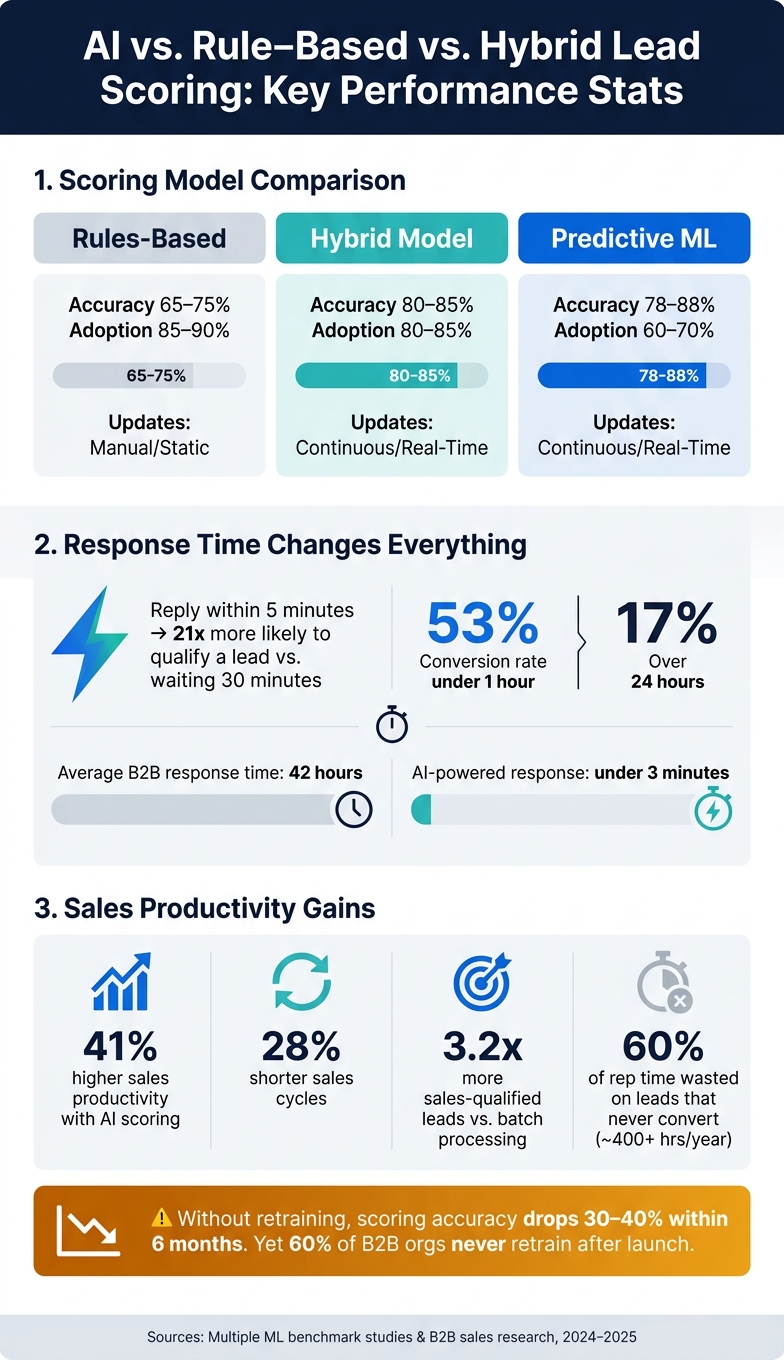
Rule-based scoring gets old fast. Research in the article says scoring models can lose 30%–40% of accuracy within 6 months if no one updates them.
Fast follow-up changes results. Teams that respond within 5 minutes are 21x more likely to qualify a lead than teams that wait 30 minutes.
AI scoring tends to beat static systems. The article cites 78%–88% accuracy for predictive ML in production, versus 65%–75% for rules-based models.
Real-time routing matters. In most studies here, “real-time” means scoring and routing a lead within 2 to 5 minutes.
Sales teams waste time on weak leads. Reps spend about 60% of their time on leads that never buy, and AI scoring helps cut that down.
Hybrid setups often make sense first. If you don’t have enough conversion data, a rules layer plus an ML re-ranker is often the safer path.
Clean data and retraining decide the outcome. Messy CRM fields and stale models are two of the main reasons scores stop helping.
If I were summarizing the piece in one line, I’d say this: AI lead scoring is less about fancy models and more about getting the right lead to the right rep at the right time.
The article then backs that up with research on model accuracy, response-time impact, signal types, retraining cycles, and agency use cases.
AI vs. Rule-Based vs. Hybrid Lead Scoring: Key Performance Stats
Research on real-time AI lead scoring pulls from academic papers, benchmark reports, and live implementation data. And across those sources, the pattern is pretty clear: AI-driven systems tend to beat static rule-based models on accuracy, speed, and conversion results [7][9].
At the center of the research is a simple comparison: static scoring, predictive ML, and hybrid systems. The big question is which model type performs best when scoring leads in real time.
From Static Rules to Machine Learning Models
The research describes this shift in plain terms. Teams move from manually assigning point values to using statistical weights learned from past data. Rule-based systems depend on fixed if-then logic and manual updates. Machine learning models, on the other hand, study historical win/loss data to find the patterns most tied to conversion.
A March 2025 study that compared 15 classifiers found that Gradient Boosting performed best, with lead source and lead status ranking as the top predictors [8]. In most cases, rule-based models land at 65–75% accuracy, while predictive ML reaches 78–88% in production [7]. Some studies go further and show that many rule-based scores don’t line up with actual conversion at all [11].
Where the Evidence Is Strongest
The clearest evidence shows up in three places: conversion prediction accuracy, speed-to-lead response, and sales output.
Organizations using AI-powered lead scoring report 41% higher sales productivity and 28% shorter sales cycles than teams using rule-based systems [9]. Companies using real-time AI scoring also generate 3.2x more sales-qualified leads (SQLs) than those still relying on batch processing [9].
Research also points to hybrid models as a strong middle ground. These systems combine a transparent rules-based layer with an ML re-ranker. They usually reach 80–85% accuracy and often see better sales-team adoption than pure ML systems [7]. Most studies also suggest having at least 500 historical conversions before moving to predictive ML. Below that mark, rule-based systems are often the safer bet [10].
Across the research, the same three patterns keep showing up: accuracy, speed, and sales output.
The next section breaks down which signals these systems measure and how those inputs change scores in real time.
What Studies Measure in Real-Time Lead Scoring Systems
Studies look at two things: how well the model predicts outcomes and whether that prediction changes sales results. First comes model quality. After that, researchers check whether scoring improves response speed and pipeline output.
Core Metrics Used Across Studies
Most researchers begin with technical metrics like AUC (Area Under the Curve), precision, and recall. These show how well a model separates leads that are likely to convert from those that probably won’t [1][8].
AUC is one of the main checkpoints. A score of 0.75 is usually the lowest level that’s still useful. Hit 0.85 or higher, and the model is generally seen as strong [1].
Studies also track day-to-day sales metrics, including speed-to-lead, time-to-first-touch, and SLA compliance[3][10]. In this research, “real-time” usually means a lead gets scored and routed within 2–5 minutes after submission [3][9].
That speed can make a big difference. For example, following up with a high-intent lead within the first hour leads to a 53% conversion rate, compared with 17% when the reply comes after 24 hours [10].
Rep productivity shows up a lot too. Sales reps spend about 60% of their time on leads that never convert. That adds up to more than 400 hours per rep each year[5][12]. AI scoring cuts into that waste by pushing likely buyers to the top of the queue.
Summary Table of Research Findings
These metrics show up in different ways across studies, but they all get at the same issue: does scoring help teams move faster and produce more revenue?
Study Type
Evaluation Metric
Reported Impact
ML Algorithm Comparison
Accuracy & ROC AUC
Gradient Boosting outperformed 14 other classifiers [8]
In an agency setup, these numbers only matter if they lead to action. That’s the whole point.
With SalesLabel, real-time scores can trigger replies, follow-ups, and routing right away, so high-intent leads get immediate attention under the agency’s brand.
How AI Improves Real-Time Lead Scoring
Data Signals Commonly Used by Models
AI models pull together 200+ signals across four groups: Fit (firmographics like industry, employee count, and tech stack), Behavior (first-party engagement such as page visits), Intent (third-party intent feeds and high-intent actions such as demo requests), and Decay (negative or stale signals that lower priority) [7].
That matters because buying intent rarely shows up in just one action. A single pricing page visit doesn't say much on its own. But a cluster of actions, like pricing page views, documentation reads, and demo requests, paints a much clearer picture. Recent studies show these intent bundles predict outcomes better than single actions [3].
AI also looks at derived signals, not just raw counts. For example, a 7-day visit acceleration signal can be 5–8x more predictive of conversion than basic behavioral totals [9]. In plain English: it's not just about how much activity happened, but whether interest is picking up.
Negative signals count too. Modern models can factor in recent layoffs, leadership departures, or downward revenue revisions, then down-weight leads that are less likely to buy right now [6].
Unlike fixed point systems, AI weighs these signals together and adjusts as buyer behavior shifts. That gives teams a score that's tied to what's happening now, not what happened last week.
Those inputs matter most when the model can refresh scores as behavior changes.
Continuous Score Updates and Model Learning
Good signals don't help much if scores update too slowly.
Modern systems pull data from CRM, web analytics, and intent feeds, then refresh scores as new signals come in [3][13]. Continuous updates matter. Daily or weekly refreshes can miss the short window when a buyer is active and ready to talk.
This is why studies look at both model accuracy and time-to-action. AI models get better over time by retraining on closed-won and closed-lost outcomes [9][7]. Many systems also apply decay rules. A common setup reduces score weight after 30 days of inactivity and resets the activity score after 90 to 180 days[7]. That helps sales teams stay focused on leads that are engaged now instead of names that have gone quiet.
Most buying signals bunch up in a short period before outreach, so late refreshes hurt conversion odds. Overnight refreshes can trail the buying cycle.
That speed affects more than scoring. It shapes routing, timing, and how much time reps spend on the right accounts.
Performance Gains and Practical Limits
Reported Gains in Accuracy, Speed, and Productivity
Once scores update all the time, the next thing to ask is simple: do they lead to better results? In many cases, yes.
Rule-based scoring often lands in the 15–25% accuracy range. AI-driven models tend to move that up to 40–60%[2]. Pure predictive ML models can hit 78–88% accuracy, but there’s a catch: they usually need 5,000+ historical leads for training [7].
Speed changes just as much. The average B2B response time is 42 hours. Real-time AI scoring can cut that to under 3 minutes[14].
One example makes the shift easy to see. A Series B SaaS company set up a trigger that added +40 points when technical titles from mid-market accounts visited its integration page. That change cut average time to first contact from 4 hours to 9 minutes and increased SQLs by 28% in one quarter[13].
Implementation Conditions and Research Limits
Those gains don’t happen by magic. They depend on three conditions.
Data standardization comes first. If CRM fields are messy, the model starts on shaky ground. Small differences like "USA" vs. "United States" or "SaaS" vs. "Software as a Service" can weaken performance before scoring even starts [3].
Training volume comes next. Pure ML needs enough past data to learn from. If the dataset is small, a hybrid setup often works better: a rule-based base layer, plus an ML re-ranker on top [7].
Model decay is the third issue. Left alone, accuracy can fall 30–40% within six months[2]. That’s a big drop. And yet 60% of B2B organizations never retrain their scoring model after launch[2]. So the problem usually isn’t the model itself. It’s the lack of upkeep.
A simple cadence helps:
Monthly retraining works best for teams handling 500+ leads per month[4][9]
Quarterly retraining is enough for teams below that volume [4][9]
There’s one more piece people often miss: explainability. If scores feel like a black box, sales teams are less likely to trust them. Accuracy matters, but if no one believes the score, it won’t shape action.
What the Research Means for Agency Growth
For agencies, the takeaway is pretty direct: clean data, clear scoring logic, and regular retraining decide whether real-time AI turns into growth or just another tool sitting in the stack. SalesLabel is built for that workflow, with real-time lead scoring, enrichment, and outreach.
FAQs
How much data do I need before using AI lead scoring?
You’ll generally need at least 100–150 closed-won deals or 500–1,000 historical deals to train AI lead scoring models in a way that works well.
That’s the rough threshold where the model starts to spot patterns instead of just guessing. With less data, lead scores can get shaky fast.
How often should a real-time lead scoring model be retrained?
A real-time lead scoring model should be retrained at least quarterly.
That said, some sources suggest monthly or even weekly retraining if market conditions shift fast or the model starts to drift from new data. In plain terms: the more your buyers, traffic sources, or sales patterns change, the more often you should update the model.
What signals matter most in real-time AI lead scoring?
The most important signals are behavioral engagement, firmographic fit, and active intent.
Here’s what that looks like in practice:
Behavioral engagement: website visits, demo requests, and content interactions
Firmographic fit: company size, industry, and revenue
Active intent: third-party research, content consumption, and recent funding or hiring events
Decay factors help you put more weight on the most current activity.
 HubSpot">