Predictive scoring helps agencies prioritize leads by using AI to predict conversion likelihood based on data. This approach saves time, reduces bias, and boosts efficiency by focusing on high-value prospects. Key benefits include:
AI-driven scoring: Calculates dynamic, real-time lead scores using data like CRM history, behavior (e.g., email clicks), and external signals (e.g., hiring trends).
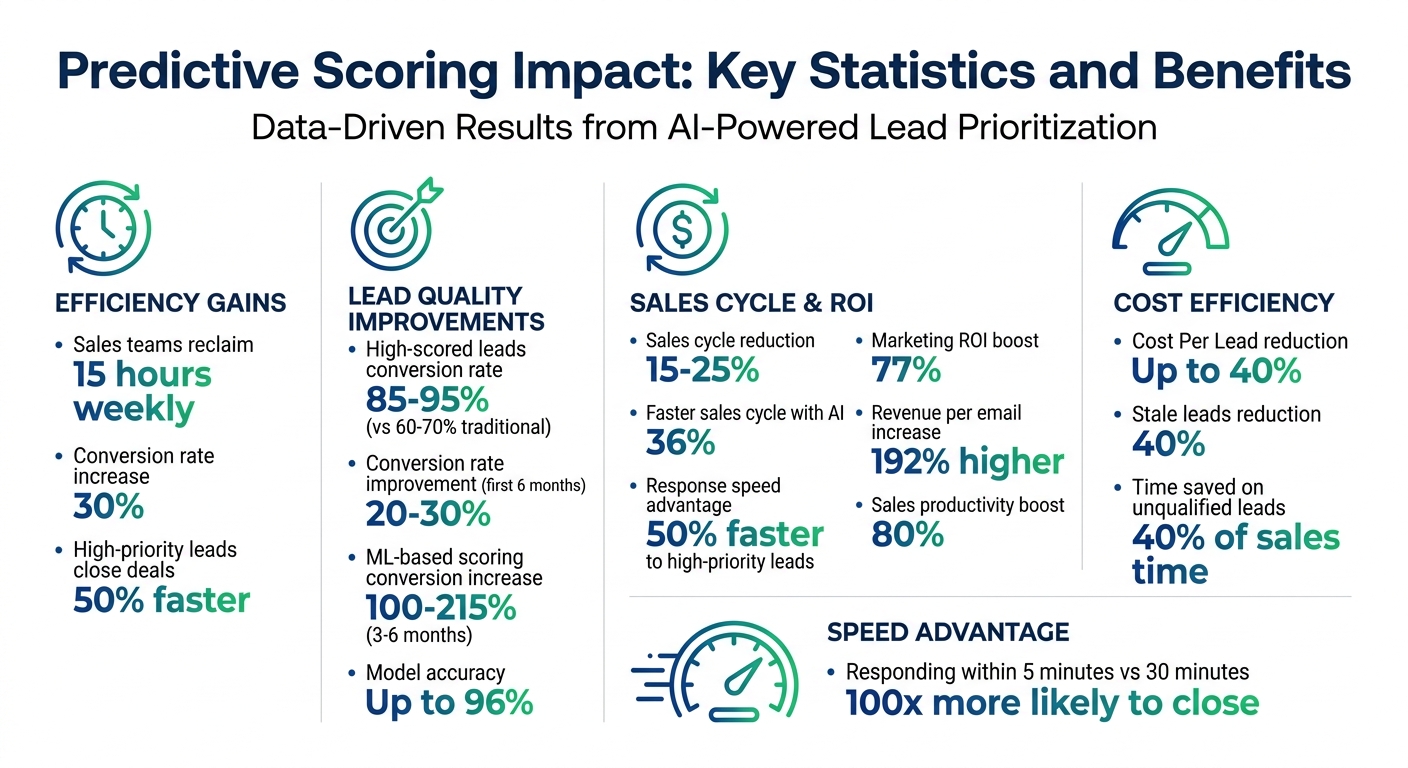
Improved efficiency: Sales teams reclaim up to 15 hours weekly and report a 30% increase in conversion rates.
Faster sales cycles: High-priority leads close deals 50% faster, with predictive scoring increasing accuracy as it learns.
Agencies can implement predictive scoring by preparing data, training machine learning models, and integrating tools like CRMs. Metrics like lead quality and time-to-close ensure performance monitoring. Challenges include ensuring data accuracy, smooth integration, and team buy-in. Tools like SalesLabel simplify implementation with automated lead management and white-label options for agencies.
Takeaway: Predictive scoring streamlines lead prioritization, increases sales productivity, and drives better results by aligning resources with high-conversion opportunities.
Predictive Scoring Impact: Key Statistics and Benefits for Agencies
Master AI-Powered Lead Scoring & Automation (Predictive AI CRM Explained)
sbb-itb-a781ab9
How Predictive Scoring Works
Predictive scoring collects data, applies machine learning models, and adjusts scores dynamically. Grasping this process is essential for boosting agency conversions.
Data Inputs Used in Predictive Scoring
Predictive scoring relies on three key data types:
Explicit data: Includes firmographic details like job title, company size, annual revenue, industry sector, and geographic location.
Implicit data: Tracks behavioral signals such as website visits, content downloads, email engagement, webinar participation, and product trials.
Negative scoring inputs: Deducts points for certain signals - for example, personal email domains like Gmail might subtract 10 points, while job titles like "student" could reduce scores by 15 points or more [4][5][6].
Using effective lead scoring systems, companies often see conversion rates improve by 20% to 30% within the first six months. Additionally, intelligent scoring can shorten sales cycles by 15% to 25% [4].
Data is gathered through forms that build detailed profiles over time, automated tracking that monitors real-time behavior, and third-party tools that enrich information - such as company growth rates - based on a lead's domain [5][6].
Machine Learning Models
Machine learning uncovers patterns that predict conversions. It begins with feature engineering, where raw data is transformed into actionable signals like the time between visits or the number of pricing page views. These refined signals are far more predictive than simple activity counts [7]. To train models effectively, at least 12 months of historical data - covering both successful and unsuccessful deals - is required. For instance, certain combinations of job titles and engagement timing might indicate a 60% likelihood of conversion [4][7].
Multiple algorithms are used simultaneously:
Logistic Regression: Simple and easy to interpret.
Random Forest: Handles complex feature interactions well.
Gradient Boosting: Often delivers the highest accuracy by learning from errors in stages [7].
To ensure reliability, historical data is split - 80% for training and 20% for testing against unseen leads [7]. Machine learning-based scoring has led to conversion increases of 100% to 215% within three to six months, with advanced models achieving up to 96% accuracy in predicting conversions [7]. Unlike static, rules-based systems, these models continuously learn. For example, if a high-scoring lead fails to convert, the algorithm adjusts its weighting to improve future predictions through automated feedback loops [4].
Real-Time Score Updates
Scores adjust instantly with new inputs. For example, if a prospect downloads a pricing guide, their score increases immediately, ensuring they are prioritized for follow-up as soon as your sales team begins their day [4]. This speed is critical - responding within five minutes makes you 100 times more likely to close a deal compared to waiting 30 minutes [8].
Real-time monitoring also accounts for score decay. Points are subtracted (e.g., 5–10 points per month) for inactivity, ensuring outdated leads do not rank highly. For instance, a lead who engaged heavily six months ago but has since gone silent will see their score drop, allowing the team to focus on prospects showing current buying intent. Organizations with sophisticated lead scoring processes report 192% higher average revenue per email, and well-implemented scoring can boost sales productivity by 80% [1].
The system removes human bias by evaluating all leads using consistent, data-driven criteria. Continuous recalibration ensures the scoring model evolves with market trends, improving accuracy with every interaction and supporting better decision-making for agencies.
Metrics to Track for Predictive Scoring
To determine whether predictive scoring improves conversions or simply adds complexity, it's essential to track specific metrics. By monitoring lead quality indicators and efficiency gains, agencies can justify their investment and fine-tune their models for better outcomes.
Lead Quality and Conversion Rates
One of the most important metrics is the Lead-to-Opportunity conversion rate by score range. A strong predictive model should show that high-scored leads (e.g., 85/100 or higher) convert at rates of 85–95%, compared to 60–70% with traditional scoring methods. This helps minimize false positives and negatives, providing a basis for adjusting scoring thresholds [10][1].
Another key metric is the Sales Acceptance Rate (SAR), which measures the percentage of scored leads that sales teams qualify for follow-up [1]. Regularly auditing outliers can reveal missing variables or the need to adjust attribute weighting for better accuracy [1].
"AI lead scoring metrics form the backbone of modern sales pipelines, quantifying prospect quality through data-driven signals." – Lucas Correia, CEO & Founder, BizAI [10]
Also, keep an eye on the Lead Quality Distribution, which segments prospects based on buying intent [9]. Companies using predictive scoring have reported conversion rate improvements of 20% to 30% and a 77% boost in marketing ROI [11][9]. For example, setting a score threshold of 85/100 for "hot leads" can trigger instant sales notifications, while lower scores can be routed into automated nurture campaigns [10][1].
These metrics provide a foundation for analyzing overall sales efficiency.
Time-to-Close and ROI
After assessing lead quality, focus on metrics that reflect sales cycle efficiency and return on investment. Start with Sales Cycle Length, which measures how quickly deals close. Predictive scoring can significantly speed up this process - some agencies have achieved a 36% faster sales cycle [10][11]. Sales teams leveraging AI-driven scoring also respond to high-priority leads 50% faster than those using manual processes [2].
Track Cost Per Lead (CPL) reduction, as more targeted marketing efforts often lower expenses. Some agencies have reported CPL reductions of up to 40% [10]. To calculate your ROI, compare the costs of implementing predictive scoring (software, data preparation, training) against the revenue growth and operational efficiencies it generates.
Another critical metric is Lead Response Time, which ensures high-scored leads are addressed quickly. Implementing score decay - reducing points for inactivity after 7–14 days - helps maintain focus on active prospects [9][11][1]. Companies with advanced scoring systems have seen a 192% increase in average revenue per email and a 20% boost in sales productivity within the first year [1][10].
Regularly reviewing these metrics not only validates your model's performance but also helps refine it to align with your agency's goals and objectives.
How to Implement Predictive Scoring in Your Agency
You can implement predictive scoring within two to three months. Start with a 60-day historical data audit before layering in advanced AI features [1].
Data Preparation and Model Training
Begin by auditing 12–24 months of customer data to ensure it’s complete, accurate, and relevant [1]. To build an effective predictive model, aim for at least 100 converted leads and 100 non-converted leads[3].
Negative: Competitor domains, personal emails, bounces
"The best thing you can do is block bots from submitting fake leads so you're able to train the ad networks using real data. This dramatically reduces the number of irrelevant leads." – Frank Ferris, Sr. Manager, Product Specialists, Coefficient [3]
Track real-time interactions like website navigation, content consumption, and email engagement. Apply a time-based decay model where recent actions (0–7 days) carry full weight, while older actions (90+ days) are reduced to 25% or less [1]. Regularly clean up duplicate records to keep lead profiles accurate.
Once your data is ready and the model is trained, the next step is integrating the scoring system into your existing tools.
Integration with Existing Tools
Link your scoring model to your CRM and marketing automation platforms to enable two-way data synchronization. This allows engagement data, like email opens and site visits, to feed into the scoring model, while updated scores flow back into the CRM to adjust lead statuses [3].
Test the AI scoring system alongside your manual process for 30–60 days to ensure it delivers accurate results [2]. Automate workflows based on score tiers:
High scores (80+): Route these leads to sales for immediate follow-up.
Medium scores: Place these leads into automated nurture sequences.
Low scores: Share educational content with these leads [2].
Incorporate scores into CRM dashboards so sales teams can prioritize leads without switching tools. For leads scoring 80+ points, ensure they’re contacted within one hour [13]. Use scoring decay to maintain pipeline accuracy - for example, reduce scores by 50% after 31–90 days of inactivity [1].
Team Training and Adoption
Involve your sales team early to define scoring criteria based on their experience closing deals [5][1][3]. Document your scoring logic in a shared resource, like a spreadsheet, that explains why leads receive specific scores [13][1].
"Foster strong collaboration between sales and marketing teams to define what constitutes a qualified lead. This ensures a unified approach to scoring and nurturing leads." – Factors.ai [3]
Keep scoring outputs straightforward - use A-D grades or 0–100 scores and include context for each score [3]. Start with a 30-day pilot program to validate the system’s accuracy before rolling it out agency-wide [5]. Hold joint review sessions between marketing and sales to analyze outliers, such as high-scoring leads that didn’t convert or low-scoring leads that did [5][13].
Share success stories and conversion data to build confidence in the system. Agencies using AI-driven scoring contact high-priority leads 50% faster, and AI-optimized scoring can boost overall conversion rates by 20–35%[2].
Once your team is aligned, shift your focus to scaling and ongoing optimization.
Scaling and Continuous Optimization
Think of predictive scoring as a dynamic system that requires regular updates. Review performance monthly and adjust quarterly based on actual sales results [5][13][1]. When making changes, adjust one variable at a time to measure its impact accurately, and maintain a change log [13].
Start with a simple model focusing on high-impact criteria. Over time, expand to more advanced methods like account-based scoring or integrating intent data [1]. Use negative triggers (e.g., -10 to -50 points) for disqualifiers like competitor domains, student email addresses, or personal accounts to filter out unqualified leads [5][13].
As you scale, adopt progressive profiling to gather data incrementally [5]. Agencies with well-developed lead scoring processes see 192% higher average revenue per email compared to those without [1].
Using Predictive Scoring in Multichannel Outreach
Predictive scoring helps agencies allocate their outreach efforts more effectively across different channels. Instead of treating every lead the same, high-touch channels like SMS and WhatsApp can be reserved for leads scoring 80 and above, while lower-scoring leads remain in automated email sequences. This strategy ensures that resources are directed toward leads with higher chances of converting, enhancing overall efficiency and boosting conversion rates [3].
Automated, score-based triggers also enable dynamic adjustments in outreach. For instance, if a lead's behavior - like frequent visits to the pricing page - pushes their score to 85, it can trigger immediate outreach through LinkedIn or WhatsApp [16][17]. Companies using predictive analytics for lead management report up to a 20% increase in pipeline conversions and a 15% improvement in deal velocity [15]. Below, we’ll dive into specific strategies for email, LinkedIn, and mobile outreach.
Email and LinkedIn Campaigns
Once predictive scoring segments your leads, you can refine your outreach tactics. Email often serves as the starting point, but scoring helps determine when to escalate to more personal channels like LinkedIn. For example, leads scoring between 60 and 79 might receive personalized LinkedIn messages, while those scoring below 60 stay in automated email nurture campaigns [16].
Your scoring model should also identify which channels work best for different lead types. If LinkedIn clicks are a stronger indicator of interest than email opens - particularly for enterprise accounts - then prioritizing LinkedIn InMail for high-scoring leads makes sense. Agencies leveraging AI-driven scoring can reach top-priority leads 50% faster, which can translate to a 20–35% boost in overall conversion rates [2].
It’s equally important to monitor negative signals. For instance, subtract points if a lead visits "Careers" pages or uses a personal email domain, as these behaviors may indicate they’re not a qualified prospect [16]. While email and LinkedIn are effective for broader outreach, mobile channels offer a direct, immediate way to engage top-tier leads.
SMS and WhatsApp are ideal for engaging leads with scores between 80 and 100, provided they have valid mobile numbers and recent buying signals [18]. With B2B companies averaging 1,877 leads per month but converting only around 20% [14], predictive scoring ensures that mobile outreach is reserved for the most promising prospects, avoiding wasted effort and resources.
The timing and content of mobile messages should align with predictive insights. For example, if intent data shows that a lead has been researching specific topics online, you can time a WhatsApp message to reach them during their active buying window [14][15]. This approach shifts leads from email nurturing to direct mobile engagement at just the right moment.
Additionally, configuring your CRM to confirm that leads have provided mobile numbers helps ensure SMS and WhatsApp campaigns target the right audience [18]. Advanced predictive tools can even analyze past interactions to suggest personalized follow-up topics or draft initial messages. This allows you to maintain a personal touch while scaling your outreach efforts effectively [16].
Common Challenges in Predictive Scoring Implementation
Even with a solid plan, agencies often encounter hurdles when implementing predictive scoring. Knowing these challenges ahead of time can help you tackle them before they disrupt your efforts. Let’s explore some of the most common obstacles and how to address them.
Data Quality and Accuracy
The effectiveness of your predictive model depends entirely on the quality of your data. It’s the classic "garbage in, garbage out" scenario - if your historical data is flawed, the scores your model generates will be unreliable, leading to mistrust among your team [3]. One common issue is bot interference, where fake lead submissions distort the data, causing the AI to learn the wrong patterns for identifying high-quality leads [3].
To counter this, consider implementing score decay over a period of 7–14 days, which prioritizes fresh leads and reduces the impact of outdated data. In fact, AI-powered score decay has been shown to cut down stale leads in pipelines by as much as 40% [11][3]. For more on preparing your data, check out the Data Preparation and Model Training section for minimum dataset requirements.
Consistency across your tools is also critical. Align data formats in your CRM, marketing platforms, and analytics tools to ensure a unified view of each lead [3]. Inconsistent formats can create fragmented insights. Negative scoring can also help by deducting points for disqualifiers like competitor email domains, job seekers, or unsubscribes [11][1]. Addressing these issues is essential to making predictive scoring a reliable tool for boosting conversions.
Integration and Compatibility Issues
Technical challenges often slow down adoption. On average, setting up predictive scoring can take anywhere from two to six weeks unless you have a pre-integrated data layer [20]. Using native CRM integrations, like those for Dynamics 365 or Salesforce, makes it easier to view scores seamlessly [19][20].
A bi-directional integration is key. Your CRM should update the scoring model with changes, and score updates should automatically trigger workflows or alerts within the CRM [20]. Avoid relying on third-party middleware like Zapier for core scoring syncs, as these tools can introduce delays and additional points of failure compared to native API connections [20].
Before diving into integration, clean and normalize your data. Map out all the platforms you use to capture leads - whether it’s ad networks, your CRM, or product analytics - and ensure your scoring software connects to them, either natively or through a data warehouse [20]. For multi-channel outreach, a unified data layer can help aggregate signals from disconnected sources into one cohesive model [20]. Tackling these technical barriers ensures your predictive scoring system runs smoothly.
But technology isn’t the only factor. Building trust within your team is just as important.
Team Buy-In and Usage Adoption
Even the best integration and cleanest data won’t matter if your team doesn’t trust the scoring system. Transparency is crucial - sales reps need to understand why a lead received a particular score to feel confident acting on it [3][21]. Using explainable AI models like SHAP or LIME can help clarify how scores are determined [21].
"Your reps won't trust a 'black box.' Show them why leads score the way they do. Make the model explainable. When they see it working, adoption follows naturally." - SBI Growth [12]
Involving sales and marketing teams early in the process can foster a sense of ownership [21][22]. Interestingly, 58% of predictive scoring projects fail because of lack of acceptance within the sales team, not technical issues [21]. For example, a medium-sized IT service provider in 2025 implemented a "scoring buddy system", pairing tech-savvy staff with veteran sales reps. This approach boosted internal usage rates from 34% to 91% in just three months [21].
Visual integration also plays a big role in adoption. Embedding scores directly into CRM views can increase usage rates by an average of 46% [21]. Adding a simple feedback feature, like a "thumbs up/down" button in the CRM, allows reps to rate lead quality, providing valuable input to refine the model [14][21]. Running the predictive system alongside existing manual processes during the initial rollout can also demonstrate its accuracy without putting immediate pressure on the team [21]. Addressing these adoption challenges is essential for making predictive scoring a trusted part of your workflow.
How SalesLabel Powers Predictive Scoring for Agencies
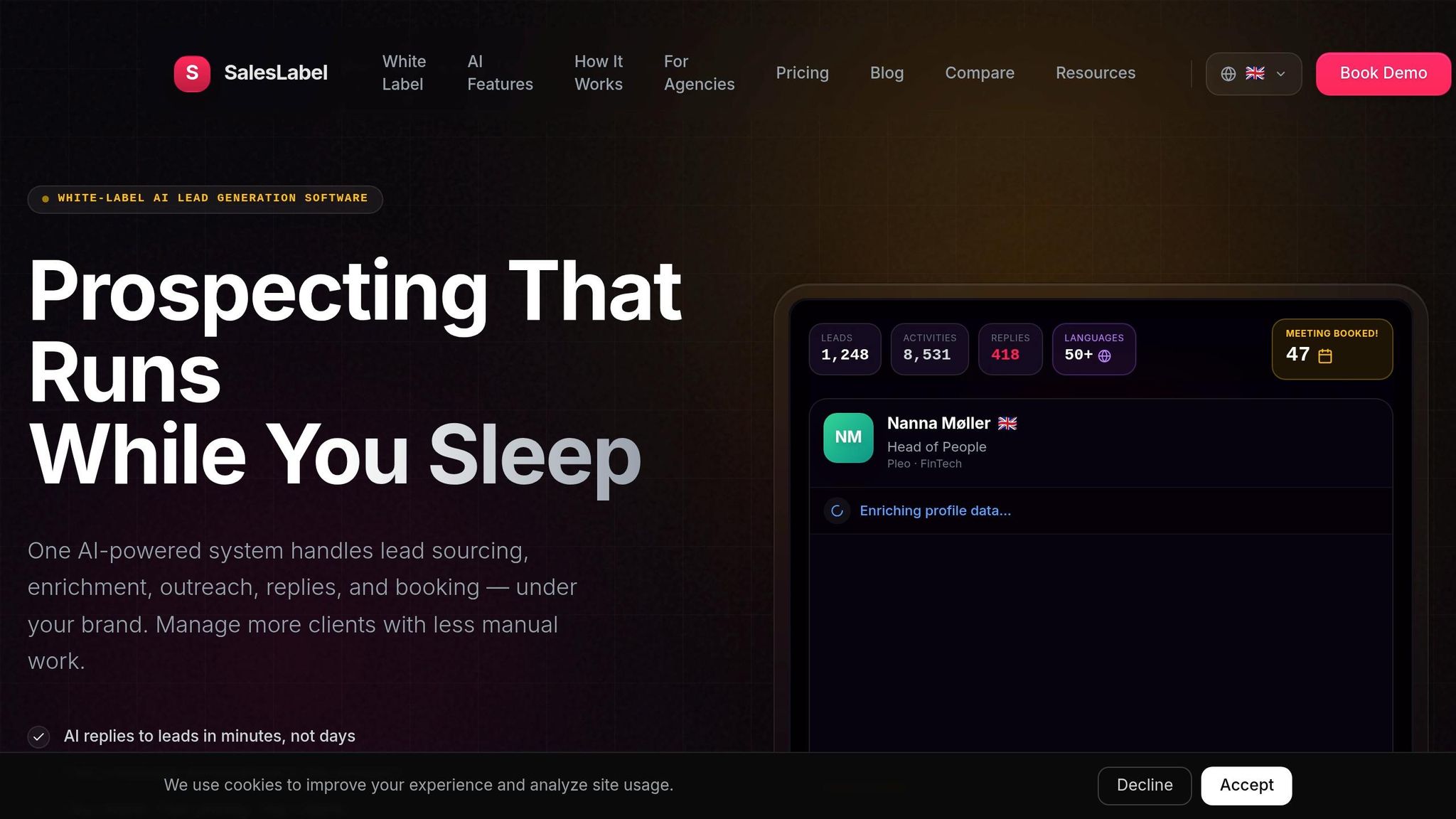
SalesLabel provides agencies with a comprehensive platform to implement predictive scoring without the hassle of starting from scratch. This AI-powered solution is designed to help agencies streamline their processes while operating under their own branding.
Real-Time Lead Scoring Features
SalesLabel's AI takes the guesswork out of lead prioritization by analyzing response intent and ranking leads based on their likelihood to convert. It calculates a Fit Score (up to 100) using four essential factors: ICP Match, Intent, Urgency, and Personality type (e.g., ENTJ – Commander) [24]. This scoring system helps teams focus on prospects that matter, cutting down on the 40% of sales time often wasted on unqualified leads [24].
The platform's AI continuously learns from your agency's historical data, improving prediction accuracy by 25–40% in just six months [2]. It also sends instant alerts when key behavioral thresholds are crossed, ensuring your team can act quickly [2].
"The AI handles dozens of conversations simultaneously. It detects intent, drafts personalized replies, and prioritizes hot leads automatically." - SalesLabel [24]
Users can opt for Autopilot, which sends fully automated AI responses, or Copilot, where AI-drafted messages can be reviewed and edited before sending [24]. Henry F., an Enterprise Account Executive at Salesforce, shared his experience:
"I was able to automate something that would have taken me days or weeks of consistent manual work. After 8 days, I'm already getting 4–5 responses per day" [23].
SalesLabel doesn’t just stop at scoring - it optimizes lead management across the board.
Automated Lead Management
SalesLabel simplifies the entire lead generation process. From sourcing and enriching data to running multi-channel outreach campaigns via LinkedIn and email, the platform covers it all. It even automates meeting scheduling [23]. A standout feature, Reply Detection & Classification, categorizes responses as "Interested", "Meeting", or "Question", eliminating the need for manual sorting [23].
This automation addresses a critical issue: agencies often lose up to 30% of warm leads if follow-up takes longer than six hours [24]. SalesLabel ensures timely engagement by drafting personalized replies in minutes, keeping conversations active. The platform boasts a 42% average reply rate and a 93% client retention rate as of Q2 2026 [34,35].
"SalesLabel has transformed our lead generation process. The platform's intuitive interface and smart automation features have significantly boosted our sales efficiency."
By reducing manual lead qualification time, agencies can scale their client base from 10–15 to over 100 without needing additional staff [23].
White-Label Customization for Agencies
SalesLabel also offers a white-label option, allowing agencies to launch a fully branded version of the platform on a custom domain. With personalized logos, colors, and branding, agencies can seamlessly integrate the platform into their services in as little as seven days [23].
This white-label solution is entirely invisible to end clients. Agencies can set their own pricing models - whether monthly retainers, per-lead fees, or performance-based structures - and retain 100% of the margins [25]. Industry benchmarks suggest a 3x to 5x markup on platform costs, with 60–70% gross margins being ideal for sustained profitability [25]. Pricing starts at $799 per month for up to 30 LinkedIn accounts and scales to $1,999 per month for unlimited accounts, which includes a dedicated success manager [24].
This approach not only strengthens your agency's brand but also enhances client trust by delivering a consistent experience. Most agencies can go from sign-up to onboarding live clients within seven days, offering tiered packages to maximize client lifetime value [34,36].
Conclusion and Next Steps
Predictive scoring isn't a "set it and forget it" tool - it thrives on consistent monthly updates informed by sales feedback [5][1]. This ongoing, data-focused approach is essential for boosting conversion rates and fine-tuning your sales process.
To get started, analyze 6–12 months of historical data to uncover patterns tied to conversions [2]. Use a straightforward 100-point scale to set intuitive thresholds, and adjust your sales-qualified lead threshold to match your team's capacity [5].
With a well-developed lead scoring system, you could see up to a 77% improvement in lead generation ROI. Achieving this requires monthly reviews, quarterly adjustments to thresholds, and retraining your model every 3–6 months to adapt to market changes [1][21][16]. Don’t forget to implement score decay to ensure your pipeline remains relevant [5][1]. These refinements align perfectly with the implementation steps already outlined.
Create feedback loops by having sales reps provide simple "thumbs up/down" ratings on leads, helping to refine the model further [21][2]. With the right inputs, AI can boost prediction accuracy by 25–40% within the first six months [2].
Before rolling out predictive scoring across your organization, pilot it for 30 days with one product line or team [21][2]. This trial period builds confidence, verifies accuracy, and allows you to address any integration challenges. By starting small and iterating based on performance data, you can stay ahead of the curve. The organizations excelling with predictive scoring are those that start with simplicity, measure results consistently, and adapt to what genuinely drives conversions.
FAQs
How much data do I need to start predictive scoring?
The data you need depends on how complex your model is and the type of insights you're aiming for. Predictive scoring tends to perform well when it’s built on diverse datasets, like historical interactions, demographic details, and behavioral patterns. While there isn’t a strict minimum requirement, it’s often smart to begin with a smaller, high-quality dataset and grow it over time. Prioritize diversity and quality in your data to achieve accurate predictions - volume alone won’t guarantee success.
How can I prevent bad data and bots from affecting my scores?
To keep your predictive scores accurate, start with thorough data cleaning. This means removing duplicates, fixing errors, and filtering out any irrelevant information. Incorporate real-time validation and monitoring to spot and block bot activity before it skews your results. It’s also a good idea to regularly update your data sources and use filters to identify and manage anomalies. Together, these steps ensure your scoring remains precise and dependable.
What score thresholds should trigger sales outreach vs. nurturing?
Leads scoring 75 or higher should be prioritized for immediate sales outreach. Meanwhile, those with scores ranging from 50 to 74 are often better candidates for nurturing campaigns. These thresholds aren’t set in stone - feel free to tweak them to align with your agency’s unique objectives and strategies.