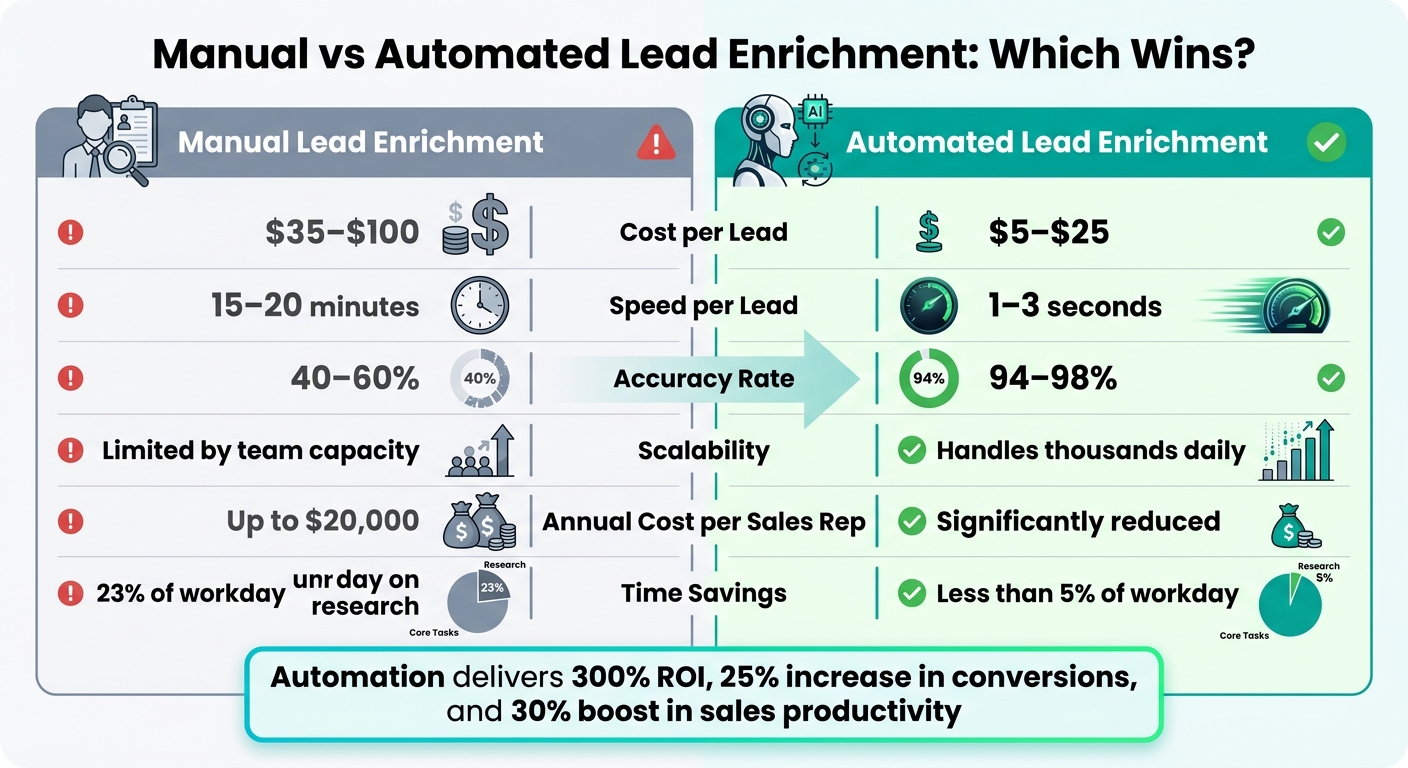
When it comes to lead enrichment, automation outperforms manual methods in speed, cost, and scalability. Manual enrichment relies on human effort to gather and verify data, taking 15–20 minutes per lead and costing up to $100 per lead. In contrast, automated tools complete the same task in seconds, achieve up to 98% accuracy, and reduce costs to as low as $5 per lead.
Manual methods excel in nuanced insights for high-value accounts but are slow, prone to errors, and expensive. Automation, while less effective at interpreting complex contexts, is faster, more accurate, and better suited for scaling operations.
AI Agents for CRM: How to Auto-Enrich Leads Instantly
sbb-itb-a781ab9
What is Manual Lead Enrichment?
Manual lead enrichment is the process where sales or marketing professionals dig deeper into customer data to create a more complete profile. Starting with basic details like a name and email address, they expand the record by adding verified phone numbers, job titles, company size, industry, revenue figures, and other relevant firmographic details. This effort helps sales teams assess a prospect's potential more effectively [5][2].
To do this, sales reps scour professional networks, company websites, and financial databases. They verify contact information, update outdated job titles, and fill in missing details like company size or the technology stack. On average, a sales representative spends 15 to 20 minutes per lead gathering this data [2]. Over time, this adds up - Sales Development Representatives (SDRs) collectively dedicate about 6 hours per week, or roughly 312 hours annually, to manual prospect research [10].
Manual enrichment isn’t just about collecting data; it also involves a critical human verification step. This ensures the information is accurate and complete, reducing errors that could harm a company’s reputation [5][9].
"B2B data enrichment takes your standard business records and adds crucial details about contacts and companies" [9].
This process is typically handled by SDRs or other sales professionals, requiring sharp research skills and the ability to interpret subtle cues that automated systems might miss [7][8]. However, manual enrichment comes with challenges. Sales teams spend around 21% of their time on data entry and management [5], and 60% of businesses identify manual data entry as a major obstacle in their lead generation efforts [6]. While manual enrichment ensures thorough human oversight, it is undeniably time-consuming - a stark contrast to automated solutions.
Next, we’ll dive into how automated lead enrichment simplifies these labor-intensive tasks.
What is Automated Lead Enrichment?
Automated lead enrichment uses AI to instantly enhance basic lead records, eliminating the need for manual research. Instead of relying on time-consuming processes, these systems provide detailed profiles in just seconds. For example, when a prospect submits a form with their name and email, enrichment APIs tap into multiple data sources to build a full profile. This includes details like job title, company size, revenue, industry, technology stack, and contact information - all delivered within 1 to 3 seconds [2].
Here’s how it works: When a lead enters your system - either through a form submission or a CRM upload - the API identifies the lead using key information, such as an email address or company domain. It then queries sources like business databases, LinkedIn, company websites, and public records. AI algorithms verify the data in real time, checking details like email validity and phone line status to ensure the contact is reachable. The system also compares the enriched data against your Ideal Customer Profile (ICP) to assign a priority score. Finally, all structured data is mapped directly into your CRM or marketing automation platform.
Today’s advanced AI systems do more than just pull data from databases. They analyze web content and track trigger events to provide deeper insights. For instance, they can distinguish between a SaaS company and a consulting firm by reviewing website content. They also monitor events like funding announcements or new leadership hires, which might indicate a prospect’s readiness to buy. This means your sales team gets not only contact details but also actionable insights into why a prospect could be a strong lead.
These AI-driven tools can deliver contact accuracy rates as high as 98%, compared to the 40–60% accuracy typically seen with static databases. Companies using these systems report a 25% boost in lead conversion rates and a 30% reduction in lead processing time [5].
"Enrichment isn't a luxury feature - it's foundational infrastructure that determines whether your pipeline moves at the speed of research or the speed of revenue." - Orbitforms.ai [2]
Since B2B data deteriorates at a rate of 22.5% to 30% annually [3][12], automated systems can re-enrich leads regularly, whether quarterly or monthly. This ensures that your sales team isn’t wasting time on outdated contacts or prospects who are no longer relevant. Platforms like SalesLabel integrate these automated insights, allowing businesses to scale operations while keeping their data accurate and actionable.
Manual Lead Enrichment: Pros and Cons
Pros of Manual Lead Enrichment
Manual lead enrichment relies on human judgment, which is often unmatched in its ability to understand context. For example, a sales rep manually verifying a lead's job title, company size, or industry can pick up on subtle distinctions - like recognizing the difference between a VP of Sales at a Fortune 500 company and one at a small startup. Automated tools can miss these nuances [5]. This approach also allows for detailed research, combining information from sources like LinkedIn profiles, company websites, and relevant news. The result? A comprehensive view of each prospect [2].
Another advantage is its flexibility. Manual enrichment allows teams to collect unique, non-standard data points, such as a prospect's role in a recent merger or insights into their company's technology stack. These details can lead to highly personalized outreach [5]. For instance, Salesforce reported a 25% boost in sales productivity after adopting manual data enrichment, while Marketo saw a 30% drop in data errors through manual validation [5].
When dealing with high-stakes accounts, manual verification ensures that the right message reaches the right person. This method also avoids the need for expensive software subscriptions, as it relies on team effort rather than costly tools [11].
However, this approach isn't without its challenges.
Cons of Manual Lead Enrichment
While manual enrichment offers valuable insights, it comes with significant drawbacks, particularly in terms of time and cost. The process is slow and labor-intensive. On average, sales professionals spend 5.7 hours per week researching prospects [13]. For a team of 10, this adds up to about 2,600 hours annually - equivalent to the workload of a full-time employee [13]. Enriching 500 leads manually can take roughly 167 hours of work [15].
This time commitment creates an opportunity cost. Every hour spent on research is an hour not spent building relationships or closing deals. Additionally, manual data entry can cost businesses up to $20,000 annually per sales rep. These inefficiencies often become a bottleneck for companies trying to scale their operations in fast-moving sales environments [6].
Scalability is another major issue. For example, a mid-sized SaaS company handling 6,000 leads per year could see costs soar to $350,000 when factoring in labor and delayed pipeline progress [15]. On top of that, manual methods are prone to human error - things like inconsistent formatting, duplicate records, and personalization mistakes. These issues can hurt brand credibility and cost businesses an estimated $12.9 million annually [5][13].
To make matters worse, B2B data decays at a rate of 22% to 30% per year [1]. Keeping records up to date manually becomes a constant and unsustainable effort.
Automated Lead Enrichment: Pros and Cons
Pros of Automated Lead Enrichment
Automated lead enrichment offers a dramatic boost in efficiency, cutting the time needed for enrichment from 15–20 minutes to just 30 seconds [3][4]. This shift allows sales reps to devote more energy to closing deals instead of spending 23% of their day on manual research [3][4]. By cross-checking data with primary sources, these tools achieve an impressive 98% accuracy, which improves lead quality scores by 54% and reduces time-to-first-contact by 43% [3].
Another major advantage is the ability to keep records up to date. Automation tracks trigger events like job changes or funding rounds, ensuring data stays relevant. For instance, one agency saw its Ideal Customer Profile (ICP) match rate jump from 35% to 92%, while cutting costs by 65% [3]. Additionally, 90% of businesses report fewer data entry errors thanks to automation, with organizations experiencing a 25% increase in sales conversions on average [6]. These systems can handle thousands of leads daily - an impossible feat for manual processes - and work nonstop, enriching leads as they come in.
While these benefits are compelling, automation isn’t without its hurdles.
Cons of Automated Lead Enrichment
Despite its strengths, automated enrichment has its limitations. One of the biggest challenges is the lack of human judgment in complex situations. For example, automated tools may struggle to interpret conflicting data or determine if a "VP of Sales" at a small startup holds the same level of influence as someone with the same title at a large corporation [3][16].
Integration and compliance can also complicate automation. Setting up integrations requires significant effort, and without connecting automation to workflows like lead scoring or routing, the enriched data might not be fully utilized. There’s also a dependency on API uptime and the data coverage of chosen providers, which can vary by industry or region [2].
Privacy regulations such as GDPR and CCPA add another layer of complexity. Automated systems must ensure data is processed lawfully and include mechanisms to handle deletion requests [2][3]. Even with 98% accuracy, it’s wise to manually review a random sample of about 20 leads each week to catch potential edge cases and ensure the AI aligns with your specific ICP [3][4]. While automation is powerful, mistakes - like contacting the wrong person with an irrelevant pitch - can damage your brand’s reputation.
Manual vs Automated Lead Enrichment: Side-by-Side Comparison
When it comes to lead enrichment, the differences between manual and automated approaches are striking - especially in terms of cost, speed, scalability, and accuracy.
Cost is a big differentiator. Manual enrichment typically costs $35 to $100 per lead, while automated methods are far more affordable at $5 to $25 per lead[7]. Add in labor, and manual enrichment costs about $0.45 per record, compared to just $0.08 per record for automation [14]. And the hidden expenses? Manual data entry alone can rack up $20,000 per year per sales rep[6]. These numbers make it clear: automation offers significant savings.
Speed is where automation pulls far ahead. Manual research averages 42 hours to process leads, while automation completes the same task in only 5 minutes[7]. Breaking it down further, manual enrichment takes 15–20 minutes per lead, whereas automation does it in just 1–3 seconds [2]. This time difference means a sales rep can only handle 20–50 leads manually in a day, while automated tools can process thousands in the same timeframe [7]. Faster lead processing not only boosts productivity but also opens the door to scaling operations effortlessly.
Speaking of scalability, manual processes hit a wall as lead volumes grow. Agencies often need to hire additional staff just to keep up [11][6]. In fact, 60% of businesses report that manual data entry creates significant bottlenecks in their lead generation workflows [6]. Automation sidesteps this issue entirely, processing leads in bulk without requiring extra manpower. Sales reps spend an average of 5.7 hours per week researching prospects [13], but automation frees up that time for more impactful activities like selling.
Accuracy is a mixed bag. Manual enrichment shines when interpreting complex or context-heavy information where human judgment is key. However, it’s prone to errors, especially as the workload scales [11][5]. Automated systems, on the other hand, deliver consistent results through multi-source verification, improving data quality by up to 90%[6]. That said, automation can struggle with nuanced decisions requiring deeper contextual understanding [11].
The benefits of automation extend beyond time and cost savings. It reduces customer acquisition costs by 20% and increases sales productivity by 25% to 30%[6][5]. Businesses that adopt automated enrichment report a 25% boost in sales conversions[6], with 90% experiencing fewer data entry errors[6]. Considering that poor data quality costs organizations an average of $12.9 million annually[13], automation’s ability to consistently process data in real time is a game-changer.
Next, discover how SalesLabel takes these efficiencies to the next level by automating lead enrichment for agencies.
How SalesLabel Automates Lead Enrichment for Agencies
SalesLabel tackles the challenges of manual lead enrichment with an AI-powered prospecting engine that searches through a database of over 250 million contacts to instantly find perfect matches for your Ideal Customer Profile (ICP) [19]. Instead of spending 15–20 minutes per lead gathering data, the platform handles research, enrichment, and verification in just seconds[18]. This speed is made possible by a proprietary algorithm that integrates data from multiple sources in real time, ensuring profiles are accurate and up to date. It even goes a step further by analyzing communication styles - like identifying an "ENTJ - Commander" persona - so outreach efforts can be more personalized and effective [19].
But SalesLabel isn’t just about collecting data. It assigns a "Fit Score" to each lead, factoring in ICP alignment, intent signals, and urgency. This helps agencies focus on high-priority leads while avoiding time spent on prospects who aren’t ready to commit [18]. The platform also scans recent posts and headlines to detect response intent, giving agencies valuable context without the need for manual research. All this information feeds into a scoring system that makes it easy to identify the hottest prospects.
"I was able to automate something that would have taken me days or weeks of consistent manual work. After 8 days, I'm already getting 4-5 responses per day."
– Henry F., Enterprise Account Executive, Salesforce[17]
SalesLabel also empowers agencies to elevate their services with a white-label infrastructure. Agencies can rebrand the entire system - complete with custom domains, logos, and client dashboards - and keep 100% of the profits[17]. The platform automates multi-channel outreach and personalized follow-ups, making it easier to manage client engagement at scale [17]. With this setup, agencies can launch a fully branded lead generation service in as little as 7 days[17], allowing for rapid growth without the need to hire additional staff [17].
The impact is clear. SalesLabel boasts a 93% client retention rate as of Q2 2026, a stark contrast to the 23% annual client loss seen with manual outreach [17]. Users like Svit Babarovic, COO at Mountaindrop, report a 90% reply rate thanks to the platform’s automation capabilities [17]. By eliminating slow, error-prone manual processes, SalesLabel lets agencies handle far more than the typical 10–15 active clients, all while maintaining the level of personalization that drives conversions [18]. This automation transforms lead enrichment into a scalable, high-quality process that helps agencies grow without limits.
Performance Metrics: Manual vs Automated Lead Enrichment
When comparing manual and automated lead enrichment, the differences in performance are striking. Manual enrichment takes an average of 15–20 minutes per lead, while automation completes the same task in just 30 seconds [3]. Over time, this difference adds up. Sales representatives typically spend about 23% of their workday - or roughly 9.2 hours each week - on manual research and data entry. Automation reduces this to less than 5% [3].
But speed isn’t the only factor where automation shines. Accuracy is another area where manual methods fall short. Data entered manually is only 40–67% accurate, and this is further impacted by the 22.5–30% annual decay rate of B2B data. In contrast, AI-driven enrichment achieves an impressive 94–98% accuracy rate [3].
The financial implications are just as compelling. For a company handling 6,000 leads annually, the combined labor and delay costs of manual enrichment can reach $350,000. Automating the process slashes that cost to approximately $51,000 [15]. Moreover, poor data quality alone costs organizations an average of $12.9 million every year [13].
Speed to contact is another critical metric. Leads contacted within 5 minutes are 21 times more likely to qualify than those reached after 30 minutes [12]. Automation reduces the time-to-first-contact by 43%, while also improving lead quality scores by 54% [3]. Businesses that adopt automation report productivity gains of 25–50% [12] and see sales conversions increase by an average of 25% [6]. These results emphasize the significant return on investment (ROI) that automation delivers, enabling businesses to scale with greater efficiency.
The takeaway is clear: relying on manual lead enrichment means higher costs, less reliable data, and slower response times - giving competitors an edge. Automation not only saves time and money but also enhances lead quality and conversion rates, making it a game-changer for teams looking to scale effectively.
When to Use Manual, Automated, or Hybrid Lead Enrichment
Deciding between manual, automated, or hybrid lead enrichment depends on factors like lead volume, budget, and the need for speed. For small lead volumes, manual enrichment works well - especially in specialized markets. But as lead numbers grow, manual methods can slow things down significantly. In fact, 60% of businesses report that manual data entry hinders their lead generation efforts [6]. Let’s break down how budget, speed, and hybrid strategies influence your choice.
Budget considerations play a big role. At first glance, manual enrichment might seem affordable since it's primarily labor-based. However, when you factor in the time spent, it can cost as much as $20,000 annually per sales rep [6]. On the flip side, automated tools come with upfront software costs - ranging from $30/month for basic platforms to $800/month for enterprise-level solutions - but they can save up to 70% of the time usually spent on data entry [6]. For growing agencies, this time savings can mean handling more clients and generating more revenue.
Speed is equally vital. If your sales success hinges on reaching leads quickly while they’re still engaged, automation is a must. Manual research simply can’t match the speed of automated systems, and being slow to respond could mean losing out to faster competitors.
A hybrid approach works best for account-based marketing campaigns or when targeting high-value enterprise accounts. Automation can handle broad data points like company size, industry, and revenue, while your team focuses on gathering in-depth insights for top-tier prospects. This method balances costs by reserving manual efforts for the most promising leads [2]. Sales teams, who often spend 23% of their day on data tasks, can cut this down to under 30 minutes per week with a hybrid model, all while maintaining quality where it matters most [4].
Finally, don’t overlook data decay. With B2B data deteriorating at a rate of 22–30% annually [1], automated systems are essential for keeping your CRM updated. These tools can refresh data regularly, unlike manual enrichment, which struggles to keep up with quarterly updates.
Why Automated Lead Enrichment is Better for Scaling Agencies
For agencies focused on growth, automation isn’t just helpful - it’s essential. Think about it: manually enriching leads takes around 15–20 minutes per lead. That might work for a small operation, but it quickly becomes a bottleneck when you’re handling hundreds or thousands of leads. Automation, on the other hand, can process thousands in just seconds [2].
The costs of manual data entry add up fast. A single rep can rack up expenses of up to $20,000 annually [6]. Automation slashes that cost dramatically, cutting the price per record from $0.45 to just $0.08 - a savings of roughly 82%. Plus, it improves accuracy from 40–60% to an impressive 98% [3][14]. The result? An average ROI of 300% and a 30% bump in sales productivity [5][6].
Speed is another game-changer. Leads contacted within five minutes are 21 times more likely to qualify [12]. With automation, you can route and score leads almost instantly, increasing conversions by about 25% and cutting processing time by 30% [5]. Compare that to the delays of manual processes, and the difference is night and day.
Manual methods also have a hard limit: your team’s capacity. Automation, however, can handle thousands of leads at once and even refresh data continuously to combat the 22.5–30% annual decay rate [3]. These capabilities make automation a cornerstone of scalable growth for agencies.
"Enrichment doesn't just save time, it fundamentally accelerates how quickly prospects move through your funnel."
– Orbit AI
For agencies leveraging SalesLabel’s white-label solution, automation delivers top-tier data quality under your branding. This means your team can focus on strategy and closing deals instead of getting bogged down in research. By combining speed, accuracy, and scalability, automation doesn’t just remove manual roadblocks - it sets the stage for sustainable, long-term growth.
FAQs
How do I choose manual, automated, or hybrid enrichment?
Choosing the right method for lead enrichment - manual, automated, or hybrid - comes down to what matters most to your business: speed, accuracy, cost, or scalability.
Manual enrichment gives you more control and allows for tailored, high-quality results. However, it’s a time-consuming process and doesn’t scale well for larger data sets.
Automated enrichment, often using AI tools, works much faster and handles large volumes efficiently, making it perfect for businesses dealing with high lead flow.
Hybrid approaches strike a balance by automating bulk tasks while reserving manual review for more nuanced or complex leads. This ensures both efficiency and attention to detail where it counts.
Each option has its strengths, so the best choice depends on your specific goals and resources.
What data fields should I enrich first in my CRM?
To make your CRM more effective, focus on filling in fields that provide practical insights for sales and marketing teams. Start with contact details like verified email addresses and phone numbers - these are essential for direct communication. Include firmographic data, such as company size, industry, revenue, and location, to better understand prospects and tailor your approach. Add job titles to enable personalized outreach that resonates with decision-makers. Including company websites and social media profiles can also offer extra context, helping create accurate profiles that boost lead qualification and simplify targeted outreach efforts.
How often should I re-enrich leads to prevent data decay?
To keep your data accurate and up-to-date, it's essential to re-enrich leads continuously through automated, real-time processes. This approach combats the natural decay of data, which can reach rates of 22.5% to 30% annually. By regularly updating your lead information, you ensure it stays reliable and useful for driving effective sales and marketing campaigns.