AI revenue forecasting is transforming how lead-gen agencies predict income by improving accuracy, saving time, and reducing guesswork. Traditional methods often rely on outdated data and human bias, leading to inaccuracies - 79% of B2B companies miss revenue forecasts by over 10%. AI solves these problems by analyzing real-time behavioral signals, automating updates, and identifying at-risk deals earlier.
Key takeaways:
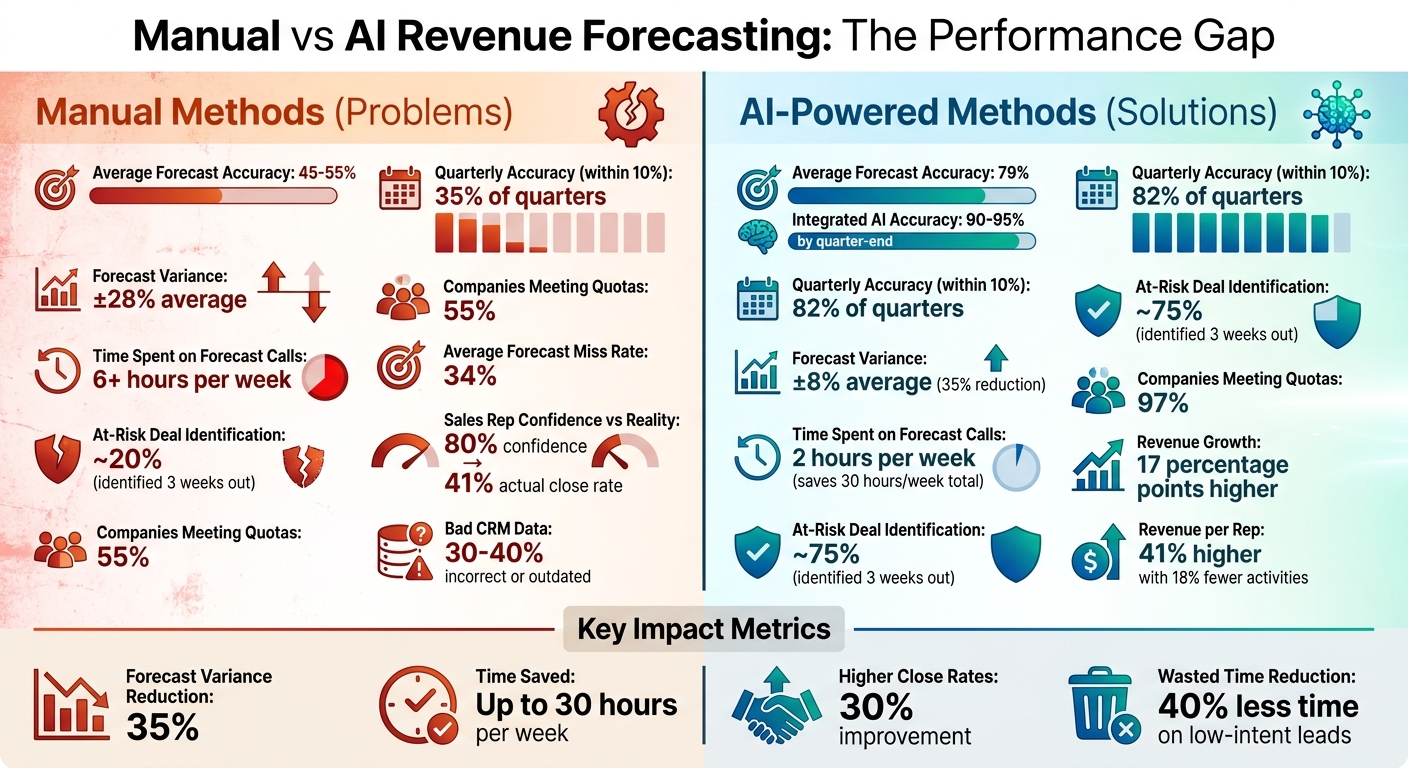
AI-driven forecasting achieves 79% accuracy on average, compared to 45%-55% with manual methods.
Integrated AI systems can reach 90%-95% accuracy by quarter-end.
AI reduces forecast variance by 35% and saves agencies up to 30 hours per week.
Tools like SalesLabel provide real-time lead scoring, pipeline analysis, and multi-account dashboards to streamline forecasting.
Next-Gen Sales Forecasting: AI-Powered Pipeline Management | The Data Apps Conference
sbb-itb-a781ab9
Manual vs AI Revenue Forecasting Methods
Manual vs AI Revenue Forecasting: Accuracy and Efficiency Comparison
Problems with Manual Forecasting
Manual forecasting often forces agencies into costly guesswork, with the average forecast miss rate sitting at 34%. For a $50 million company, a 10% miss translates to a staggering $1.2 million loss [5]. That’s a lot of money slipping through the cracks.
Simone Adeyemi, RevOps Expert at Prospectory, sums up the issue perfectly:
"Traditional forecasting is fundamentally broken, not because people are bad at it, but because we're asking humans to do something humans aren't wired to do: accurately predict complex outcomes with incomplete information" [5].
Why is manual forecasting so unreliable? For starters, sales reps tend to overestimate their chances of closing deals, often assigning an 80% confidence level to deals that ultimately close at only 41% [5]. Plus, as deals progress and evolve, manual forecasts quickly become outdated [5]. To make matters worse, 30% to 40% of CRM data is either incorrect or outdated, especially when it comes to deal stages and close dates. This leaves agencies building forecasts on shaky foundations [5].
There’s also a human element at play. Sales reps might deliberately underestimate numbers to manage expectations, while managers might inflate them to avoid scrutiny. Rachel Krall, former VP of Revenue Operations at LinkedIn, explains:
"Sales forecasts are never perfect because they rely on human-entered data shaped by personality types and optimism levels" [2].
What AI Brings to Forecasting
AI-powered forecasting tackles these challenges head-on. Instead of relying solely on what sales reps say, AI analyzes objective behavioral signals like email response times, meeting frequency, and stakeholder engagement [2][3]. It updates forecasts in real time via API connections, flagging changes immediately - like when a key contact goes silent - rather than waiting for the next forecast meeting.
The numbers speak for themselves. AI-driven forecasting achieves an average accuracy of 79%, compared to the 45% to 55% range for traditional methods [2]. Companies that combine AI with integrated planning systems can hit 90% to 95% accuracy by the end of the quarter [2]. Even more compelling, 97% of companies using AI-based forecasting processes meet their quotas, compared to just 55% of those relying on manual methods [2].
Metric
Manual Methods
AI-Powered Methods
Quarterly Forecast Accuracy
35% of quarters (within 10%)
82% of quarters (within 10%)
Forecast Variance
±28% average
±8% average
Time Spent on Forecast Calls
6+ hours per week
2 hours per week
At-Risk Deal Identification
~20% (identified 3 weeks out)
~75% (identified 3 weeks out)
AI also eliminates the noise that clouds human judgment. For example, it can detect patterns across thousands of deals that would be impossible to track manually. It might flag that deals in a specific stage with no buyer response for three weeks close at just 12%, even if a rep has rated them at 60% probability [3]. This shift turns guesswork into actionable intelligence, allowing agencies to spot at-risk deals weeks earlier and take corrective steps.
How AI Fixes Revenue Forecasting Problems for Lead-Gen Agencies
AI Lead Scoring for Conversion Prediction
AI lead scoring transforms traditional methods by using predictive models that adapt and learn from historical data. Instead of focusing on surface-level actions like email clicks, AI evaluates deeper signals, such as new funding announcements, executive hires, or regulatory changes at the account level [7]. This approach helps agencies achieve 30% higher close rates by directing efforts toward deals with the greatest potential [8].
"AI lead scoring isn't a futuristic concept; it's an essential tool for any modern revenue team. It removes the burden of manual research and equips sellers to engage accounts with precision" [7].
This technology gathers data from diverse sources - like call transcripts, email sentiment, Slack conversations, and third-party intent platforms such as G2 or LinkedIn [3][9]. By eliminating biases that can inflate deal probabilities, AI reduces forecast variance by 35% and cuts wasted time chasing low-intent leads by up to 40%[8].
Sales Pipeline Trend Analysis
Building on lead scoring, AI enhances pipeline analysis by focusing on buyer behavior instead of sales rep assumptions. It tracks real actions - like email response times, meeting attendance, and stakeholder involvement - uncovering patterns that indicate deal outcomes [10][3]. By analyzing thousands of historical deals, AI identifies combinations of signals that reliably predict whether a deal will close.
"Where traditional forecasting aggregates what reps believe, AI forecasting aggregates what buyers have done" [10].
AI also flags "drifting" deals - those showing signs of trouble, such as reduced engagement or missing key decision-makers - long before they become end-of-quarter surprises [10][9]. It even generates confidence ranges, such as predicting a 70% chance of landing between $4.8M and $5.3M[9][3].
The results speak for themselves. While only 7% of sales teams using traditional methods achieve 90%+ forecast accuracy, AI-powered teams are 1.3 times more likely to experience revenue growth [10][3]. For instance, Lenovo's use of an AI platform during its Digital Workplace Solutions launch in 2025 supported over $400 million in contract value and improved response times by over 90% in the first quarter [11].
Using Past Data to Predict Future Revenue
AI excels at comparing current deals to past outcomes, identifying risks that might go unnoticed by human managers. By analyzing patterns in closed-won and closed-lost deals, AI establishes benchmarks for what successful deals look like. Outreach customers, for example, achieved 81% forecast accuracy by weighting factors like cycle length and multithreaded engagement [4].
As Sandeep Gaur explains:
"The model might discover that deals in a certain industry close 40 percent faster when the first call happens within 24 hours of lead creation... These patterns get built into the forecast engine" [6].
To maximize accuracy, agencies must ensure clean data. This includes auditing for duplicates and integrating tools like sales dialers and email platforms directly into the CRM, so every interaction is captured [6]. With this foundation, AI can continuously refine its forecasts in real time.
Real-Time Lead Prioritization
AI takes lead prioritization to the next level by continuously recalculating priorities throughout the day. Instead of relying on static, weekly updates, it uses live data to adjust rankings based on factors like lead source, industry, and sales cycle length. For instance, if a key contact goes silent or a competitor is mentioned, the system immediately updates its recommendations [4][6].
This real-time adaptability is especially valuable for agencies managing high lead volumes. By 2026, more than 60% of B2B sales teams are expected to use machine learning–based intent scoring as a core part of their qualification process [10]. The benefits are clear: In 2025, AI-powered sales teams saw 17 percentage points more growth, with reps generating 41% higher revenue per person while performing 18% fewer activities[11].
SalesLabel's AI tools tackle common forecasting challenges by shifting from subjective guesses to precise, data-backed projections. The platform offers three key tools that agencies can use to build reliable forecasts.
First, the real-time lead scoring system assigns each prospect a Fit Score (ranging from 0 to 100). This score is based on factors like how well the lead matches the Ideal Customer Profile (ICP), intent signals, urgency indicators, and even personality traits like ENTJ (Commander) [12]. This replaces gut feelings with objective metrics that refresh instantly as sales conversations evolve.
Next is the Priority Inbox, which identifies high-intent leads by analyzing reply sentiment and categorizing responses. This tool ensures that the most promising deals are front and center. Mike R., a sales professional who uses the platform, shared:
"The AI sometimes answers better than I would. It analyzes the website and profile of the person." [12]
Lastly, the multi-account pipeline view is a game-changer for agencies managing multiple clients. It consolidates prospecting data from up to 99 LinkedIn accounts - or even unlimited accounts, depending on the plan - into a single branded dashboard. This feature allows agencies to project revenue with greater precision [12][13]. Agencies using SalesLabel report an average 42% reply rate[12], creating a strong foundation for accurate forecasting.
These tools are designed to help agencies select the best SalesLabel plan for their forecasting needs.
Choosing the Right SalesLabel Plan
Selecting the right SalesLabel plan depends on how extensive your forecasting requirements are.
The Starter plan ($799/month) supports up to 30 LinkedIn accounts and includes the full suite of AI prospecting features, such as real-time scoring and automated replies [12]. This plan is ideal for boutique agencies experimenting with AI-driven forecasting on a smaller scale.
The Growth plan ($1,279/month) is the most popular choice, extending account coverage to 99.
For agencies with larger operations, the Scale plan ($1,999/month) removes account limits entirely and adds a dedicated success manager [12].
Higher-tier plans also include strategy sessions to fine-tune AI scoring and improve forecasting accuracy, helping agencies see measurable returns by reducing forecast errors [12].
Improving Forecast Accuracy with Strategy Sessions
In addition to its core features, SalesLabel offers strategy sessions that further refine forecasting accuracy. Depending on the plan, these sessions occur monthly (Growth) or bi-weekly (Scale) and are led by experts who help calibrate your forecasting model [12].
Svit Babarovic, COO at Mountaindrop, highlighted the platform's impact, saying:
These sessions also help agencies align reply dispositions with CRM stages, ensuring the AI updates forecasts in real time as conversations progress [6]. With a 93% client retention rate reported in Q2 2026 [13], SalesLabel's forecasting tools clearly provide lasting value.
Measuring AI Forecasting Performance
Key Metrics for AI Forecasting
Understanding how well AI performs in forecasting comes down to specific metrics. One of the most critical is Mean Absolute Percentage Error (MAPE). This measures how far predictions deviate from actual outcomes. AI models with strong performance typically achieve a MAPE under 10% [15], whereas manual forecasting methods usually hover around 15.2% [14]. By quantifying deviations, MAPE directly addresses issues like fragmented data and human bias.
Another crucial metric is Forecast Bias, which shows whether predictions lean toward overestimating (positive bias) or underestimating (negative bias) revenue. Ideally, AI systems should maintain bias within ±5% [15]. Then there’s Win Rate by Lead Score Band, which evaluates whether high-scoring leads (as determined by AI) convert at better rates than lower-scored ones [6][16].
Metrics like Sales Cycle Length reveal whether AI helps shorten the time it takes to move deals from initial contact to closure [6][15]. Similarly, the Pipeline Coverage Ratio - calculated by dividing total pipeline value by the sales target - offers insights into pipeline health. While the general rule of thumb is a 3x coverage ratio, AI refines this by incorporating actual win probabilities instead of relying solely on deal volume [16][15]. Lastly, keep an eye on the Slipped Deals Percentage, which tracks how often opportunities are delayed beyond the current forecast period. AI tools can flag early signs of stalled deals, helping teams take action sooner [16].
By defining these metrics, you can better evaluate how AI compares to traditional forecasting methods and measure its impact.
Comparing Results Before and After AI
To truly understand the impact of AI on forecasting, compare results from AI-driven methods with those from traditional approaches. This side-by-side analysis highlights how AI addresses delays and inaccuracies that often plague manual forecasting.
For the best insights, run both AI-powered and manual forecasts in parallel for at least three months [14]. This allows you to directly measure improvements. Michael Torres, VP of Sales, shared his experience:
"We switched from spreadsheet forecasting to an AI-powered tool and saw forecast accuracy jump from 68% to 91% within 3 months. The AI caught deals we thought were safe but were actually stalling." [15]
Start by establishing baseline metrics like MAPE and bias before implementing AI, then monitor these monthly to track progress. AI-driven systems often outperform manual methods, which typically achieve just 45–55% accuracy [2]. Breaking down results by factors like lead source, region, or sales rep can also help pinpoint where AI delivers the greatest benefits [6]. Another major advantage? AI can cut time spent on manual data entry and research by as much as 80% [17], allowing sales teams to focus more on closing deals rather than administrative tasks.
Conclusion: Growing Your Agency with AI Forecasting
AI-powered revenue forecasting helps lead-gen agencies break free from the unpredictable "feast-or-famine" cycle. Instead of scrambling to address revenue gaps, agencies can craft growth strategies grounded in reliable data. By analyzing recurring income from retainers and accurately predicting project-based revenue, AI establishes a dependable financial baseline.
This reliability also opens the door to scaling operations. With AI managing tasks like prospecting and lead qualification, agencies can serve up to 10 times more clients without significantly increasing payroll. Platforms like SalesLabel's white-label solution automate lead sourcing, enrichment, and outreach - all under your branding. In just seven days, agencies can launch a fully branded AI-driven lead generation service, creating steady revenue streams while maintaining strong profit margins [13].
AI doesn't just save time - it transforms how teams work. By automating over 30 hours of manual forecasting each week [1], managers can shift their focus to strategic activities like deal coaching. AI even tracks behavioral signals, such as email response times and stakeholder engagement, to identify at-risk deals weeks earlier than traditional methods [1].
The financial benefits are clear. Companies using AI in their sales processes report a 3–15% increase in revenue and a 10–20% boost in sales ROI [18]. Top-performing sales teams are nearly five times more likely to use AI and advanced forecasting tools compared to their peers [18]. These tools are reshaping how agencies grow and scale.
To make the most of AI forecasting, ensure your CRM data remains clean and actionable. Weekly pipeline reviews and a three-scenario approach (Best Case, Expected Case, Worst Case) can guide safer hiring and investment choices. With SalesLabel's Scale plan priced at $1,999/month, agencies can build a predictable, data-driven growth engine that sets them up for long-term success.
FAQs
What data do I need in my CRM for AI forecasting to work well?
To make the most of AI forecasting in your CRM, your data needs to be clean, accurate, and complete. The key data points to focus on include:
Deal stage: Tracks where each opportunity stands in the sales process.
Win probability: Estimates the likelihood of closing a deal.
Deal size: Provides the potential revenue tied to each opportunity.
Time in each stage: Measures how long deals stay in specific stages.
Activity logs: Captures interactions like calls, emails, and meetings.
Maintaining consistent data hygiene is critical. Incomplete or outdated information can throw off AI predictions, reducing their reliability. To avoid this, ensure that all pipeline details and sales activities are fully integrated and regularly updated. This approach keeps your forecasts accurate and actionable.
How quickly can AI forecasting improve accuracy for my agency?
AI tools can boost your agency's revenue prediction accuracy by as much as 20% in just a few months. These systems rely on real-time data and machine learning, allowing them to adapt swiftly and produce reliable forecasts in a matter of weeks. By analyzing deal signals and identifying potential risks early on, AI empowers agencies to adjust strategies proactively, allocate resources wisely, and approach sales targets with increased confidence.
How do I measure if AI forecasting is actually working?
To gauge how well AI performs in forecasting, compare its predicted revenue or deal outcomes to the actual results over time. The process focuses on key metrics like forecast accuracy rates, early detection of risks, and spotting potential deal stalls.
AI models typically deliver accuracy rates between 85% and 96%, which often surpass the performance of traditional forecasting methods. By regularly reviewing these metrics, you can ensure the forecasts remain reliable and provide actionable insights that support your agency’s revenue planning efforts.