AI objection handling can transform how agencies manage sales conversations by addressing common client concerns like price, timing, and trust. Unlike manual methods, which are slow and inconsistent, AI delivers faster responses, higher success rates, and scalable solutions. Here's why it matters:
Manual Handling Challenges:
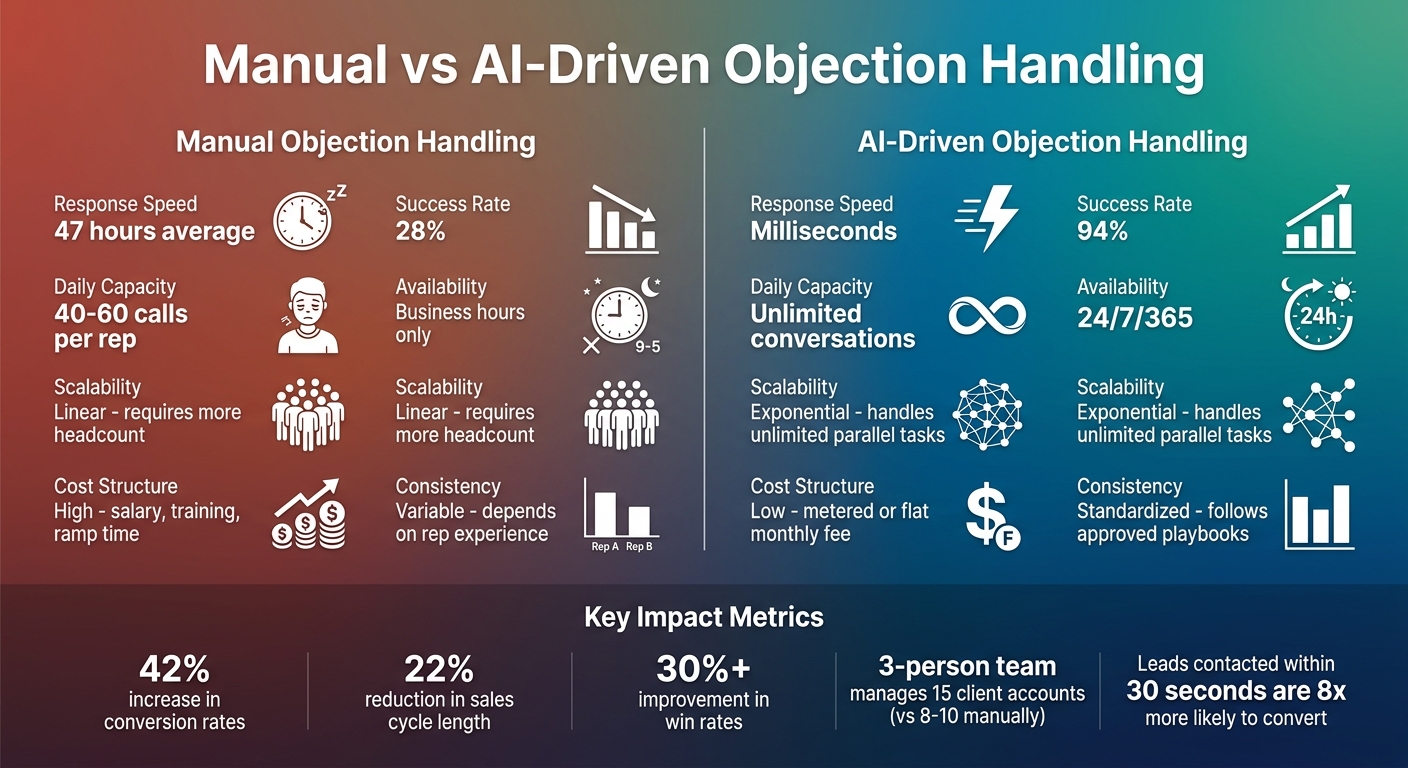
Average response time: 47 hours.
Success rate: Only 28%.
Limited scalability and high costs due to reliance on human reps.
AI-Driven Benefits:
Instant responses (milliseconds for live calls).
94% success rate in addressing objections.
Handles unlimited conversations 24/7 without adding staff.
Boosts conversion rates by 42% and shortens sales cycles by 22%.
Platforms like SalesLabel streamline objection handling by automating responses, updating strategies in real time, and equipping teams with consistent, data-driven tools. This allows agencies to scale operations efficiently while reducing costs and improving client interactions.
Manual vs AI-Driven Objection Handling: Performance Comparison
1. Manual Objection Handling
Response Speed
Manual processes often slow down response times significantly. The average first response time in the industry is 47 hours[8] - nearly two full business days. This is a major issue when leads contacted within just 30 seconds are 8 times more likely to convert[8]. Even during live calls, human reps typically experience a 3–8 second pause before addressing objections [2]. These pauses disrupt the flow of conversation and can make reps appear uncertain [2].
The delays stem from the need to manually search for information, which is far from ideal. As Christopher Good from EverWorker explains:
Objection handling breaks at scale because knowledge is fragmented, responses aren't consistent, and reps can't access the right proof in the moment across every channel [11].
When buyers are already leaning toward self-service, a delayed or generic response can do more than just lose a deal - it can completely shut down the conversation [4]. This problem becomes even more pronounced as agencies attempt to scale.
Scalability
Manual objection handling hits a wall when agencies try to grow. Most reps can handle only 40–60 calls per day before their performance and energy levels start to drop [2]. Scaling up requires hiring additional SDRs, support reps, and analysts at the same rate as call volume increases [11][12]. This creates a linear cost structure that makes growth both expensive and inefficient.
This limitation often results in agencies losing 30–50% of qualified leads at the first sign of resistance [3]. Nathan Thompson from Copy.ai highlights the issue:
Objection handling is often treated as an art, a skill unique to top performers. This approach breeds inconsistency, stalls deals, and leaves valuable customer insights on the table. It simply does not scale [6].
These challenges underscore the urgency for a more scalable, AI-powered solution.
Cost Efficiency
Manual objection handling also comes with high costs - not just in terms of staffing but also in time and missed opportunities. Each objection can require 10–16 labor hours to address across multiple steps [13]. Often, the most effective responses remain locked in a single rep's memory or buried in a call recording [9]. This means agencies waste time reinventing the wheel instead of leveraging proven strategies.
Inconsistency adds another layer of cost. Human performance is influenced by mood, fatigue, and experience. For example, a rep’s 50th call of the day might lack the energy and precision of their first call [2]. With cold email reply rates already declining - down from 6.8% in 2023 to 5.8% in 2024[4] - every mishandled objection becomes even more costly.
Accuracy and Consistency
Manual objection handling succeeds only 28% of the time[2], meaning reps fail to address objections correctly in the majority of cases. Agencies often rely on outdated "tribal knowledge" or static battlecards that haven’t been updated in over six months [10]. Critical information is scattered across CRM notes, support tickets, and chat threads [10][11], making it nearly impossible for reps to find the right proof point when they need it.
Emotional reactions can further derail conversations [1][2]. Traditional coaching methods focus on analyzing mistakes after deals are lost, rather than providing real-time solutions to salvage opportunities [11]. These gaps highlight the potential for AI to deliver more reliable and consistent objection handling.
AI systems drastically cut down response times compared to traditional methods. While manual processes average a 47-hour response time[8], AI can draft, edit, and send personalized emails in under a minute. For live calls, responses are delivered in milliseconds[4][16]. These tools provide real-time prompts and battle cards to help sales reps handle objections on the spot, ensuring smooth and immediate interactions. Common concerns - like pricing or timing - are automatically categorized and addressed, with the system working 24/7 to prevent losing leads due to after-hours delays[14][16]. Plus, AI handles unlimited simultaneous conversations, avoiding bottlenecks during high-demand periods[16]. This speed ensures businesses can maintain seamless, round-the-clock operations.
Scalability
AI's ability to manage multiple interactions at the same time transforms the way sales teams handle objections. Unlike traditional methods limited by team size, AI processes unlimited parallel interactions[16]. For instance, a three-person team can now manage 15 client accounts, compared to the 8–10 accounts typically handled manually[8]. These systems also create self-updating feedback loops - new objections discovered during sales calls automatically update marketing materials, ad copy, and SDR prompts without requiring manual input[8]. AI audits call data to identify top-performing strategies and converts them into structured battle cards for company-wide use[9]. With 95% of companies using AI in sales and 84% of sales professionals reporting improved customer interactions, AI is proving essential for scaling operations[4]. As cold email reply rates decline yearly (dropping from 6.8% in 2023 to 5.8% in 2024), AI-personalized campaigns have shown reply rates as high as 25%, compared to the typical 8%[4]. Platforms like SalesLabel empower agencies to scale effortlessly by automating lead sourcing, enrichment, outreach, follow-ups, and real-time lead scoring across unlimited LinkedIn accounts under their Scale plan.
Cost Efficiency
AI centralizes critical sales insights into accessible battle cards, enabling all team members to benefit from the same high-quality resources. The "AI drafts, humans decide" model allows AI to handle research and drafting, while humans refine the output to align with brand voice and risk management requirements. This approach reduces performance inconsistencies caused by factors like fatigue or mood. For example, AI-powered systems have reduced RFP response times by 60%[15], and companies using AI for objection handling report a 42% increase in conversion rates when addressing price or timing concerns[5].
"AI shouldn't replace judgment - its job is to make your best judgment easier to apply in every reply, on every call, every time." - SalesHive[4]
Accuracy and Consistency
AI delivers a level of precision and uniformity that manual methods struggle to achieve. Advanced systems can identify unstated objections with 87% accuracy[5]. For example, AI recognizes that phrases like "budget is tight" and "cost is prohibitive" often reflect the same underlying concern, then provides tailored, data-backed responses based on the prospect's industry and position in the sales funnel[5][3]. By linking objections to relevant value propositions, social proof, and logical arguments, AI goes beyond basic scripts to create a dynamic, data-driven framework[5]. It also analyzes conversation history in real time, generating personalized responses in milliseconds[5][1]. Businesses using AI for objection handling report a 22% reduction in sales cycle length and over a 30% improvement in win rates[5][4]. With weekly updates to competitive intelligence to reflect market trends[9], and considering that 68% of qualified leads cite unresolved objections as the main reason for non-conversion[5], the consistency provided by AI is crucial for improving conversion rates.
The Ultimate AI Agency Sales Training for 2026 (FULL MASTERCLASS)
Pros and Cons
When comparing manual methods to AI-driven approaches, each has distinct strengths and weaknesses that impact their effectiveness in objection handling.
Manual methods bring a personal touch, relying on human empathy and the ability to interpret subtle emotional cues during complex negotiations. However, they tend to lack consistency, with representatives successfully handling objections in less than one-third of cases [2]. These methods often depend on outdated and fragmented information [11][9], and scaling up requires hiring more staff, which increases costs [12].
AI-driven solutions, on the other hand, excel in standardization and efficiency. With an impressive 94% success rate[2], AI ensures that best practices are applied consistently across all interactions. It can handle an unlimited number of conversations at once [16], drastically reducing workflow time from 10–16 hours to just 30–60 minutes [13]. AI tools also provide instant access to case studies, ROI data, and compliant scripts during live calls [11][10]. Companies using AI for objection handling report 42% higher conversion rates for price and timing concerns [5], and early adopters have seen win rates increase by over 30%[4]. These benefits make AI-driven tools an attractive option for agencies aiming for faster, more consistent, and cost-effective objection handling.
That said, AI isn't without its challenges. Without proper training tailored to specific agency needs, it can produce responses that feel overly mechanical or reveal sensitive pricing or legal details by mistake [4]. As one expert points out:
The problem is not that reps lack intelligence. It is that humans are inconsistent under pressure. AI does not have that problem. [2]
The ideal solution may lie in a human-in-the-loop model, where AI drafts responses instantly, but humans refine them to ensure the tone fits the situation and minimize risks [4][10].
The table below highlights the key differences between manual and AI-driven objection handling, with platforms like SalesLabel showcasing how AI can scale operations through automated replies and real-time lead scoring across LinkedIn accounts under their Scale plan:
For agencies aiming to grow without inflating payroll costs, AI-powered objection handling delivers several standout benefits: consistent performance, limitless capacity, and 24/7 availability. While traditional methods typically handle 40–60 calls daily with a 28% success rate, AI achieves an impressive 94% success rate across unlimited simultaneous conversations [2]. Agencies leveraging AI see a 42% boost in conversion rates when addressing price and timing concerns and shorten their average sales cycle by 22% [5].
SalesLabel turns these benefits into tangible results. By offering white-label AI prospecting under their branding, agencies can manage over 15 client accounts with just a three-person team - work that would ordinarily require 8–10 full-time sales development representatives (SDRs) [8]. As Svit Babarovic, Chief Operating Officer at Mountaindrop, highlights:
Speed is another critical factor in conversions. Leads contacted within 30 seconds are eight times more likely to convert compared to those reached after a 47-hour delay [8]. AI bridges this gap instantly, ensuring prospects are engaged at the perfect moment.
With 68% of qualified leads citing unresolved objections as the main reason deals fall through [5], agencies can't afford to rely on inconsistent manual follow-ups. SalesLabel's AI-driven responses and real-time lead scoring address every objection effectively, transforming a common roadblock into a scalable opportunity.
FAQs
What objections should agencies automate first?
Agencies can benefit greatly by automating responses to frequent objections that often slow down the sales process. Common examples include objections like: "Your price is too high,""We're already using a competitor," and "We're not ready to implement."
AI tools excel at addressing these concerns with consistent, value-driven replies. This not only speeds up response times but also enhances engagement with prospects. By integrating AI into this part of the process, agencies can handle larger volumes of inquiries while keeping workflows efficient.
How do you ensure AI replies stay on-brand and compliant?
To ensure AI-generated replies stay aligned with your brand, they should reflect your brand voice, follow established messaging standards, and feel personalized and relevant to the audience. Incorporate verified information from your knowledge base to support responses, while staying consistent with your brand's tone and guidelines.
What data does AI need to handle objections well?
AI thrives on understanding the specifics of objections - whether they relate to price, timing, trust, or technical issues - to craft responses that resonate. By analyzing historical conversation data, it can spot patterns and fine-tune its replies. When objections are categorized and paired with insights into what prospects are worried about, AI can deliver responses that feel personalized and on-point. This equips agencies to address concerns more convincingly and refine their approach as they gather more data over time.