AI in Multi-Channel Outreach: What Agencies Need to Know
If I had to sum it up in one line: AI helps agencies run more outreach without losing control of quality, timing, or brand voice.
If I manage outbound for many clients, the main problem is not ideas. It’s execution. Messages need to go out across email, LinkedIn, phone, and SMS, in the right order, at the right time, with data that is clean enough to support personalization. AI can help with that by handling the repeat work: drafting messages, scoring leads, routing replies, and keeping follow-ups on schedule.
Here’s the short version:
Manual outreach breaks first at scale
AI works best on personalization, lead scoring, and follow-up
Humans should still review tone, claims, and high-intent replies
Clean data, local send times, and CAN-SPAM rules matter
White-label tools help agencies sell outreach under their own brand
The numbers to watch are replies, meetings, cost per meeting, and pipeline
A few numbers stand out:
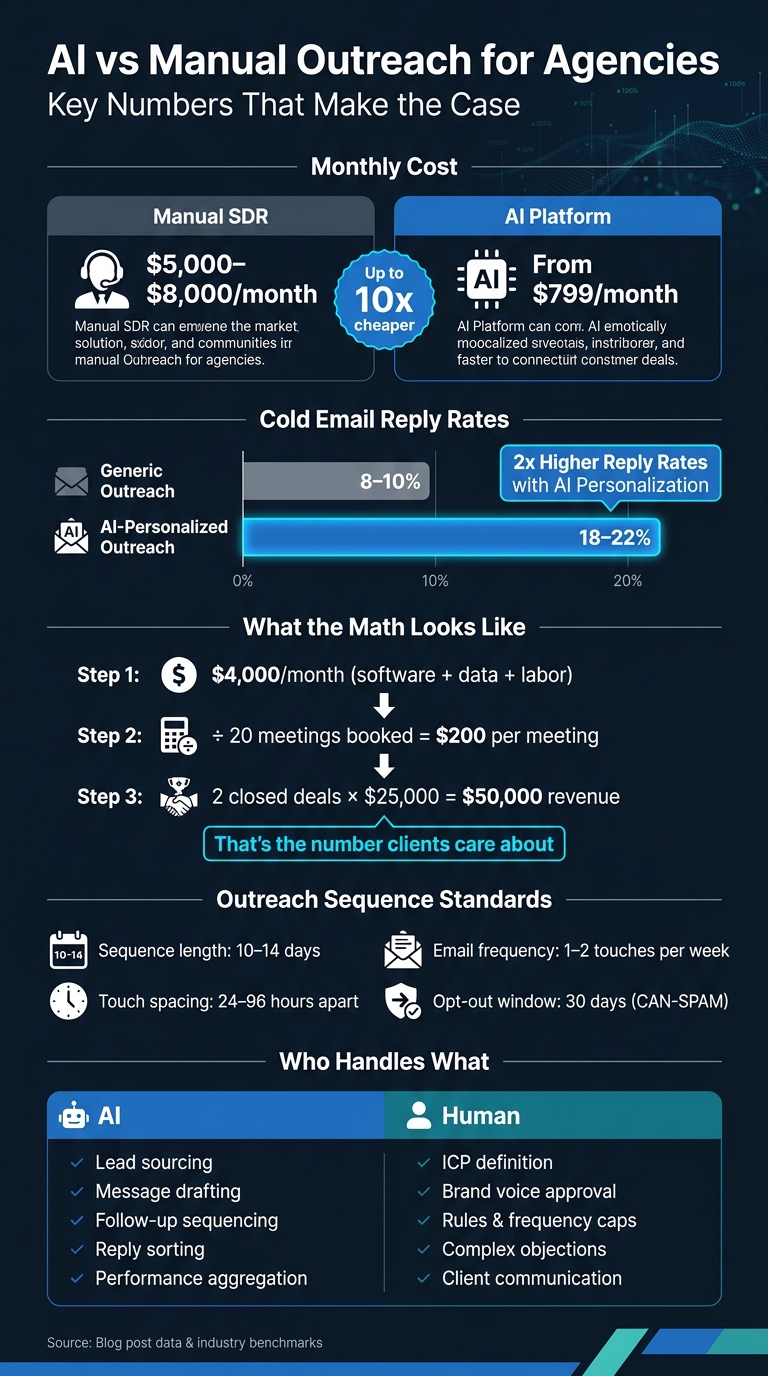
Outreach sequences often run 10–14 days
Touches are often spaced 24–96 hours apart
Email cadence should stay around 1–2 touches per week
One manual SDR seat can cost about $5,000–$8,000/month
One platform example starts at $799/month
AI-personalized outreach has been reported at 18%–22% reply rates, versus 8%–10% for generic outreach
What I take from the article is simple: AI is not the strategy. It is the system that helps agencies carry out the strategy with less drift from one client account to the next. And if I want to scale this as a service, white-label delivery matters because clients see my agency’s brand, not just the tool behind it.
for Agencies" >
AI vs Manual Outreach: Cost, Performance & ROI for Agencies
The Biggest Outreach Problems AI Solves
AI fixes the three outreach bottlenecks agencies usually hit first: personalization, lead quality, and follow-up. Those are also where teams tend to see the fastest gains.
Personalization Without the Time Cost
Generic outreach falls flat because it stops feeling relevant fast. The hard part is volume: writing tailored messages for hundreds of prospects each week just doesn’t hold up when done by hand.
AI can draft outreach using LinkedIn activity, firmographics, tech stack, and recent news. So instead of staring at a blank page, a human rep starts with a draft and edits it for tone, accuracy, and brand fit. The result is a message that still sounds right but also points to something real in the prospect’s world.
For example, a U.S.-based B2B agency used AI to tailor first lines based on role and recent company news. Positive reply rates on cold email campaigns aimed at mid-market accounts went from about 3–4% to 8–10%, mainly because prospects felt the outreach was researched and relevant. [1]
Even a strong message won’t do much if it lands with the wrong lead.
Better Lead Quality and Prioritization
AI helps at the top of the funnel by sourcing, enriching, and scoring prospects. For most agencies, the bigger issue isn’t just weak personalization. It’s list quality. Reps can lose hours working contacts who were never a fit in the first place.
AI spots ICP patterns from past closed-won deals, pulls matching accounts and contacts, and adds details like job titles, seniority, U.S. time zone, tech stack, and recent hiring or funding signals. Then predictive scoring models rank prospects by how likely they are to reply or book a meeting.
That gives SDRs a much clearer starting point. Instead of treating every lead the same, teams can send only higher-scoring leads to outbound and keep reps focused on contacts with a better chance of moving.
Once the right leads are in motion, timing becomes the next issue.
Consistent Follow-Ups Across Channels
Most deals don’t close on the first touch or even the second. Follow-up is where agencies often lose momentum, especially when volume picks up. Timing slips. Messages start to sound the same. Hot leads cool off because nobody sees the signal soon enough.
AI keeps follow-up sequences moving by watching engagement signals and adjusting timing on its own. If a prospect opens, clicks, or replies, AI can change the schedule, pause inactive contacts, trigger the next step, and send messages in local time.
Humans should still step in for high-intent replies and harder objections. AI handles the cadence. Humans handle the moments that need judgment.
sbb-itb-a781ab9
How to Add AI to Your Outreach Workflow
Once AI is helping with personalization, lead quality, and follow-up, the next move is simple: fit it into the workflow you already run. The best place to start is where manual work eats up time. In most teams, that means list building, enrichment, drafting, scoring, and follow-up routing.
What AI Should Handle vs. What Humans Should Own
The cleanest way to set this up is to split repeatable work from judgment calls. AI can take care of the heavy lifting. Your team should keep control of decisions that need context, nuance, and brand judgment.
Task
AI Handles
Human Owns
Lead sourcing & enrichment
✓
ICP definition
Message drafting
✓ (drafts)
Approval & brand voice
Follow-up sequencing
✓
Rules & frequency caps
Reply sorting
✓ (categorizes)
Complex objections & closes
Performance analysis
✓ (aggregates data)
Interpretation & client communication
A smart starting point is AI drafting, not auto-sending. That gives you room to catch tone issues, compliance problems, or messages that just feel off before anything goes live. For the first wave, keep human review in place. After that, if the output looks solid, you can move toward full features">automation.
The Data and Process Setup You Need First
AI outreach runs on clean, structured prospect data. If the records are messy, the output usually is too. Before you switch anything on, make sure each prospect record includes the fields that actually shape personalization and routing:
Job title
Seniority
Company size
Industry
Revenue range in USD
City, state, and local time zone
That last group matters a lot for U.S. campaigns. Timing can make or break outreach.
For U.S. campaigns, sending rules matter just as much as the workflow itself. Set outreach to land during each prospect's local business hours, Monday through Thursday, and avoid major U.S. holidays. Keep email frequency to one to two touches per week. And if someone replies or unsubscribes, stop right away.
Those rules help with CAN-SPAM compliance and protect deliverability. If you're running outreach for clients and need this under one branded system, SalesLabel gives agencies a way to automate outreach while keeping the client's brand front and center. Even then, agencies still need to define the ICP signals that matter most.
Why White-Label AI Matters for Agency Growth
When AI takes care of the work, the next step is simple: package that work as your own service.
That’s where white-label AI starts to matter. It gives agencies room to scale outreach under their own brand without hiring in a one-to-one way. Forrester found that 9 in 10 U.S. marketing agencies use generative AI[7], but only 30% had fully integrated it across the campaign lifecycle[8]. That gap gives agencies a shot to stand apart.
Brand control plays a big role here. If clients log into a portal, view a dashboard, or read a report with your name and logo on it, they connect the work to your agency’s process, not a third-party tool. That helps support premium retainer pricing. It also lowers the chance that a client tries to bypass you and work straight with the software company. On top of that, it makes switching more of a hassle.
What to Look for in a White-Label Outreach Platform
Use these criteria to judge whether a platform can handle your current client load.
Criterion
Why It Matters for Agencies
What to Verify Before Adopting
Lead sourcing
Decides whether you can keep finding the right prospects
Data coverage for U.S. markets, filtering by industry, revenue, and role
Enrichment
Powers personalization and qualification
Accuracy, freshness, and field depth (firmographics, technographics)
Personalized outreach
Helps lift reply rates without manual writing
Email, LinkedIn, channel flexibility, and tone control
Shared inbox, intent classification, routing, and assignment rules
Lead scoring
Helps your team focus on the best opportunities
Real-time updates, scoring logic, and explainability
White-label branding
Lets you present the service as your own
Custom domain, SSL, logo, branded client portal, no provider logos
Multi-client delivery
Supports recurring revenue and multi-account management
Multi-tenant support, role-based permissions, and reporting visibility
A simple way to test a platform is to run a pilot with one to three clients. Track reply rates, meetings booked, and internal hours saved. That gives you a clear way to compare tools, and it gives your team an ROI story you can use in future client talks. Use those criteria to judge whether a platform can handle current client load.
Agencies that want to run the full outbound lifecycle under their own brand often run into the same problem: no single platform covers every step. SalesLabel aims to solve that by combining AI-powered lead sourcing and enrichment, personalized multi-channel outreach, automated follow-up sequences, inbox management, real-time lead scoring, and AI-driven replies, all under a custom domain, logo, and branded client-facing dashboards.
Plans start at $799/month[3]. By comparison, a manual SDR seat usually costs $5,000–$8,000 per month[2][4]. That gives agencies room to sell a higher-margin service without adding full-time headcount. Early users report faster response times after automation.
Branding only matters if compliance and deliverability hold up.
Using AI Responsibly in U.S. Outreach
Compliance, Deliverability, and Brand Control
Once an agency takes charge of the brand experience, compliance becomes the next checkpoint. White-label control falls apart fast if messages don’t meet the rules or never make it to the inbox.
For email in the U.S., follow CAN-SPAM. That means:
accurate sender information
truthful subject lines
a physical mailing address
a working opt-out link
That opt-out link needs to stay active for 30 days, and requests should be honored right away. If a vendor or AI platform sends messages for you, your agency still holds the liability. The same level of control should carry across email, LinkedIn, SMS, and calls.
For deliverability, set up SPF, DKIM, and DMARC on every sending domain. Warm up new accounts slowly, not all at once, and keep bounce rates low. Each client should also have a dedicated sending domain. It’s a simple move, but it helps protect sender reputation and keeps one client’s issues from spilling into another account.
Brand control is just as important. AI drafts; humans approve. That review step before any first-touch message goes out helps catch tone drift, weak personalization, and off-brand claims. Start by setting approved frameworks and forbidden claims. Then review sample sends for tone and accuracy.
How to Measure What's Working
Once compliance and deliverability are in place, the next thing to look at is simple: does the system produce meetings and pipeline?
Opens and clicks don’t tell the full story. Replies, meetings, and revenue do. The numbers that matter most are reply rate, positive reply rate, meetings booked, cost per lead, cost per meeting, and pipeline generated. Track all of it in U.S. dollars.
Benchmark data has reported AI-personalized outreach reaching 18–22% reply rates compared with 8–10% for generic templates [5][6]. Those lifts show up most when outreach is based on real signals and checked by a human before it goes out.
Here’s what that can look like in plain math:
$4,000 per month for software, data, and labor
20 meetings booked = $200 per meeting
2 closed deals at $25,000 each = $50,000 in revenue
That’s the math clients care about. It lands a lot harder than click-through rate ever will.
Key Takeaways for Agencies
At scale, the bottleneck isn't strategy anymore. It's execution.
Manual outreach is usually the first thing to crack when volume goes up and client accounts stack up. One team member writes one way, another follows up late, and results start to swing from client to client. That makes growth harder than it needs to be.
There's one condition behind the lift: AI-personalized multi-channel outreach beats generic single-channel campaigns only when it's built on clean data and clear rules. AI helps because it keeps email, LinkedIn, and follow-ups in sync. It doesn't win just by adding more volume.
The split is simple. AI handles the repeatable work. Humans handle judgment. That's what keeps quality high even as output grows.
Once that workflow is dialed in, agencies can turn it into a productized service. White-label AI makes it possible to package outreach as a branded recurring offer. A platform like SalesLabel lets agencies run AI-powered lead sourcing, enrichment, personalized outreach, follow-ups, and meeting bookings under their own brand.
The best results come from treating AI like a controlled system, not a one-time automation switch. The agencies that grow keep testing, refining, and tightening the process.
FAQs
How much oversight should humans keep?
Agencies can choose the level of human oversight they want with SalesLabel.
In copilot mode, a person reviews and approves every message before it goes out. That gives teams full control over what gets sent.
In autopilot mode, AI runs outreach, lead research, and meeting bookings 24/7. People can still jump in when a conversation gets more nuanced, while AI takes care of routine replies and status updates.
What data do I need before using AI outreach?
Before using AI for outreach, define a clear Ideal Customer Profile (ICP) so it can score lead fit with accuracy.
You’ll also need prospect data for deeper research. That includes LinkedIn profiles, recent posts, comments, and real-time intent signals like website activity and email engagement.
SalesLabel helps by automating data enrichment and verification, which supports personalized outreach and helps keep it accurate.
How do I measure AI outreach ROI?
Measure AI outreach ROI by tracking conversion metrics and engagement data. Focus on AI-powered lead scoring based on ICP fit and engagement, then compare those signals with reply rates and meeting bookings.
That gives you a clearer view of what's working. Are high-scoring leads replying more often? Are they booking more meetings? That's where the numbers start to tell the story.
SalesLabel also includes analytics and reporting in its white-label dashboard. That helps agencies monitor performance while keeping control of client revenue and pricing.
 for Agencies" >