Use intent-weighted actions, recency decay, thresholds, and real-time routing to prioritize leads and trigger timely follow-up.
SalesLabel Team
Growth Expert • 7.09.2026 г.
Share:
Търсите готово решение?
SalesLabel автоматизира проспектирането от край до край — AI намира потенциални клиенти, изпраща персонализирани съобщения и резервира срещи под вашия бранд.
If I had to sum this up in one line: behavioral lead scoring helps me act on intent, not just profile data.
A lead can look like a fit on paper and still be nowhere near a buying decision. On the other hand, a less-than-ideal contact can turn into a hot lead fast if they visit pricing pages, click emails, start a trial, or ask for a demo. That’s why I’d use fit score + behavior score together.
Here’s the short version:
Fit score tells me who the lead is
Behavior score tells me what the lead is doing right now
High-intent actions like demo requests, trial signups, and pricing-page visits should get the most points
Low-intent actions like a single blog visit should get only a few points
Negative actions like unsubscribes and spam complaints should lower the score
Recency matters: actions from the last 7 to 14 days should count more than old activity
Decay matters: if a lead goes quiet for 30, 60, or 90 days, the score should drop
Thresholds matter: many teams use around 65 points as an MQL starting point, then add a fit requirement before sales handoff
Fast follow-up matters: when a score jumps from buyer activity, routing and outreach should happen right away
Clean data matters: duplicate events, bad field mapping, and broken CRM syncs can skew the whole model
Review matters: I’d check score bands weekly, data quality monthly, and model weights quarterly against meetings, pipeline, and closed-won deals
Here’s the part that matters most: a score is only useful if it changes what happens next. If a lead crosses a threshold, I’d tie that to a clear next step such as nurture, SDR follow-up, or direct sales handoff.
Score band
What I’d call it
What should happen
0–29
Nurture
Keep in automated follow-up
30–59
MQL
Put on watch list or nurture track
60–79
SDR follow-up
Assign to SDR and send an alert
80+
Sales-ready
Create an urgent follow-up task
So the core idea is simple: score actions by buying intent, weight recent activity more, lower stale scores over time, and connect score changes to immediate follow-up. That’s how I’d turn website, email, and product activity into a working lead-priority system.
HubSpot Lead Scoring Tutorial 2026: New Tool Setup, AI & Best Practices | HubSpot Excellence
sbb-itb-a781ab9
The Most Important Behavioral Metrics to Track
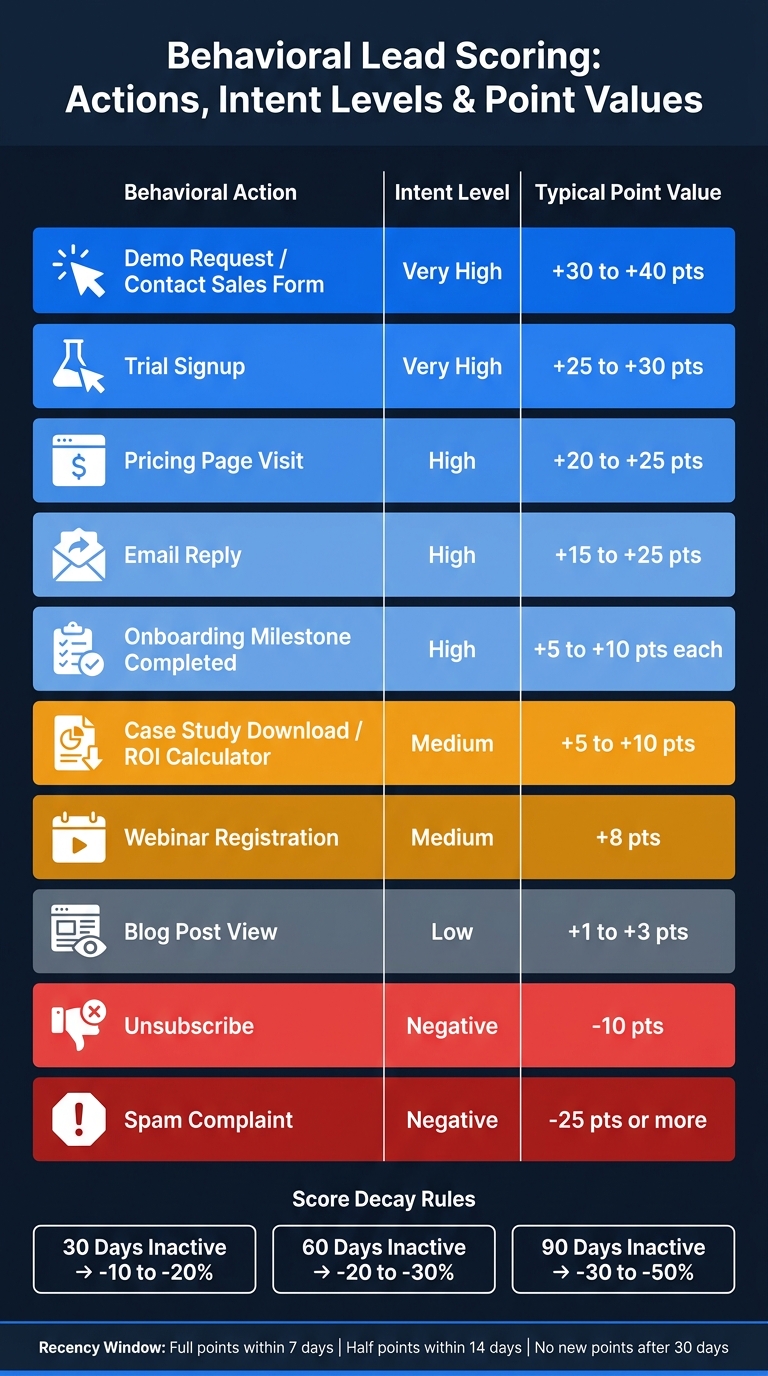
Behavioral Lead Scoring: Actions, Intent Levels & Point Values
These are the actions that turn interest into a score. And not every signal means the same thing. The goal is to score active research, not casual browsing.
Website and Content Engagement
Pricing and demo-page visits are the clearest signs of website intent. In many scoring models, they earn 20 to 25 points[9][2][14][17][22]. If someone visits pricing and demo pages close together, that usually deserves even more weight.
Other mid-funnel actions matter too. Case study views, ROI calculator interactions, and webinar registrations show that a prospect is checking whether your product fits what they need. These actions often earn 5 to 10 points each[7][9][2][15][18][1][22].
Timing matters just as much as the action itself. A pricing page visit from last week says a lot more than one from six months ago. Most scoring models put more weight on actions from the last 7 to 14 days and let older activity lose weight over time [13][19][21][22].
Use grouped visits to flag urgency, not just total pageviews.
Email and Outreach Engagement
Email opens can help with deliverability, but they don't say much about buying intent. Clicks are stronger because they show active interest, and they often earn +5 to +10 points. Replies are much stronger and often earn +15 to +25 points[10][15][18][20][21][22]. A booked meeting is one of the strongest outreach signals and can trigger MQL status.
Negative signals matter just as much. Unsubscribes should reduce scores, often by around -10 points, and they should pause automated sequences. Spam complaints are more serious. They call for heavy penalties and immediate suppression to protect list quality and sender reputation [6][10][18][20][21].
Email engagement gets more meaningful when it happens after website intent. A click after a pricing-page visit tells a stronger story than a click on its own.
Product and Conversion Actions
Product actions often mark the moment when simple interest turns into buying review. Trial signups usually earn a high score, often +25 to +30 points[5][8][2][14][16][17], and they should trigger follow-up fast. Onboarding completion and core feature use help you tell the difference between serious evaluators and people who signed up, poked around, and disappeared.
Demo requests and Contact Sales form submissions carry some of the highest point values in behavioral scoring. In many models, they earn +30 to +40 points[7][8][2][11][12][17][22]. They should also trigger a direct sales workflow.
Action
Intent Level
Typical Point Value
Demo request / Contact Sales form
Very High
+30 to +40
Trial signup
Very High
+25 to +30
Pricing page visit
High
+20 to +25
Onboarding milestone completed
High
+5 to +10 each
Case study download / ROI calculator
Medium
+5 to +10
Webinar registration
Medium
+8
Blog post view
Low
+1 to +3
Email reply
High
+15 to +25
Unsubscribe
Negative
-10
Spam complaint
Negative
-25 or more
How to Build a Behavioral Scoring Model
A behavioral scoring model works best when marketing and sales follow the same simple rules. Once you’ve picked the right signals, the next step is to turn them into a model both teams can use in the same way.
Assign Point Values by Intent Level
Start by mapping actions to intent levels with historical conversion data. Use 6–12 months of funnel data to score behaviors based on conversion lift. Behaviors under 1.5x baseline lift should get 2–5 points. Actions in the 1.5–3x lift range fit in the 10–25 point band. And behaviors above 3x lift can support 30–60 points. Review these mappings every quarter as more data comes in. [31][32][33]
Those point values give you the starting score. After that, decay rules help keep the score tied to what’s happening now.
Apply Recency, Frequency, and Score Decay Rules
Use 7-day, 14-day, and 30-day windows, then reduce points as actions get older. For example, a 20-point action counts as the full +20 within 7 days, drops to +10 within 14 days, and falls to +5 within 30 days. Once an action is older than 30 days, it should add no new points. [26][28][29]
Frequency matters too. Give full points for the first one to three occurrences of an action inside the same window, then trim the credit for extra repeats. That helps stop score inflation from the same behavior happening again and again.
Once point values and decay rules are in place, define the score bands that decide what happens next.
Score Band
Stage
Typical Action
0–29
Nurture
Automated nurture sequence
30–59
MQL
Marketing nurture
60–79
SDR Follow-Up
SDR outreach
80–100
Sales-Ready
Sales Handoff
Most B2B teams start their MQL threshold at around 65 points. [4][23][24][25] Sales handoff should also require a minimum fit score, such as 60+. Then back-test those thresholds against historical conversion data, review them quarterly, and document each change. [30][32][34]
Once those thresholds are set, connect score changes to routing, alerts, and follow-up. Next, tie score changes into automated routing and follow-up.
Running Behavioral Scoring in Real-Time Systems
Once your score thresholds are set, the next step is simple: make the system react the moment a lead shows intent.
If scoring updates only once per day, you can miss the window. A prospect might visit your pricing page, click a sales email, and book time while interest is high, then go cold before anyone reaches out. That’s the problem real-time scoring solves.
Connect Score Changes to Automated Actions
Real-time scoring means a lead’s score updates right away, or within seconds, after a behavioral action like visiting a pricing page, clicking a sales email, replying, or booking a meeting. The score should go straight back into the CRM, and the next step should fire within seconds. That keeps follow-up tied to what the lead is doing now, not what they did yesterday.
To make that work, you need three parts working together:
Event tracking
A scoring engine
An features">automation layer that reacts to score changes
Each score band should map to one clear action:
Score Band
Stage
Automated Action
30–59
Nurture / MQL
Enroll in nurture sequence; assign to SDR watch list
60–79
SDR Follow-Up
Update lifecycle stage; assign to SDR; send alert with key behaviors
80+ plus qualifying behaviors
Sales-Ready
Trigger urgent follow-up: send a booking link and create a call task within 15 minutes
Speed matters. Leads contacted within 5 minutes convert far better than leads contacted later. For agencies, automated routing is what makes that kind of response time possible.
If you manage more than one client, add escalation rules too. For example, if a hot lead isn’t touched within the target SLA, the system should reassign that lead to a backup rep or flag it to a manager on its own.
For agencies running this workflow under their own brand, SalesLabel fits that use case. SalesLabel gives agencies a white-label way to run real-time scoring, AI replies, inbox triage, and branded follow-up workflows from one system.
Next, the model needs regular cleanup so score changes stay accurate.
How to Keep Behavioral Scoring Accurate Over Time
A scoring model that worked at launch can drift if you leave it alone. Tracking changes. New tools get added. Buyer behavior shifts. And when that happens, scores can slowly stop matching what’s going on in the pipeline. Sales notices fast. Trust drops even faster.
Keep Data Clean and Reporting Consistent
Once scores start driving routing, even small tracking mistakes can skew results. Most scoring problems don’t come from bad scoring logic. They come from bad data flowing into solid logic.
Say a pricing page visit fires twice because of a duplicate tag. Or a form submission gets mapped to the wrong CRM field. The system adds points, but the lead didn’t show any extra intent. That’s how scores get inflated.
Start with a tracking blueprint. This should be a documented list of every behavioral event used in scoring, where each event is captured, and how it maps to a CRM field. Keep event names consistent across systems, such as pricing_page_view, email_link_click, and lead_form_submit, so the same action always triggers the same score update.
Run a monthly QA check on:
Event volume
Timestamps
UTM data
CRM syncs
It also helps to standardize CRM fields, dates, currency, and number formats. That way, the same event always maps to the same score and the same report.
Review Scores Against Actual Conversion Results
After cleaning up the data, test the model against actual pipeline results. Point values are still assumptions until they line up with outcomes.
On a monthly basis, review conversion rates by score band, such as 0–49, 50–74, and 75–100+, and track how many leads in each band moved to a booked meeting, an opportunity, and a closed deal. If your top score band isn’t converting to meetings at a much higher rate than the middle band, that’s a sign the model is off. The Pedowitz Group recommends validating scoring with outcomes like meeting rate, stage conversion, and qualified pipeline created by tier, and specifically advises fixing data inputs first if higher tiers aren't outperforming baseline. [35]
For quarterly deep audits, pull 6–12 months of closed-won data. Group those leads by their score at the time of handoff, then calculate win rate, average deal size, and total closed revenue for each band. Use that data to adjust weights for behaviors that show up again and again in won deals, such as multiple pricing page visits or direct replies to outreach. Cut points for actions that have a weak tie to revenue, like generic blog visits. Drop signals that do not outperform baseline, then pilot changes before rollout. [36]
Use a simple cadence: weekly score-band checks, monthly data QA, and quarterly recalibration. If you use SalesLabel, review score-triggered automations, outreach triggers, and booking rules on that same cycle. Log every scoring change with the date, the reason behind it, and the expected impact so the model stays auditable.
Conclusion
Behavioral scoring turns buyer activity into timing. It helps teams act when intent is at its peak. That shifts the model away from static labels and toward when to act.
It beats profile-only scoring because it reflects what people are doing, not just who they are. For agencies, that matters most when those signals lead to immediate action.
SalesLabel supports this workflow with real-time scoring, AI replies, inbox management, and automated booked meetings.
Treat the model like an operating system that gets better from results. Refine it based on closed-won outcomes, not gut feel. The best models mix intent signals, decay rules, thresholds, and regular review.
FAQs
How do I combine fit and behavior scores?
Create separate scores for ICP fit and lead engagement, then roll them into one metric with predictive AI.
Here’s the basic idea: one score tells you how closely a lead matches your ideal customer profile. The other shows how much interest that lead is showing through recent activity. When you combine the two, you get a clearer view of who your team should talk to first.
SalesLabel can calculate these scores on the fly using data from your website, email campaigns, and CRM. Add time-decay, and recent actions carry more weight than older ones. That helps your team focus on the leads that are both a strong fit and showing intent right now.
Which actions should count most in lead scoring?
Put the most weight on actions that show high buyer intent. That usually means real-time engagement signals like website visits, email interactions, and broader intent data.
SalesLabel uses AI to read these behavior patterns, so agencies can spend more time on leads that are showing active interest. When you focus on live actions instead of static data, it becomes easier to move prospects through the funnel and improve conversion rates.
How often should I update my scoring model?
Update it on a regular schedule by comparing engagement and fit scores against actual conversion metrics.
AI-powered systems like SalesLabel can score leads in real time using live site, email, and intent data. But human review still matters. When you check conversion data from time to time, you can fine-tune the parameters so the model stays aligned with your Ideal Customer Profile and current sales results.