Rank leads by fit, engagement, and intent to route hot prospects, speed SDR response, and boost conversions with real-time scoring.
SalesLabel Team
Growth Expert • 3.08.2026 г.
Share:
Търсите готово решение?
SalesLabel автоматизира проспектирането от край до край — AI намира потенциални клиенти, изпраща персонализирани съобщения и резервира срещи под вашия бранд.
More outreach does not mean more meetings. Better lead ranking does.
I’d sum up the whole article like this: if I automate outreach without scoring leads first, I send too many messages to the wrong people and miss the ones ready to talk. Lead scoring fixes that by ranking leads based on fit, engagement, and intent, then using that score to decide the next step right away.
Here’s the short version:
Without lead scoring, features">automation becomes bulk messaging
Rules-only systems miss behavior changes
Real-time scoring helps SDRs reply to hot leads sooner
Score bands can trigger routing, nurture, or direct booking
Agencies can cut wasted SDR time and lower cost per meeting
Results can improve fast: some data in the article shows 26% higher lead conversion, 28% better conversion with predictive scoring, and a jump from 4.2% to 11.8% in one rollout
A simple example makes the point fast. If an SDR costs $6,000/month and books 20 meetings, cost per meeting is $300. If weak prioritization drops output to 12 meetings, cost per meeting climbs to $500. Same spend, worse output.
I’d look at lead scoring as the control layer for outreach automation:
Low score: keep in nurture
Mid score: review or send lighter follow-up
High score: route to an SDR and push same-day action
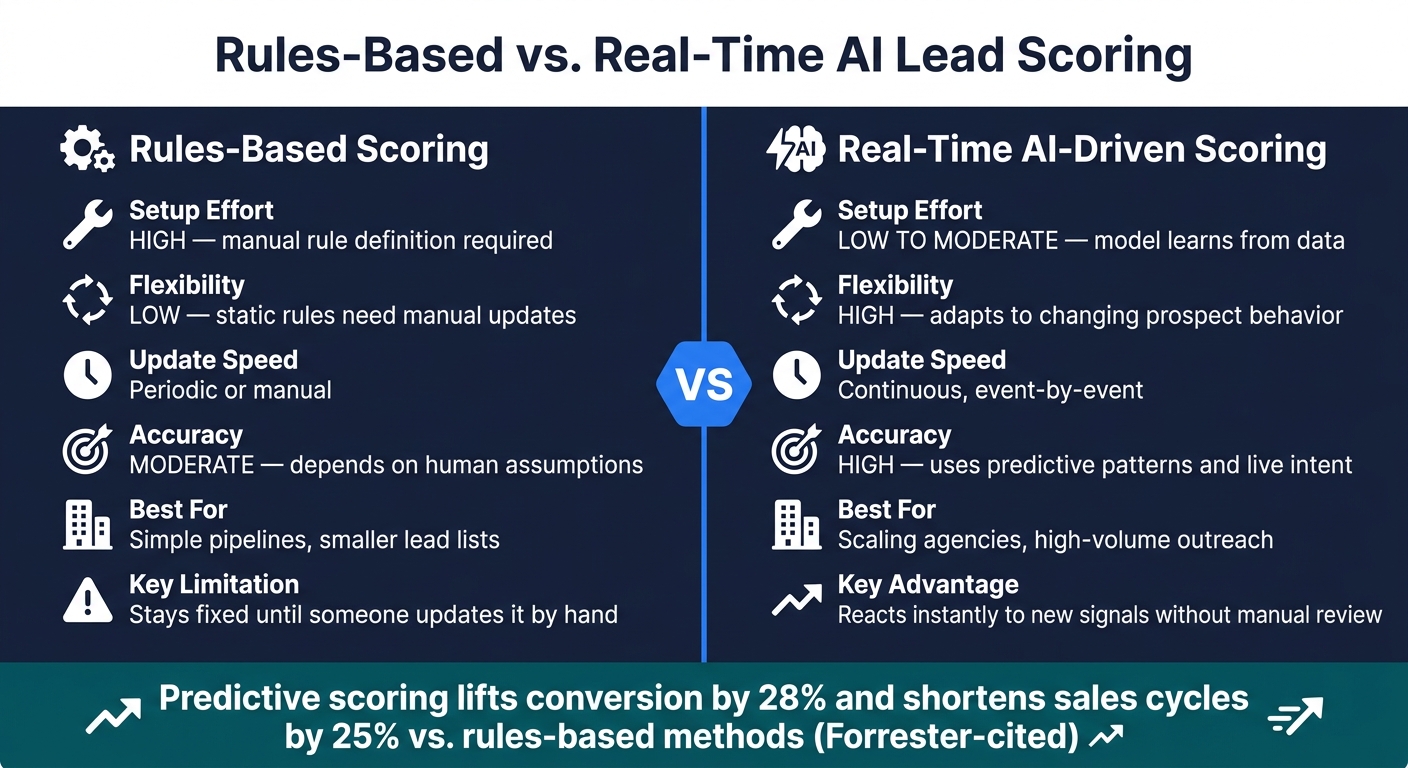
The article also shows the difference between rules-based scoring and real-time AI-driven scoring. Rules-based scoring is easier to audit, but it stays fixed until someone updates it. Real-time scoring changes as new signals come in, so the workflow can react at once.
For agencies, the main point is simple: scores only matter when they trigger action. If the score just sits in a CRM field, it does not change meetings, pipeline, or reply speed. If the score controls routing, message type, ownership, and follow-up timing, outreach automation works much better.
That’s the core idea I’d take into the rest of the article.
The SIMPLEST Way To Build An AI Lead Scoring Assistant (AI Automation)
sbb-itb-a781ab9
Why Outreach Automation Breaks Without Lead Prioritization
Automation helps with volume. It does not decide who matters most right now.
Without a system to rank intent, every lead ends up in the same cadence, gets hit at the same time, and sees the same message. That burns SDR time fast. Instead of spending time with people who may actually want to talk, SDRs work through mixed queues packed with both high-intent buyers and contacts who were never going to reply. That’s the point where lead scoring changes the day-to-day workflow.
Where Manual and Rules-Only Workflows Hit a Ceiling
A decision-maker who opened your email three times in one morning shouldn’t get the same next step as a low-fit contact who clicked once.
But in manual or rules-only systems, that’s exactly what happens.
As lead volume climbs, the problem turns into a bottleneck. SDRs stop focusing on real conversations and start acting as manual triagers. At that stage, engaged prospects sit right next to cold ones, response times stretch from hours to days, and the outreach system can’t adjust when buyer behavior changes. The rules stay fixed, and in many teams, they barely get updated. Once priority is clear, the system can send the next action to the right place on its own.
The Cost of Poor Prioritization in Agency Operations
The math gets ugly fast.
Take an SDR who costs $6,000 per month and books 20 qualified meetings. That puts cost per meeting at $300. If weak prioritization drops output to 12 meetings from the same outreach volume, cost per meeting jumps to $500. That’s a 67% increase, and it can squeeze margins hard, especially on fixed-fee or performance-based client contracts.
Poor prioritization also drives up data and software costs. More contacts get added to sequences. More emails go out. More enrichment credits get used. But booked meetings don’t rise at the same pace.
Agencies usually spot this in the dashboard: high send volume, flat or falling reply rates, and a pipeline that looks busy without producing better results.[3][4] On paper, forecasts may still look fine. In practice, close rates start slipping.
Lead scoring fixes that by pushing time and outreach toward the leads most likely to convert.
What Lead Scoring Means in an Automated Outreach Workflow
Rules-Based vs. Real-Time AI Lead Scoring: Key Differences
Lead scoring gives each prospect a value based on fit and buying signals. In an automated outreach workflow, that score isn't just a label. It acts as a trigger that tells the system what to do next: nurture the lead, route it to sales, book a step, or pause outreach.
The main job is simple: turn a score into an instant workflow decision.
The Signals That Make a Lead Score Useful
A useful score separates who the prospect is from what they're doing and how close they are to buying.
Fit covers firmographic and demographic details like company size, industry, and job title. A senior buyer at a target account should score differently from a junior contact at a non-target account, even if both clicked the same email.
Engagement tracks active behavior, such as email opens, website visits, and demo requests. A pricing page visit means more than a blog post visit. One shows buying interest. The other may just show casual research.
Intent looks for signs that a prospect is judging options right now. That can include sentiment in email replies, return visits after a quiet stretch, or direct responses to outreach. These signals often show that a lead is closer to a decision than engagement data alone might suggest.
A simple way to think about it: fit sets the ceiling, while engagement and intent move the lead up within that range. Once those inputs are clear, automation can route each lead without manual review.
Rules-Based vs. Real-Time AI-Driven Scoring
Rules-based scoring uses fixed logic set by your team. For example, you might add 10 points for a director-level title and subtract 15 points for a free email domain. It's easy to audit because every score comes from a known rule. But it doesn't change on its own. If buyer behavior shifts or your ICP changes, someone has to go in and update the rules by hand.
Real-time AI-driven scoring works differently. It updates as new data comes in, so the score changes with each new action or signal. That means the workflow can react right away instead of waiting for a manual review or a batch update. A Forrester-cited report found that predictive scoring lifts conversion by 28% and shortens sales cycles by 25% compared with rules-based methods.[6]
Feature
Rules-Based Scoring
Real-Time AI-Driven Scoring
Setup Effort
High - manual rule definition required
Low to moderate - model learns from data
Flexibility
Low - static rules need manual updates
High - adapts to changing prospect behavior
Update Speed
Periodic or manual
Continuous, event-by-event
Accuracy
Moderate - depends on human assumptions
High - uses predictive patterns and live intent
Best-Fit Use Case
Simple pipelines, smaller lead lists
Scaling agencies, high-volume outreach
For agencies handling large lead volumes across many clients, real-time scoring is what makes automation feel responsive instead of stiff. At that point, lead scoring isn't just there to describe a lead. It helps run the workflow.
How Real-Time Lead Scoring Improves Outreach Automation
Real-time lead scoring fills the gap that rules-only automation leaves behind. When a score changes, the system can act on it right away. That score change becomes a routing trigger, not just another data point.
Using Score Thresholds to Trigger the Right Next Step
Score bands act as the routing layer behind automated workflows. A cold lead (0–39) stays in a low-frequency educational sequence. A warm lead (40–69) moves into a more direct outreach track with a tailored value proposition. A hot lead (70+) triggers an immediate booking sequence with a direct booking link or call request.
What matters most is timing. The trigger fires the moment the threshold is crossed, not in a nightly batch. A pricing-page visit at 2:00 p.m. can switch the sequence that same day.[1]
Once scoring starts changing routing, it can shape the message too.
Better Personalization Without Slowing Down Scale
Real-time score data helps decide which message a lead gets. A senior decision-maker at an ICP-fit company who just visited a pricing page should get a very different email than a junior contact who only opened a newsletter.
That’s where the score does more than sort leads. Paired with role and company profile tags, it tells the system which template to use, which case study to mention, and which CTA fits the moment. The result is a specific message without manual drafting.
Why Faster Prioritization Leads to More Meetings
Speed-to-lead has a direct effect on whether a prospect books a call. Real-time scoring pushes hot leads to the top of the SDR queue the moment they qualify. No manual triage. No digging through the inbox. No waiting until the next day.
That usually leads to higher reply rates, more qualified meetings, and shorter sales cycles.
From there, agencies can define the score bands and ownership rules that make the system work day to day.
How Agencies Can Add Lead Scoring to Their SDR Systems
Lead scoring does its best work when it feeds straight into SDR routing rules. If a score just sits in the CRM and doesn't change who responds, how fast they respond, or what happens next, it doesn't do much.
Define Score Bands, Actions, and Ownership Rules
A simple place to start is a 100-point model split across three signal types: fit (40 points), intent (40 points), and engagement (20 points). Build the bands from actual conversion data, not random cutoffs.
Score Band
Range
Automated Action
Ownership
High
75–100
Immediate alert, priority routing, and same-day follow-up
Named SDR, assigned immediately
Medium
40–74
SDR review, task creation, or a lighter personalized sequence
Shared queue for SDR review
Low
0–39
Educational nurture flows, periodic check-ins, or retargeting logic
Unassigned until re-engagement
This part matters: each band needs a clear owner and a clear next step. A high-score lead with no owner is still a lost lead. Set the owner, the response-time target, and the fallback route in case the first handoff fails.
After that, check whether those bands are doing what they're supposed to do - predicting meetings, not just sorting records.
Measure Performance and Refine the Model Over Time
Track a small set of numbers that show whether the model is pulling its weight:
Meetings booked by score band
Opportunity creation rate
Reply rate
Time to first touch
If high-score leads beat low-score leads on those numbers, you're on the right track. If the bands all perform about the same, the cutoffs likely need work.
It also helps to watch for process leaks. Missed follow-up on high-score leads often points to weak ownership. Medium-score leads stuck in nurture for too long usually mean the automation logic isn't firing the way it should.
One predictive scoring rollout using 200+ features lifted lead-to-customer conversion from 4.2% to 11.8% and cut sales cycles from 89 to 61 days. [2]
Review the model on a regular cadence and tighten the bands based on pipeline results. Once score bands route leads this cleanly, full automation becomes a much safer move.
How SalesLabel Supports Real-Time Lead Scoring for Agencies
Once scoring rules are in place, the hard part is execution. Every new signal has to lead to the right next step right away, without someone checking it by hand. If that doesn’t happen, lead scoring turns into a reporting tool instead of an action system.
Turning Lead Scores Into Automated Outreach Decisions
SalesLabel ties real-time lead scoring straight to outreach decisions. When a lead matches the ICP and shows buying intent, SalesLabel updates the score and moves that lead into the right sequence on its own. Leads with high scores get priority outreach. Midrange leads stay in nurture.
The same setup works when a lead shifts from plain engagement to clear buying intent. Once that happens, SalesLabel can send a booking link, assign ownership, and stop more outbound touches. That helps avoid over-contacting warm prospects and keeps the handoff clean.
Routing also goes past outbound sequences. It needs to deal with replies too. AI reply handling classifies responses, drafts a response, and routes the next action in seconds. Everything runs under the agency's brand.
Why This Matters for Scaling Agencies and Resellers
Building a manual SDR operation for multiple clients is expensive and slow. SalesLabel is built so agencies can skip that step. The platform handles sourcing, enrichment, scoring, outreach, follow-ups, and inbox management in one place. That means a small agency can run outbound programs for several clients without adding headcount for each one.
The white-label setup lets agencies offer scoring, outreach, follow-up, and inbox management under their own brand without having to build the stack themselves.
Conclusion: Lead Scoring Makes Outreach Automation Work Better
Without scoring, automation spends time on low-intent leads and slows down for high-intent ones. That isn’t a volume issue - it’s a prioritization issue.
Real-time scoring fixes that by controlling who gets contacted, when, and with what message. In one analysis of 150 organizations, AI-driven scoring increased conversion rates from 20% to 31%, which led to a 55% revenue increase from the same lead volume.[5]
But those gains only show up when scores trigger action. Dashboards display scores. Workflows do something with them.
For agencies, that gap shows up in day-to-day output. SalesLabel builds real-time lead scoring into sourcing, enrichment, outreach, follow-ups, and inbox management, so agencies can scale without losing relevance.
Real-time lead scoring turns outreach automation from a volume engine into a precision tool.
FAQs
How do I know if my lead scoring model is accurate?
Check your model against actual conversion numbers. Put your predicted scores next to real outreach results and see if the leads at the top of your list are the ones that turn into closed deals.
That’s the whole test. If a lead scores high on ICP fit, engagement, time-decay, and predictive AI, but never moves forward, something’s off. On the other hand, if lower-scored leads keep closing, your scoring rules may need a tune-up.
SalesLabel helps with this by scoring leads in real time using inbox signals, website behavior, and intent data. Review those results on a regular basis so you can spot gaps, adjust the logic, and keep your scoring tied to what sales teams care about most: revenue.
What signals matter most in real-time lead scoring?
Prioritize signals that blend ICP fit with measurable engagement. That usually means looking at:
website behavior
email interactions
broader intent data
Use time-decay and predictive AI to keep scores current, then check those scores against conversion metrics to make sure they line up with what drives pipeline.
SalesLabel uses real-time inbox and behavioral signals to spot intent and push hot leads to the top, so teams can reach out at the right moment with personalized messaging.
When should a lead move from nurture to SDR outreach?
A lead should move from nurture to SDR outreach when AI-driven predictive scoring shows strong intent.
Using SalesLabel, teams can mix ICP fit with real-time engagement signals like site activity, email interactions, and inbox behavior to spot the right time for sales outreach. That gives SDRs a clearer view of which leads are most likely to convert, so they can spend time on the best opportunities and follow up fast.