White-Label Software for Nonprofit Lead Generation
White-label platforms let agencies offer nonprofits rebranded AI tools for donor outreach, lead scoring, CRM sync, and compliance.
SalesLabel Team
Growth Expert • 12.06.2026
Share:
Hazır bir çözüm mü arıyorsunuz?
SalesLabel, giden satışı uçtan uca otomatikleştirir — yapay zekâ potansiyel müşterileri bulur, kişisellendirilmiş mesajlar gönderir ve markanız altında toplantılar ayarlar.
White-Label Software for Nonprofit Lead Generation
Nonprofits face unique challenges like securing donors, managing volunteers, and building partnerships - all with limited resources. White-label lead generation software helps agencies support nonprofits by offering rebranded tools for donor outreach, lead scoring, and follow-ups.
Here’s how it works:
Agencies license a platform, customize it with their branding, and offer it to nonprofits.
Nonprofits use these tools to streamline donor acquisition, automate outreach, and track leads effectively.
AI features like real-time lead scoring and automated follow-ups improve efficiency and reduce costs.
The result? Nonprofits achieve higher conversion rates, lower donor acquisition costs, and better engagement with prospects. Agencies benefit by scaling their services, managing multiple clients from one dashboard, and increasing profit margins.
Key highlights:
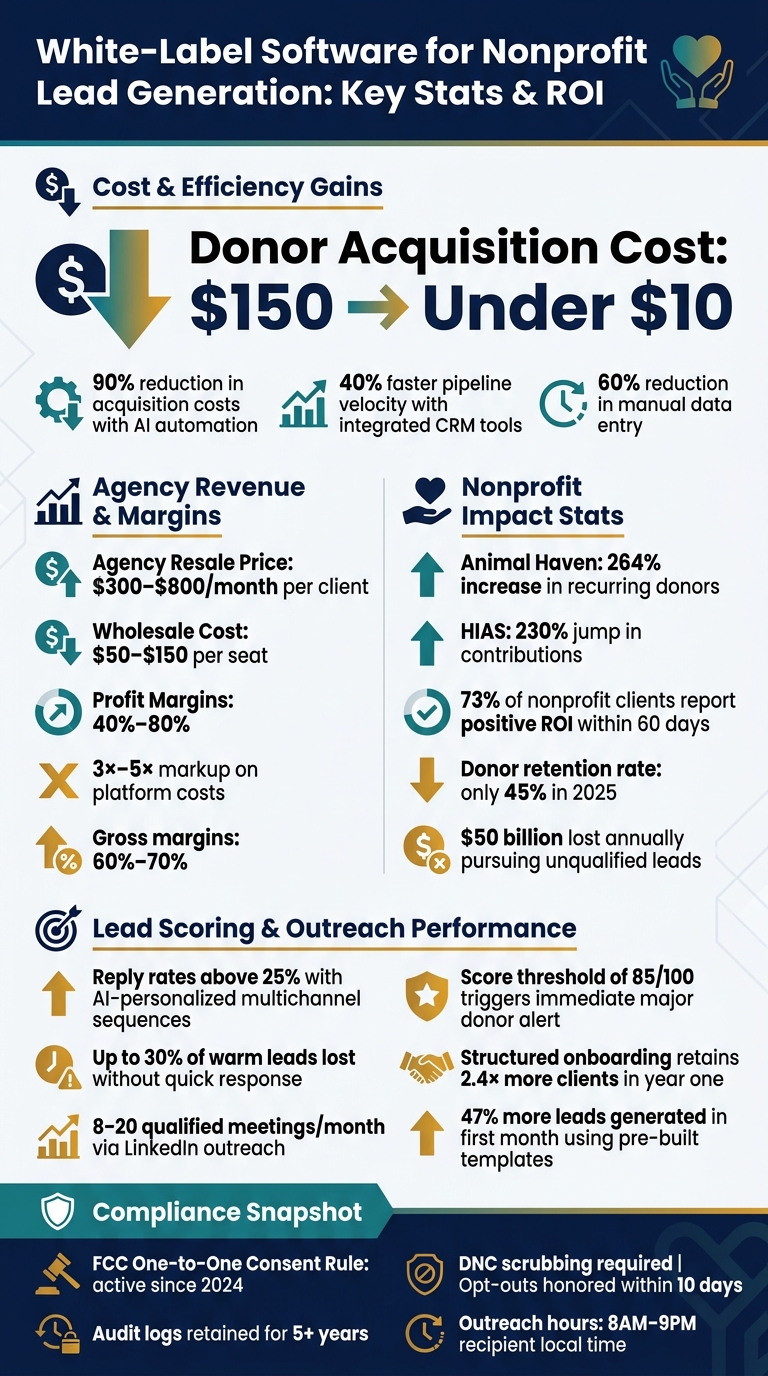
AI automation reduces donor acquisition costs from $150 to under $10.
Lead scoring prioritizes high-value prospects, boosting engagement.
Compliance tools ensure adherence to strict outreach regulations.
Agencies can earn 40%-80% margins by reselling these platforms.
White-label solutions are a game-changer for nonprofits and agencies alike, offering a cost-effective way to scale donor and partnership efforts.
White-Label Nonprofit Lead Gen: Key Stats & ROI at a Glance
Core Features of Nonprofit Lead Generation Software
Nonprofit Lead Types and Donor Journeys
Nonprofits deal with a variety of leads - each requiring unique strategies. A major donor, a corporate CSR director, a foundation program officer, or a skilled volunteer all need different approaches and timelines. The best software handles these differences seamlessly without requiring multiple systems.
Effective platforms map each lead type to its own journey. For example, a first-time donor might convert in weeks, while securing a corporate partnership could take months. Treating all leads the same way risks losing prospects at critical stages. Look for tools that offer distinct pipelines, customizable stages, and automated follow-up sequences tailored to each journey. These features help nonprofits scale their operations efficiently while managing diverse lead categories.
Behavioral scoring is another powerful tool. It can automatically trigger personalized sequences for engaged prospects - like those who frequently visit donation pages or open multiple emails - without requiring manual updates.
By tailoring donor journeys, nonprofits can ensure they remain compliant with ethical and legal standards.
Compliance and Ethical Requirements
As donor journeys become more personalized, nonprofits must adhere to strict compliance rules. These aren't optional. The FCC's one-to-one consent rule, implemented in 2024, mandates that donors or prospects must see a clear disclosure naming your organization before giving consent. Generic "marketing partners" language no longer meets the standard [6].
"Every lead you generate or purchase must have a valid consent record that meets the highest applicable standard. Since the FCC's one-to-one consent rule took effect, that means the consumer must have been shown a clear disclosure naming your specific company." - LeadCompliant [6]
Beyond consent, your software should manage automated DNC scrubbing against the National Do Not Call Registry, honor opt-out requests within 10 days, and restrict outreach to approved hours (8:00 AM–9:00 PM in the recipient's local time zone). It’s also critical to maintain tamper-proof audit logs - including IP addresses, timestamps, and disclosure language - for at least five years [6]. Non-compliance can lead to severe penalties, including TCPA fines and class action lawsuits that could cost millions [6].
To protect your email deliverability, avoid sending cold emails from your primary domain. Use a separate domain with properly configured SPF, DKIM, and DMARC records instead [3].
Integration with Nonprofit Tools
Seamless integration with nonprofit tools is essential for efficient lead management. Automated lead enrichment and scoring should update your constituent records without adding extra work. The most vital integrations are with nonprofit-focused CRMs like Salesforce NPSP, HubSpot for Nonprofits, and Bloomerang. These systems maintain constituent histories, and without bidirectional syncing, you risk duplicate entries and losing critical context [1][2].
Bidirectional syncing ensures that when someone makes a gift or updates their status in the CRM, their lead score is automatically updated. Nonprofits using integrated systems report 40% faster pipeline velocity and a 60% reduction in manual data entry[2]. For volunteer management, tools like VolunteerHub can match skills and send SMS reminders automatically, eliminating the need for custom workflows [1].
APIs and webhooks can further streamline processes. For instance, a form submission or status change in Bloomerang can trigger enrichment, scoring, and outreach - all without manual effort [1].
White-Label Branding and Multi-Client Management
Consistent branding is critical for agencies managing multiple nonprofit clients. If a client logs into a platform that displays another company’s branding, it undermines your agency’s value and reminds them they could bypass you entirely.
"Most agencies lose clients not because of bad results, but because of bad branding. When your client logs into a tool that says 'Powered by SomeOtherCompany,' you have just reminded them they do not need you." - SalesMind AI [5]
Platforms like SalesLabel are designed for this purpose. Agencies can customize the solution with their own domain, logo, and pricing. Each nonprofit client gets a separate sub-account, while a master dashboard allows agencies to monitor campaign performance, lead volume, and inbox activity across all clients. This setup strengthens client relationships and allows agencies to manage a large portfolio without increasing staff. Agencies typically resell white-label solutions for $300–$800/month per client, with wholesale costs ranging from $50–$150 per seat, achieving margins of 40% to 80%[5].
sbb-itb-a781ab9
Building Effective Lead Generation Workflows for Nonprofits
Lead Sourcing and Enrichment
Effective workflows for nonprofits start with refining the lead sourcing process to align with specific goals. Whether you're targeting individual donors, corporate CSR contacts, foundation program officers, or volunteers, each group requires a tailored approach. They operate on different platforms and respond to distinct outreach strategies.
By 2026, sourcing strategies have evolved to include cold email for CSR leads, LinkedIn outreach for brand marketing contacts, and grant database research using platforms like Candid and Foundation Directory. These methods typically take 8 to 16 weeks to yield results, depending on the channel [3]. Once leads are identified, AI tools step in to fill in missing details by analyzing profiles and ESG reports. This ensures outreach can begin after a 21–35 day preparation period, which includes warming up email domains to maintain sender reputation [8].
One key rule: always send cold outreach from a separate domain (e.g., @org-partners.org) instead of your primary domain. This protects the main domain, which is often used for donor receipts and grant communications, from deliverability issues [3].
Lead Segmentation and Scoring for Nonprofits
To prioritize leads effectively, nonprofits are turning to AI-powered segmentation. Modern lead scoring goes beyond basic donation histories by analyzing behaviors like how deeply someone scrolls on giving pages, their email click-through rates, or even pauses on budget-related sections of a website. These subtle actions can reveal an individual’s level of interest [2].
A strong scoring system combines two key metrics: a Fit Score (how well the lead matches your ideal donor profile) and an Intent Score (their level of engagement). For example, if a lead scores 85 out of 100, an alert can notify the development team immediately, allowing them to respond within minutes rather than hours. This quick response can prevent the loss of up to 30% of warm leads [2][7].
The results of these strategies speak for themselves. Organizations like Animal Haven reported a 264% increase in recurring donors after using AI to re-engage lapsed supporters. Similarly, HIAS saw a 230% jump in contributions by leveraging AI analytics to better target major donors [10].
"Lead scoring in nonprofits ranks prospects by predicted lifetime value, using signals like past gifts and page interactions." - Lucas Correia, CEO, BizAI GPT [2]
With this framework, nonprofits can focus their energy on the most promising prospects and improve engagement.
Mission-Driven Personalized Outreach
Generic outreach doesn’t cut it in nonprofit fundraising. Messages need to be crafted specifically for each prospect, aligning with their mission and CSR goals. When recipients understand why your cause matters to them personally, they’re far more likely to engage.
A white-label platform like SalesLabel allows nonprofits to create highly customized campaigns that reflect their mission. For corporate outreach, referencing a company’s specific CSR initiatives in the first message dramatically increases response rates [3]. AI tools can handle this research at scale, scanning websites and recent updates to craft personalized, human-like openers [7].
The language you use also plays a big role. In corporate outreach, avoid terms like "donate", which can make the relationship feel one-sided. Instead, use phrases like "brand alignment", "shared impact", or "CSR collaboration" to position the partnership as mutually beneficial [3].
A successful outreach sequence might include 4–5 touchpoints over three to four weeks. For instance, start with an email on Day 1, follow up with a LinkedIn connection on Day 5, and send a second email with impact metrics on Day 10. Using AI to personalize these interactions across multiple channels can push reply rates above 25% in 2026 [3][8].
Follow-Up and Lead Handoff Workflows
Timely follow-ups are critical to maintaining donor relationships. A structured workflow can prevent leads from slipping through the cracks. Begin by categorizing replies into three groups: ready to meet, not ready yet, and not a fit. AI tools can help by reading incoming messages and sorting them automatically. Hot leads can be routed directly to calendar booking tools, while "not now" responses are flagged for long-term nurturing [5][3]. For these “not now” leads, reconnecting every six months with program updates - rather than another ask - keeps the relationship warm without being overbearing.
When a lead is ready to move forward, automated calendar links make scheduling seamless. A synced CRM ensures the development team has all the context they need, including past interactions, lead scores, and enriched data, before the first conversation [7][2]. Tools like SalesLabel’s AI-driven inbox management further streamline this process, ensuring no qualified lead is overlooked, even when managing outreach for multiple clients.
"I was able to automate something that would have taken me days or weeks of consistent manual work. After 8 days, I'm already getting 4–5 responses per day." - Henry F., Enterprise Account Executive, Salesforce [7]
Blueprints for Scaling Nonprofit Lead Generation
Donor Acquisition and Retention Workflows
Scaling donor acquisition starts with targeting the right people. High-net-worth individuals contribute 60% of U.S. charitable giving[2], yet nonprofits lose nearly $50 billion annually by pursuing general leads instead of focusing on qualified ones [2]. AI-powered tools can dramatically cut acquisition costs - from over $150 per donor using manual methods to under $10[2]. This shift is a game-changer for organizations working with tight budgets.
Once a donor is secured, the real challenge is keeping them engaged. Donor retention rates were just 45% in 2025[2]. Automated workflows can help close this gap. For example, a simple sequence that includes a thank-you message on Day 3, an impact update on Day 14, and an upgrade request after the first month can keep donors connected and engaged - without requiring extra manual effort.
Next up, let's explore how nonprofits can refine their approach to major donors and planned giving, where precision and long-term engagement make all the difference.
Major Donor and Planned Giving Pipelines
When it comes to major donors, quality beats quantity. Using philanthropy databases to cross-check site visitors can help identify individuals with a history of making $10,000+ gifts[2]. Once a prospect’s behavioral score hits 85 out of 100 - based on actions like spending time on a planned giving page or revisiting an endowment section - an automated alert can prompt a tailored follow-up for major gift opportunities [2].
"Lead gen software for nonprofits cuts acquisition costs by 90%, turning budget-strapped orgs into donation machines." - Lucas Correia, CEO & Founder, BizAI GPT [2]
Planned giving, on the other hand, requires patience. These pipelines are slow-moving, and nurturing relationships over the long term is key. Automated check-ins every six months - focused on sharing program updates rather than making direct asks - help maintain meaningful connections without overwhelming potential donors.
These strategies for major donors and planned giving provide a framework that can also be applied to corporate and foundation outreach.
Corporate and Foundation Partnership Outreach
Building corporate partnerships can take time - anywhere from 6 to 18 months from the initial contact to finalizing a deal [3]. Successful outreach begins with personalization. Referencing a company’s specific Corporate Social Responsibility (CSR) or Environmental, Social, and Governance (ESG) goals in your opening message - such as “early-childhood literacy” or “workforce equity” - is far more effective than generic appeals to social impact [3]. Using a unified platform ensures consistency in messaging throughout these extended cycles.
For example, in 2026, QualitaX developed an AI-driven prospecting tool for an education nonprofit. The tool identified seven new corporate partners by focusing on companies already supporting similar organizations. By eliminating irrelevant leads and generating high-quality, actionable prospects, the nonprofit’s two-person team managed the entire process efficiently, with no additional enrichment costs [11].
"A corporate-partnerships team is, in practice, a small B2B sales function - it has to find the right accounts, reach the right person, and make a relevant offer." - QualitaX [11]
For foundations, the approach is similar. Program officers are most responsive to clear evidence of mission alignment and successful project execution. Leveraging AI to create tailored outreach materials from grant databases and program data can save significant time - especially when a single grant proposal can take up to 50 hours to write manually [1].
Volunteer recruitment often mirrors donor pipelines: identify, qualify, engage, and retain. Skill-based matching is a particularly effective strategy. For instance, analyzing LinkedIn profiles can help match lawyers to compliance roles or designers to campaign projects, increasing the likelihood of long-term engagement [2].
Automated tools also streamline volunteer management. Features like SMS reminders and onboarding workflows reduce the administrative burden on staff. A well-managed LinkedIn account alone can generate 8–20 qualified meetings per month for a nonprofit [9], making it an essential tool for scaling outreach and engagement efforts effectively.
Setting Up and Scaling White-Label Nonprofit Services
Configuring a White-Labeled Platform
Start by building a strong technical foundation. Create a custom subdomain (e.g., outreach.youragency.com) to keep the platform's branding discreet. Next, incorporate client logos, adjust brand colors, and tweak email templates to reflect each nonprofit's identity seamlessly [12]. To ensure data security, set up isolated sub-accounts for individual nonprofit clients, keeping donor information separate. Then, integrate the platform with the nonprofit’s CRM - whether it’s HubSpot, Salesforce, or another tool - to streamline lead management [12]. Agencies that rely on pre-built campaign templates at this stage report generating 47% more leads in their first month compared to those starting from scratch [12].
Once the platform is fully personalized and integrated, the focus shifts to onboarding nonprofit clients effectively.
Onboarding Nonprofit Clients
A smooth onboarding process can make all the difference for client retention and satisfaction. Structured onboarding not only speeds up launches by threefold but also results in retaining 2.4 times more clients during the first year [12]. A typical 4-week onboarding timeline might look like this:
Each phase builds on the last, ensuring nonprofits benefit from a scalable lead generation system. From technical setup in Week 1 to fine-tuning campaign performance in later stages, this structured process helps deliver measurable results quickly.
"Done-With-You is the agency enablement sweet spot. You maintain full margin control and client ownership while getting expert guidance from a team that has onboarded over 200 agency partners." - SalesLabel [12]
After onboarding, the next priority is monitoring and improving campaign performance.
Measuring and Improving Performance
Key metrics for nonprofit lead generation include positive reply rates, meetings booked, and cost per qualified lead. Using white-labeled dashboards that automatically update these metrics saves time, allowing agencies to focus on strategic growth rather than manual reporting [5]. Platforms like SalesLabel simplify this process with inbox management and real-time lead scoring, making it easier to track results across multiple clients.
Defining what constitutes a "qualified lead" before starting any engagement is a smart move. Clear documentation - such as a booked discovery call or a confirmed donation intent - avoids misunderstandings down the line [13]. Interestingly, 73% of nonprofit clients report a positive ROI within 60 days of launching a well-organized outbound system [3].
Managing Multiple Nonprofit Clients at Scale
Handling more clients means putting efficient systems in place. Standard operating procedures (SOPs) can significantly reduce the time needed to launch campaigns [4]. When managing 10 or more clients, hiring a dedicated onboarding specialist to oversee technical setup and ICP alignment becomes a worthwhile investment [4].
On the financial side, agencies often aim for a 3× to 5× markup on their white-label platform costs while maintaining gross margins between 60% and 70%. A hybrid pricing model - combining a base monthly retainer with a performance bonus - has been shown to retain clients 40% longer than retainer-only or performance-only models. Offering tiered packages (e.g., Starter, Growth, Enterprise) also gives nonprofits a clear path to upgrade as their donor pipelines expand [13]. This pricing strategy allows agencies using the SalesLabel model to maintain strong margins while delivering tailored, mission-driven services nonprofits rely on.
White Label AI-Powered Lead Generation & No-Code Prospecting Software | Boost Agency Revenue & MRR
FAQs
How does white-label lead gen work for nonprofits?
White-label lead generation for nonprofits leverages customizable software to streamline and expand outreach efforts, all while keeping the nonprofit's branding front and center. By using AI to analyze donor behavior, it pinpoints high-quality leads, automates personalized communication and follow-ups, and seamlessly connects with existing CRM systems. This method not only creates a scalable donor pipeline and enhances lead quality but also ensures adherence to privacy regulations - all while presenting a polished, branded image.
What compliance rules does the software need to handle?
The software needs to meet strict compliance standards for consent verification and documentation. This includes maintaining explicit consent records that align with rules like the FCC's one-to-one consent requirement. It must also comply with major regulations such as the TCPA, the FTC's Telemarketing Sales Rule, GDPR, and CCPA to avoid penalties or legal issues. Key factors include ensuring consent is obtained at the right time, clearly identifying the source, and keeping thorough records to meet regulatory demands.
Which nonprofit CRMs should it integrate with?
The article suggests using tools like HubSpot for Nonprofits, Bloomerang, and the Claude API. These tools play a key role in nonprofit CRM workflows by helping organizations simplify their operations and improve how they manage leads.