SaaS vs. Tech Lead Generation: Key Workflow Differences
Workflows must match the revenue model: SaaS uses product signals and scale; tech services need account-fit, trust, and manual handoffs.
SalesLabel Team
Growth Expert • 10.08.2026
Share:
Hazır bir çözüm mü arıyorsunuz?
SalesLabel, giden satışı uçtan uca otomatikleştirir — yapay zekâ potansiyel müşterileri bulur, kişisellendirilmiş mesajlar gönderir ve markanız altında toplantılar ayarlar.
SaaS vs. Tech Lead Generation: Key Workflow Differences
If you use the same lead gen workflow for SaaS and tech services, you will waste time and send weak leads to sales.
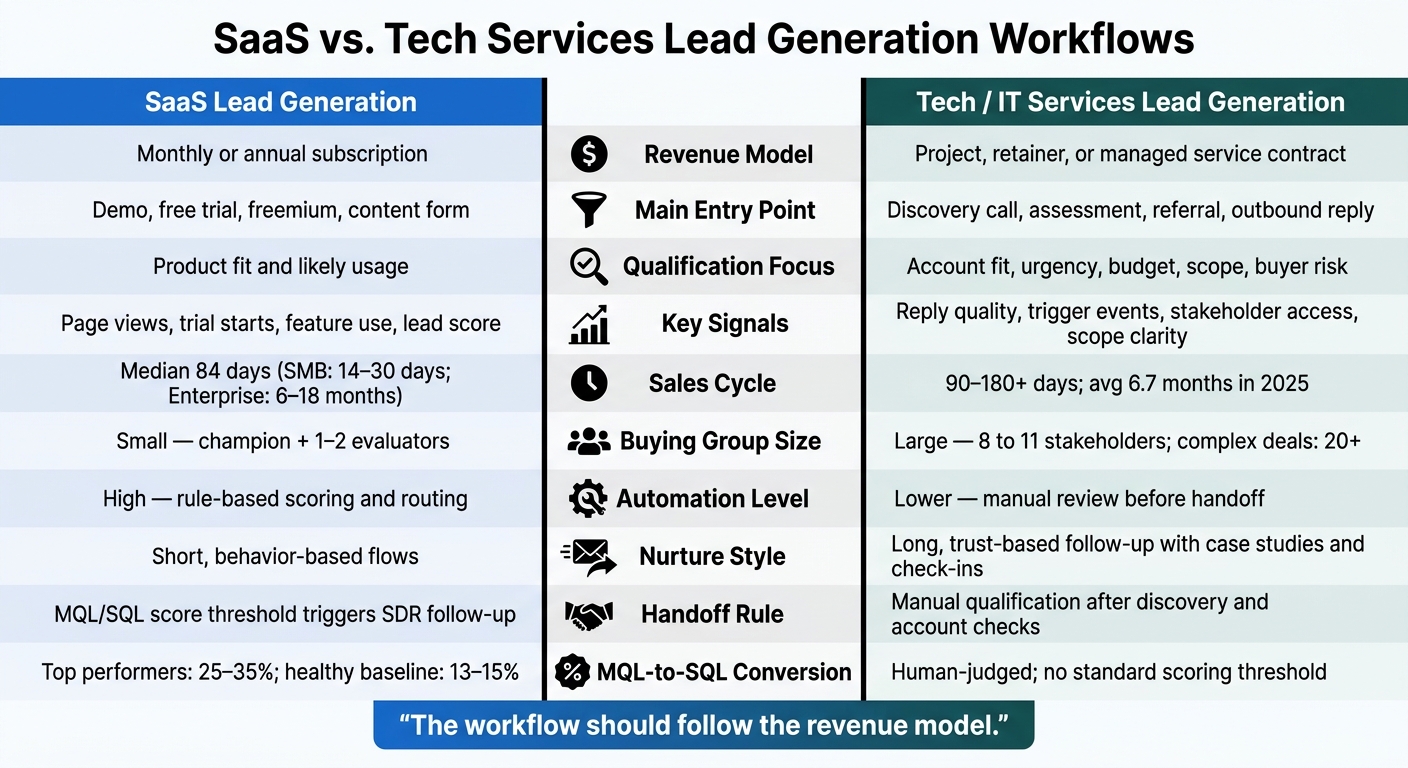
I see the split in three areas: what you target, which signals you trust, and when sales steps in. SaaS leans on volume, scoring, product use, and faster routing. Tech and IT services lean on account fit, buying-group depth, longer nurture, and manual review before handoff.
Here’s the short version:
SaaS usually sells subscriptions, so the workflow is built for scale, scoring, and conversion paths like demo requests or free trials
Tech services usually sell projects or retainers, so the workflow is built around fit, trust, scope, and buyer risk
SaaS teams often score leads with firmographic, behavioral, and product-use data
Tech services teams look more at stakeholder access, project timing, budget, and deal scope
SaaS cycles can be short for SMBs, but median B2B SaaS sales cycles sit at 84 days
Enterprise tech services deals often run 90 to 180+ days, with buying groups of 8 to 11 people
If I had to reduce the whole article to one line, it would be this: <u>the workflow should follow the revenue model</u>.
Score or product signal triggers SDR/sales follow-up
Manual review after discovery and account checks
Nurture style
Shorter, behavior-based flows
Longer, trust-based follow-up with proof and check-ins
So when I compare SaaS vs. tech lead generation, I’m not just comparing channels. I’m comparing two very different buying motions that need different routing, scoring, and handoff rules.
sbb-itb-a781ab9
How SaaS Lead Generation Workflows Are Built
Unlike service-led tech sales, SaaS workflows are built to qualify leads fast and then turn that process into something a team can repeat at scale. The goal is simple: handle a lot of volume, sort people into the right path, and stop sales reps from burning time on poor-fit leads.
Digital Channels and Product-Led Entry Points
Most SaaS teams pull leads from a mix of channels, including SEO, LinkedIn, webinars, paid search, review sites, retargeting, and email nurture. Some of these channels build pipeline over time. Others bring in people who are already looking for a solution.
The key is tying those channels together. That usually means shared forms, UTM tracking, and the same core offers across campaigns, such as "Book a demo", "Start free trial," or "Download guide."
In product-led growth motions, the free trial or freemium signup is the main front door. Instead of starting with a discovery call, the product does the early filtering. Teams watch usage signals like logins, team invites, feature adoption, and integrations to judge intent. That's the big shift: the product stops being just the thing you sell and starts acting like part of the sales process.
Those entry points only do their job if the workflow sends each lead into the right next step, whether that's a lead score, a nurture track, or a trial motion.
Qualification, Scoring, and Funnel Movement
A typical SaaS flow looks like this: anonymous visitor → known lead → MQL → SQL → opportunity → customer → expansion.
In self-serve motions, content, SEO, and paid search often push people into a trial or freemium tier. In sales-assisted motions, demo requests, outbound email, LinkedIn outreach, and intent data help SDRs move MQLs into meetings.
SaaS teams usually score leads using a mix of signals:
Firmographic data
Demographic data
Behavioral data
Product-usage data
A simple scoring model might look like this: +20 for a U.S. company with 50–500 employees, +15 for a director-level role, +10 for a pricing page visit, and +25 for starting a free trial. MQL thresholds are often set between 50 and 75 points. [1][2]
That score shapes what happens next. A lead might go into a self-serve nurture flow, get SDR follow-up, or move straight to sales. And this is where PQL-based scoring stands out: it often converts at 25%–30%, compared with 5%–10% for MQL-only approaches. [3]
SaaS Metrics and Sales Cycle Benchmarks
These workflow decisions show up fast in cost and sales cycle length. The median B2B SaaS sales cycle is 84 days, up 22% since 2022. [5]
The range is wide. SMB sales cycles can run 14–30 days, while enterprise deals can take 6–18 months. That gap changes almost everything: how much nurture is needed, how fast follow-up has to happen, and how much human input makes sense.
In SMB SaaS, the math often pushes teams toward high-volume, low-touch flows. In mid-market and enterprise, teams usually need more personal outreach and tighter handoffs. The shorter the cycle, the more the workflow needs automation for routing and qualification.
How Tech and IT Services Lead Generation Workflows Are Built
Where SaaS workflows turn product signals into speed, tech and IT services workflows turn account fit into trust.
Tech and IT services workflows depend on account fit and proof that the team can deliver. They don't rely on product-led conversion. There’s no trial-based handoff or self-serve path. Instead, the workflow is built around trust and fit, because buyers are judging operational risk. Custom projects and managed services need more human proof before a buyer says yes. That changes who gets targeted, how leads get qualified, and what kind of nurture keeps the deal moving.
Account Targeting and Account-Based Outreach
The workflow starts with a target account list. Firms segment by industry, company size, geography, current tech stack, growth stage, and operational issues. A cybersecurity consultancy might go after organizations with compliance exposure. An IT services firm might focus on manufacturers running legacy ERP systems. The tighter the criteria, the better the outreach tends to land. That targeting logic shapes list building, messaging, and routing.
Outreach is multi-channel. Email, LinkedIn, phone, referrals, partner networks, and industry events all matter. Service buyers usually need to see a provider more than once, so one channel alone rarely does the job. What makes outreach work is specificity. Referencing a known tech stack, a recent growth event, or a compliance requirement shows the message isn’t random. Messages built around a clear problem, like lowering cloud migration risk or improving incident response maturity, fit service-led sales much better than broad claims.
From there, the workflow shifts from early account interest to risk validation.
Longer Nurture Cycles and Risk-Based Qualification
Qualification moves away from product fit and toward delivery risk. The main questions are simple: Is there urgency? Who owns the budget? What are the technical requirements? Who can approve the deal internally? What does procurement look like? If a lead lacks budget ownership, technical scope, or visibility into procurement, it stays low priority.
Buying committees in enterprise tech deals include technical stakeholders, economic buyers, procurement, legal, and executive sponsors. Recent benchmarks put enterprise committees at around 8 to 11 stakeholders[6][9]. Enterprise deals often run 90 to 180+ days, and some deals above $250,000 stretch to 192 days[8][4]. B2B sales cycles have also grown by 37% since 2019, reaching an average of 6.7 months in 2025 [7].
Because these deals move slowly, nurture sequences aren’t about forcing a conversion. They’re about staying credible and relevant during a long vendor review window. That usually means case studies, technical validation content, and check-ins that keep the provider in view. In service-led sales, nurture helps hold momentum until the committee is ready to move.
SaaS vs. Tech Lead Generation: Side-by-Side Workflow Comparison
Once the core workflows are in place, the comparison comes down to three things: targeting, offer design, and handoff rules. That’s where the split becomes clear. In plain terms, the gap shows up in target, signal, and handoff.
ICP Design and Buying Committee Differences
SaaS ICPs tend to focus on product fit. Tech services ICPs lean more on need, risk, and trigger events.
For example, a managed security provider may go after mid-market healthcare organizations with HIPAA obligations and no internal security team. An IT services firm may focus on manufacturers still running legacy ERP systems and heading toward a migration decision. Same broad market category, very different reason to buy.
Buying committees also look different.
In SaaS, deals often move with a business champion plus one or two evaluators. In tech services, the group is usually much bigger. You may need buy-in from the CIO, IT director, compliance lead, procurement, and line-of-business leaders. Median enterprise buying groups for technology purchases above $100,000 ACV sit at 11 stakeholders, and complex deals can involve 20 or more[10][6]. That changes the whole motion. You can’t rely on a single contact and hope the deal carries itself. You need multi-threaded outreach and messaging shaped for each role.
Channel Mix, Lead Capture, and Offer Structure
SaaS lead capture is built for low-friction digital entry points. Think free trial signups and demo booking forms that collect just enough information to support scoring and routing.
Tech services usually take a different path. Outreach often runs through:
LinkedIn
Cold email
Referrals
Partner networks
Industry events
The offer is different too. Instead of asking for a trial, tech services teams often lead with proof of skill: a free infrastructure health check, a security gap assessment, or a discovery call. That kind of offer helps show fit before asking for a larger commitment.
Automation, Data Signals, and Handoff Logic
The split is easiest to see in a side-by-side view.
Workflow Area
SaaS
Tech Services
ICP filters
Product fit, revenue fit, team size, tech stack
Infrastructure needs, service gaps, compliance pressure, trigger events
Buying committee
Business champion + evaluators, occasional IT/security
CIO, IT director, compliance, procurement, line-of-business leaders
Manual qualification, discovery depth, then proposal or scoping
In SaaS, automation does most of the heavy lifting. Intent signals like pricing page visits, trial activations, and feature adoption milestones can trigger email sequences, SDR tasks, or in-app messages on their own. Healthy funnels usually aim for 13%–15% MQL-to-SQL conversion at a minimum, while top performers reach 25%–35%[11].
Tech services are different. Automation is useful for repeat tasks like follow-up sequences, scheduling, and basic enrichment. But qualification still depends on human judgment. Discovery depth, access to the right stakeholders, and scope clarity are not easy to score with rules alone. Software can help sort the pile. People still need to decide what’s sales-ready.
For agencies, this is where things can go right - or go sideways. These workflow differences shape how much automation you can run before lead quality starts to slip.
What These Workflow Differences Mean for Agencies Scaling Lead Generation
For agencies, these workflow gaps shape how much you can automate before quality starts to slip. And that’s the hard part: scaling both motions without rebuilding the whole machine for every new client.
Why Manual SDR Execution Breaks at Scale
A single manual SDR can research and contact about 30–50 prospects per day.[12][14] So if an agency wants to reach 10,000 leads per month, it would need about 33 SDRs. That cost setup doesn’t pencil out for most agencies.[13]
Qualification creates another limit. Each rep can usually qualify 15–20 leads per day, which means a five-person team maxes out at roughly 75–100 qualifications daily.[16]
Now add client-by-client variation into the mix. One client wants a different ICP. Another needs different messaging. Another has its own qualification rules. Before long, prospect research, list building, personalization, follow-ups, and inbox management turn into the main job. The agency spends less time thinking about growth and more time pushing tasks around.
That’s the point where automation changes the way the business runs.
How White-Label AI Workflows Help Agencies Serve Both Models
AI-driven systems can work through far more leads each day than a manual team. In plain terms, 5 SDRs using automation can engage 10,000 prospects per month - output that would otherwise take about 50 fully manual reps.[15]
That’s where a platform like SalesLabel starts to matter for agencies. SalesLabel handles lead sourcing, enrichment, personalized outreach, follow-up, scoring, inbox management, and meeting booking under the agency’s brand.
The scoring logic can also shift by client type instead of forcing every account into the same playbook:
For SaaS clients, scoring can focus on product usage intent, demo requests, trial activation, and fit signals like company size or technology stack.
For tech services clients, it can focus on project urgency, budget indicators, stakeholder seniority, and scope complexity.
Matching the Workflow to the Client Type
The right workflow comes down to revenue model, sales cycle length, and buying complexity.
Pick the workflow based on three factors: What is the client’s revenue model? How long is their sales cycle? How complex is their buying committee?
If the client sells a subscription product with repeatable use cases and fairly fast digital conversion, a SaaS-style workflow makes more sense. That usually means shorter cadences, lower-friction offers like demos or trials, and scoring tied to product engagement signals.
If the client sells implementation, consulting, or infrastructure services, a tech-services workflow is the better fit. That often calls for longer nurture sequences, consultative offers like audits or assessments, and qualification that depends more on human review before handoff.
For agencies, the smart move is to build workflows that can be configured by client. ICP filters, messaging, cadence, offer structure, and qualification logic should all be adjustable without rebuilding the full process every time. One template won’t work across every account, because the buying motion, proof points, and offer structure shift by client type - and the workflow needs to match the client’s revenue model.
Conclusion: Align the Workflow to the Revenue Model
There’s one clear rule here: the workflow has to match the revenue model.
SaaS, tech, and IT services don’t just look different on the surface. They’re built differently. And that changes how buyers act, what kind of proof they want, and how fast deals move.
So the workflow needs to fit that reality. For SaaS, that often means leaning on product-usage signals. For tech and IT services, it means focusing more on account-level intent signals. It also means using different qualification thresholds, handoff rules, and success metrics for each.
For agencies, this is where configurability matters more than templates. If ICP filters, messaging, cadence, offer structure, and scoring logic can be changed for each client without starting over every time, an agency can support both SaaS and tech and IT services accounts.
AI-driven platforms like SalesLabel can help by handling sourcing, enrichment, outreach, scoring, and follow-up under the agency's brand.
Put simply: the workflow should reflect the revenue model, not the other way around.
FAQs
How do I know if my business needs a SaaS or tech services workflow?
If manual B2B prospecting is eating up 20+ hours per rep each week, or adding more sales development reps at $5,000 to $8,000 per month per seat is starting to strain the budget, an automated workflow may make more sense.
It can also cut mistakes in list building, research, and scheduling. And because it runs around the clock, it supports 24/7, multilingual outreach without piling more work onto the team. Tools like SalesLabel can expand outreach capacity without adding headcount.
Which lead signals matter most for qualifying sales-ready leads?
The most important signals are ICP fit and engagement signals.
Start with a fit score and an engagement score. Then track how the prospect interacts over time. Add time-decay so recent activity carries more weight than older activity. After that, check those scores against actual conversion data to make sure they line up with what leads to pipeline and closed deals.
In practice, that means you should enrich and verify lead data, watch profile and post activity, segment leads by behavior, and move the highest priority to people showing strong, recent engagement.
What should agencies customize first for each client type?
Agencies should start by defining the Ideal Customer Profile (ICP) for each client. That first step gives the lead generation system a clear target, so it pulls in the right contacts instead of a random list of names.
Once those criteria are in place, SalesLabel can automate enrichment, personalize outreach, and score prospects based on behavior. Setting the criteria up front keeps the workflow aligned with each SaaS or tech client's needs.
 Lead