Turn behavior signals into timely outreach: score and route leads with signal-triggered playbooks to raise reply and qualified-meeting rates.
SalesLabel Team
Growth Expert • 16.09.2026
Share:
Hazır bir çözüm mü arıyorsunuz?
SalesLabel, giden satışı uçtan uca otomatikleştirir — yapay zekâ potansiyel müşterileri bulur, kişisellendirilmiş mesajlar gönderir ve markanız altında toplantılar ayarlar.
Most B2B outreach fails for one simple reason: it ignores timing. If I use behavior data well, I can spot who is just browsing, who is doing research, and who is close to a buying step - then match the message, channel, and follow-up window to that signal.
Here’s the short version:
I use static data to see who fits.
I use behavior data to see who is active now.
I treat demo requests, pricing-page revisits, and multi-person account activity as top-priority signals.
I keep case study downloads, webinar attendance, and repeat service-page visits in a softer follow-up track.
I leave blog visits, newsletter signups, and single email opens in nurture until a second action shows up.
I score leads with fit + intent, use score decay after inactivity, and watch account-level activity, not just one contact.
I route people into simple plays: high-intent, nurture, re-engagement, or early research.
I track what matters: reply rate, qualified meetings held, pipeline in USD, and time-to-first-touch.
I also set hard limits, like 10 touches in 30 days, to avoid over-contacting people.
A few numbers stand out. Behavior-triggered outreach can land 10%–25% reply rates, while broad cold outreach often sits around 3%–8%. And when intent is high, reaching out in under 1 hour can change results in a big way.
The core idea is simple: fit tells me who to target; behavior tells me when to act. The rest is just scoring, routing, and keeping the rules clean.
How to Personalize Cold Email Outreach at Scale With AI to Get More Replies
sbb-itb-a781ab9
Which Behavioral Signals Matter Most
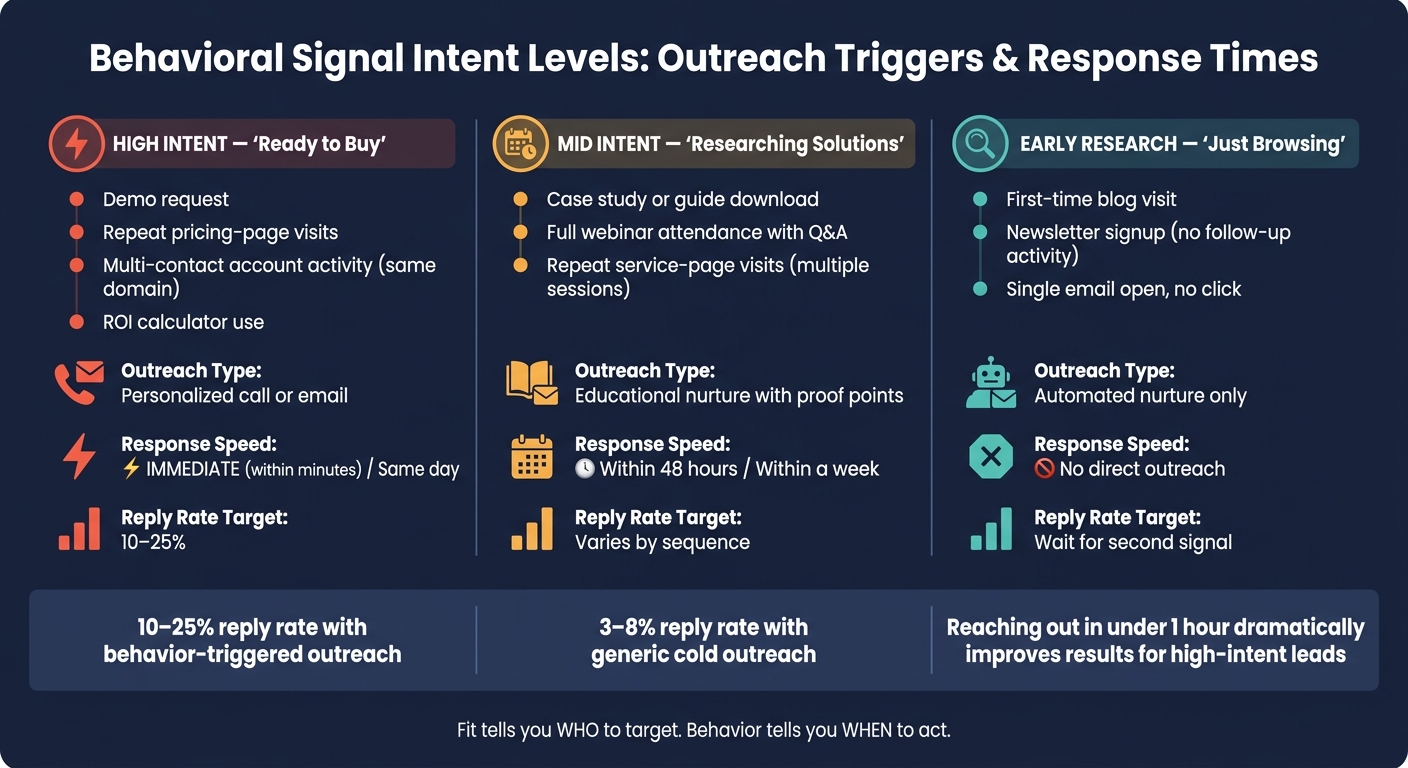
Behavioral Signal Intent Levels: Outreach Triggers & Response Times
Not every click or page view means the same thing.
Some actions suggest a prospect is ready to talk this week. Others come from someone who’s still in research mode. The goal isn’t to track more activity. It’s to connect each action to the right message and the right timing.
High-Intent, Mid-Intent, and Early Research Signals
A simple way to think about behavioral signals is by buying stage.
High-intent signals show that someone is actively deciding whether to buy. That can look like repeated pricing-page visits, a demo or consultation request, a "contact sales" form submission, or use of an ROI calculator tied to actual service or retainer ranges. If several people from the same company domain visit your site within a short window, that’s another strong sign. In many cases, it means the internal discussion is already underway.
The key difference here is urgency. High-intent signals call for fast outreach. Mid-intent signals need more context first.
Mid-intent signals show problem awareness and solution research, but not immediate buying readiness. This includes case study views, downloads of an implementation guide or vendor checklist, full webinar attendance with Q&A participation, or repeated visits to service pages across multiple sessions. These prospects are weighing options, so the follow-up should offer proof and help, not a hard sales push.
Early research signals sit at the top of the funnel. A first-time blog visit, a newsletter signup with no follow-up activity, or a single email open all fit here. These actions show curiosity, not intent to buy. Keep these contacts in nurture.
Mapping Signals to Outreach Triggers
Each signal should connect to a clear response speed and message type.
For high-intent signals, speed matters. A demo request or repeated pricing-page visit should trigger personalized outreach within minutes during business hours. The message should mention the specific action, tie it to a clear outcome, and end with a direct, time-based CTA like, "How does Thursday at 2:00 PM ET work for a 20-minute call?"
For mid-intent signals, the tone shifts toward education and trust. If someone downloaded a case study or attended a webinar, follow up in a way that shows you understand what they’re researching. Offer something useful, like a relevant benchmark or a short diagnostic. A low-friction CTA works best here, such as "Reply if you'd like a quick audit."
For early research signals, patience wins. Don’t jump into direct outreach until there’s a second engagement or a clearer pattern. Use automated nurture with soft CTAs.
Signal-to-Trigger Comparison Table
Behavioral Signal
Intent Strength
Recommended Outreach Type
Response Speed
Demo request
High
Personalized call or email within minutes
Immediate
Repeat pricing-page visits
High
Direct outreach referencing specific pages; meeting CTA
Same day
Multi-contact account activity
High
Account-level outreach; involve senior rep
Same day
Case study or guide download
Mid
Personalized nurture with industry-specific proof
Within 48 hours
Full webinar attendance
Mid
Recap email with audit offer or soft CTA
Within 48 hours
Repeat service-page visits
Mid
Educational content; low-friction next step
Within a week
First-time blog visit or newsletter signup
Early
Add to educational nurture sequence
No direct outreach
Single email open, no click
Early
Continue nurture; wait for stronger signal
No direct outreach
Use these signals to decide what to score, route, and automate next.
Next, turn these signals into a scoring model that keeps outreach consistent.
Building the Data and Scoring Foundation
Signals only matter if they land in one place fast enough for your team to use them. Once you know which actions matter, the next job is simple: pull them together and score them the same way every time.
Centralizing Website, Email, and CRM Activity
Most agencies already sit on the data they need. The issue isn't lack of data. It's that the data lives in different tools, so acting on it gets messy and slow.
Choose one platform as your system of record. In most cases, that's a CRM like HubSpot or Salesforce, or a modern sales engagement platform. Then send all behavior data into that system. Website activity should come in through your analytics setup. Email engagement - clicks, replies, and bounces - should sync from your marketing and outbound tools. Outbound work like calls, LinkedIn messages, and manual emails also needs to be logged the same way every time, either through integrations or a standard manual workflow your team sticks to.
Before connecting anything, define shared event names and fields. Labels such as "Website: Pricing Page View" and "Email: Clicked Pricing Link" keep data clean and easy to compare across tools. Each contact and account also needs a unique identifier so website sessions, email events, and CRM records can join into one timeline. If that piece is missing, duplicate records and mismatched timestamps can make reporting feel shaky.
When every event sits in one timeline, score updates can happen right away and with less guesswork.
Creating a Behavior-Based Lead Scoring Model
A scoring model should keep fit and intent separate.
A practical 0–100 model can split down the middle: up to 50 points for fit and up to 50 for intent. [2][5][8] Fit looks at firmographic data like industry, company size, and job title to show how close a lead is to your ideal customer profile. Intent adds behavior signals to show how close that lead may be to a buying decision. Set clear tiers so the team knows what each score means:
80–100: sales-ready
50–79: nurture
Below 50: marketing-only nurture
Intent signals should be weighted based on how closely they line up with closed deals. [1][2][3][5][8][9] For example, a demo request might earn +40 points. A pricing page visit could add +20. A positive reply to a cold email might be +30. A newsletter open with no click may be just +5. Negative signals count too. An unsubscribe should remove points, and a spam complaint should drop a contact far below your outreach threshold.
Score decay keeps the list current. Remove a few points after 14 days of no activity, then keep lowering the score during longer periods of inactivity. [4][5][7] That way, your team stays focused on people who are engaged now, not someone who visited the site six weeks ago and disappeared.
For committee-based deals, account-level scoring matters just as much as contact-level scoring. [3][6][7] If three people from the same company domain visit your case study page within a week, that says more than a single visit from one person. Roll contact scores into one account score, then set a trigger point - for example, an account score that jumps 20 points within 48 hours. That kind of spike can kick off a coordinated outreach play.
Data Quality, Consent, and Compliance Basics
Clean scoring falls apart if the data is wrong, stale, or collected without clear permission.
Run regular spot-checks. Make sure key pages still fire tracking events. Check that email metrics match what's shown in your CRM. Test form submissions from start to finish. Tracking tends to break at the worst time - right after a landing page redesign or a switch to a new email tool. Finding those breaks early saves a lot of cleanup later.
On the compliance side, U.S. agencies need to stay current with CAN-SPAM for commercial email, TCPA for calls and SMS, and state-level laws like CCPA for contacts in California. Every marketing email needs an unsubscribe link. Opt-outs should sync across systems. Your privacy policy should spell out how behavioral data is used. For calls and outbound messages, respect time zones. Don't contact people outside normal business hours in their local time, and keep your do-not-call list current.
Keep access to behavioral data role-restricted. Track only what your team needs to make outreach decisions, and put your data-use policy in writing. Review it at least once a year as U.S. rules keep shifting.
Once the rules are set, the platform should handle score updates and outreach routing on its own.
SalesLabel can centralize enrichment, real-time scoring, and behavior-triggered outreach under your agency's brand. Agencies can set scoring rules right inside SalesLabel, assigning weights to signals like pricing page visits, email clicks, and meeting bookings. As new behavior comes in, the platform updates each contact's score in real time. Higher-scoring leads can move into tailored outreach sequences, while lower or mid-range scores can shift into nurture tracks with educational content. Under the agency's brand, it feels like a system your team built for itself.
Designing Personalized Outreach Playbooks
Once scoring is live and behavior data is landing in one place, the next move is simple: turn those signals into plays your team can run again and again.
A playbook is just a set of rules for the trigger, message, channel, and inputs. Use the score tiers above to send contacts into the right play. Then line up each play with the high-, mid-, and early-intent signals already defined. The aim is to make outreach feel personal without rebuilding every message from scratch.
Signal-Gated Sequences by Buying Stage
A signal-gated sequence starts only when a specific action happens, or moves forward only after that action appears. That keeps outreach tied to actual intent instead of some random schedule.
In most cases, four plays handle the bulk of outreach.
The high-intent playbook starts when a prospect shows a sales-ready signal. Here, speed matters. Send a same-day email, then follow with a LinkedIn message or a call, then one follow-up.[10][11] Keep it short. Keep it tied to the moment.
The nurture playbook fits people who download a guide, join a webinar, or like or comment on social posts. They’re learning, not ready to buy yet. So the sequence can run longer, usually with weekly educational touchpoints and softer CTAs. The point is to help them see how similar companies deal with the problem.
The re-engagement playbook is for contacts who used to be active but have gone quiet, along with closed-lost and churn-risk accounts. Lead with a recent case study, benchmark report, or another new proof point. Then close with an easy way to reconnect.[12]
Each sequence should stop or reset as soon as a stronger signal shows up. If someone in nurture suddenly visits the pricing page, don’t wait for the next scheduled email. Move them into the high-intent play.
Personalization Inputs That Move the Needle
Some personalization helps. Some just adds noise.
The inputs that matter most are recent behavior, role and seniority, company context, industry, account-level activity, and timing around the trigger.
Recent behavior gives you the opening line and makes the message feel current. Role changes the angle. A VP of Sales cares about quota attainment and rep productivity. A CFO is more focused on ROI and risk reduction. Company context, like a funding round, hiring spike, expansion, or tech-stack change, gives you a natural reason to reach out. Account-level activity can show whether your message should help the buyer build internal support. Timing pulls it all together. Funding news, quarter-end pressure, or seasonality can shift both the angle and the CTA.
Anchor each message on one signal plus one or two context points. More than that can feel a little too close for comfort.
Choosing the Right Channel Based on Behavior
Pick the channel based on what the prospect has already done.
Email works best when you need room for context, proof points, and case-study-led follow-up. It also scales well and lets the prospect read on their own time. LinkedIn works well for warm outreach after someone has engaged with content or viewed a profile. Phone is best when intent is high and timing is tight. Retargeting helps keep repeat engagers warm until they show a stronger buying signal.
For high-intent accounts, use a mix of channels: email, LinkedIn, and a call within 72 hours. For mid-range engagement, email plus retargeting is usually enough until the next stronger signal appears.
Playbook Comparison Table
Playbook Type
Trigger Behavior
Primary Channel
Core Personalization Inputs
High-Intent
Sales-ready signal: demo request, pricing page revisit, or trial start
Email + phone
Recent behavior, role, company context, timing
Nurture-Stage
Content download, webinar attendance, or social engagement
Email or LinkedIn
Role, industry, recent content behavior, timing
Re-engagement
Dormant, closed-lost, or churn-risk account
Email with LinkedIn follow-up
Past interaction, new case study or proof point, timing
Early Research
First blog visit or single social interaction
Automated nurture only
Role, industry, timing
SalesLabel can route leads into the right sequence and generate the first outreach draft based on score, role, industry, and recent behavior.
Once these plays are live, track which triggers convert and tighten the rules that overfire.
Running and Improving Behavior-Based Outreach at Scale
Once your playbooks are live across multiple clients, the job changes. You’re no longer just building the system. Now you need to keep it sharp, keep it clean, and make sure it keeps producing revenue instead of just noise.
That starts with tracking the right numbers. Tag every metric by trigger type and client so you can see which behaviors lead to pipeline, not just clicks, replies, or booked calls.
Core Metrics to Track
Track each metric by trigger type and client.
Response rate shows whether your message and timing are connecting. With behavior-based outreach, 10–25% reply rates are a solid target when strong signals trigger the sequence. Generic cold outreach usually falls in the 3–8% range.
Qualified meeting rate matters more than raw bookings. A calendar invite means very little if the prospect doesn’t show up or isn’t a fit. No-shows can quietly wipe out 20–40% of booked meetings [14], so track meetings held using clear qualification rules, not just accepted invites. Strong outbound programs turn 3–8% of contacted leads into qualified meetings.
Pipeline generated needs to be split by client, campaign, and trigger type. Measure it in USD, log it in your CRM’s opportunity value fields, and review it monthly. This is the metric that shows which behavior signals deserve more attention.
Speed-to-contact matters more than many teams think. Reaching out within 5 minutes can make qualification much more likely than waiting 30 minutes [15][16]. For high-intent actions like trial starts or repeat visits to the pricing page, your SLA should stay under 1 hour during business hours.
Metric
What It Tells You
Target Range
Response rate
Message and timing quality
10–25% (behavior-triggered)
Qualified meeting rate
Lead quality and sequence fit
3–8% of contacted leads
Pipeline generated (USD)
Revenue impact by trigger
Segment by client and signal
Speed-to-contact
Activation speed on high-intent signals
Under 1 hour for high-intent
Testing, Guardrails, and Continuous Improvement
Once your metrics are tagged by trigger, the next step is tightening the system: what fires, what converts, and what should be suppressed.
Review scoring weights and trigger rules on a regular basis because buyer behavior changes. Run a monthly optimization cycle, then use quarterly reviews to reset scoring weights. Keep tests simple. Change one variable at a time, whether that’s timing windows, personalization depth, or scoring thresholds.
A test works best when the outcome is clear. For instance, a hypothesis like "Raising the score threshold for sales outreach from 50 to 70 will improve qualified meeting rate by 20% for mid-intent leads" gives you something concrete to measure. Track reply rate, meeting rate, and pipeline for each test arm using the same lead segments.
Guardrails matter just as much as testing. Without them, teams end up piling touches on the same lead and burning interest.
Use a few hard rules:
Cap outbound at 10 touches in 30 days across all channels.
If multiple signals appear at once, route the lead into a single sequence based on the highest-intent trigger.
After several ignored touches, pause outbound for 30–60 days.
SalesLabel’s real-time lead scoring and inbox management can apply these rules across all client accounts automatically, which saves your team from managing caps and suppression logic by hand.
Common Mistakes in Behavior-Based Outreach
Behavior-based outreach tends to drift when teams stop reviewing trigger rules, timing, and shared definitions. A few mistakes come up again and again.
Overreacting to weak signals is the big one. One blog visit is not a buying signal. If you launch a sales sequence off one low-intent action, reply rates drop and outreach starts to feel random. Set a minimum score, or require more than one signal, before sales outreach begins.
Stale data is another issue, and it often slips by unnoticed. If someone attended a webinar six months ago, that alone is a weak reason to contact them today. Recency matters. Build time decay into your scoring model and set expiration windows by trigger type. Research suggests 87% of organizations report unreliable or inflated intent signals[13], so old signals shouldn’t be enough to trigger outreach.
Overly specific personalization can also hurt. Mentioning the exact time someone visited a page doesn’t feel helpful. It feels creepy. Keep personalization tied to context instead. Mention what they looked at and why it may matter to them.
Misaligned definitions between sales and marketing can quietly break the whole process. If one team sees a lead as high intent and the other doesn’t, handoffs get messy fast. Align both teams on intent tiers and score thresholds so the system still works as client volume grows.
Conclusion: Turning Behavior Insights Into Better Outreach
Behavior-based outreach works for a simple reason: it turns signals into timing, timing into triggers, and triggers into revenue. Instead of reaching out to everyone on a list and hoping something sticks, you focus on prospects who are already showing intent, like pricing page visits, demo requests, and repeat content engagement. That approach works when signals, scoring, and timing stay tied together.
The system itself is pretty simple: signals, scoring, triggers, and playbooks. Behavioral segmentation works because it matches the message to the right moment and the right level of intent.
Review signal weights and thresholds on a regular basis. Buyer behavior shifts, and stale rules can weaken outreach. The best way to improve the system is to start small with a narrow test you can repeat.
A Simple Starting Plan for Agencies
Start with one focused use case. Choose three high-intent signals: pricing page visits, demo requests, and case study downloads. Assign points, set an SDR follow-up threshold, and launch one trigger-based playbook.
Then track a few core numbers:
Reply rate
Qualified meetings held
Pipeline generated in USD
If those numbers beat your previous static outreach, you’ve got proof the model works and a strong case for rolling it out to more signals, more clients, and more channels.
If you want to put that process into action fast, use a platform built for it. SalesLabel's real-time scoring and automated sequences help agencies run behavior-based outreach under their own brand.
FAQs
How do I start with behavior-based outreach?
Start by pulling live data from your site, email activity, and intent signals to spot prospects who are ready to act. Then use lead scoring to rank them based on engagement and how closely they match your ICP.
SalesLabel can help automate lead enrichment, behavior-based segmentation, tailored messaging, and follow-ups, so your team can respond to buyer intent fast and scale personal outreach.
What signals should trigger sales outreach?
Sales outreach works best when it starts from real-time behavior that points to high intent and a close match with your ideal customer profile.
The main signals to watch are website activity, email engagement, broader intent data, and live inbox signals. SalesLabel uses AI to read these touchpoints so agencies can focus on the right leads and reach out when prospects are most likely to convert.
How often should I update lead scores?
Update lead scores in real time so your outreach stays effective and in step with buyer behavior.
SalesLabel’s AI-driven scoring updates as new signals come in. That includes site visits, email engagement, and intent data. The result is simple: your team works from the latest behavior, reaches out at the right moment, and puts high-intent leads first.