AI scheduling saves time, cuts errors and cost, and scales far beyond manual SDR booking.
SalesLabel Team
Growth Expert • 08.05.2026
Share:
Hazır bir çözüm mü arıyorsunuz?
SalesLabel, giden satışı uçtan uca otomatikleştirir — yapay zekâ potansiyel müşterileri bulur, kişisellendirilmiş mesajlar gönderir ve markanız altında toplantılar ayarlar.
Manual scheduling wastes time and risks losing leads. AI scheduling solves these issues by automating the process, improving speed, accuracy, and scalability. Here’s why AI scheduling is better:
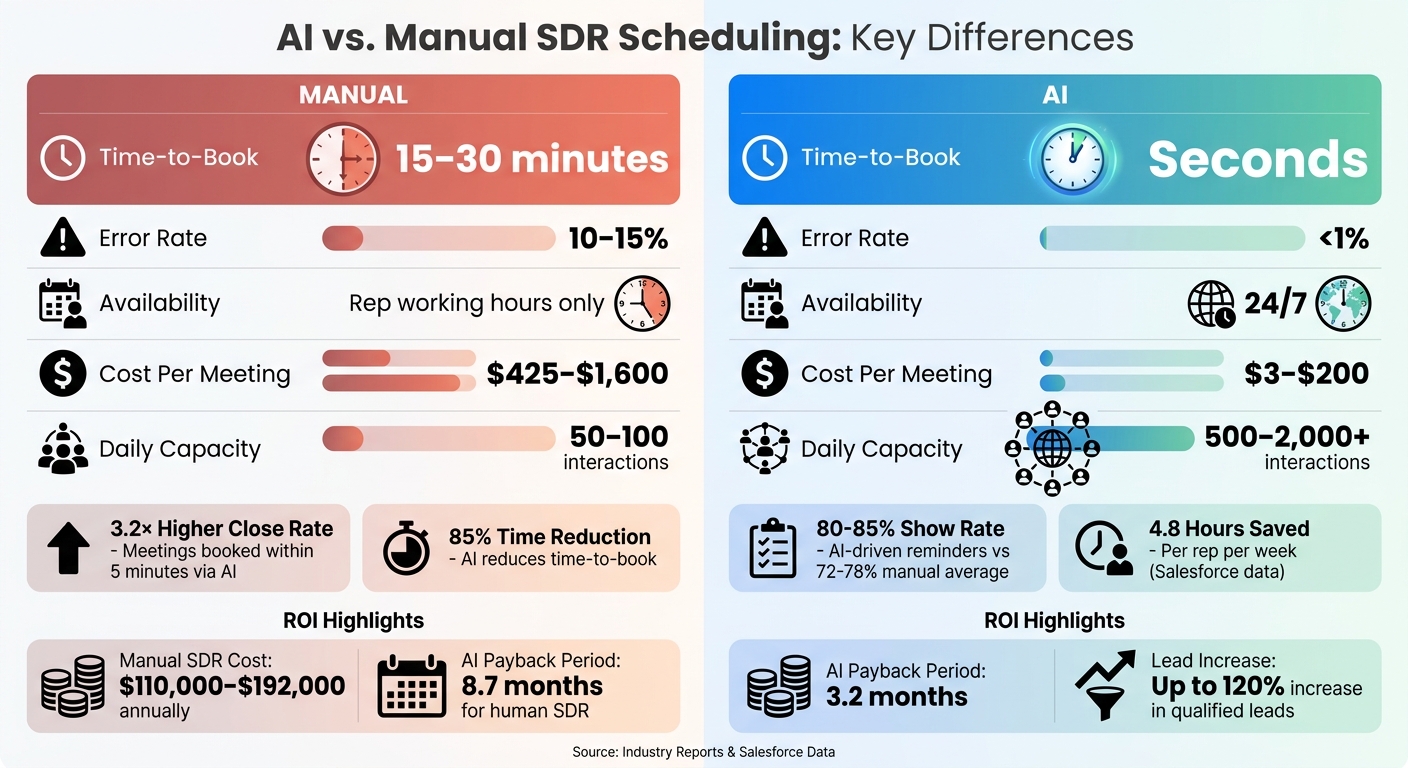
Time Saved: Manual scheduling takes 15–30 minutes per meeting with 4–6 emails. AI completes it in seconds.
Fewer Errors: Manual processes have a 10–15% error rate (e.g., timezone mistakes). AI reduces errors to less than 1%.
Higher Close Rates: Meetings booked within 5 minutes via AI are 3.2× more likely to close.
Cost Efficiency: Manual scheduling costs $425–$1,600 per meeting. AI reduces this to $3–$200.
Scalability: AI handles up to 2,000 interactions daily, while humans manage 50–100.
Quick Comparison
Feature
Manual Scheduling
AI-Powered Scheduling
Time-to-Book
15–30 minutes
Seconds
Error Rate
10–15%
<1%
Availability
Rep working hours only
24/7
Cost Per Meeting
$425–$1,600
$3–$200
Daily Capacity
50–100 interactions
500–2,000+ interactions
AI scheduling not only saves time and money but also ensures no lead slips through the cracks, helping sales teams focus on closing deals instead of wasting hours on admin tasks.
AI vs Manual SDR Scheduling Comparison: Time, Cost, and Performance Metrics
Automate Meeting Scheduling with Jason AI SDR
sbb-itb-a781ab9
What is Manual SDR Scheduling?
Manual SDR scheduling refers to the traditional way sales development representatives (SDRs) handle every aspect of booking meetings. From researching prospects to sending out calendar invites, SDRs manage the entire process without automation. This approach involves constant email monitoring, juggling calendars, and multiple back-and-forth exchanges just to secure a single meeting.
The process kicks off with lead discovery, where SDRs manually search platforms like LinkedIn or Apollo and cross-check data with spreadsheets. After initiating outreach - via cold emails or calls - they monitor inboxes for responses. When a prospect shows interest, the real coordination begins: SDRs open calendars, propose time slots, manage scheduling conflicts, and account for timezone differences manually. They also create calendar events, generate video conferencing links, and send formal invitations. All of this happens while ensuring follow-ups keep the prospect engaged [1][5][7]. It’s a time-consuming and error-prone process that highlights the need for more efficient, automated alternatives.
Steps in Manual Scheduling
Manual scheduling involves several time-intensive steps. After identifying potential leads and sending outreach messages, SDRs monitor inboxes for responses. Once a prospect expresses interest, SDRs manually coordinate schedules by proposing time slots. This often leads to a tedious back-and-forth negotiation, where managing timezones becomes critical. In fact, timezone errors account for 12% of scheduling failures in global outreach [5].
Next, SDRs create the calendar event, generate meeting links (e.g., Zoom or Google Meet), and send manual follow-ups to ensure the meeting is confirmed. Without automated reminders, 35% of tentative meetings remain unconfirmed [5]. On average, this process requires 4 to 6 email exchanges and takes 15 to 30 minutes of effort per meeting [1]. As Andres Muguira from SalesSheet.ai aptly states:
"Scheduling a meeting should take five seconds. Instead, it usually takes five emails." [6]
Problems with Manual Scheduling
Manual scheduling creates numerous inefficiencies that slow down the sales process. Switching between CRM tools, email platforms, and calendars fragments focus and reduces productivity. Timezone mistakes and availability conflicts result in 23% of interested prospects disengaging during the scheduling process [5]. According to the Salesforce State of Sales Report:
"Manual scheduling friction, the back-and-forth emails, timezone confusion, forgotten follow-ups, costs B2B sales teams an average of 4.8 hours per rep per week." [5]
Human error and inconsistency are also major drawbacks. SDRs spend 72% of their time on non-selling tasks like lead scraping and data entry [7]. This administrative burden contributes to a 34% annual turnover rate among SDRs, the highest of any sales role [8]. Speed is another critical factor - prospects who book meetings within 5 minutes of expressing interest are 3.2 times more likely to close than those who book after 24 hours [5]. Manual processes simply cannot keep up with this pace.
The financial cost is equally concerning. For agencies handling 100 meetings per month, manual scheduling labor costs range from $1,250 to $2,500 monthly [1]. These inefficiencies not only waste time but also limit growth potential. The challenges of manual scheduling make a strong case for adopting smarter, automated solutions.
What is AI-Powered SDR Scheduling?
AI-powered SDR scheduling automates booking meetings by syncing directly with platforms like Google Calendar or Microsoft Outlook. It eliminates the back-and-forth of manual email exchanges, making scheduling quicker and hassle-free. The system uses Natural Language Processing (NLP) to interpret phrases like "next Tuesday at 2pm" into exact calendar entries [6]. Additionally, agentic AI enables the system to make autonomous booking decisions without needing human input [10][11].
Unlike traditional booking links that redirect prospects to external pages, AI scheduling integrates directly into conversations. It offers 3–4 specific time slots, creating a smoother experience and improving acceptance rates. The system also handles timezone conversions, adjusts for Daylight Saving Time, and respects user preferences like buffer times and working hours. The Rocket Agents team sums it up well:
"AI scheduling is more than a simple calendar link. It's an intelligent system that handles the entire booking lifecycle - from initial time proposal to post-meeting follow-up." [9]
To reduce no-shows, the system sends automated confirmation sequences, such as immediate confirmations, 24-hour reminders, and 1-hour nudges. If cancellations happen, it suggests alternative times with full context, recovering up to 40% of potentially lost meetings. These features work together to simplify the entire scheduling process.
Core Features of AI Scheduling
AI scheduling platforms combine advanced technologies to make booking seamless:
Real-Time Calendar Intelligence: Syncs with calendars in real-time to avoid double-booking, even during last-minute changes.
Automated Timezone Adjustments: Detects prospect locations via email headers or IP data, ensuring proposed times are converted to their local timezone and adjusted for Daylight Saving Time.
Predictive Analytics and Sentiment Analysis: Uses historical data to identify the best meeting times and applies sentiment analysis to prioritize high-interest leads.
Smart Rescheduling & Behavioral Insights: Tracks abandoned booking attempts, refines reminder strategies, and proactively follows up to recover lost opportunities.
CRM-Aware Scheduling: Links meetings directly to CRM records, ensuring all details are logged accurately while preventing overbooking during peak times.
Benefits of AI in Scheduling
The combination of these features results in faster, more accurate scheduling. AI scheduling reduces the time-to-book by 85% [5], completing in seconds what usually takes an average of 8.1 email exchanges per meeting [9]. This efficiency can save up to 20 hours a week previously spent on administrative tasks.
Speed is critical in sales. Reaching out to a lead within 5 minutes increases the likelihood of qualifying them by 21 times compared to waiting 30 minutes [9]. Additionally, meetings scheduled within 5 minutes of initial interest have a 3.2× higher close rate compared to those booked 24 hours later [5]. As noted by Aurium Research:
"The gap between 'interested' and 'on the calendar' is where most pipeline dies." [5]
AI scheduling also reduces errors, such as the 12% failure rate tied to manual timezone conversions. It boosts meeting attendance too, with AI-driven reminders maintaining show rates of 80% to 85%, compared to the industry average no-show rates of 22% to 28%. Even if unexpected changes arise, the system ensures meetings are rescheduled promptly, operating 24/7 to respond to interest as soon as it’s expressed. This approach removes common bottlenecks in manual scheduling, paving the way for a more efficient sales process.
Efficiency and Accuracy Differences
AI scheduling leaves manual scheduling in the dust when it comes to speed and precision. While coordinating a meeting manually can take 15–30 minutes and involve 4–6 emails per meeting[1], AI systems handle the same task in seconds - cutting the time-to-book by a whopping 85%[5]. Even more impressive, meetings booked within 5 minutes are 3.2 times more likely to close successfully[5].
How AI Reduces Scheduling Errors
Speed is just one piece of the puzzle - accuracy is where AI scheduling truly shines. Manual scheduling is prone to mistakes, with an error rate of 10–15%, including a significant 12% caused by timezone mismanagement[4][5]. AI tools nearly eliminate these issues, reducing errors to less than 1% by automatically managing timezones and resolving conflicts[4].
For instance, Citrix saw a dramatic shift after adopting AI scheduling. Previously, 30% of their meetings needed rescheduling due to conflicts or errors. Post-AI implementation, this rate dropped to under 5%[4].
Another common problem with manual scheduling is the lack of follow-up. Without automated reminders, 35% of tentatively scheduled meetings never get confirmed[5]. AI solves this by sending instant confirmations and layered reminders. Additionally, 23% of prospects lose interest during manual scheduling due to timezone or availability issues[5]. AI removes these barriers, ensuring smoother interactions.
Time-to-Schedule Comparison
When it comes to closing deals, timing is everything. Manual scheduling often takes hours - or even days - to finalize, while AI responds in seconds, no matter the time of day[2]. According to the Salesforce State of Sales Report, this lag costs B2B sales teams an average of 4.8 hours per rep each week[5]. Companies like Accenture have seen the difference firsthand, cutting scheduling time by 70% with AI. This saved them 1.5 hours per employee per week, adding up to an impressive 12,000 hours annually[4].
Manual vs. AI Scheduling Comparison Table
Here’s a side-by-side look at how AI scheduling outperforms manual methods:
When it comes to cost and scalability, AI scheduling stands out as a game-changer. For growing agencies, the financial gap between manual scheduling and AI-powered solutions becomes even more apparent. A single human SDR costs between $110,000 and $192,000 annually when factoring in salary, benefits, taxes, and recruiting fees [14]. To maintain 24/7 availability like an AI system, you'd need at least three full-time employees working in shifts - tripling those costs [13].
Cost Per Meeting Booked
The cost per meeting (CPM) is another area where AI dominates. Manual scheduling costs range from $425 to $1,600 per qualified meeting. In contrast, AI tools like SalesLabel can secure meetings for as little as $3 to $200 [14]. For example, SalesLabel’s Starter plan, priced at $799 per month, can handle the workload of multiple SDRs who would otherwise cost $8,000 to $15,000 monthly [14]. That’s an 88% reduction in CPM for many agencies [15].
Scaling with a human team adds expenses like recruitment and training, while AI systems scale instantly. With SDRs averaging a tenure of just 14–18 months, agencies face a constant cycle of hiring and onboarding [15]. On the other hand, AI systems can be up and running in 24–48 hours and operate round the clock [16].
Scalability Metrics
AI scheduling offers instant scalability. Adjusting capacity is as simple as tweaking configurations, with almost no additional cost [14]. Compare that to manual scaling, which requires 3–6 months of recruiting, hiring, and training new staff [14]. While a human SDR can handle around 50–100 activities daily, AI systems manage between 500 and 2,000+ prospect interactions [14]. The results speak for themselves: companies using AI have reported up to a 120% increase in qualified leads, with 83% noting measurable improvements in their sales pipeline [14].
"AI SDRs win on volume, speed, cost and consistency. Human SDRs win on complex deals, strategic relationships and creative problem solving." - Multiply Revenue Sales Operations Team [15]
The ability to scale effortlessly makes AI scheduling an invaluable tool for driving growth.
ROI of AI Scheduling
The ROI comparison between AI and human scheduling further highlights AI's advantages. The payback period for AI scheduling averages just 3.2 months, compared to around 8.7 months for a human SDR [17]. Beyond cost savings, AI ensures no lead slips through the cracks - 34% of meetings stem from prospects engaging outside of standard business hours [15].
Take SaaStr, for instance. In January 2026, they closed over $1 million in revenue within 90 days of deploying AI agents, achieving a 6.7% outbound response rate - double the industry average [18]. Similarly, Greenhouse saw its chat-to-meeting conversion rate soar from 20% with human teams to between 50% and 70% with AI [18].
This combination of cost efficiency and consistent performance doesn’t just save money - it drives sustained growth for the sales pipeline.
SalesLabel takes the convenience and precision of AI scheduling and adapts it specifically for agencies. It automates tasks like lead discovery, personalized outreach, and meeting scheduling, allowing your team to concentrate on closing deals. Two key modes - Autopilot and Copilot - offer flexibility: Autopilot handles conversations entirely on its own, while Copilot drafts responses for human review. Using LinkedIn insights and real-time intent scoring, SalesLabel creates highly personalized messages and updates lead statuses instantly. When a prospect expresses interest, the AI seamlessly schedules meetings directly into your calendar, all while maintaining your agency’s branding [19].
How SalesLabel Scales Agency Operations
The platform’s features directly enhance operational efficiency and deliver measurable results. Agencies report a 40–55% increase in qualified meetings and a 30–45% reduction in cost per meeting. This is like adding the productivity of 1.5 to 2 full-time team members to a five-person group. Since manual scheduling typically consumes 60–70% of a representative's time, SalesLabel reduces this oversight to just 2–4 hours per week, boosting lead-to-meeting conversions by 25–35%[20].
SalesLabel’s pricing is designed to reflect these performance improvements, offering packages that cover the equivalent workload of multiple SDRs at a fraction of the usual cost.
Impact on Pipeline Growth
AI scheduling doesn't just enhance efficiency - it delivers tangible results for pipeline growth. The improvements are immediate and measurable. Take HouseofMVPs, for example. Before adopting AI, their sales team, led by VP of Sales Thomas Wright, managed 500 inbound leads per month manually. After introducing an AI sales agent to monitor their CRM and handle BANT qualification, lead response times plummeted from 4 hours to just 90 seconds. As a result, their qualified meetings skyrocketed from 45 to 108 per month - a 2.4× increase. Wright summed it up:
"Our SDRs were spending 70% of their time on leads that would never buy. The AI handles all initial qualification now. Response time went from 4 hours to 90 seconds, and our qualified meeting rate more than doubled." [21]
The benefits go beyond speed. At Cotera, founder Ibby Syed introduced AI meeting prep agents in March 2026, transforming how the sales team operated. For instance, rep Anya used to spend 35 minutes researching each prospect. With 90-second AI briefs, she now saves 3 hours daily, boosting her pipeline value by 40% in just one quarter. Meanwhile, her colleague Tomás saw his close rate jump from 16% to 24%[22].
The importance of rapid engagement can't be overstated. Responding to an inbound lead in under a minute, compared to 30 minutes, can increase conversion rates by up to 391%[23]. AI scheduling ensures that prospects are engaged before their interest wanes. In one standout example at Cotera, an AI enrichment agent identified a booking from a generic Gmail address as the CTO of a target account, verified through LinkedIn. Armed with this insight, the team assigned a senior enterprise rep to the meeting, leading to a $67,000 deal[22].
AI also excels at follow-ups, a critical yet often overlooked part of the sales process. While manual methods typically follow up on only 58% of meetings, AI-powered systems achieve follow-up rates as high as 96%. Post-meeting response rates also improve, rising from 31% to 48%[22]. These consistent follow-ups, combined with faster initial responses, significantly enhance pipeline performance. As sales rep Marcus put it:
"A slightly off-base follow-up sent two hours after the meeting beats a perfect follow-up sent never." [22]
When to Choose AI Over Manual
Switching from manual to AI scheduling becomes crucial when inefficiencies start to hinder productivity. For example, if your sales reps are spending 15–20 hours a week on administrative tasks instead of selling, you're losing valuable time that could be driving revenue[20]. That’s nearly half their workweek tied up in non-revenue-generating activities.
Another key factor is response time. Studies show that leads contacted within five minutes are far more likely to convert. In fact, responding within five minutes instead of 30+ minutes boosts conversion rates by an impressive 391%[20]. If your manual process slows down response times, it’s likely costing you opportunities and giving competitors an edge.
Pipeline performance offers another clue. If your team is hitting activity benchmarks - like calls and emails - but the number of qualified meetings isn’t growing in line with lead generation, manual scheduling may be the bottleneck. This is especially true if your team is managing more than 20–30 meetings per month, where manual scheduling becomes increasingly inefficient[1].
Signs Your Agency Needs AI Scheduling
High SDR turnover is a major red flag. With an average tenure of just 14 months[3], frequent turnover means you're stuck in a loop of recruiting, onboarding, and training. Each departure drains institutional knowledge, creating inefficiencies that AI can help solve. By automating scheduling, you maintain consistency and avoid the "leaky bucket" problem.
Cost is another critical factor. Manual scheduling doesn’t just waste time - it drives up expenses. Scaling your meeting volume often requires hiring more SDRs, with base salaries ranging from $60,000 to $80,000[3]. This creates a linear growth model that eats into your margins. AI, on the other hand, reduces the cost-per-meeting from $80–$150 to just $25–$60[20]. As Hans Dekker from Instantly.ai explains:
"The agency operators who scale profitably treat meeting scheduling as a logistics problem and solve it with automation, not headcount."[1]
Recognizing these patterns can help you streamline operations and improve profitability.
Benefits for Scaling Agencies
AI scheduling removes growth limitations imposed by manual processes. Typically, manual workflows force a trade-off between quality and quantity - you can either scale outreach or personalize it, but rarely both. AI changes the game by enabling high-volume execution while maintaining personalization, managing 500+ emails per day without requiring additional staff[1].
This shift reclaims 12–16 hours of selling time each week[20], allowing your team to focus on high-value tasks like building relationships and closing deals. It also boosts job satisfaction and retention since sales reps can spend more time doing what they were hired to do instead of juggling administrative tasks.
For agencies managing multiple client domains, AI streamlines operations further by consolidating all replies into a single inbox. This ensures no opportunity is lost in the shuffle and provides 24/7 responsiveness across time zones[20]. Whether a prospect in Tokyo replies at 2:00 AM Eastern, or one in London follows up mid-morning, AI ensures a timely response without relying on your team’s availability.
FAQs
Will AI scheduling work with my Google or Outlook calendar?
AI scheduling integrates effortlessly with both Google and Outlook calendars. These platforms automatically manage tasks like matching availability, detecting time zones, and resolving conflicts. Best of all, they sync directly into your workflow, eliminating the need for manual adjustments.
How does AI prevent timezone and double-booking mistakes?
AI helps eliminate timezone mix-ups and double-booking headaches by identifying where participants are located and automatically adjusting for daylight saving time. It also finds the best meeting times for everyone involved. Plus, by keeping calendars synced, it prevents scheduling conflicts and overlaps, making the entire process smoother and more precise.
When is it worth switching from manual scheduling to AI?
Switching to AI scheduling makes sense when manual methods start slowing things down - whether it's due to wasted time, frequent mistakes, or trouble handling growth. On average, manual scheduling eats up about 7.2 hours per week, thanks to endless back-and-forth communication and human errors. In contrast, AI systems cut that down to just 1.1 hours. If your current process is dragging productivity, driving up costs, or holding back your ability to scale, AI scheduling can simplify your workflow and free up valuable time.