Slow follow-up kills conversions; respond within minutes and use AI to score, route, and automate follow-up to capture high-intent leads.
SalesLabel Team
Growth Expert • 14.08.2026
Share:
Hazır bir çözüm mü arıyorsunuz?
SalesLabel, giden satışı uçtan uca otomatikleştirir — yapay zekâ potansiyel müşterileri bulur, kişisellendirilmiş mesajlar gönderir ve markanız altında toplantılar ayarlar.
If I reply to a lead within 5 minutes instead of 30 minutes, my odds of contact and qualification can change by a huge margin. That is the core point: lead timing drives conversion, and slow follow-up wastes ad spend, meetings, and sales.
Here’s the short version:
The first 5–10 minutes matter most.
Manual follow-up often breaks once lead volume grows.
AI can reply in seconds, score intent, and route leads fast.
Inbound leads need near-immediate contact.
Outbound leads need a paced, multi-touch follow-up plan.
Better timing can turn the same lead volume into more meetings and more revenue.
I’d boil the article down to this: the problem is not only lead quality. In many cases, the problem is delay. When teams wait hours, warm leads cool off, reps spend time sorting queues, and high-intent contacts slip through. AI helps by sending the first reply fast, changing follow-up timing based on behavior, and moving hot leads to sales while lower-intent leads go into nurture.
A few numbers stand out:
Responding within 5 minutes can make contact far more likely than waiting 30 minutes
Many companies still average about 42 hours for first response
One example cut reply time from 2–4 hours to under 90 seconds
In a 500-lead month, better timing may move results from about 10 new customers to 16–17
Use this article if you want a simple answer to one question: how fast should I follow up, and how can AI help me do it at scale?
Manual vs. AI Lead Follow-Up: Timing, Speed & Conversion Stats
AI Lead Qualification & Follow-Up Automation (Step-by-Step)
sbb-itb-a781ab9
1. Lead Timing Is the Core Conversion Problem
Timing is often the choke point in conversion. A lead answered in 5 minutes behaves very differently from one answered 6 hours later. The big issue is simple: is the prospect still engaged when you reach them?
Why the first few minutes after a lead action matter
When someone fills out a demo request, clicks a pricing link, or replies to an outbound email, their intent is highest in that exact moment. They’re already thinking about the problem, they just took action, and they’re open to talking. But that window doesn’t stay open for long.
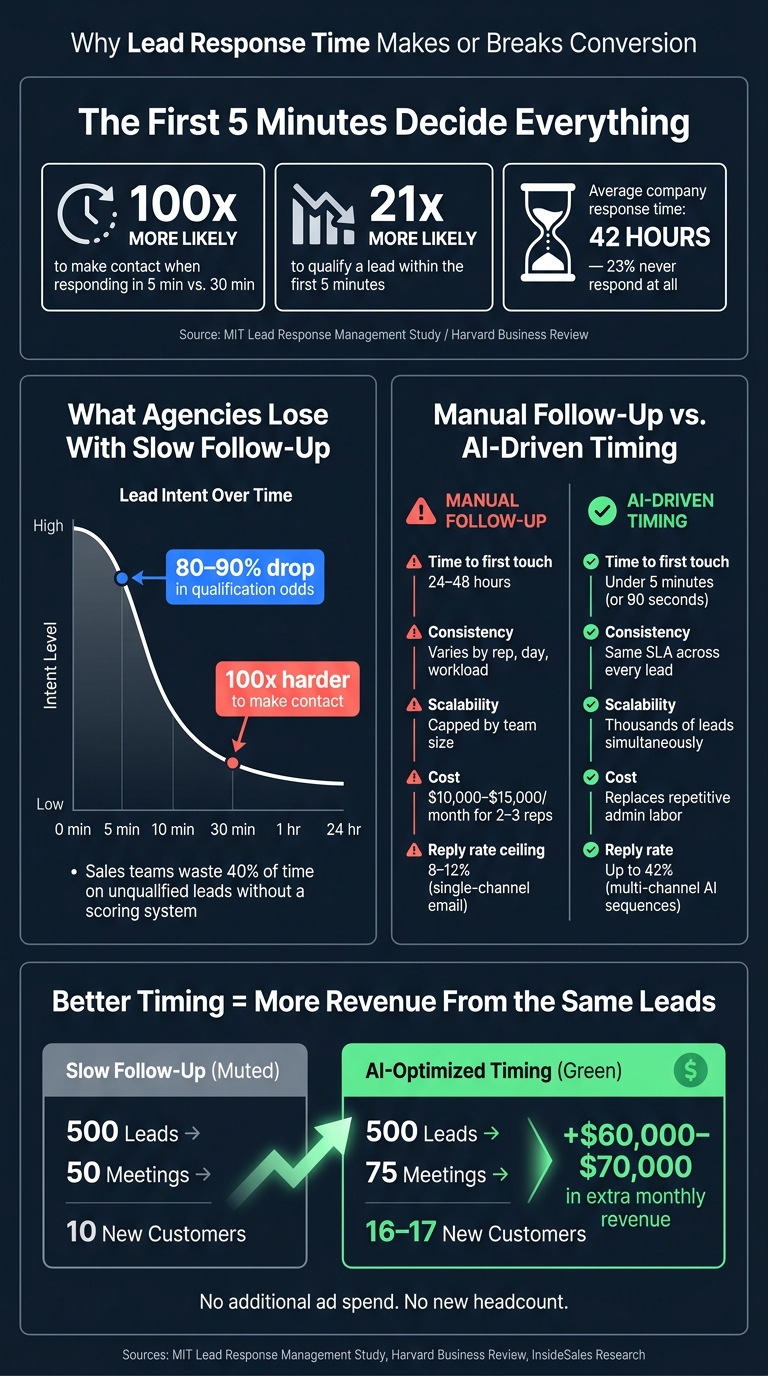
Research from MIT and InsideSales found that responding within 5 minutes makes you up to 100× more likely to make contact and 21× more likely to qualify the lead than waiting 30 minutes.[3][2] Move from 5 to 10 minutes, and qualification odds can fall by 80–90%.[4][3] That drop is sharp. It’s not a slow slide.
Fast follow-up catches demand while intent is still high. That’s why timing, more than lead volume, often decides conversion.
What agencies lose when follow-up is late
A Harvard Business Review audit of 2,241 U.S. companies found an average first response time of 42 hours; 23% never responded at all.[5][6][7]
When follow-up is late, agencies get fewer meetings from the same number of leads. Pipeline quality slips because leads contacted late are less engaged and less ready to decide. Clients see fewer qualified opportunities, start doubting campaign performance, and renewals become harder.
At scale, this turns into an operations problem, not just a sales problem.
2. Why Manual Follow-Up Fails at Scale
As lead volume goes up, manual follow-up starts to crack. You usually see it in two spots: slow replies and poor prioritization.
Inconsistent response times
In many agency setups, leads come in through website forms, ad platforms, chat widgets, and other third-party tools. Then they end up in shared inboxes or CRM queues that only get checked a few times a day. Every handoff adds friction. By the time a rep finally sees the lead, the buying window may already be closed.
Workload adds another layer to the problem. One rep is often trying to handle new leads, follow-ups, calls, admin work, and reporting all at once. So what happens? They batch replies whenever they get a free moment. That leads to uneven timing. Some leads hear back in 15 to 30 minutes, while others wait until the next business day. Once a rep is dealing with 40 to 60 new leads per day, consistency starts to fall apart.[1]
Missed lead prioritization
Without automated scoring, reps tend to go after what’s easiest instead of what’s hottest. High-intent signals get buried while lower-intent contacts move to the front of the line. A prospect who visited the pricing page several times, replied to an earlier campaign, or submitted a "Talk to Sales" form can sit untouched for hours just because the submission got lost in the queue.
Sales teams waste 40% of their time on unqualified leads when they don’t have a scoring system.[1] That means the best prospects - the ones most likely to convert - are left waiting while reps sort through lower-intent contacts. Agencies then end up with weaker close rates on leads that looked strong on paper. The issue isn’t always lead quality. A lot of the time, it’s timing.
The real cost of manual operations
Scaling manual follow-up usually means adding headcount. A fully loaded outreach rep, including salary, benefits, and overhead, costs about $5,000 per month. Bring on two or three reps to manage higher lead volume across several clients, and labor alone can hit $10,000 to $15,000 per month. And a big chunk of that work is repetitive admin.
At a certain point, bringing in one new client barely covers the cost of the rep needed to support them. That puts a cap on growth, and most agencies run into it at around 10 to 15 active clients.[1] After that, SLAs start slipping, and performance drops.
AI solves this by responding at once and sending each lead down the right path based on intent.
3. How AI Fixes Follow-Up Timing
AI closes the timing gap by replying in seconds and sending leads where they need to go based on intent. So timing can't sit on a fixed cadence anymore. It has to shift as lead behavior shifts.
Instant response and lead routing
The moment a prospect fills out a form, requests a demo, or lands on a pricing page, intent is at its peak. Research based on 5.7 million inbound leads found that after just 5 minutes, conversion rates drop by about 8×. Yet only 0.1% of inbound leads get engagement inside that window.[3]
That's where AI changes the game. It can trigger outreach within seconds of a lead action, without waiting for a rep to check in.
At the same time, AI handles routing. It scores each lead using company data and behavior signals like company size, industry, pages visited, form fields, and source channel. Then it sends high-intent leads to sales reps and lower-intent leads into nurture paths. In one case, this cut response times from 2–4 hours to under 90 seconds and pushed qualified lead conversion from 18% to 27% in the first month.[9]
Follow-up based on engagement signals
Fixed follow-up schedules assume every lead should get the same treatment. That rarely works. Some people need a nudge the next day. Others are ready NOW.
AI tracks what each lead does after the first touch:
opening an email
clicking a link
returning to the pricing page
going silent
Then it adjusts timing based on those signals.
If a contact opens an email but doesn't reply, AI might wait 24–48 hours and send a follow-up from a different angle. If that same contact clicks a pricing link or books a calendar slot, AI can mark them as high-intent and either send a message right away or alert a rep to call during local business hours.
SalesLabel uses this approach across email, LinkedIn, and other channels with real-time scoring that changes as engagement changes. It handles white-label scoring, routing, and follow-up under the agency's brand.
The result is simple: high-intent leads get faster and more relevant follow-up, while low-engagement contacts don't get hammered with messages. That helps protect deliverability and improves conversion. Agencies using AI-personalized, multi-channel sequences have reached 42% reply rates in the top quartile, versus the 8%–12% ceiling common with single-channel email outreach.[8]
AI turns behavior signals into exact follow-up windows that line up with each lead's level of intent.
4. AI Timing Rules That Improve Conversion
When AI handles timing on its own, agencies still need clear response windows tied to intent. That means looking at lead signals: how someone came in, what they clicked, and how recently they took action. Match speed to those triggers, and timing stops being guesswork. It becomes a system built to drive conversions.
Recommended follow-up windows
Inbound and outbound leads should not be treated the same.
For inbound leads - demo requests, pricing page submissions, and "Contact Sales" forms - the target is fast action. Respond within 0–5 minutes during business hours (9:00 AM–5:00 PM local time). Then send a personalized follow-up within 1–2 hours. After that, run 2–3 follow-ups across Days 1–3, then move to once-a-day or every-other-day contact through Days 4–7. After Day 8, switch to a nurture cadence with 1–2 value-focused touches per week.
For outbound campaigns, the pace is slower but steadier. Plan for 5–8 touchpoints over 2–3 weeks: start with an opening email on Day 1, then send a follow-up email and LinkedIn touch on Days 2–3. Add phone attempts on Days 4–7, then keep the sequence going with a mix of email, social, and phone every 2–3 days through Day 14. From there, move into lighter, value-based nurture on Days 15–21.
Use these windows as default SLA targets across every lead source.
Follow-up timing comparison table
Response Speed
Lead Type
Conversion Priority
Best-Fit Channel
0–5 minutes
Inbound high-intent
Very high
Email + phone call
Within 1 hour
Inbound high-intent
High
Email + optional phone
1–4 hours
Inbound medium-intent
Moderate
Email / LinkedIn
24 hours
Outbound initial follow-up
High
Email / LinkedIn
48–72 hours
Outbound follow-up #2
Moderate
LinkedIn / multi-channel
5+ days
Nurture / low-intent
Low to moderate
Email newsletter
Inbound is about speed. Outbound is about sticking with it. Agencies that set these windows and automate them keep follow-up steady, and those rules work best when they’re tied into scoring, routing, and booking workflows.
5. Building AI Timing Into an Agency Workflow
Timing rules only matter when they’re part of the day-to-day workflow. If scoring, outreach, replies, and booking all live in separate places, leads get stuck between steps. But when those pieces connect, timing stops depending on who’s online or how busy a rep is.
From lead scoring to meeting booking
The workflow begins the second a lead enters the system. AI enriches the lead, scores it in real time, and sends high-intent leads into immediate outreach. Lower-priority leads go straight into nurture sequences without anyone needing to sort them by hand.
As engagement shifts, AI updates the next step too. A lead who starts showing stronger intent can move up fast, while lower-intent leads stay in nurture until their behavior changes. Replies and booking can also be routed on their own, with a calendar link that shows local times and a meeting confirmation sent without manual input. The result is simple: high-intent leads keep moving, and lower-intent leads don’t eat up rep time with manual triage.
For agencies, features">automation alone isn’t the whole story. The bigger win is running that workflow under their own brand. SalesLabel is built for that exact setup.
Every step, from outreach to meeting booking, runs under the agency’s brand. So the client sees one smooth experience tied to the agency’s identity, not a patchwork of tools. Its real-time scoring engine starts outreach when fit and intent signals cross a set threshold. Its AI inbox management drafts replies in the client’s tone of voice and sends more complex conversations to a human when needed.
If an agency wants more control during onboarding, SalesLabel also has a "Copilot" mode. In that setup, the AI drafts replies for human review before anything goes out. Once the system is calibrated, it can shift into full autopilot. [1]
Low - human oversight only on high-value interactions
Manual processes usually don’t break because people don’t care. They break because the volume is too high and the timing window is too tight for any team to keep up with by hand. AI doesn’t take over the human judgment that closes deals. It takes care of everything leading up to that conversation. That’s the shift that makes timing measurable across clients, channels, and booking volume.
6. Better Timing Turns More Leads Into Revenue
A lead that sits overnight often disappears before your team ever gets a shot.
And that delay hits conversion rates fast. Speed has a direct effect on your odds of turning interest into pipeline. According to the MIT Lead Response Management Study, the odds of contacting a lead drop 100x when response time slips from 5 minutes to 30 minutes. The odds of qualifying that lead drop 21x[11][4][12].
This is where AI changes the day-to-day math. It removes manual lag, closes the response gap, and helps agencies stop losing leads just because no one was available at the right moment.
When response time gets better, revenue usually follows. In a typical 500-lead month, better timing can move a team from 50 meetings and 10 new customers to 75 meetings and about 16 or 17 new customers. That works out to about $60,000 to $70,000 in extra monthly revenue without adding ad spend or headcount[1].
For agencies, timing isn't just a support issue. It's a conversion lever.
FAQs
How fast should I follow up with inbound leads?
Aim to respond to inbound leads within the first hour. That window matters more than most teams think. A slow reply can cost agencies up to 30% of warm leads.
If a prospect doesn’t reply to your first message, follow up after 72 hours, or 3 business days. SalesLabel helps by automating personalized follow-ups and real-time lead scoring, so you don’t miss a touchpoint.
What tasks can AI automate in lead follow-up?
AI can handle lead follow-up from start to finish. That includes lead capture, real-time scoring, personalized outreach, and fast replies across channels.
It can also send follow-ups on a set schedule, keep inboxes in one place so conversations don’t slip through the cracks, and book meetings right on the calendar. SalesLabel supports all of this under your agency’s branding.
How do I know which leads need immediate outreach?
Use AI lead scoring to rank high-intent prospects based on ICP fit, live buyer behavior, and engagement signals like website visits and email activity.
Add time-decay weighting, and the newest activity gets more weight. That means hot leads move to the top faster, your sales team can reply sooner, conversions can go up, and reps spend less time on people who aren't ready.