White-Label Lead Management Software: A 2026 Buyer's Guide
White-label lead management software lets agencies sell a branded platform and earn recurring revenue without building software. Here is the 2026 buyer's checklist.
SalesLabel Team
Growth Expert • 29.07.2026
Share:
Szukasz gotowego rozwiązania?
SalesLabel automatyzuje prospecting od początku do końca — AI znajduje potencjalnych klientów, wysyła spersonalizowane wiadomości i rezerwuje spotkania pod Twoją marką.
White-Label Lead Management Software: A 2026 Buyer's Guide
White-label lead management software lets an agency run its clients' leads inside a platform that carries the agency's own brand, not a vendor's. Your clients log in to your logo, your colors, and your domain, while you skip the years and budget it takes to build the software yourself. For agencies that generate leads for other businesses, it is the fastest way to look like a serious platform company instead of a reseller. This guide explains what to look for, the mistakes to avoid, and how to choose a platform you will not outgrow.
We wrote this with AI assistance and grounded every point in how agencies actually buy and run white-label tools today. Let's get into it.
What white-label lead management software actually does
Lead management software captures leads, organizes them, scores them, and tracks every follow-up until a lead becomes a customer or drops off. The "white-label" part means all of that runs under your brand. You set the logo, the domain, and often the pricing your clients see. They never know which vendor powers it underneath.
For an agency, that changes the business model. Instead of charging only for the leads you deliver, you can charge a recurring fee for the platform your clients log in to every day. That recurring revenue is stickier and worth more than one-off project fees, and it makes your agency far harder to replace.
What to look for in white-label lead management software
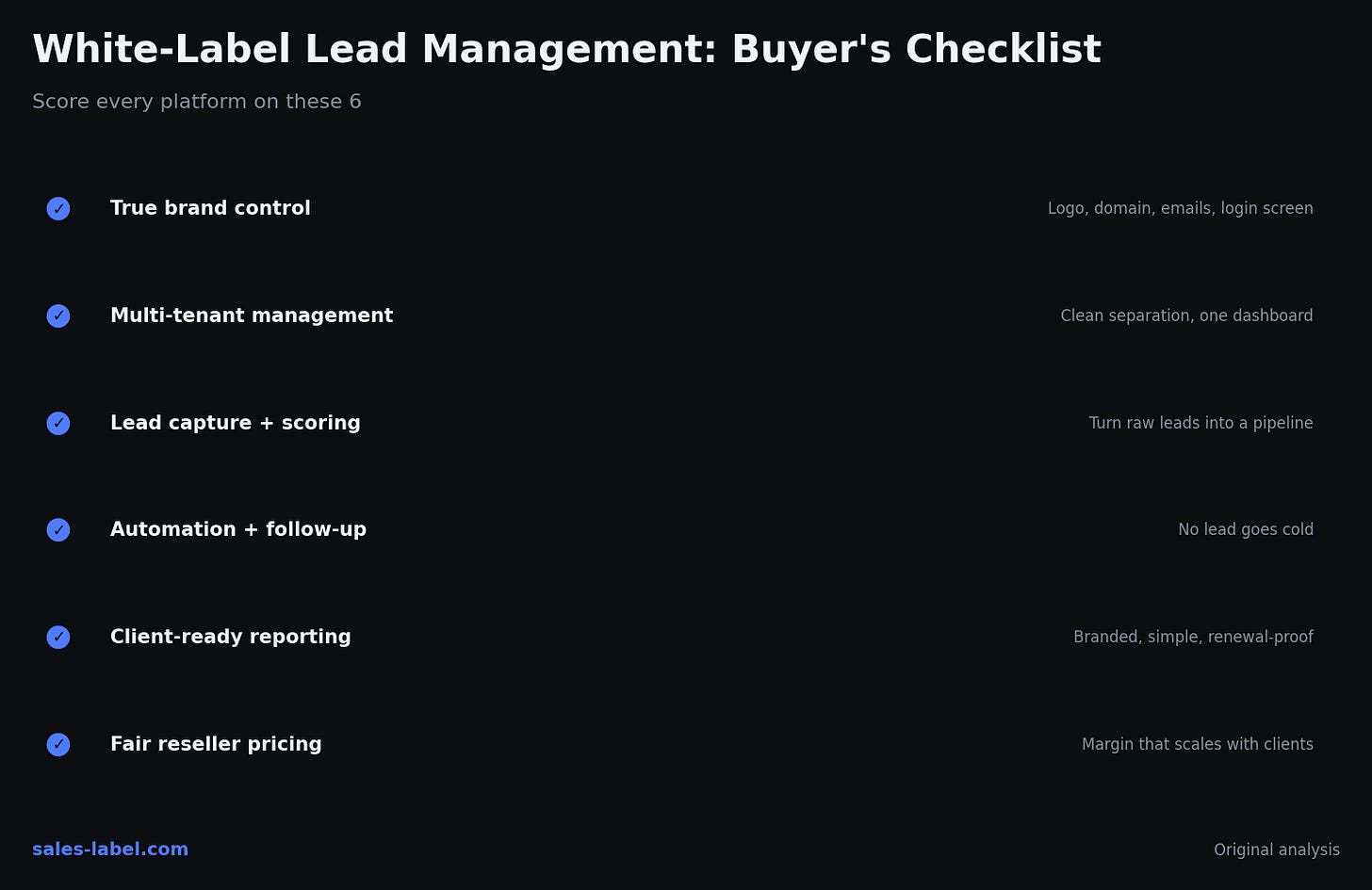
Not every platform that says "white-label" truly delivers. Score each option against this checklist before you commit.
Original analysis — sales-label.com
1. True brand control
Look for full branding: your logo, your color scheme, a custom domain, and branded email notifications. If the vendor's name shows up anywhere your client can see, it is not really white-label. The best platforms let you control branding down to the login screen and the reports your clients download.
2. Multi-client (multi-tenant) management
You run many clients, so you need clean separation between them. Each client should have its own workspace, its own data, and its own users, while you keep a single dashboard to manage them all. Without this, you end up with a mess of logins and a real risk of one client seeing another's data.
3. Lead capture and scoring built in
The platform should capture leads from forms, ads, and integrations, then score them so your clients focus on the best ones first. Automatic scoring is what turns a pile of raw leads into a workable pipeline, and it is a feature your clients will happily pay for.
4. Automation and follow-up
Leads go cold fast. Look for built-in features">automation: instant replies, follow-up sequences, and reminders so no lead is forgotten. This is where a good set of AI features earns its keep, drafting messages and flagging the leads that need attention now.
5. Reporting your clients will read
Branded, simple reports prove your value every month. If a client can see how many leads came in, how many converted, and what it cost, they renew without a fight. Clear reporting is the quiet reason clients stay.
6. Fair, scalable pricing for resellers
The economics have to work. Look for reseller pricing that leaves room for a healthy margin as you add clients, without a per-seat model that punishes growth. Check how the platform works and priced before you sign, so a big new client makes you money instead of eating it.
The point of white-label software is leverage: sell a platform under your brand without building or maintaining one. If a tool adds work instead of removing it, it is the wrong tool.
Common mistakes agencies make when buying
Choosing on branding alone. A pretty logo screen means nothing if the automation and reporting are weak.
Ignoring multi-tenant needs. Tools built for a single company break the moment you add your third client.
Underpricing your offer. If the software is under your brand, you can charge for the platform, not just the leads. Many agencies leave money on the table here.
Skipping the migration question. Ask how client data moves in and out. A tool you cannot leave is a tool that can raise prices on you later.
Forgetting support. When a client has a problem, you own it. Make sure the vendor supports you well behind the scenes.
How to roll it out with your clients
Brand it fully first. Set your logo, domain, and colors before a single client sees it. First impressions sell the platform.
Start with one client. Move your best relationship over, learn the workflow, and fix any gaps before you scale.
Package it as a monthly plan. Price the platform as recurring access, not a one-time setup, so you build predictable revenue.
Train clients lightly. A short onboarding call and a branded help doc are usually enough. Keep it simple.
Review results monthly. Use the branded reports to show value and to spot clients ready for an upgrade.
Done this way, white-label lead management becomes a product line, not a favor you do for clients. If you want to see how a fully branded platform looks in practice, explore the white-label platform and how it maps to your agency.
The revenue model that makes it pay off
The reason agencies move to white-label lead management is not features; it is economics. When you deliver leads on a project basis, you get paid once and start the chase again next month. When you sell a branded platform your clients log in to daily, you earn a recurring fee whether or not a new campaign is running. That shift from project income to subscription income is what turns a busy agency into a durable business.
It also protects you. A client who runs their entire lead workflow inside your branded platform is not going to switch on a whim, because their process, their data, and their reporting all live with you. The software becomes the reason they stay, and every new client you add compounds that recurring base. Buy once, brand it, and resell it many times; that leverage is the entire case for going white-label.
Frequently asked questions
Is white-label lead management software worth it for a small agency?
Often yes. Even with a handful of clients, charging a recurring platform fee under your own brand usually beats billing only for leads. It adds predictable revenue and makes your agency stickier, which matters most when budgets tighten.
How is white-label different from reselling a normal tool?
Reselling a normal tool means your clients see the vendor's brand and can go straight to the source. White-label puts everything under your brand, so you own the relationship, the pricing, and the perceived value. That control is the whole point.
What should I pay for white-label lead management software?
Pricing varies by features and client count, but look for reseller plans that scale with you and protect your margin as you grow. Avoid per-seat pricing that punishes success, and always confirm what is included before you sign.
The bottom line
The right white-label lead management software lets your agency sell a branded platform, earn recurring revenue, and serve clients better, all without building software yourself. Score every option on true branding, multi-tenant management, lead scoring, automation, reporting, and fair reseller pricing, and you will pick a platform you can grow on for years. Ready to see it in action? Book a demo of the white-label platform and find out how fast you can launch under your own brand.