White-Label CRM for Agencies: How to Resell a Branded CRM in 2026
A white-label CRM lets your agency resell a branded CRM for recurring revenue. Here is how it works, what to look for, and how to launch in 2026.
SalesLabel Team
Growth Expert • 30.07.2026
Share:
Szukasz gotowego rozwiązania?
SalesLabel automatyzuje prospecting od początku do końca — AI znajduje potencjalnych klientów, wysyła spersonalizowane wiadomości i rezerwuje spotkania pod Twoją marką.
White-Label CRM for Agencies: How to Resell a Branded CRM in 2026
A white-label CRM lets your agency sell a customer relationship platform under your own brand, logo, and domain, without building software from scratch. For agencies, that is a fast path to recurring revenue and stickier clients. Instead of pointing customers to someone else's tool, you hand them a CRM that looks and feels like yours. This guide explains how a white-label CRM for agencies works, what to look for, and how to turn it into a real revenue line in 2026.
If your agency already runs lead generation, outreach, or marketing for clients, a branded CRM is the natural next product. It keeps client data in your ecosystem and gives you a reason to stay in the account every month.
What a white-label CRM actually is
A white-label CRM is a fully built platform that a vendor lets you rebrand and resell as your own. The vendor maintains the software, hosting, and updates behind the scenes. You control the brand, the pricing, and the client relationship. Your customers see your name on the login screen and never know a third party powers it.
That split matters. You get the product depth of a mature CRM without the years of engineering, and you keep the margin and the customer. The vendor gets a reseller; you get a product to sell.
Why agencies add a branded CRM in 2026
Recurring revenue. A CRM is a monthly subscription, not a one-off project. That turns unpredictable project income into predictable monthly cash.
Stickier clients. Once a client runs their pipeline inside your branded CRM, switching away is painful. Retention goes up.
One ecosystem. When your outreach, lead data, and CRM live under one brand, clients see a single partner instead of a pile of tools.
Higher perceived value. Offering your own software makes a small agency look like a serious platform, which supports premium pricing.
What to look for in a white-label CRM platform
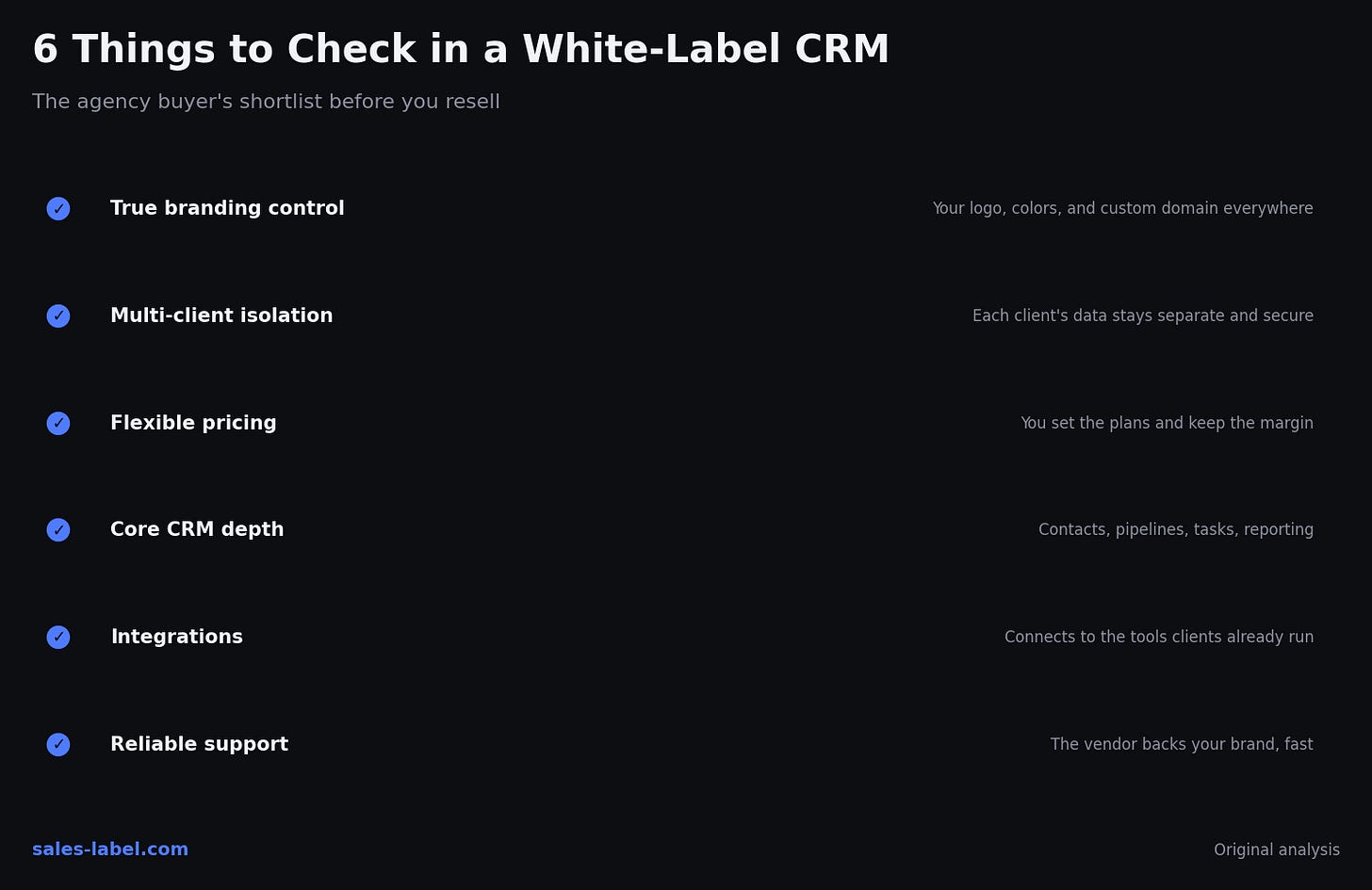
Not every reseller program is built for agencies. Score any platform on these six points before you commit:
True branding control. Your logo, colors, and custom domain on every screen and email, not just a badge in the corner.
Multi-client isolation. Each client's data stays separate and secure, so you can run many accounts from one place without leaks.
Flexible pricing. You set the plans and margins. The vendor charges you a wholesale rate; you keep the spread.
Core CRM depth. Contacts, pipelines, tasks, and reporting that a real sales team will actually use every day.
Integrations. It should connect to the tools your clients already run, from email to lead sources.
Support you can rely on. When a client has an issue, you need the vendor behind you fast, because your brand takes the blame.
The best white-label CRM is invisible. Your client should experience your brand, your support, and your value, never the vendor underneath.
How to price and package it
Pricing a resold CRM is where many agencies leave money on the table. Three simple models work:
Flat monthly seat. Charge per user, per month. Easy to explain and easy to forecast.
Bundled into a retainer. Fold the CRM into your existing service fee so the client sees one number and one partner.
Tiered plans. Offer good, better, and best tiers so clients can grow into higher plans as they add users and features.
Whatever model you choose, price on the value the client receives, not on the wholesale cost you pay. A CRM that runs a client's whole pipeline is worth far more than the seat fee behind it.
How to launch your white-label CRM
You can go from decision to first paying client in a few focused weeks:
Pick the platform. Use the six-point checklist above and choose a partner built for agencies.
Brand it. Add your logo, colors, and custom domain. Set up your support email and help links.
Build one clean offer. Package the CRM with the service you already sell so it is easy to say yes to.
Pilot with a friendly client. Onboard one existing client, gather feedback, and fix rough edges before a wider launch.
Roll it out. Introduce the branded CRM across your book of business as a natural upgrade.
See how the pieces fit together on the how it works page, and explore the AI features that make a resold CRM more than a contact list.
White-label vs building your own CRM
Some agencies wonder if they should just build a CRM themselves. For almost all of them, the answer is no. Building means hiring engineers, running servers, fixing bugs at midnight, and shipping features forever. That is a software company, not an agency. A white-label CRM gives you the product without the payroll. You focus on clients and sales; the vendor carries the engineering load. The math is simple: reselling a mature platform reaches revenue in weeks, while building your own reaches it in years, if ever.
There is also a risk difference. If you build and the project stalls, you carry the sunk cost alone. With a white-label partner, the platform already works for other agencies, so you are buying a proven product, not a hope.
Common mistakes agencies make reselling a CRM
Underpricing. Charging just above wholesale leaves money on the table. Price on the value the client gets from running their pipeline, not on your cost.
Skipping onboarding. A CRM only sticks if the client actually uses it. Walk every new client through setup so the tool becomes part of their day.
Treating it as a side offer. The agencies that win make the branded CRM a core part of their pitch, not an afterthought bolted on at the end.
Choosing a weak platform. If the underlying CRM is thin or unstable, your brand wears the damage. Pick depth and reliability over a cheap wholesale rate.
Avoid these four traps and a resold CRM becomes one of the steadiest lines in your agency, not a support headache.
Frequently asked questions
What is the difference between white-label and reseller?
A reseller sells another company's product under that company's brand. A white-label partner sells the same product under their own brand. White-label gives you more control and a stronger relationship with the client.
Do my clients know it is white-labeled?
No, if the platform is built well. Your branding covers the login, the app, and the emails. Clients experience your brand end to end.
How much can an agency charge for a white-label CRM?
You set the price. Because you control the plans, you keep the margin between your wholesale rate and what clients pay. Price on value, and a branded CRM can become a healthy recurring line.
Can I run many clients from one account?
Yes, if the platform supports multi-client isolation. Each client's data stays separate while you manage everything from one dashboard.
Turn your agency into a software brand
A white-label CRM for agencies is one of the simplest ways to add recurring revenue, lock in clients, and look like the platform you already are. You bring the brand and the relationships; the platform brings the product. If you are ready to resell a branded CRM, become a partner and book a demo to see how it fits your agency.