White Label Sales Outsourcing: Resell Booked Meetings Under Your Brand
White label sales outsourcing lets your agency deliver a full outbound function under your own brand without hiring SDRs. See what you resell, the margin math, how to pick a provider, and a 90-day launch plan.
SalesLabel Team
Growth Expert • 2.9.2026
Share:
Leter du etter en ferdig løsning?
SalesLabel automatiserer utgående prospektering fra A til Å — AI finner potensielle kunder, sender personaliserte meldinger og booker møter under ditt merke.
White label sales outsourcing lets an agency deliver a full outbound sales function — prospecting, outreach, and booked meetings — to its clients under its own brand, without building an SDR team in-house. The client sees your logo and your account manager. Behind the scenes, a specialist provider runs the engine. Done right, it turns a service you could never staff profitably into a repeatable, high-margin offer.
This guide explains exactly what white label sales outsourcing includes, how the economics work, how to choose a provider, and the 90-day plan to launch it as a productized service. It is written for agency owners and consultants who want to add outbound revenue without adding payroll.
What is white label sales outsourcing?
White label sales outsourcing is an arrangement where a third-party provider performs sales-development work — building target lists, running multichannel outreach, qualifying replies, and booking meetings — while remaining invisible to the end client. Your agency owns the relationship, the branding, and the pricing. The provider supplies the labor, tooling, and process.
The client buys "your" outbound team. You buy capacity from a specialist and resell it under your brand. Everyone plays to their strength.
It differs from a referral or reseller deal in one key way: the work is delivered as if it were yours. There is no co-branding, no "powered by" footer, no separate provider login handed to the client. That invisibility is the entire value — it protects your brand as the single point of trust.
What you actually resell
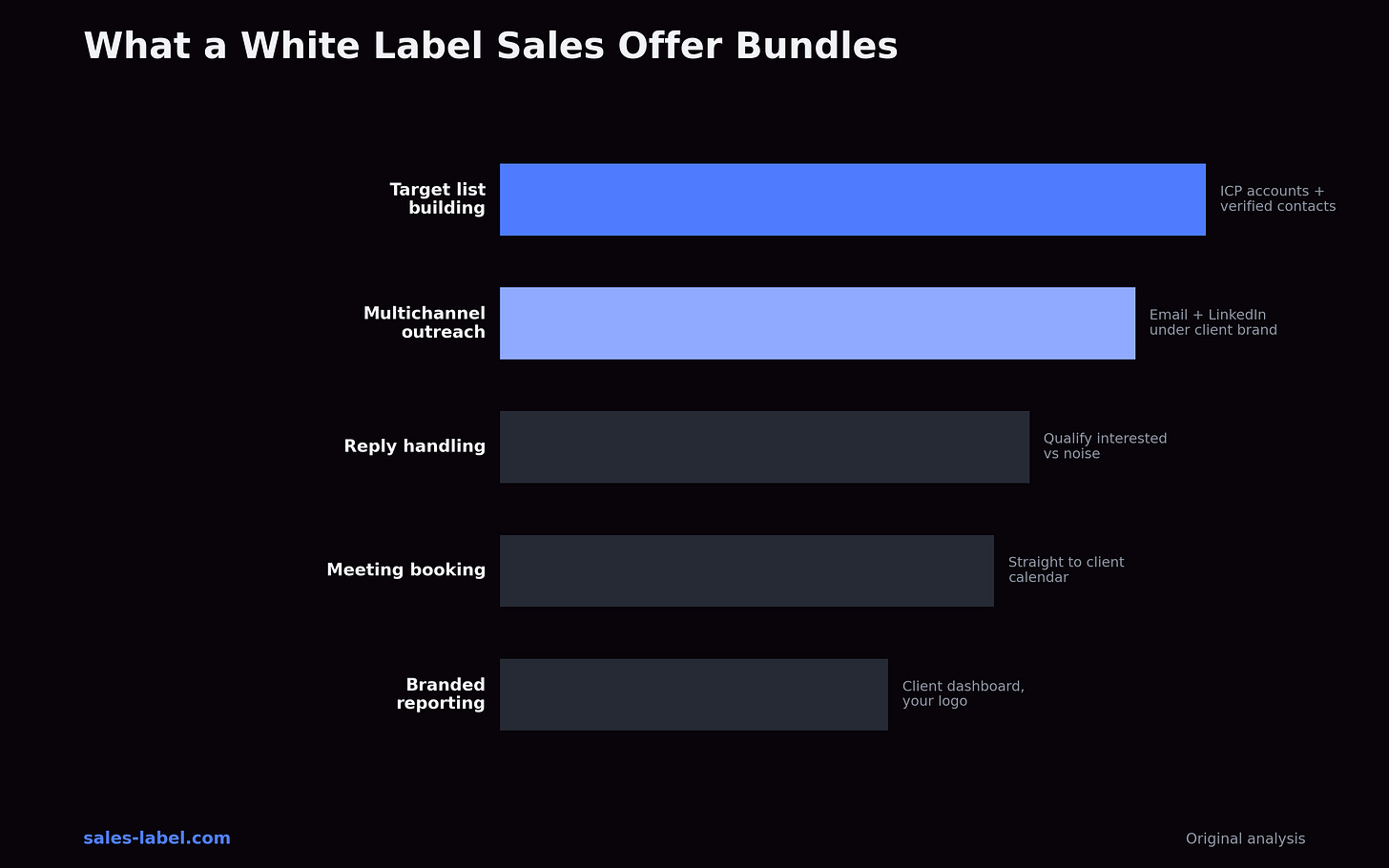
A complete white label sales outsourcing offer typically bundles:
Target list building — ICP-matched accounts and verified decision-maker contacts.
Multichannel outreach — email and LinkedIn sequences, written and sent under your client's domain and identity.
Reply handling and qualification — sorting interested prospects from noise and vetting them against agreed criteria.
Meeting booking — appointments dropped straight into the client's calendar.
Reporting — a branded dashboard the client logs into to see activity and results.
The best providers give you a partner console to manage every client account from one place — which is what makes running ten clients as easy as running one.
The five components of a white label sales offer. Original analysis by sales-label.com.
How the economics work
The margin model is what makes this attractive. Suppose a provider charges you a wholesale rate per client seat, and you package it to your client at a retail rate that includes your strategy, account management, and brand premium. The spread between wholesale and retail is your margin — and because the delivery cost is fixed and outsourced, that margin holds as you scale.
A realistic structure: you pay the provider a flat monthly fee per client, price your service at roughly two to three times that to the client, and keep the difference. Because you are not carrying SDR salaries, benefits, tooling licenses, or the cost of a bad hire, the model stays profitable even at a handful of clients. Add clients and the fixed provider tooling gets amortized further, so unit margins improve rather than erode.
Compare that to building in-house. A single SDR carries a full salary, ramp time, management overhead, and a real chance of turnover before they ever hit quota. Miss on one hire and you have burned months of runway. With white label sales outsourcing there is no ramp and no bench cost — you turn capacity on and off per client. That flexibility is what lets a two-person agency credibly sell an enterprise-grade outbound service, and it is why the model has become the default way lean agencies add a sales-development line without betting the business on headcount.
How to choose a white label provider
Not all providers are built to be resold. Pressure-test these before you sign:
True white label — is the client-facing dashboard, reporting, and outreach genuinely unbranded, or is there a "powered by" leak somewhere? One leak breaks the illusion.
Multi-client management — can you run and isolate many client accounts from one partner console, or is each client a manual setup?
Deliverability infrastructure — do they warm domains, rotate inboxes, and protect sender reputation? Their deliverability is now your brand's reputation.
Transparent reporting — can your client see real activity and outcomes without exposing the provider underneath?
Onboarding speed — how fast can you spin up a new client? Faster spin-up directly protects your margin.
A 90-day launch plan
You do not need a big bang. Launch it as a productized service in three phases:
Days 1–30 (validate): pick a provider, run one pilot client at a slight discount, and prove you can deliver booked meetings under your brand. Document every step into a repeatable playbook.
Days 31–60 (package): turn the pilot into a fixed-scope, fixed-price offer with a clean landing page and a simple onboarding form. Set your retail price against the wholesale rate.
Days 61–90 (scale): sell to three to five clients, manage them from the partner console, and refine your qualification criteria based on which meetings actually convert for clients.
This is exactly the motion a white label platform is designed to support. If you want to see how the partner console, branded dashboards, and multi-client management fit together, take a look at the white label platform or how it works before you commit to a provider.
Common mistakes to avoid
Two errors sink most first attempts. First, under-pricing: agencies nervous about the wholesale cost set their retail price too low and leave all the margin on the table — price for the value of booked meetings, not for cost-plus-a-little. Second, over-promising volume: outbound is a quality game, and a provider promising hundreds of meetings a month is a red flag, not a feature. Sell realistic, sell quality, and your clients renew.
Frequently asked questions
What is the difference between white label and reseller sales outsourcing?
A reseller openly sells another company's product. White label sales outsourcing delivers the service invisibly under your own brand — the client never sees or interacts with the underlying provider. White label protects your brand as the single point of trust.
Is white label sales outsourcing profitable for a small agency?
Yes. Because delivery is outsourced at a fixed wholesale rate and you price at a retail premium, the model is profitable even with a few clients. You avoid SDR salaries, tooling, and hiring risk, so margins hold as you scale.
How fast can I launch a white label sales offer?
With the right provider you can run a pilot client within 30 days and package a repeatable offer within 90. Onboarding speed is the biggest variable, so choose a provider with a fast multi-client setup.
Will my clients know I am outsourcing?
Not if the provider is genuinely white label. The dashboards, reporting, and outreach all carry your brand, and there is no "powered by" leak. That invisibility is the entire point of the model.
Add outbound revenue without adding payroll
White label sales outsourcing is the fastest way for an agency to offer a real outbound sales function without the cost and risk of building one. Choose a true white label provider, price for value, launch with a pilot, and scale from a single partner console. Ready to see how it works under one brand — yours? Book a demo of the white label platform and map your launch.