White Label Appointment Setting: How Agencies Resell Booked Meetings
White label appointment setting lets agencies resell booked, qualified meetings under their own brand. See the 6 requirements, pricing models, and mistakes to avoid.
SalesLabel Team
Growth Expert • 11.8.2026
Share:
Leter du etter en ferdig løsning?
SalesLabel automatiserer utgående prospektering fra A til Å — AI finner potensielle kunder, sender personaliserte meldinger og booker møter under ditt merke.
White label appointment setting lets an agency sell booked sales meetings to its clients under its own brand, while a partner platform or team does the work behind the scenes. The client sees your agency delivering qualified meetings on their calendar. They never see the engine underneath. This model turns a hard-to-staff service into a clean, resellable offer, and it is one of the fastest ways for an agency to add recurring revenue without hiring a room full of callers.
This guide explains how white label appointment setting works, what a resellable offer must include, how to price it, and the mistakes that quietly kill margins. The goal is simple: help you sell booked meetings as a product, not a favor.
What white label appointment setting actually means
Appointment setting is the work of turning a lead into a confirmed meeting with a decision-maker. It covers outreach, follow-up, qualifying, and getting the meeting on the calendar. "White label" means you resell that service as your own. Your brand is on the emails, the reports, and the booking links. The delivery partner stays invisible.
For the client, the promise is easy to understand: meetings show up, and their sales team just has to close. For your agency, it means you can offer a high-value outcome without building a calling team, a dialer stack, or a data pipeline from scratch. You focus on the client relationship and the margin; the partner focuses on delivery.
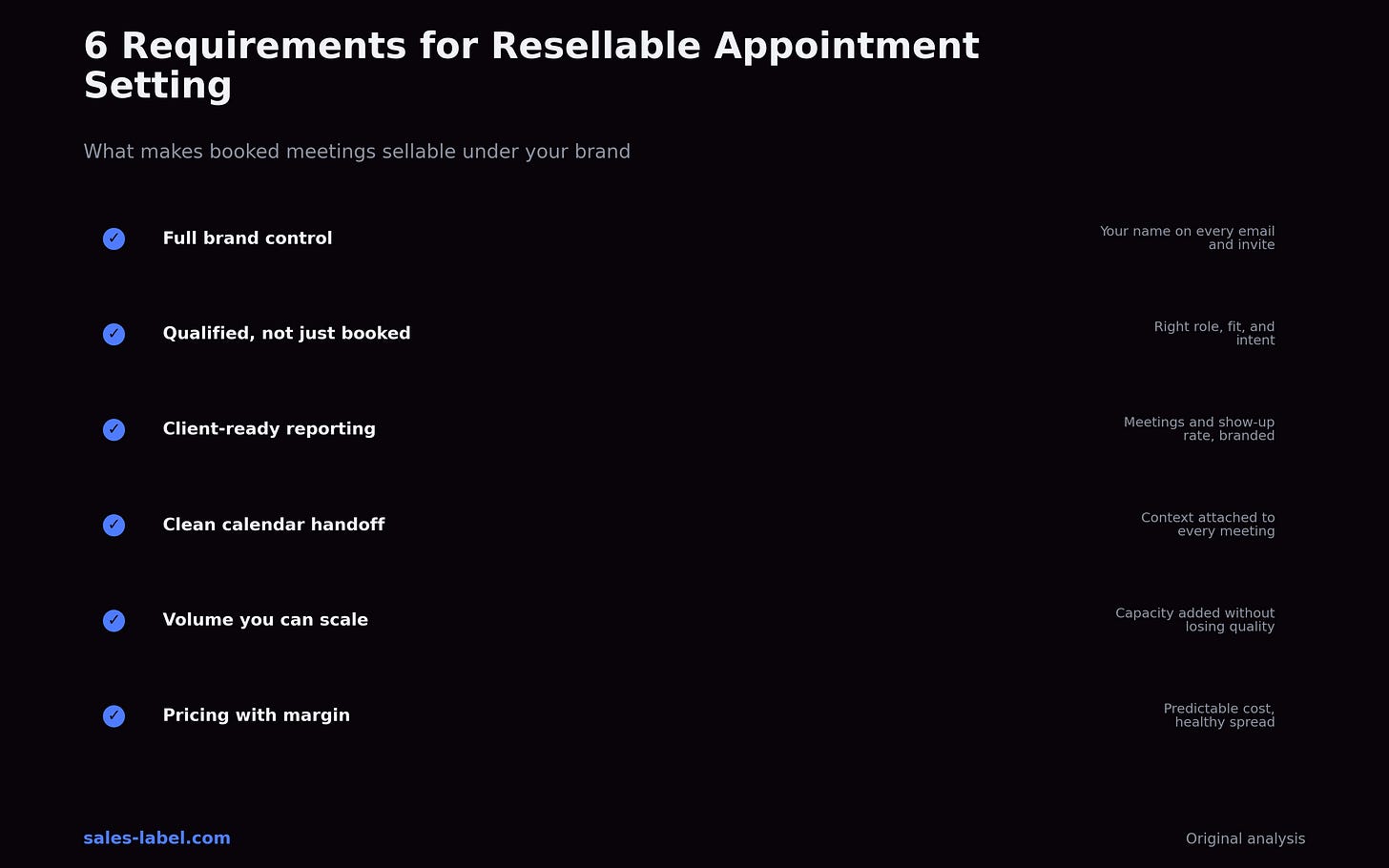
The six pieces that make appointment setting sellable under your own brand.
6 things a resellable appointment setting offer needs
Plenty of vendors will "set appointments for you." Far fewer are built to be resold under your brand at a profit. Use these six requirements as your checklist before you sign a partner.
1. Full brand control
Emails, calendar invites, and reports must carry your agency's name and domain, not the vendor's. If a prospect or client ever spots the delivery partner, your pricing power and your positioning both take a hit. Ask to see exactly what the prospect receives.
2. Qualified, not just booked
A meeting with the wrong person is worse than no meeting, because it wastes your client's time and your reputation. A good offer qualifies for role, fit, and intent before booking. Agree on what "qualified" means in writing so no-shows and bad fits do not fall on you.
3. Client-ready reporting
Your client pays for meetings and wants proof. Branded reports that show outreach sent, replies, meetings booked, and show-up rate give them a clear picture every week. Reporting is what turns a nervous first month into a renewed retainer.
4. A clean calendar handoff
Booked meetings should land directly on the right rep's calendar with the context attached: who they are, why they agreed to meet, and what they care about. A messy handoff means missed meetings and frustrated clients.
5. Volume you can scale
When you win three new clients in a month, the partner has to keep up without dropping quality. Ask how they add capacity and how they protect sending reputation as volume grows. Your growth should not break their delivery.
6. Pricing that leaves you margin
Whether the partner charges per meeting, per seat, or a flat monthly fee, you need to know your cost before you quote a client. Predictable input cost is what lets you price with confidence and keep a healthy spread.
How to price white label appointment setting
Three models work, and many agencies blend them:
Per-meeting: you charge the client a set price for each qualified meeting delivered. Easy for clients to grasp and directly tied to value.
Monthly retainer: a flat fee for a target number of meetings per month. Predictable revenue for you and a clear budget for them.
Bundled: fold appointment setting into a larger growth package so the client buys an outcome, not a line item.
Price on the value of a booked meeting to the client, not just your cost per meeting. If one closed deal from these meetings is worth far more than your monthly fee, the math sells itself. Anchor your price to their pipeline, and keep your partner cost predictable so your margin holds as you scale.
Who this model is for
White label appointment setting fits agencies that already have client trust and want to add a high-value outcome without building a delivery team. Marketing agencies can attach it to their existing retainers so clients get meetings, not just traffic. Lead generation agencies can move up the value chain from delivering contacts to delivering booked calls. Consultants and fractional sales leaders can offer it as the execution arm of their strategy work. In each case, the appeal is the same: you sell a result your clients feel immediately, without hiring, training, and managing callers yourself.
It is a weaker fit if you want deep control over every script and touch, or if your clients sell a product with a very long, technical qualification process that a general partner cannot learn quickly. In those cases, a hybrid where you own qualification and the partner owns outreach can work better. Match the model to how your clients actually sell.
Common mistakes that shrink margins
Selling meetings without defining "qualified." Vague criteria lead to no-shows and refund fights. Define it up front.
Letting the vendor's brand leak. One unbranded email can unravel the whole white-label promise. Test the full prospect experience yourself.
Underpricing to win the deal. If your price barely covers your partner cost, one refund wipes out the account. Build in margin from day one.
Ignoring show-up rate. Booked is not the same as attended. Track show-ups and reminders, because that is the number clients actually feel.
Frequently asked questions
What is white label appointment setting?
It is a service where a partner books qualified sales meetings that your agency resells under its own brand. Your clients see your name on everything, while the partner handles outreach and scheduling behind the scenes.
How is it different from lead generation?
Lead generation delivers interested contacts. Appointment setting goes further and delivers confirmed meetings with qualified decision-makers on the calendar. Many agencies offer both so the client gets leads and booked meetings, not just a list.
Will my clients know I use a partner?
Not if the offer is truly white label. Branded emails, invites, and reports keep your agency front and center. Always test the exact prospect experience to be sure the partner stays invisible.
How should I price it?
Per-meeting, monthly retainer, or bundled into a package all work. Whatever you pick, know your partner cost first and price on the value a booked meeting brings the client so your margin is protected.
The bottom line
Done right, white label appointment setting lets your agency sell one of the most valuable outcomes in B2B, booked meetings with real decision-makers, without building a calling team. Hold any partner to the six requirements above, define "qualified" in writing, and price on client value. That is how appointment setting becomes a steady, branded revenue stream instead of a headache. Want to resell booked meetings under your own brand? Explore the white-label platform or see how it works and book a demo to become a partner.