How to Become a White Label Reseller (2026 Playbook)
Add recurring revenue without building software. Here is the 6-step path to become a white label reseller — the margin math that makes it work and the mistakes that sink new resellers.
SalesLabel Team
Growth Expert • 27.8.2026
Share:
Leter du etter en ferdig løsning?
SalesLabel automatiserer utgående prospektering fra A til Å — AI finner potensielle kunder, sender personaliserte meldinger og booker møter under ditt merke.
Becoming a white label reseller is one of the fastest ways to add recurring revenue without building software from scratch. You take a proven product, put your brand on it, and sell it to your clients as your own. No engineers, no roadmap, no two-year build — just a margin on something that already works.
But "fast" is not the same as "easy." Most people who try white label reselling stall on the same three things: picking the wrong vendor, mispricing the offer, and having no plan to actually sell it. This guide walks the full path — the six steps to become a white label reseller, the margin math that makes it worth doing, and the mistakes that quietly sink new resellers.
What a white label reseller actually does
A white label reseller sells another company's product or service under their own brand. The vendor builds and maintains the platform; you own the client relationship, the pricing, and the brand experience. Your client never sees the vendor — they see you.
This is different from being an affiliate (where you just refer and take a cut) and different from building your own white label SaaS business (where you own the product). As a reseller, you sit in the sweet spot: you control pricing and margins like an owner, but carry none of the build cost.
The 6-step path to becoming a white label reseller
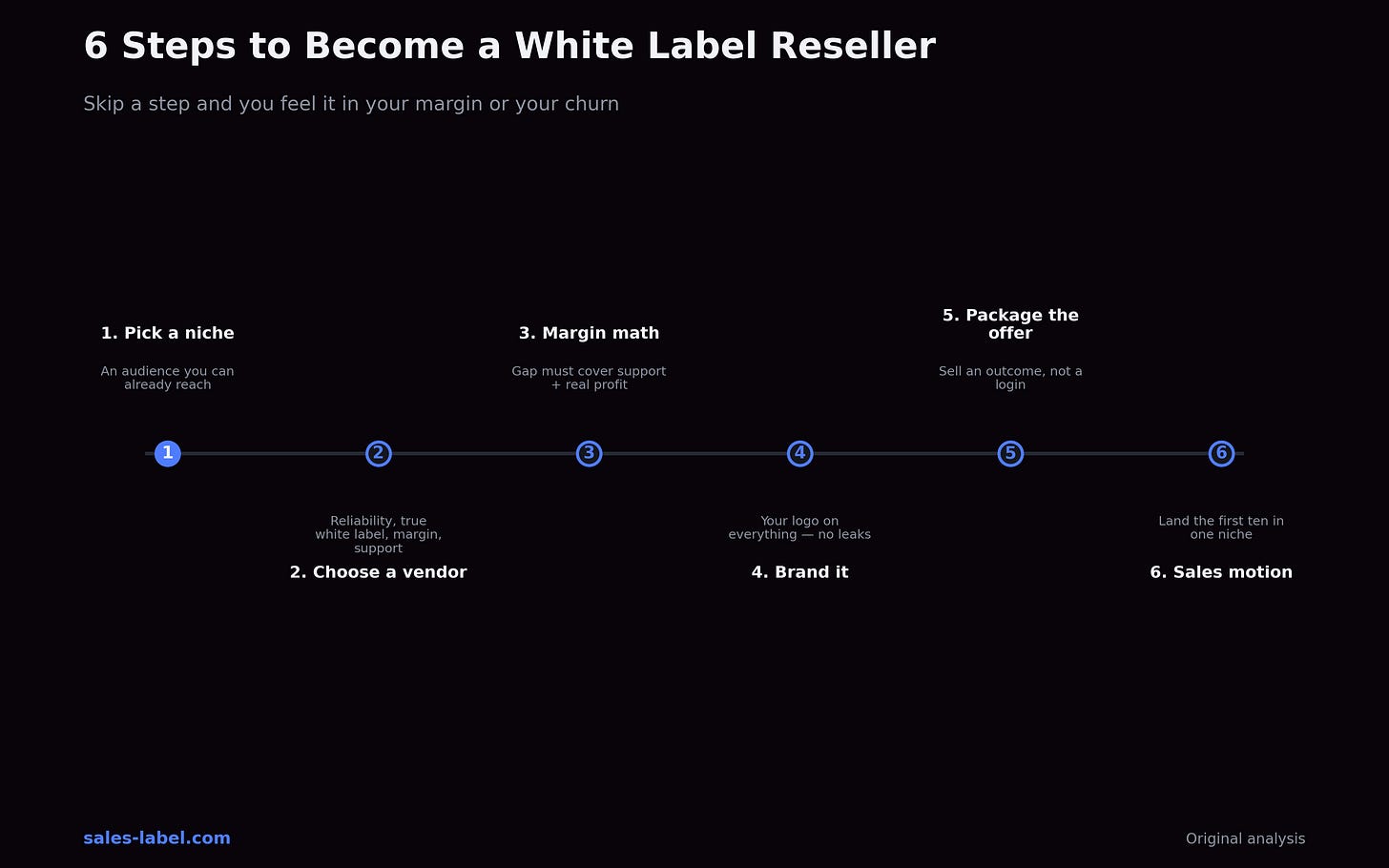
Every successful reseller launch moves through the same six steps. Skip one and you feel it later — usually in your margin or your churn.
The six-step path to a profitable reseller launch.
Step 1 — Pick a niche you already understand
The best reseller businesses are built on an audience you can already reach. If you run a marketing agency, resell tools your clients already need. If you serve recruiters, resell something that helps them fill roles. Do not chase a hot product into a market you have no way to sell to. Distribution beats novelty every time.
Step 2 — Choose the right vendor
This is the decision you cannot undo cheaply. Your vendor becomes your product. Score every candidate on four things: reliability (does it break?), true white labeling (your brand on everything, including the login and emails), margin room (is there space between their cost and a fair market price?), and support (will they help you when a client has an issue?). A cheap vendor with poor uptime will cost you clients faster than a slightly pricier, solid one.
Step 3 — Do the margin math before you sell anything
Reselling only works if the numbers do. Take the vendor's wholesale cost, decide your retail price, and make sure the gap covers your support time and still leaves healthy profit. A simple example: if a platform costs you 30 per client per month and you sell it at 100, your gross margin is 70 — but subtract onboarding and support time before you call it profit. Aim for a margin that survives a few refunds and a demanding client.
Step 4 — Brand it like it is yours
Half-hearted branding is why clients smell a reseller. Put your logo, colors, and domain on the dashboard, the notifications, and the reports. The goal is that a client could use the product for a year and never suspect it was not built in-house. Good white label vendors make this a settings screen, not a custom project.
Step 5 — Package it into a clear offer
Do not resell "a tool." Resell an outcome. Wrap the platform in onboarding, a bit of strategy, and a simple support promise, then name it and price it as a package. Clients pay far more for "your lead engine, managed" than for "a login to some software." The platform is the engine; your packaging is the product.
Step 6 — Build a simple sales motion
A great product with no sales plan earns nothing. Decide how you will get the first ten clients: your existing customer base, outbound to a niche you know, or referrals from partners. Keep it narrow. Ten happy clients in one niche is worth more than scattered interest across five.
Why the reseller model is worth it
The appeal is simple and real:
Recurring revenue. Most white label products are subscriptions, so every client you land keeps paying month after month — the compounding kind of income.
No build risk. You skip the most expensive, slowest part of software: building and maintaining it. Someone else carries that cost and risk.
Stickier clients. A branded platform your clients log into every day is far harder to leave than a one-off service. It quietly raises your retention.
Speed to market. You can launch a branded offer in weeks, not the years a real product would take.
The mistakes that sink new resellers
Choosing on price alone. The cheapest vendor is rarely the most reliable. Downtime and bad support cost you clients — which is far more expensive than a few dollars of margin.
Underpricing to "win" deals. Race-to-the-bottom pricing leaves nothing for support, and support is most of the real work. Price for the relationship, not just the software.
Reselling to no one. People fall in love with a product before checking they can actually reach buyers. Confirm your distribution before you sign a vendor.
Weak branding. If the vendor's name leaks through anywhere, you look like a middleman instead of the owner. Lock down the branding on day one.
What to look for in a white label partner
A strong white label platform should hand you full brand control, room in the pricing to build a real margin, and support that treats your clients like their own. The best partners also give you the AI features that make the product genuinely useful, not just a shell to rebrand. Before committing, walk through exactly how it works so there are no surprises after your first client signs.
Frequently asked questions
How much money do I need to start reselling?
Far less than building your own software. Most white label vendors charge a monthly or per-client fee, so your main cost is the platform plus your time to sell and support. Many resellers start profitable within their first few clients.
Do I need technical skills to be a white label reseller?
No. The vendor handles the engineering and hosting. Your skills are sales, support, and packaging — understanding your niche and serving clients well matters far more than writing code.
How is reselling different from an affiliate program?
An affiliate refers customers to another brand and earns a commission. A white label reseller sells the product as their own brand, sets their own price, and owns the client relationship — which means more control and usually far more profit per client.
How fast can I launch?
With a vendor that supports true white labeling, you can have a branded offer live in a few weeks. The slow part is not the setup — it is building your sales motion and landing those first clients.
Start with the right partner
Becoming a white label reseller is one of the cleanest ways to add recurring revenue: proven product, your brand, your margin. Pick a niche you can reach, choose a vendor you can trust, do the margin math, and package it as an outcome — not just a login.
Ready to see what you would be reselling? Book a demo and become a partner to explore the platform and the reseller economics behind it.
This article was written with AI assistance and reviewed by the SalesLabel team.