How AI Ensures GDPR Compliance in Inbox Management
AI-driven inbox management that enforces GDPR: real-time suppression, data minimization, DSR automation, and human review.
SalesLabel Team
Growth Expert • 15.05.2026 г.
Share:
Търсите готово решение?
SalesLabel автоматизира проспектирането от край до край — AI намира потенциални клиенти, изпраща персонализирани съобщения и резервира срещи под вашия бранд.
Use token-based API authentication and AES-256 encryption.
Rotate API keys every 30–90 days to limit exposure.
Handling Data Subject Requests: Automate responses to access, correction, or erasure requests while maintaining suppression lists to avoid re-contacting individuals.
AI tools simplify compliance but require proper configuration and human oversight. Agencies must document workflows, sign Data Processing Agreements (DPAs) with vendors, and conduct regular audits to ensure GDPR standards are met.
GDPR introduces a set of principles that guide how data should be handled, and these are particularly relevant for AI-driven inbox workflows. Four principles stand out: Transparency, Data Minimization, Purpose Limitation, and Accuracy.
Transparency: It’s critical to ensure that recipients are aware when AI processes their data. This isn’t just a best practice - it’s a requirement.
Data Minimization: AI workflows should only process the data absolutely necessary for their function.
Purpose Limitation: Data collected for managing inboxes cannot be repurposed - like training a language model - without explicit consent or a clear opt-out option [3][6].
Accuracy: Personal data must remain up to date. For example, B2B contact data can degrade at a rate of 2–3% per month, which adds up to 25–30% annually. Outdated data isn’t just a deliverability issue - it’s a compliance risk [10].
"GDPR doesn't kill outbound. Bad data and lazy processes do." - Prospeo Team [10]
Understanding these principles is the foundation for ensuring AI workflows align with GDPR. Let’s see how specific AI applications measure up.
AI Use Cases and GDPR Alignment
Each AI-powered inbox feature comes with its own compliance challenges. Here’s how some common AI functions align with GDPR requirements:
Automated Reply Handling: This feature processes personal data in real time, which triggers the need for transparency and accountability.
Lead Qualification Tools: These tools evaluate contacts based on email content. To comply with GDPR, they should only process data relevant to a pre-defined Ideal Customer Profile (ICP). A "two-gate" architecture can help here - data is only analyzed after confirming the company fits your ICP, and contact-level data is handled only for specific buyer personas [7].
Automated Follow-Up Sequences: These workflows tie directly to the right to object. For instance, if a prospect opts out via reply, the AI must stop all further communication immediately. Unlike the 10-day grace period allowed under CAN-SPAM, GDPR requires instant action. Real-time suppression lists can enforce this by syncing opt-outs across all inboxes as soon as they’re recorded [3][9].
"Today, with agentic GTM workflows, the [compliance] problem is solved by architecture, not by discipline." - JB Daguené, Co-founder & CEO, Evergrowth [7]
By aligning these use cases with GDPR principles, you can build workflows that prioritize compliance without sacrificing functionality.
How to Create a Data Processing Map
A data processing map is a crucial tool for maintaining GDPR compliance. It outlines every point where personal data enters, moves through, or exits your workflow. Here’s how to create one:
List All Touchpoints: Identify every stage where data is processed - like inbox creation, email receipt, LLM API calls, contact storage, and suppression list checks [6].
Detail Data Types and Handlers: For each touchpoint, specify what data is processed (e.g., name, email address, job title, LinkedIn URL), who processes it (e.g., your agency as the Data Controller, AI tools as Processors), and the lawful basis for processing. For B2B outreach, this is often Legitimate Interest, which requires a three-part balancing test covering purpose, necessity, and balancing interests [6][11].
Define Retention Periods: Specify how long data is retained and document auto-purging processes once the purpose is fulfilled. Without clear retention policies, you risk accumulating what experts call "compliance debt"[6].
A well-documented map ensures that every data interaction meets GDPR standards, reducing risks and improving accountability across your AI workflows.
sbb-itb-a781ab9
AI Models and GDPR Compliance: Key Insights from the EDPB Opinion
Designing GDPR-Compliant AI Inbox Tools
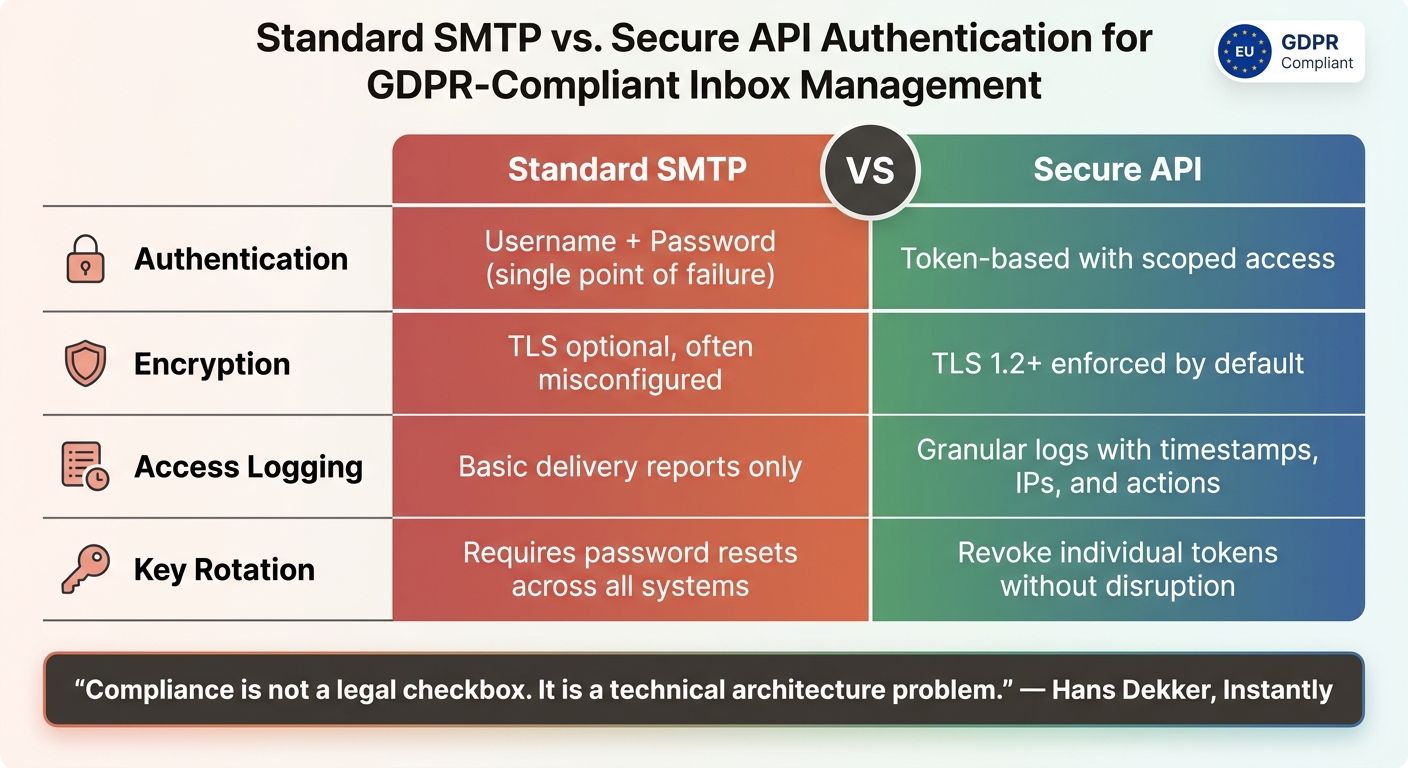
Standard SMTP vs Secure API: GDPR Security Features Compared
When creating AI tools for inbox management, it's crucial to integrate GDPR compliance into the design from the very beginning.
Setting Up Transparency and Lawful Processing
Before your AI processes any emails, you must establish a lawful basis for processing. In most B2B outreach scenarios, this is typically Legitimate Interest. However, this requires conducting a written three-part balancing test that examines the purpose, necessity, and how your interests compare to the recipient's privacy rights [8][2].
Transparency isn't just about legal documentation - it’s about keeping recipients informed. For example, a simple footer note like "We found your contact via LinkedIn" can meet GDPR's disclosure requirements without disrupting your messaging flow [2][4]. Additionally, update your privacy notice to reflect AI processing and sign Data Processing Agreements (DPAs) with all relevant vendors. This includes providers like OpenAI or Anthropic for language models, email infrastructure providers, and any data enrichment tools [6][12]. Ensure that your LLM provider explicitly opts out of using submitted email content for model training [6].
"The agent is a processor (or sub-processor) acting on your instructions. That distinction matters because the controller bears primary responsibility for lawful processing." - Samuel Chenard, Co-founder, LobsterMail [6]
Data Minimization and Retention Strategies
Stick to a simple rule: only collect what’s necessary. Configure your AI tools to gather professional details like job title, company name, and business email - avoiding unnecessary metadata. Before sending data to any third-party LLM, remove anything that isn’t essential [3][12]. By processing metadata locally and only transmitting minimal context to cloud-based APIs, you also limit cross-border data transfer risks under Schrems II[3].
Retention policies are another area where companies often overlook risks. A good standard is to automatically delete non-responder data within 30 days of initial contact [1][4]. Suppression lists should be managed at the platform level to ensure that any new inbox honors previous opt-outs automatically [3][12]. As Samuel Chenard explains: "If your infrastructure retains everything by default and gives you no controls, you're accumulating compliance debt every day the agent runs."[6]
Strengthening Security Controls
Two immediate technical upgrades can enhance security. First, replace standard SMTP authentication (username and password) with token-based API authentication. This approach provides scoped access, detailed logging, and the flexibility to revoke individual tokens without disrupting the entire system [12].
Security Feature
Standard SMTP
Secure API
Authentication
Username + password (single point of failure)
Token-based with scoped access
Encryption
TLS optional, often misconfigured
TLS 1.2+ enforced by default
Access Logging
Basic delivery reports only
Granular logs with timestamps, IPs, actions
Key Rotation
Requires password resets across all systems
Revoke individual tokens without disruption
Second, enforce AES-256 encryption for data at rest and TLS 1.2 or higher for data in transit [12]. Rotate API keys every 30–90 days to minimize potential exposure [12]. These measures not only improve security but also demonstrate accountability to regulators in case of an audit.
"Compliance is not a legal checkbox. It is a technical architecture problem that you solve with the right email API infrastructure." - Hans Dekker, Instantly[12]
Staying compliant with GDPR in your AI-powered inbox isn't a one-and-done task. It takes consistent, daily effort. Once your technical setup is in place, the challenge is ensuring it works smoothly when handling live campaigns and real-time client interactions.
Handling Data Subject Requests
Under GDPR, you have 30 days to respond to any Data Subject Request (DSR) - whether it's about accessing, correcting, or erasing personal data [14]. The clock starts ticking the moment the request is received, no matter how packed your schedule is.
To streamline this process, set up a dedicated privacy inbox, such as [email protected], and configure your AI to spot keywords related to erasure or objections across all communication channels - email, LinkedIn, or web forms [14]. When a data removal request comes in, your system should automatically pause all outreach and update suppression lists across your CRM, email tools, and active workflows [14][13].
But here's a key distinction: erasure isn't the same as deletion. As Derrick App explains:
"Erasure doesn't mean deleting everything... If you wipe a prospect's email address entirely... nothing stops them from being re-enriched and added back to a campaign six months later." [14]
The solution? Delete the active record but add the identifier (like an email address) to a permanent suppression list. This way, even if the person’s data is re-imported, they won't accidentally re-enter your campaigns [14][13].
Here’s a quick breakdown of GDPR rights and the corresponding actions:
Right
Action Required
Deadline
Access
Export all held data (e.g., email, job title, interactions) and list third-party processors
1 month
Rectification
Update incorrect data across CRM, enrichment tools, and active workflows
1 month
Erasure
Delete active records and add identifiers to a permanent suppression list
1 month
Objection
Stop all outreach on all channels immediately
Immediate
While automation can handle much of this, manual reviews are essential for ensuring nothing falls through the cracks.
Maintaining Human Oversight
Automated processes are great for speed, but they can't replace human judgment. GDPR Article 22 ensures individuals have the right not to be subject to decisions made entirely by automated systems - especially when those decisions could have significant consequences, like being flagged as a low-priority lead or excluded from campaigns altogether.
As the Data Controller, you’re responsible for ensuring a human reviews and approves any AI-driven decision that could meaningfully impact a prospect. Sophie Ricci of Salesso sums it up well:
"Your AI can draft, recommend, score, and suggest - but a human must review and approve before it matters." [1]
Beyond reviewing decisions, audit logging is a must. Every action your AI takes - whether it's sending an email, pulling data, or making API calls - should be logged with timestamps and stored in an easy-to-access format [6]. This creates a clear trail to answer questions like, "What data did your system handle, and when?"
Ameya Deshmukh of EverWorker emphasizes this point:
"If you can't prove you would stop when asked, you aren't ready to scale." [5]
To stay on top of compliance, make it a habit to conduct quarterly checks. Randomly select a contact from your database and confirm that you can trace their data’s origin, the legal basis for processing it, when they were notified under Article 14, and their current rights status [5]. It’s a simple yet effective way to ensure your system is always audit-ready.
When managing multiple client inboxes, keeping data separate isn’t just smart - it’s required under GDPR. SalesLabel makes this easier by allowing you to create custom domains (e.g., app.yourbrand.com) and isolated workspaces for each client. This ensures prospect data stays siloed, avoiding any unwanted crossover between clients. Plus, each client gets their own branded dashboard, offering a clear view of their pipeline without exposing anyone else’s data.
To go a step further, configure unique tracking subdomains for each client (e.g., track.clientname.com). This not only keeps sender reputations distinct but also maintains consistency in domain usage [11].
GDPR-First Configuration for AI Features
SalesLabel’s AI tools are designed with GDPR compliance in mind, especially when it comes to data separation. To meet GDPR Article 22 requirements, you can activate Copilot mode. This feature ensures that AI-generated replies aren’t sent automatically - they must be reviewed by a human first. As Mike R., a SalesLabel user, shared:
"The AI sometimes answers better than I would. It analyzes the website and profile of the person." [15]
The platform processes only essential data, such as names, job titles, and company details. Unnecessary metadata is deleted after classification, and automated retention limits ensure outreach history is purged once its purpose is fulfilled. Additionally, suppression lists are enforced at the platform level, blocking opted-out leads across all client accounts and active sequences in real-time [6].
For prospects in regions with stricter privacy rules, like Germany, you can use a plain-text send option. This eliminates tracking pixels, helping you comply with the ePrivacy Directive’s consent requirements [11].
Ongoing Compliance Reviews and Governance
GDPR compliance isn’t a “set it and forget it” task - it requires consistent effort. SalesLabel provides tools to make this process manageable. Hans Dekker from Instantly.ai emphasizes this point:
"Compliance is a system, not a one-time setting." [11]
Keep a Records of Processing Activities (RoPA) document that details how prospect data is handled for each client [1]. Audit logs with timestamps for all inbox actions are essential, allowing you to respond to Data Subject Access Requests (DSARs) within the required 30-day timeframe [6].
Regular internal reviews are crucial. Schedule quarterly check-ins to ensure your Legitimate Interest Assessments (LIAs) are up to date. Confirm that all vendors, including LLM providers like OpenAI or Anthropic, have signed Data Processing Agreements (DPAs) that explicitly opt out of model training on your data [3][6]. If you’re on SalesLabel’s Scale plan ($1,999/month), use the bi-weekly strategy calls to incorporate compliance checkpoints alongside performance reviews. This habit ensures your governance practices evolve alongside your agency’s growth.
FAQs
What qualifies as 'Legitimate Interest' for AI outreach emails?
When it comes to B2B cold outreach, the concept of "legitimate interest" plays a crucial role in ensuring compliance with GDPR, specifically under Article 6(1)(f). To meet these requirements, businesses must take specific steps:
Conduct a Legitimate Interest Assessment (LIA): This involves evaluating whether the outreach aligns with GDPR principles by balancing business objectives with the privacy rights of individuals.
Honor Opt-Outs Promptly: If recipients choose to opt out, their preferences must be respected without delay.
Include a Postal Address: Every outreach email should contain a valid postal address to maintain transparency and accountability.
Use Verified Data: Ensure that all contact information is accurate and gathered in compliance with data protection laws.
By following these guidelines, businesses can address their outreach goals while respecting user privacy and maintaining GDPR compliance.
How do I keep a “permanent suppression list” without storing too much data?
To keep a "permanent suppression list" while limiting data storage, focus on data minimization and real-time suppression management. This means updating the list as soon as a suppression event happens (like an unsubscribe) instead of holding onto large amounts of historical data. Using automated tools for real-time suppression helps meet GDPR guidelines by securely handling only the necessary information and avoiding the storage of extra, unneeded data.
What AI inbox actions require human approval under GDPR Article 22?
Under GDPR Article 22, any automated actions taken by an AI - like sending emails or processing personal data - require human approval if they involve decisions that carry legal consequences or significantly affect individuals. These actions must align with GDPR regulations to safeguard people's rights and ensure proper oversight.