Compare six AI lead tools by sourcing, personalization, automation, and white‑label fit to choose the right outbound workflow.
SalesLabel Team
Growth Expert • 5.08.2026 г.
Share:
Търсите готово решение?
SalesLabel автоматизира проспектирането от край до край — AI намира потенциални клиенти, изпраща персонализирани съобщения и резервира срещи под вашия бранд.
If I had to boil this down to one point, it’s this: these six tools split into three groups - tools that help me find leads, tools that help me work lead data, and tools that help me run outreach. The best pick depends on whether I need a database, better targeting, multi-channel sending, or a white-label setup for clients.
Here’s the short answer:
SalesLabel fits agencies that want white-label outbound and more of the workflow handled in one place.
Apollo.io and ZoomInfo fit teams that care most about contact data and list building.
Clay fits teams that want cleaner lead data before outreach starts.
Lemlist and Reply.io fit teams that already have lists and want to run email, LinkedIn, or multi-channel sequences.
I’d look at each tool through four checks:
Lead sourcing: Does it help me find people, or do I need to bring my own list?
Personalization: Does it use profile, firmographic, or CRM data to tailor messages?
Automation: Does it just send sequences, or can it also sort replies and move meetings forward?
Scalability: Can it handle many users, clients, or accounts, and does it support white-label use?
A few numbers stand out fast:
250M+ contacts in SalesLabel’s sourcing flow
50+ languages for outreach support
42% average reply rate reported for AI-personalized openers with multi-channel sequencing
60%–70% of outreach and reply handling automated in SalesLabel
12–18 hours saved per week per campaign
Pricing starts around $799/month for SalesLabel and $15,000+/year for ZoomInfo
The Best Lead Generation Tools 2026: I Ranked 11 Platforms (Honest Tier List)
sbb-itb-a781ab9
Quick Comparison
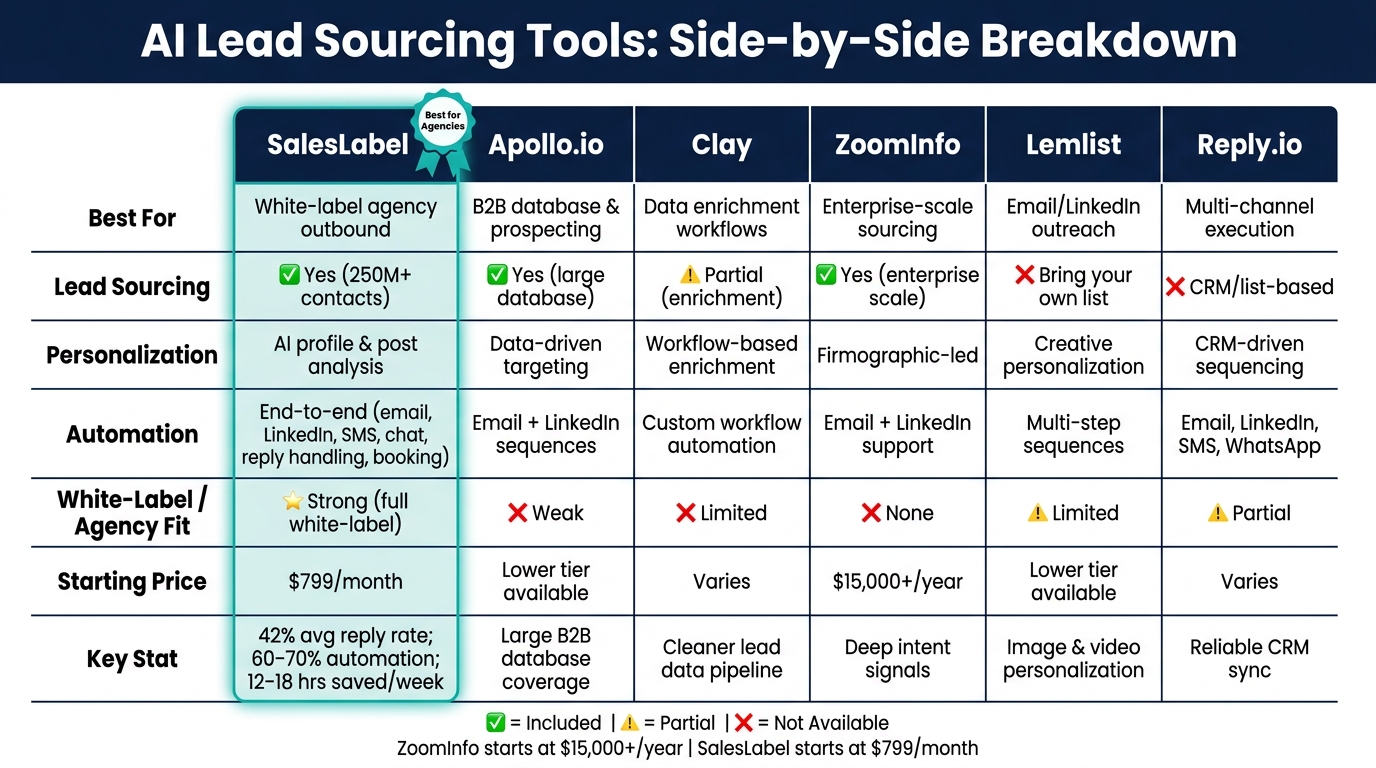
AI Lead Sourcing Tools Comparison: Features, Pricing & Agency Fit
Bottom line: if I need client-facing branding, I’d lean toward SalesLabel. If I need raw prospect data, I’d start with Apollo.io or ZoomInfo. If I already have leads and just need outreach execution, I’d look at Lemlist or Reply.io. And if my main issue is messy lead data, Clay makes the most sense.
That’s the lens I’d use for the full comparison below.
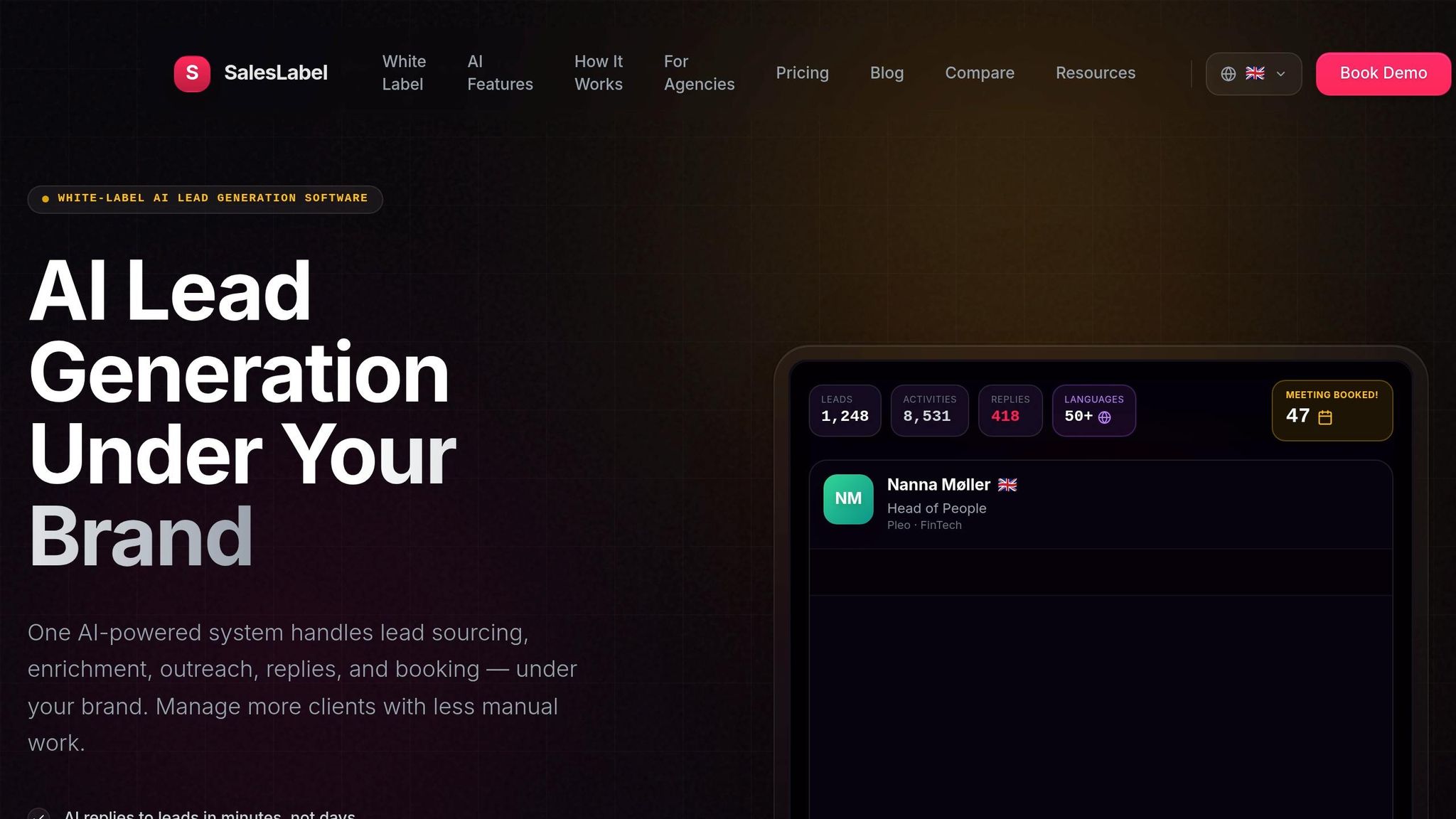
SalesLabel gives agencies a way to run outbound under their own brand. You get branded dashboards, templates, a Chrome extension, and custom domains. On top of that, the platform builds, enriches, and scores prospect lists before outreach begins.
Lead Sourcing
SalesLabel uses AI to search 250M+ contacts, LinkedIn, and company data sources to find prospects that match an agency's ICP. It then enriches and verifies each lead with details like role, company size, industry, email, and LinkedIn data before anything gets sent.
Agencies can also import leads by CSV or connect their current data sources. From there, the AI scores and prioritizes prospects based on fit and behavioral signals.[1][2] Once the list is ready, the AI writes outreach that matches each prospect's context.
Personalization
The AI reviews each prospect's LinkedIn profile, posts, and headline to write messages tied to that person's context. That makes the outreach feel more relevant instead of sounding like a copy-paste blast.
It also supports outreach in 50+ languages, which helps agencies run multilingual campaigns from one place. Agencies using AI-personalized openers with multi-channel sequencing report an average 42% reply rate.[1][2] That same context then flows into automated follow-up sequences.
Automation
SalesLabel automates email, LinkedIn, SMS, and chat sequences from one dashboard. That includes connection requests, first messages, and follow-ups.
AI also classifies replies and either sends them in Autopilot or drafts them in Copilot. The platform can automate 60%–70% of outreach and reply handling, which saves 12–18 hours per week per campaign. When a lead is ready to book, the system sends the agency's calendar link and schedules meetings through connected CRM and calendar tools.[4][5][6]
Scalability
SalesLabel is built for agencies handling more than one client at a time. A single account can manage multiple client workspaces, with separate workspaces, role-based access, and branded reporting for each client.
Pricing starts at $799/month and goes up to $1,999/month. The top plan includes unlimited accounts, a dedicated success manager, and bi-weekly strategy calls.[1][2]
Apollo is a data-first prospecting tool built for high-volume contact discovery and enrichment.[3]
Lead Sourcing
Apollo’s database is one of its biggest strengths. Teams get access to a large pool of contacts, plus filtering and enrichment tools that help narrow in on the right prospects fast. That strong data layer also makes personalization and sequence setup easier to move on quickly.[3]
Personalization
Apollo uses AI to write personalized first lines and tailor messaging based on prospect data. It leans on that prospect data, along with send-time optimization, to reach people when they’re more likely to engage.[3]
Automation
The platform supports email and LinkedIn sequences, which covers the two outbound channels most teams use day to day. Apollo stays focused on those channels instead of branching into broader multi-channel flows like SMS or WhatsApp.[3]
Scalability
Apollo works well for internal sales teams that need to run outreach at volume. For agencies, though, the fit is weaker because the interface stays branded as Apollo. Client-facing views keep Apollo branding in place, which limits its use for agencies that want to present outbound under their own name. That matters most for teams that need scale without custom branding.[3]
Clay moves the workflow from finding prospects to enriching their data. It helps teams build lead lists and fill in missing details before outreach starts.
Lead Sourcing
Clay is a strong fit for teams that need cleaner, richer lead lists before adding prospects to sequences. That extra context can also make targeting more precise.
Personalization
When lead data is enriched, teams get more context for AI-personalized messages. That makes it easier to tailor outreach instead of sending the same note to everyone.
Automation
Clay works best as a data layer that feeds sequencing tools and CRM setups. In practice, those integrations shape how far the tool can go.
Scalability
At scale, Clay’s main upside is a cleaner flow of data across the stack. If integrations are weak, teams can end up with data stuck in one place.
ZoomInfo takes a different route. Instead of starting with enrichment, it starts with the database itself.
That makes it a strong fit for prospecting teams that need to find contacts and build target lists at scale.
Lead Sourcing
ZoomInfo stands out for its filterable contact and company data. It also includes intent signals like job changes, funding rounds, and tech stack updates.[3] That extra context helps teams find better-fit prospects and set up more relevant outreach later on.
Personalization
ZoomInfo helps with personalization by giving teams richer prospect data to use in downstream messaging.[3]
Automation
ZoomInfo supports email and LinkedIn outreach.[3] In practice, it tends to work best as one part of a broader outbound stack.[3]
Scalability
It syncs with HubSpot, Salesforce, and Pipedrive.[3] There’s no white-label option, though, so it’s usually a better match for internal teams than for client-facing agency workflows.
Lemlist puts less weight on having a huge contact database and more on how well your message lands.
Lead Sourcing
Lemlist works best when you already have a prospect list and want to turn it into outreach through email and LinkedIn sequences. Its strong suit is execution, not database depth.
That means personalization does a lot of the heavy lifting.
Personalization
Lemlist uses AI to write personalized first lines, adjust copy based on prospect data, and fine-tune send times.[3] The goal is simple: help teams move beyond generic blasts and send outreach that feels tied to the person receiving it.
Automation
Lemlist automates multi-step email and LinkedIn sequences.[3]
Scalability
Agency branding only covers logo and domain changes, which limits full white-label use.[3]
Reply.io is built for sales teams that need multi-channel outreach and tight CRM integration in one place. It’s made for running structured sequences on target lists you already have. In plain English: this is an execution-first tool, not a prospecting database.
Lead Sourcing
Reply.io is not a data-heavy prospecting tool. Instead, it connects to your current CRM, like HubSpot, Salesforce, or Pipedrive, and works from there. That makes it a strong match for teams that already know who they want to contact and just need a system to run outreach, not find new leads. [3]
Personalization
The platform uses AI to write personalized first lines and adjust messaging based on prospect data. It also classifies replies by intent, such as interested, not now, or wrong person, so your team can send follow-ups to the right place without extra manual work. That helps move reply handling along at scale. [3]
Automation
Reply.io handles native multi-channel sequences across email, LinkedIn, SMS, and WhatsApp. [3] This is where it stands out. You can build one sequence that starts with a LinkedIn connection request, follows with a message, and then triggers an email automatically. It keeps those touchpoints in one flow instead of making your team jump between tools.
Scalability
For agencies, Reply.io offers an Agency plan that lets you manage multiple client sub-accounts from one dashboard, including client accounts, campaigns, and billing. [3] That said, its white-label options are limited. So while agencies can use it, it tends to fit internal teams better than shops that need a fully branded client setup. Its strongest use case is clear: multi-channel execution paired with account management.
Feature-by-Feature Comparison
Here’s the short version: these tools differ in four big ways: where they begin, how they handle personalization, how much of the process they automate, and whether they can support agency branding across many accounts. The tables below strip that down into a simple side-by-side view.
Lead Sourcing
The biggest divide is simple. Some tools find leads, while others help you work the lists you already have. SalesLabel, Apollo.io, and ZoomInfo source leads directly. Clay enriches and routes data. Lemlist and Reply.io stay focused on outreach.
Apollo.io and ZoomInfo stand out most if your team wants database-led prospecting.
Personalization
Each tool takes a different route here. Lemlist leans into creative personalization. Apollo.io is more focused on data-driven targeting. SalesLabel pushes further into AI-led message drafting [1].
That difference matters. One tool may help you tailor a message from profile activity, while another is better at sorting people by firmographic data.
Automation
Automation breaks down pretty cleanly. Reply.io is sequence-first. Clay is workflow-first. Lemlist is personalization-first. SalesLabel is built to handle the full funnel [1][3].
For agencies, that’s the key distinction: does the tool just run a sequence, or does it run the whole workflow?
At the agency level, scale is about more than one sender account. What matters is multi-account management. SalesLabel is built around that use case, with full white-label branding and unlimited LinkedIn accounts on the Scale plan [1].
If you're comparing agency fit, this is where the gap becomes clear. A tool can work well for outreach and still fall short once you need white-label delivery or many client accounts under one setup.
Pros and Cons
No tool here works for every case. Each one has a clear sweet spot, and each one comes with a trade-off. The table below lays that out in plain English.
Strengths and Trade-Offs by Tool
Tool
Pros
Cons
Best Fit
SalesLabel
Full white-labeling; end-to-end AI automation from sourcing to booking; Autopilot and Copilot modes [1]
High starting price ($799/month); too costly for solo use [1]
Agencies reselling lead gen as a service
Apollo.io
Massive B2B database; strong enrichment and data coverage [3]
No white-labeling; clients can see the platform directly [3]
SMB and mid-market sales teams doing in-house prospecting
Clay
Flexible enrichment workflows; strong data orchestration
Depends on other tools for outreach; no native white-labeling
Teams that need a data-enrichment layer
ZoomInfo
Deep North American data coverage; strong intent signals [3]
The biggest gap between these tools comes down to three things: branding, automation depth, and how much of the job they cover before outreach even begins.
SalesLabel is built for agencies that want to sell lead gen under their own name. That’s where its full white-label setup stands out, along with autonomous AI that handles replies and booking [1]. Most other tools stop earlier in the process. They can run sequences, sure, but once a prospect replies, a human usually has to step in.
That’s the key split on automation. Most platforms help you send messages. SalesLabel’s Autopilot mode goes much further by running fully autonomously, including reply handling and booking [1]. If you want software that feels more like an assistant than a sending tool, that difference matters a lot.
Conclusion
The right tool comes down to what you need most: data, sequencing, or white-label automation. Each platform here has a clear role across the four areas that matter most: lead sourcing, personalization, automation, and scalability.
For agency-branded lead generation, SalesLabel is the strongest fit. It handles the full workflow - from sourcing and enrichment to personalized outreach, follow-ups, and meeting bookings - under your own brand. Plans start at $799/month. Give yourself a 21–35 day warm-up before launch so everything is ready to go.
FAQs
How do I choose the right AI lead tool for my workflow?
Choose an AI lead sourcing tool based on what your agency needs most and how much of the workflow it can handle for you: prospecting, data enrichment, personalized multi-channel outreach, and meeting booking.
For agencies, white-label options matter a lot. They let you scale under your own brand instead of someone else’s. It also helps to look for flexible setups like autopilot or copilot modes. That way, you can automate more when volume is high, then step in when you want tighter control and a more personal feel.
When do I need built-in lead sourcing versus list enrichment?
Use built-in lead sourcing when you want one system to handle the whole process: find prospects that match your ideal customer profile, run outreach, and manage follow-ups to book meetings.
Use list enrichment when you already have prospect data but need to add missing details so your targeting and personalization are sharper.
SalesLabel does both, which means agencies can handle sourcing, enrichment, scoring, and outreach in one flow.
What should agencies look for in a white-label setup?
Agencies should put full branding control first. That means custom domains, their own logo, and client-facing dashboards that look and feel like their business, not someone else's.
They should also look for multi-tenant workspace management, so each client gets a separate sub-account with proper data isolation. On the tech side, the must-haves are clear: multi-channel sequencing, native CRM integrations, and deliverability tools like inbox warmup and rotation.
SalesLabel offers an AI-powered white-label platform built for exactly these needs.