White-Label Reseller Margins: Profit, Costs and Example
The real margin model of a white-label SaaS reseller: the four layers of revenue (recurring markup, setup fees, services, retention), the costs people forget, and a worked example.
SalesLabel Team
Growth Expert • 31.08.2026
Share:
Hazır bir çözüm mü arıyorsunuz?
SalesLabel, giden satışı uçtan uca otomatikleştirir — yapay zekâ potansiyel müşterileri bulur, kişisellendirilmiş mesajlar gönderir ve markanız altında toplantılar ayarlar.
Reselling software under your own brand sounds simple: buy a white-label product at a wholesale rate, sell it at your retail rate, keep the difference. But the difference between a reseller who scrapes by and one who builds a real business is not the markup. It is understanding where the money actually comes from, and where it quietly leaks out.
This guide breaks down the real margin model of a white-label SaaS reseller: the four layers of revenue, the costs most people forget, and a worked example you can copy. No hype, just the numbers behind the model so you can price with confidence and become a partner who profits instead of one who guesses.
Why the markup is not the margin
New resellers fixate on one number: the gap between what they pay the vendor and what they charge the client. That gap is your gross markup, and it feels like profit. It is not. Your true margin is what is left after the work of winning, onboarding, and keeping each client is paid for.
Think of it like running a restaurant. The food cost is only part of the story. Rent, staff, and the hours you spend on a table that sends its plate back all eat into the bill. In reselling, support tickets, onboarding calls, and churn are your "sent-back plates." Price only against the wholesale rate and you will feel busy and still end the quarter thin.
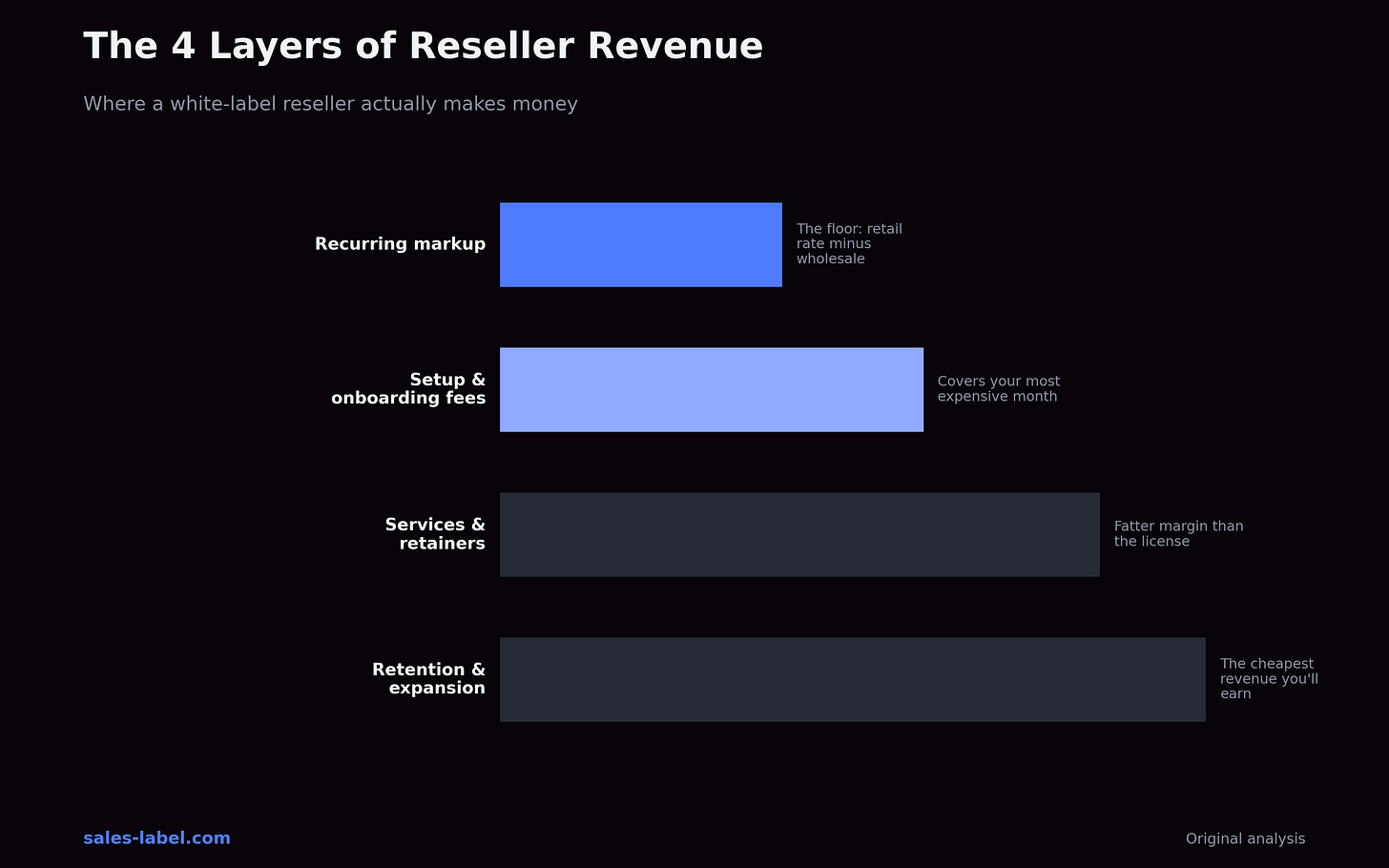
The four layers of white-label reseller revenue.
The four layers of reseller revenue
Layer 1 — The recurring markup
This is the base. You pay the vendor a wholesale rate per client and charge your own retail rate. On a platform like a white-label product, this recurring gap is predictable and compounds as you add clients. It is the floor of your business, not the ceiling.
The mistake here is pricing too close to wholesale to "win on price." A thin markup leaves nothing to pay for support and growth, so every new client makes you busier without making you richer. Price for the whole cost of serving the client, not just the license.
Layer 2 — Setup and onboarding fees
The work of getting a client live, configuring the tool, importing data, training their team, has real value, and clients expect to pay for it. A one-time setup fee does two things: it covers your most expensive hours (the first month) and it filters out tire-kickers who were never going to commit.
This layer is where many resellers leave money on the table by folding setup into "free onboarding." Your time is the scarcest thing you sell. Charge for it, and your recurring markup stays clean profit instead of paying off onboarding debt.
Layer 3 — Services around the software
The software is the anchor; the services are the growth. Managed campaigns, strategy retainers, reporting, and done-for-you work all ride on top of the platform you already resell. Because you own the client relationship, you are the obvious choice to deliver them, and services usually carry a fatter margin than the license itself.
This is the layer that turns a reseller into an agency. A client who buys the tool plus a monthly service retainer is worth far more, and far stickier, than one who bought a login and disappeared. The features you resell become the reason clients trust you with the higher-value work.
Layer 4 — Retention and expansion
The cheapest revenue you will ever earn is the client you already have. Reselling is a subscription business, which means the money is made over the lifetime of the account, not on the first sale. A client who stays two years is worth many times a client who churns in three months, even at the same monthly rate.
Expansion sits here too: more seats, more clients under their account, an upsell to a higher tier. Because the platform does the product work, you are free to focus on the relationship that drives renewals and growth. That is the quiet engine of a healthy reseller business.
The costs people forget
Margin lives and dies on the costs you did not plan for. Three eat resellers alive: support time (every ticket is unpaid unless you priced for it), churn (a lost client means re-selling just to stay flat), and acquisition cost (the ads, content, and hours it took to win the deal). A margin model that ignores these looks great on paper and disappoints in the bank.
The good news: a real white-label partner absorbs the heaviest cost of all, building and maintaining the software. You do not fund engineers or servers. That is the structural advantage of reselling, and it is why the model works when you price for the costs that are actually yours.
A worked example
Say you pay a vendor a wholesale rate of 200 dollars per client each month and charge your clients 500 dollars. Your recurring markup is 300 dollars per client. Add a one-time setup fee of 1,000 dollars and a monthly managed-service retainer of 800 dollars for the clients who want it.
With ten clients on the platform and half of them on a retainer, your recurring take is 3,000 dollars in markup plus 4,000 dollars in services each month, before the one-time setup fees. Now subtract your real costs: support hours, tools, and the marketing that won the accounts. What is left, and whether it grows, depends entirely on retention. Keep those ten clients for two years and the model compounds. Churn three of them a quarter and you are running to stand still.
How to price so the model works
Start from the full cost of serving one client for a year, not the wholesale rate. Add the margin you need to fund support and growth. Charge setup separately. Offer a service tier for the clients who want more. Then guard retention like it is the whole business, because in a subscription model, it is. If you want help mapping these layers to a real platform, see how the reseller model works or book a demo to become a partner.
Frequently asked questions
What margin can a white-label SaaS reseller expect?
It varies by how you price the four layers. The recurring markup is your floor; setup fees and service retainers are where the real profit sits. Resellers who sell only the license run thin, while those who add services and keep clients for years run far healthier margins.
Should I charge a setup fee?
Yes. Onboarding is your most expensive month of work per client, and a setup fee both covers it and filters out low-intent buyers. Folding it into "free onboarding" is one of the most common ways resellers erode their own margin.
Is reselling better than building my own software?
For most agencies, yes. Building means funding engineers, servers, and years of maintenance before the first sale. Reselling lets the vendor carry that cost while you own the brand, the client, and the higher-margin services around the tool.
What kills reseller profitability fastest?
Churn and unpriced support. A lost client forces you to sell again just to stay flat, and unpriced support turns your recurring markup into unpaid labor. Price for both from day one and the model holds.
Sell the brand, keep the margin
A white-label reseller business is not a markup, it is a stack: recurring license margin, setup fees, services, and the retention that ties them together. Price against the whole cost of serving a client, charge for your time, and protect renewals, and the model compounds year over year. See how it works and become a partner built to profit.
This article was written with AI assistance and reviewed by the SalesLabel team.